
The New Nairobi: An Investor’s Guide to the Mega-Project Race
In the rapidly evolving landscape of the Nairobi Metropolitan area, Tatu City, Two Rivers, and Northlands City have emerged as the definitive nodes for Kenya’s next decade of economic expansion. For the discerning investor, these projects represent more than just real estate; they are divergent platforms for capital deployment—whether you are seeking the steady yields of a high-end residential unit, the specialized infrastructure of a logistics park, the operational scale of a manufacturing hub, or the strategic footfall of a hospitality venture. This analysis moves beyond the marketing gloss to dissect the structural "DNA" of these mega-developments. By comparing their institutional backbones, tenant moats, and risk profiles, we provide the framework necessary to determine which of these "cities-within-a-city" best aligns with your investment mandate and risk appetite.
The differing development timelines for Northlands, Tatu City, and Two Rivers International Finance and Innovation Centre (TRIFIC) are fundamentally driven by their respective roles within the parent organizations' broader capital strategies. For the Kenyatta family, Northlands is merely one component of a vast, multi-generational portfolio, allowing for the luxury of a patient, 50-year horizon that prioritizes long-term land value appreciation over immediate liquidity. In contrast, Tatu City operates as a standalone flagship venture for its developers; the necessity to complete execution and capture value is paramount to recycling capital into emerging expansion opportunities across the African continent, such as Ivory Coast and the DRC. Meanwhile, TRIFIC faces the most acute pressure: as a project carrying significant debt obligations and high shareholder expectations, it operates under a "life or death" mandate where the primary focus is immediate performance, rapid commercialization, and debt servicing to satisfy impatient capital providers.
Table of Contents
1. Strategic & Macro Framework
2. Commercial & Economic Moats
3. Market Dynamics & Positioning
4. Risk & Feasibility Assessment
5. Mapping SEZ Incentives
I. Strategic & Macro Framework
In the landscape of Kenyan urban development, Tatu City, Two Rivers, and Northlands City represent the shift from traditional “single-node” city planning to integrated, decentralized hubs. While each shares the ambition of being a “city-within-a-city,” their strategic frameworks, scale, and maturity vary significantly.
1. Tatu City: The Industrial Heavyweight
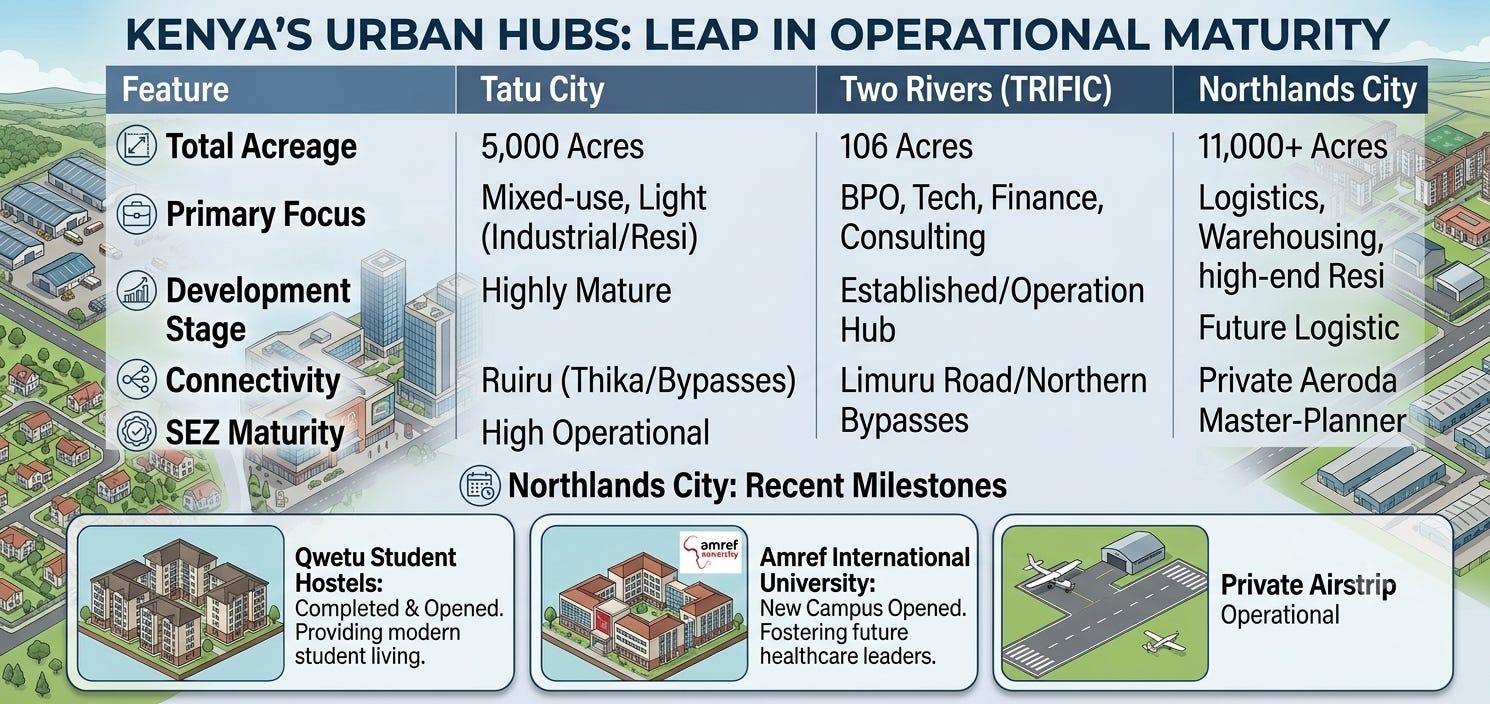
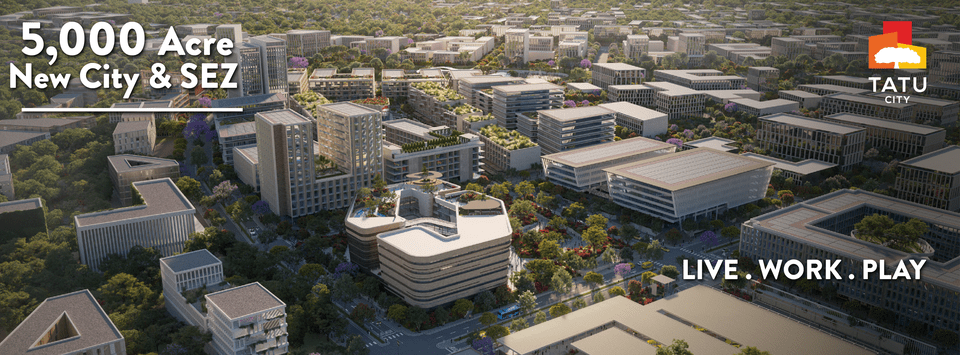
Scale & Zoning: Tatu City is a sprawling 5,000-acre development designed for 250,000+ residents. Its zoning is diverse, featuring light manufacturing parks, residential clusters (Kijani Ridge, Unity Homes), and social infrastructure like schools and medical clinics.
Connectivity: Located in Ruiru, Kiambu, it is positioned to de-congest Nairobi by decentralizing residential and industrial hubs. It benefits from proximity to the Thika Superhighway and the Northern/Eastern Bypasses.
Economic Hub Status: Tatu is Kenya’s most mature private SEZ. It operates a “One-Stop Shop” for multinational investors, hosting over 100+ businesses. Its SEZ status provides critical fiscal incentives (VAT exemptions, lower corporate taxes) that have attracted large-scale logistics and manufacturing firms, effectively acting as a regional hub for production.


2. Two Rivers (TRIFIC): The Service-Export Specialist
Scale & Zoning: At 106 acres, Two Rivers is a concentrated, high-density urban node. Its Special Economic Zone, TRIFIC (Two Rivers International Finance & Innovation Centre), is unique because it focuses on services rather than physical manufacturing.
Connectivity: Positioned in the “Diplomatic Blue Zone” off Limuru Road, it is strategically located near Nairobi’s elite professional residential areas (Gigiri, Runda).
Economic Hub Status: TRIFIC is designed to capture global service-export demand. With 0% corporate and VAT taxes on foreign-sourced income, it is a hub for BPO (Business Process Outsourcing), financial services, and tech innovation. Unlike Tatu, its “hub” status is proven by the full occupancy of its North Tower, which serves as the anchor for global service firms.

3. Northlands City: The Long-Term Vision
Scale & Zoning: Spanning 11,000+ acres, Northlands is one of the largest private land-use projects in East Africa. The vision is a 50-year master plan that integrates large-scale industrial/logistics zones with low-density high-end residential estates.
Connectivity: Its positioning along the Eastern Bypass and Thika Road is its greatest strategic asset, positioning it as a future logistics artery for goods moving through the Nairobi Metropolitan area.
Economic Hub Status: Northlands is currently in the foundational stages of its infrastructure delivery. While its potential as a massive logistics and industrial SEZ is significant, it is still transitioning from land-banking to active master-plan execution, with early phases focused on gated communities and foundational utility work.

Synthesis of Infrastructure & Connectivity
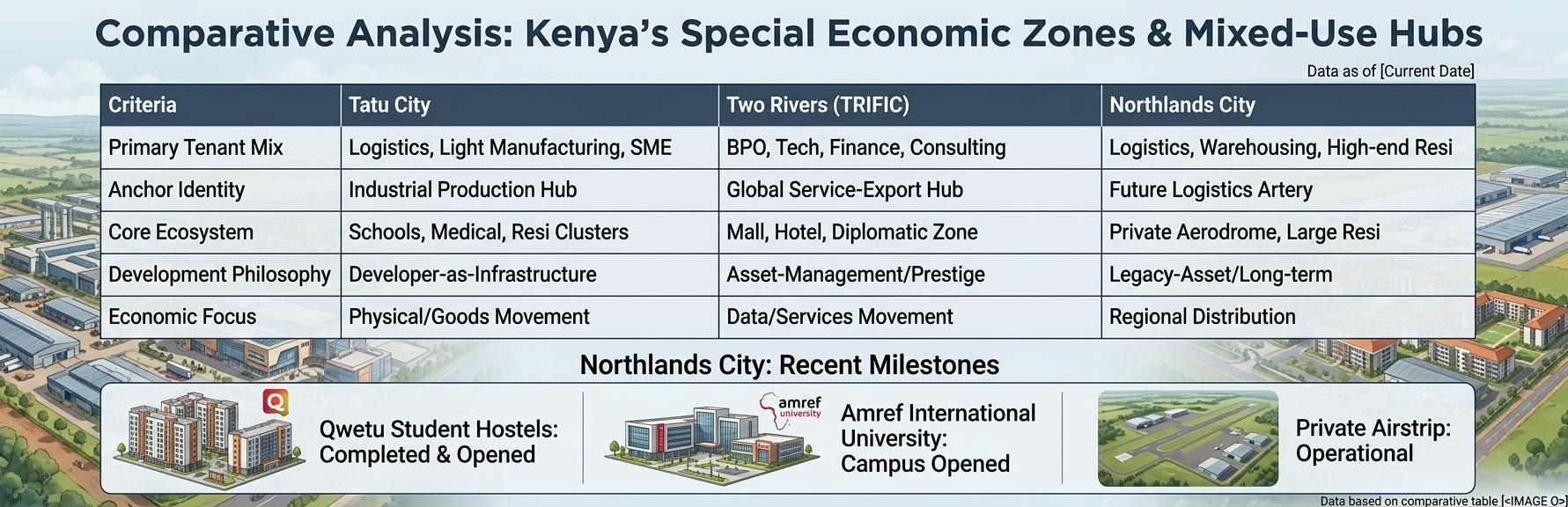
Developer Philosophy: Tatu City and Two Rivers are “Developer-as-Infrastructure” projects; the owners invested heavily in power, water, and ICT before marketing space. Northlands utilizes “patient capital,” allowing for a slower, generational rollout of utilities and road networks.
SEZ Incentives: All three leverage the Special Economic Zones Act, 2015, which offers standard benefits—including 0% duty on imported inputs, simplified customs processes, and tax holidays. However, the utility of these incentives differs: Tatu offers them for “manufacturing/moving goods,” whereas TRIFIC offers them for “moving data and services.”
Inside Kenya’s Northlands City development
This video provides an overview of the scale and master-planning status of the Northlands City development project in Ruiru, Kiambu County.
II. Commercial & Economic Moats
The differentiation between these mega-projects is clearest when analyzing their tenant mix and the “ecosystem” they cultivate. Each project acts as a strategic magnet for a specific type of capital and workforce, turning “empty land” into high-value economic assets.
1. Tatu City: The Industrial Ecosystem
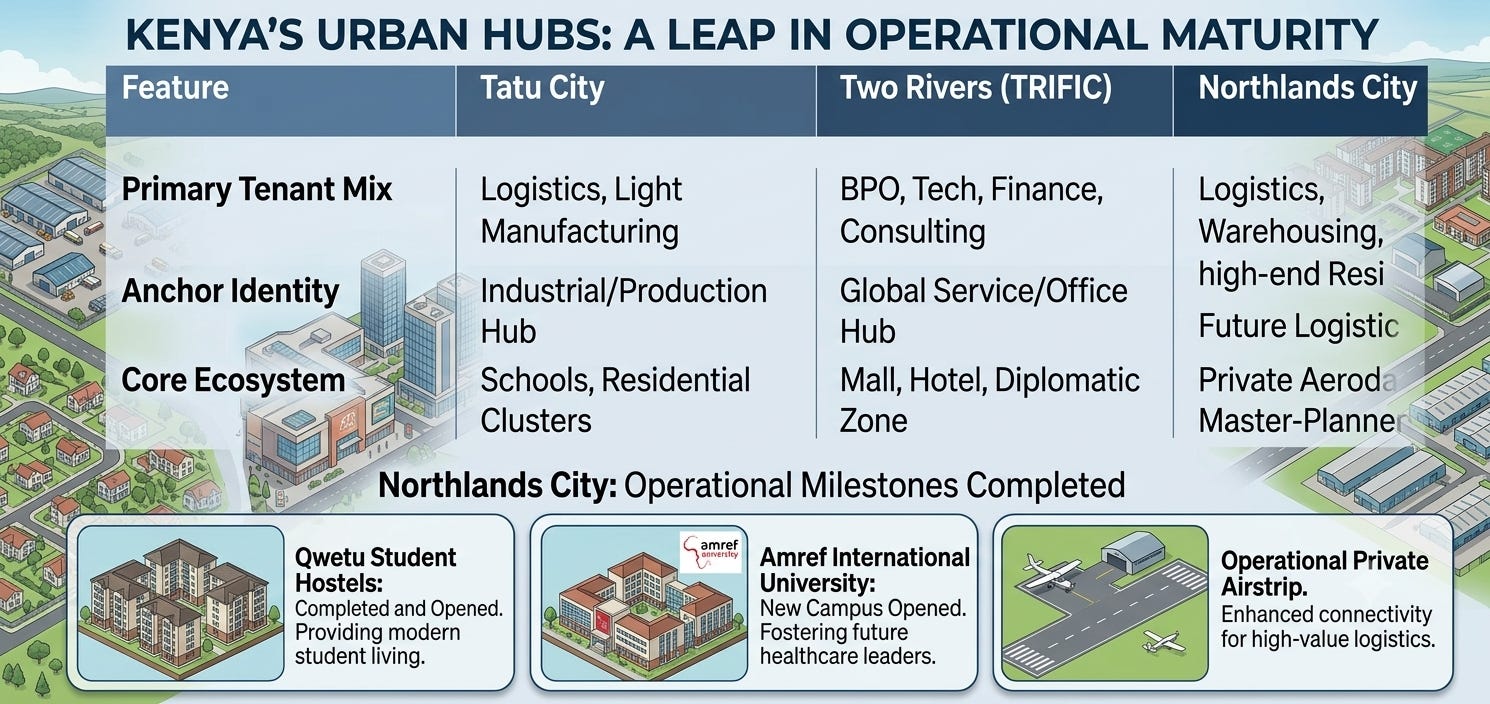
Tenant Mix: Tatu focuses on “physical” value. Its tenants are predominantly manufacturing and logistics firms (e.g., consumer goods, industrial equipment assemblers) drawn by the SEZ’s duty-free import incentives and purpose-built heavy-duty infrastructure.
The Ecosystem Effect: Tatu’s “moat” is its completeness. By integrating schools (Nova Pioneer), medical facilities, and residential units (Kijani Ridge, Unity Homes) directly into the industrial park, it provides a “live-work-play” environment that reduces the “commuter friction” typical of Nairobi. It creates a self-sustaining pool of labor that lives minutes away from the factory floor.
Institutional Alignment: Designated as a “Project of Strategic National Importance,” Tatu enjoys high-level cooperation with SEZA (Special Economic Zones Authority). This “one-stop-shop” facilitation simplifies everything from construction permits to multi-agency regulatory approvals, making it a frictionless entry point for foreign multinational corporations.

2. Two Rivers (TRIFIC): The Service-Export Moat
Tenant Mix: TRIFIC (Two Rivers International Finance & Innovation Centre) caters to “digital and professional” value. Tenants include global BPO providers like Teleperformance, consulting firms, and financial services companies. These firms export services rather than goods, often earning in USD, which creates a distinct “hard-currency” economic moat.
The Ecosystem Effect: Its anchor is lifestyle prestige. Located within the “Diplomatic Blue Zone,” TRIFIC leverages the existing Two Rivers Mall—the largest in East Africa—as a lifestyle amenity for global talent. It positions itself not as a factory town, but as a premium professional office node that appeals to the “global nomad” and remote service workforce.
Institutional Alignment: TRIFIC is a masterclass in market-facing institutional design. By launching a dollar-denominated I-REIT (Income Real Estate Investment Trust) on the Nairobi Securities Exchange, it has effectively “financialized” its real estate, aligning its growth with public market investors and institutional capital, which forces a high standard of governance and transparency.
3. Northlands City: The Logistics Frontier
Tenant Mix: Northlands is positioning itself as the future backbone of Nairobi’s supply chain. Its master plan leans heavily into large-scale warehousing and logistics, aimed at serving firms that need high-volume distribution centers within reach of both the CBD and the industrial Thika corridor.
The Ecosystem Effect: Northlands relies on the “prestige of space.” Unlike the high-density nodes of Two Rivers, its ecosystem is based on low-density, aspirational residential living and large-format commercial/industrial plots. The inclusion of a private aerodrome is a strategic anchor intended to attract high-net-worth investors and firms requiring exclusive logistics connectivity.
Institutional Alignment: As a legacy family project, its alignment is long-term and strategic. While it has not yet reached the operational “hub” status of Tatu, its sheer land volume—secured by perimeter fencing and massive infrastructure investment—makes it a dominant, if long-term, player in the region’s regulatory and planning landscape.
Tenant Mix: Northlands is positioning itself as the future backbone of Nairobi’s supply chain, blending large-scale industrial infrastructure with a burgeoning institutional and residential community. Its master plan leans heavily into high-volume warehousing and logistics, serving firms that require distribution centers strategically located between the CBD and the industrial Thika corridor. Beyond logistics, the project is actively cementing its status as a multi-use hub: Qwetu student hostels are already completed and operational, and Amref International University has officially opened its campus within the city, signaling a shift toward a vibrant, mixed-use environment.

The Ecosystem Effect: Northlands relies on the “prestige of space.” Unlike the high-density nature of other urban nodes, its ecosystem is built on low-density, aspirational residential living and large-format industrial plots. A key strategic anchor is the fully functional internal airstrip, which provides exclusive connectivity designed to attract high-net-worth investors and firms requiring rapid logistical access.
Institutional Alignment: As a legacy family project, its alignment is long-term and strategic. While it is still evolving toward the operational “hub” status of established zones, its sheer land volume—secured by robust perimeter infrastructure—makes it a dominant, if long-term, player in the region’s regulatory and planning landscape.
Kenya’s Premier SEZ for Business
This video provides a brief look at the vision and business environment within the Two Rivers International Finance & Innovation Centre.
III. Market Dynamics & Positioning
For the Boardlot investor, the true measure of a mega-project is not what is promised in the master plan, but the velocity of value creation. Market absorption, demographic targeting, and sustainability are the metrics that determine whether these projects are “cities” or merely “land-banked capital.”
1. Absorption Rate: Speed vs. Strategy
Tatu City: Operating as a high-velocity developer, Tatu has successfully established a “business district” effect. Absorption is driven by the immediate availability of serviced infrastructure. By allowing secondary developers (like Unity Homes) to build quickly, they have created a “compounding effect” where residents and businesses attract more residents and businesses.
Two Rivers (TRIFIC): Absorption here is measured in lease yields rather than plot sales. Because it is a high-density, institutional-grade commercial node, absorption is tethered to the growth of the BPO and professional services sector. It is a “steady-state” asset, designed to generate consistent USD-denominated rent rather than one-time land sale spikes.
Northlands City: Northlands follows a “patient capital” absorption model. With a 50-year horizon, it is not pressured by the immediate need for high-velocity turnover. It focuses on large-scale infrastructure readiness, effectively “warehousing” the land until the demand for industrial and high-end logistics reaches the Eastern Bypass corridor.
2. Target Demographic: The “Who” Matters
Tatu City: Strategically targets the “missing middle.” By providing a range of housing prices—from affordable units to gated luxury clusters—Tatu has captured the largest segment of the Nairobi metropolitan professional class. It is the destination for the “aspirational worker” who wants to escape the CBD congestion.
Two Rivers (TRIFIC): Targets the “Global Professional.” Its infrastructure, security, and retail amenities cater to expats, diplomats, and international service firms that require world-class connectivity and an “island” of stability within Nairobi.
Northlands City: Targets the “Long-Term Elite.” Its master plan implies a future-proof environment for high-net-worth individuals and corporate tenants needing massive, scalable space. It is building for the “generational shift” where high-density Nairobi becomes too cumbersome, and the future moves to the peri-urban fringes.
3. Sustainability: The “Green” Marketing Moat
In the modern market, “Green” is no longer a luxury; it is a regulatory requirement for international corporate tenants (who have strict ESG mandates).
Tatu City: Uses sustainability as a compliance moat. Its large-scale greenbelt protections and mandated waste-management systems make it “ESG-ready” for multinational firms. This allows them to charge a premium to tenants who require LEED-certified or sustainable operational environments.
Two Rivers: Focuses on “Urban Sustainability.” It is an integrated retail-office node that optimizes energy usage through centralized systems. Its marketing relies on the ease of a “walkable city,” which is a distinct, scarce luxury in the current Nairobi urban fabric.
Northlands City: Possesses the “Green Advantage” by default due to its scale. By retaining vast tracts of nature and integrating massive green parks into its 50-year plan, it can offer a level of “air quality and space” that its urban competitors simply cannot replicate.
Strategic Insight for the Boardlot Reader
The Velocity Gap: Tatu City is currently the “Market Engine,” absorbing demand because it is the most ready. Two Rivers is the “Yield Engine,” designed to retain high-value professional service firms. Northlands is the “Land Bank,” a massive strategic reserve that will likely be the dominant player in the next decade once the Nairobi Metropolitan expansion necessitates moving further east.
IV. Risk & Feasibility Assessment
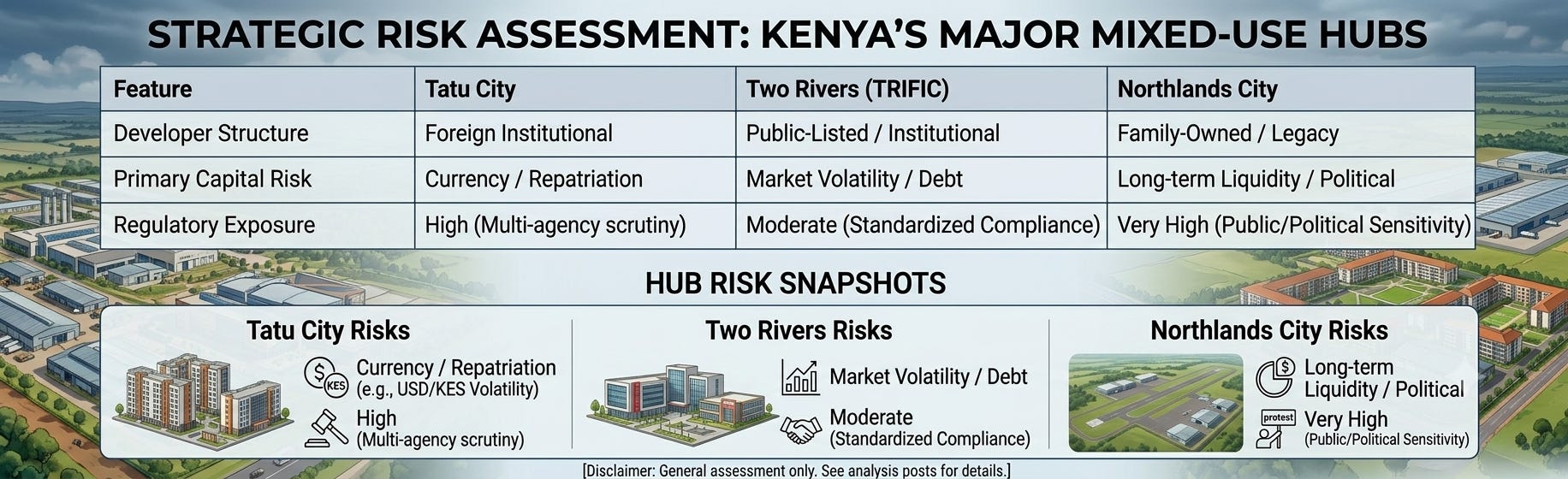
In the world of mega-project development, the structural “DNA” of the developer is the single biggest predictor of how they will weather economic storms. Whether a project is backed by foreign equity, public capital, or legacy family wealth dictates its strategy for handling regulatory hurdles and systemic risks.
1. Ownership & Governance: The “Financial Backbone”
Tatu City (Rendeavour): As a foreign-backed institutional developer, their governance is optimized for speed and transparency to appease international shareholders and potential investors. Their risk lies in “perception management”—operating a foreign-owned city in a local political environment requires constant, proactive alignment with national development goals to avoid being viewed as an “outsider.”
Two Rivers (Centum): Being a publicly listed company, their governance is dictated by NSE (Nairobi Securities Exchange) compliance. This forces a high standard of financial disclosure and project reporting. Their risk is the “market eye”—if project performance lags, the stock price reacts, potentially triggering liquidity issues that private developers (like Tatu or Northlands) do not have to worry about.
Northlands City: Their governance is closed and legacy-based. They operate with “patient capital” that is insulated from quarterly reporting or foreign shareholder exit demands. While this is an asset in downturns, the lack of external oversight can create transparency gaps, making the project a frequent lightning rod for public and political criticism.
2. Regulatory & Environmental Hurdles
Land-Use Disputes:
Tatu City has historically battled significant legal disputes regarding land titles and shareholder disagreements. Their ability to survive these and become the most “operational” mega-project is a testament to the resilience of their legal and regulatory framework.
Northlands City faces unique “political risk.” As a project intrinsically linked to the Kenyatta family, its regulatory hurdles are often played out in the public arena, making it susceptible to shifting political winds whenever a new administration takes office.
EIA & Infrastructure Gaps:
Environmental Impact Assessments (EIA) are the primary “choke point” for all three. Mega-projects in Nairobi have historically relied on private-to-public capital bridges—developers often have to fund their own trunk infrastructure (power, water, sewerage) because public infrastructure (KPLC/NCWSC) is not yet developed.
Two Rivers handles this best by its “node” approach; it is smaller and easier to connect to existing urban infrastructure. Tatu and Northlands must build “independent city utilities,” which increases the Capex burden significantly, making them more vulnerable to interest rate hikes and construction cost inflation.
Strategic Insight for the Boardlot Reader
The Risk Matrix:
If you are an Institutional Investor looking for predictable yield, Two Rivers is the most “derisked” due to its public-listed nature and concentrated infrastructure.
If you are an Industrial Operator looking for scale and regulatory certainty, Tatu City has the most battle-tested SEZ framework.
If you are a Generational Investor holding land for the next 20–50 years, Northlands is the ultimate play on the expansion of the Nairobi Metropolitan area—provided you have the patience to weather the political and regulatory friction that comes with such scale.
V. Mapping the SEZ Incentives: Tatu vs. TRIFIC
The primary differentiator between these two mega-projects lies in their SEZ value proposition. While both operate under the umbrella of the Special Economic Zones Act, 2015, they are curated for entirely different types of capital.
Tatu City is built for volume and physical throughput, while TRIFIC (Two Rivers) is architected for service-export efficiency and dollar-denominated yield.
SEZ Incentive Comparison: Tatu City vs. TRIFIC
Tatu City (Focus: Industrial, Logistics, & Manufacturing)
Corporate Tax: Benefits from a reduced corporate tax rate of 10% for the first 10 years of operation, designed to support heavy-duty capital investment.
VAT Treatment: Offers zero-rating on locally supplied goods, significantly lowering the procurement costs for manufacturers sourcing raw materials within Kenya.
Customs & Duties: Provides a 0% import duty on plant and machinery, reducing the high upfront capital expenditure required for factory setup.
Strategic Advantage: Optimized for asset-heavy operations that require physical throughput, bulk storage, and 24/7 industrial infrastructure.
TRIFIC - Two Rivers (Focus: Service-Export, Tech, & Finance)
Corporate Tax: Offers a 0% corporate tax rate for the first 10 years, specifically tailored for firms earning revenue through the export of professional services.
VAT Treatment: Provides zero-rating on services and inputs, ensuring that global consulting, BPO, and tech firms maintain lean operational costs.
Customs & Duties: Offers 0% import duty on specialized equipment required for tech hubs and financial service infrastructure.
Strategic Advantage: Optimized for asset-light, human-capital intensive businesses that export services via fiber-optic infrastructure rather than moving bulk goods via road.
1. Tatu City: The Industrial “Engine”
Tatu City’s SEZ framework is designed to lower the cost of entry for manufacturers who are sensitive to supply chain expenses.
Physical Goods Advantage: By offering duty-free import of raw materials and machinery, Tatu lowers the initial capital expenditure (Capex) required to set up production lines.
Operational Scale: Because it is a massive, purpose-built industrial zone, firms benefit from “co-location”—access to shared waste management, energy supply, and logistical support which would be prohibitively expensive to build in a non-SEZ area.
Investor Mandate: This is the ideal destination for an investor looking to build a manufacturing hub or a large-scale logistics warehouse aimed at the East African market.
2. TRIFIC (Two Rivers): The Service-Export “Hub”
TRIFIC differentiates itself by focusing on the “invisible economy.” It is designed for businesses that export services via fiber-optic cable rather than goods via trucks.
Service-Export Advantage: The 0% corporate tax rate (for the first 10 years) is specifically optimized for firms earning foreign currency through international contracts. It is the premier location for Global Business Process Outsourcing (BPO) and regional financial headquarters.
Financialization of Real Estate: TRIFIC’s integration with an I-REIT on the NSE allows for an institutional level of liquidity and transparency. Investors here are not just buying a building; they are buying into an internationally-compliant regulatory zone designed to host global consulting and technology firms.
Investor Mandate: This is the ideal destination for an investor looking for high-yield office space, tech-hub real estate, or a base for professional service firms serving the broader African continent.
Strategic Synthesis for the Investor
For the Logistics & Manufacturing Investor: Tatu City provides the most robust “factory-ready” infrastructure. The tax incentives here are optimized for companies that move bulk physical goods; the scale of the zone is designed to withstand the operational demands of 24/7 manufacturing.
For the Hospitality & Commercial Investor: If your mandate involves hospitality (e.g., business hotels or serviced apartments for international consultants), Two Rivers/TRIFIC is the superior choice. The footfall generated by global firms in the BPO and finance sectors creates a predictable, high-frequency demand for premium short-term housing and upscale retail/hospitality amenities.
VI. Infrastructure Lifecycle: The Maturity Spectrum
For the investor, the “age” of a mega-project is a critical indicator of risk versus reward. Each of these three projects is at a different stage of its lifecycle, which dictates whether you are investing for immediate income, rapid growth, or long-term capital appreciation.
The Infrastructure Lifecycle: A Maturity Spectrum
Two Rivers (TRIFIC): The Operational “Plug-and-Play”
Maturity Phase: Fully operational and mature.
Infrastructure Status: Major trunk infrastructure (roads, sewage, power, and retail anchors) is completed and functional.
Investment Character: Defensive and income-generating; best suited for immediate, de-risked cash flow.
Focus: Optimization of existing assets and yielding consistent returns from high-end tenants.
Tatu City: The “Mid-Cycle” Expansion
Maturity Phase: Mid-growth and scaling rapidly.
Infrastructure Status: Foundational infrastructure is robust enough to support heavy industrial operations, though constant new development is ongoing.
Investment Character: Balanced and growth-oriented; offers a mix of established stability and significant expansion upside.
Focus: Scaling residential and commercial nodes to meet rising demand from multinational firms.
Northlands City: The Foundational Frontier
Maturity Phase: Foundational and early-stage master-planning.
Infrastructure Status: Focus is on macro-level utility trunks, land clearing, and zoning; not yet ready for high-traffic operations.
Investment Character: Speculative and generational; a long-term play on future metropolitan expansion.
Focus: Strategic land-banking for future use as Nairobi’s primary logistics artery
1. Two Rivers: The Operational “Plug-and-Play”
Status: Two Rivers is effectively “built.” It has completed the massive, high-risk early-stage infrastructure (roads, sewage, power, and retail anchors) and is now in the operational management phase.
Infrastructure Maturity: The core infrastructure is already serving high-end tenants in the TRIFIC zone. There is little “construction noise” or infrastructure uncertainty, making it the lowest-risk environment for immediate commercial or hospitality operations.
Investor Takeaway: This is an income-generating play. You are paying a premium for a “de-risked” asset where the demand drivers—shopping, dining, and professional office work—are already active and yielding tangible returns.
2. Tatu City: The “Mid-Cycle” Expansion
Status: Tatu is currently in the “sweet spot” of the expansion lifecycle. The foundational trunk infrastructure is mature enough to support heavy industrial operations, yet the project is still absorbing land and scaling its residential and commercial nodes rapidly.
Infrastructure Maturity: The “last-mile” infrastructure is active, with thousands of daily users and dozens of operational factories. However, there is still significant ongoing construction, meaning the project is constantly evolving and creating new sub-markets for investors.
Investor Takeaway: This is a growth-oriented play. The infrastructure is robust enough to support serious industrial or residential ventures, but there is still substantial upside as more of the 5,000 acres are developed and occupied over the coming years.
3. Northlands City: The Foundational Frontier
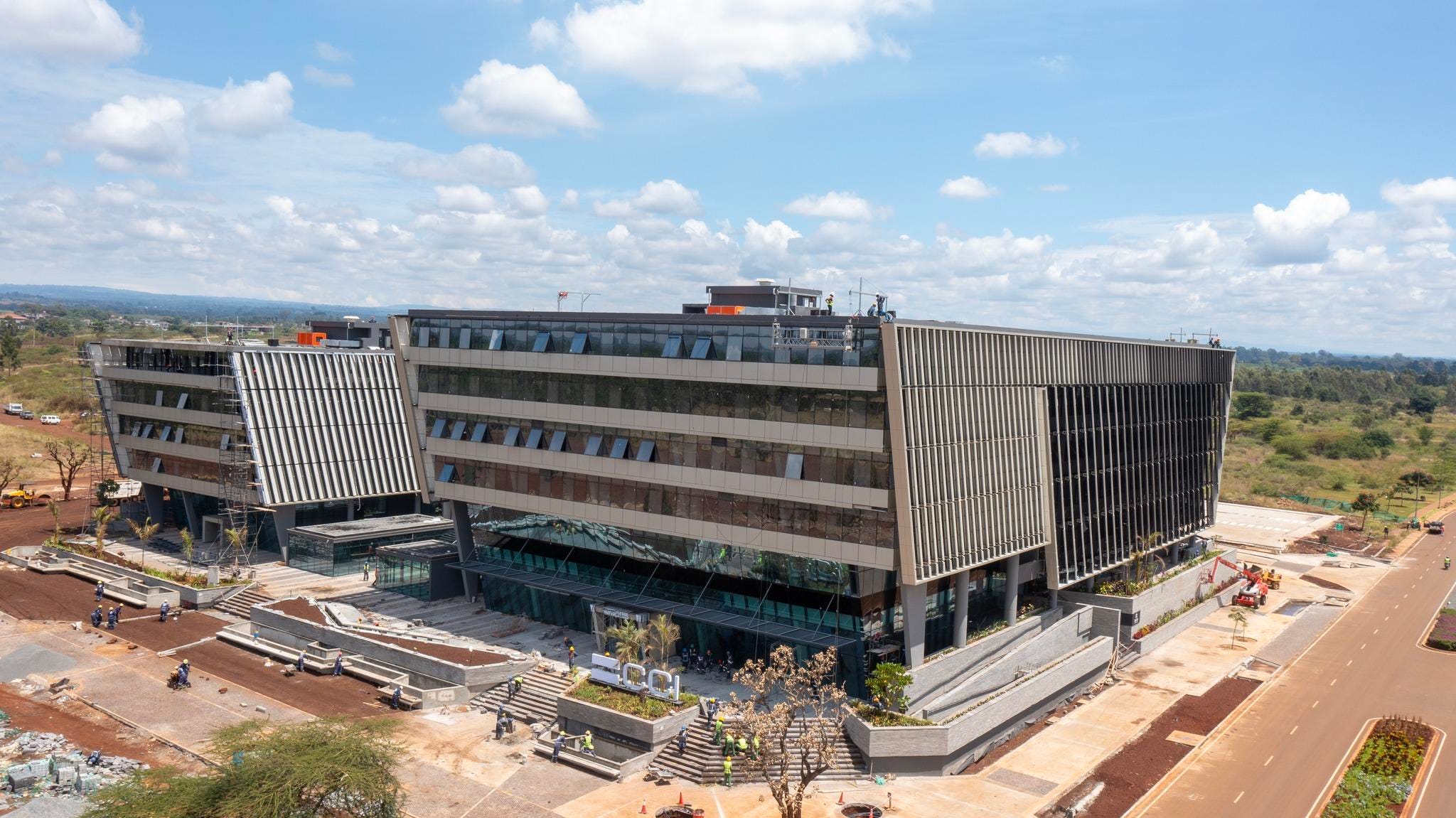
Status: Northlands remains in the large-scale foundational phase. The focus is on macro-level infrastructure: master-planning the zoning, clearing land, and installing the massive utility trunks necessary to support a city of this magnitude.
Infrastructure Maturity: It is essentially a blank canvas on a massive scale. Investors here are betting on the future arrival of infrastructure. It is not ready for immediate, high-traffic commercial or hospitality operations, but it is positioning itself to be the dominant logistics artery of the Nairobi Metropolitan area.
Investor Takeaway: This is a generational play. You are investing in land-banking at a strategic node, betting that the southward and eastward expansion of Nairobi will eventually make this site the most valuable logistics hub in the country.
Synthesis for the Boardlot Investor
The Maturity Trade-off: As an investor, you must decide where your capital fits in the lifecycle. If you need certainty and cash flow, Two Rivers is your benchmark. If you want a proven growth narrative, Tatu City offers the best balance of infrastructure maturity and expansion momentum. If you are looking to shape the next 50 years of Nairobi’s growth, Northlands represents the ultimate speculative land-bank opportunity.
Final Investment Synthesis
The decision for the Boardlot investor comes down to the “Velocity vs. Vision” trade-off. If you are seeking immediate income with minimal friction, Two Rivers offers an institutional-grade, operational asset class. If your mandate is industrial production or capturing the massive residential demand of the “missing middle,” Tatu City currently provides the most operational and regulatory certainty. If you are a long-term capital allocator aiming to shape the future of the Nairobi Metropolitan corridor, Northlands provides a blank, massive canvas that will define the city’s logistics for the next half-century.
About Boardlot Africa Research
Boardlot Africa is a premier financial intelligence and corporate governance publication dedicated to unpacking the mechanics of capital, market strategies, and structural shifts across East Africa’s corporate landscape. By bridging the gap between raw economic data and actionable market intelligence, we deliver deep-dive research, independent corporate analysis, and policy insights designed for institutional investors, boardrooms, and sharp market observers.
Get in Touch
Email: boardlot.research@gmail.com
Phone: +254 753 133 901
Substack: Subscribe to Boardlot Africa
X (Twitter): BoardLotSultan