
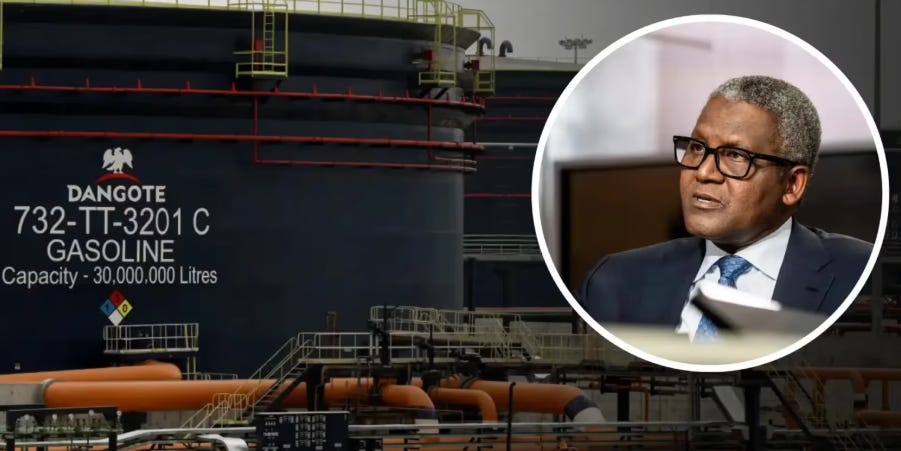
Big news just dropped from Nigeria. Aliko Dangote has officially confirmed that the Dangote Refinery will launch its IPO in September 2026.According to the announcement made during a visit by First Bank management, investor demand is already overwhelming — running into billions of dollars. This is shaping up to be one of the largest and most significant listings in African capital markets history.Why This Matters for Kenya & East Africa.650,000 barrels per day capacity — the largest single-train refinery in the world.
Positions Nigeria (and by extension the broader African energy sector) as a serious player in refined petroleum products.
For Kenyan investors, this opens a rare chance to own a piece of Africa’s most ambitious industrial project.
Reduced reliance on imported fuel across the region could mean more stable energy prices and stronger economic ties between Nigeria and East Africa.
As a Dividend King and Global Swing Trader, I see this as more than just another IPO. It’s a landmark moment for pan-African infrastructure investing. The refinery has finally stabilized operations after years of delays, and the timing couldn’t be better with strong global and local investor appetite.Expect heavy interest from institutional players, but retail investors across Africa — especially in Kenya — should start positioning themselves early.This is not financial advice, but it’s definitely an opportunity worth studying closely.What are your thoughts?
Will you be looking to participate in the Dangote Refinery IPO when it drops? Drop your comments below.Let’s keep building wealth across borders.#AfricaRising #DangoteIPO #KenyaInvesting
Africa’s Aramco: What the $50 Billion Dangote Refinery IPO Means for You
The rumors have been swirling on X (formerly Twitter) for months, but the picture is finally becoming clear. Aliko Dangote, Africa’s richest man, is preparing to take his crown jewel—the Dangote Petroleum Refinery & Petrochemicals—public.
With a valuation targeting upwards of $50 billion, this isn’t just a Nigerian event; it is a pan-African milestone that could redefine wealth creation for investors from Lagos to Nairobi.
Key Overview
Estimated Valuation: $40 billion to $50 billion
Stake on Offer: 5% to 10% of refinery equity
Implied Deal Size: Up to $5 billion
Primary Listing: Nigerian Exchange (NGX)
Additional Exchanges Under Discussion: Johannesburg Stock Exchange (JSE), Nairobi Securities Exchange (NSE), Ghana Stock Exchange (GSE), Bourse Régionale des Valeurs Mobilières (BRVM)
London Dual Listing: Under consideration
Dividend Currency: US dollars (pending SEC Nigeria approval)
IPO Advisers: Stanbic IBTC Capital, Vetiva Capital Management, FirstCap
NNPC Stake: 7.25%
Subscription Window: Expected August 2026
Refinery Capacity: 650,000 barrels per day (current); 1.4 million bpd (planned expansion)
1. Background of the Dangote Refinery: A Decade in the Making
Located in the Lekki Free Trade Zone in Lagos, the Dangote Refinery is a feat of engineering that many said was impossible. It is the world’s largest single-train refinery, with a processing capacity of 650,000 barrels per day (bpd), and there are long-term plans to scale this capacity up to an incredible 1.4 million bpd.
Commissioned in May 2023 and reaching full operational capacity in early 2026, the facility produces diesel, aviation fuel, and petrol. Beyond just fuel, the complex includes a massive fertilizer plant (the largest urea plant in Africa). For decades, Nigeria—despite being a top oil producer—exported crude and imported expensive refined fuel. This refinery flips that script, aiming to make West Africa self-sufficient while exporting refined products globally.
2. The IPO Size: Breaking Records
The scale of this listing is staggering. With a targeted valuation between $40 billion and $50 billion, floating a 5% to 10% stake means the implied deal size will top out at $5 billion (approx. KSh 650 billion).
To put this in perspective, this single IPO is larger than the entire market capitalization of many African stock exchanges. While the state-owned Nigerian National Petroleum Company (NNPC) retains a 7.25% stake, this public offering opens up the remaining closely-held equity to the public. To guide this historic float, top-tier advisers including Stanbic IBTC Capital, Vetiva Capital Management, and FirstCap have been brought on board.
3. Context: How This Compares to Africa’s Historical IPOs
To truly appreciate the magnitude of what Dangote is attempting, we have to look at the history of capital markets on the continent. Historically, Africa’s largest IPOs have been dominated by South African tech giants, state-owned telecom privatizations, and mining conglomerates.
If Dangote successfully raises $5 billion, it will instantly become the largest IPO in African history, eclipsing the previous record holder by more than double. Here is how this landmark event compares to the largest historical initial public offerings recorded across major African stock bourses:
Vodacom Group (South Africa, JSE - 2009): Raised $2.4 Billion in the telecommunications sector. It currently stands as the largest traditional IPO on the continent.
Kenya Pipeline Company (Kenya, NSE - 2026): Raised $870 Million (KSh 112.4 Billion) via a 65% government divestiture. Closing in February 2026 with a 105.7% oversubscription, this historic infrastructure listing completely ended a multi-decade major listing drought at the Nairobi bourse and serves as East Africa’s largest IPO by value.
Safaricom (Kenya, NSE - 2008): Raised $833 Million in telecommunications, marking the largest and most transformative retail IPO in East African history.
MTN Nigeria (Nigeria, NGX - 2019): Raised $650 Million in telecommunications, serving as a previous benchmark for massive capital raises in Lagos.
Quilter PLC (South Africa, JSE - 2018): Raised $615 Million within the financial services industry.
Steinhoff African Retail (South Africa, JSE - 2017): Raised $593 Million to fund regional retail infrastructure operations.
Maroc Telecom (Morocco, CSE - 2004): Raised $533 Million during North Africa’s major telecom privatization push.
Vivo Energy (Johannesburg / London - 2018): Raised $511 Million across a high-profile dual-listed energy and fuel retail play.
Seplat Petroleum (Nigeria / London - 2014): Raised $500 Million in oil and gas, establishing an early cross-border upstream template.
Telecom Egypt (Egypt, EGX - 2005): Raised $500 Million in a highly anticipated North African telecom offering.
Dangote Cement (Nigeria, NGX - 2010): Raised $300 Million in the industrial sector, representing the group’s previous flagship capital-raising benchmark.
Note: This historical comparison isolates traditional, capital-raising Initial Public Offerings rather than passive corporate unbundlings or technical dual-listings. Dangote is not just looking to edge past these milestones; he is entirely redrawing the scale of African equity markets.
4. Why is it Listing in Multiple Markets? (The Soft Power Strategy)
Aliko Dangote has been vocal about his “Pan-African” vision. The refinery is pursuing an aggressive multi-exchange strategy. While the primary listing will be on the Nigerian Exchange (NGX) and a dual listing in London remains under consideration, discussions are active with regional hubs including the Johannesburg Stock Exchange (JSE), the Nairobi Securities Exchange (NSE), the Ghana Stock Exchange (GSE), and Francophone West Africa’s BRVM.
While the primary operational reason is liquidity—the NGX alone lacks the depth to easily absorb a $5 billion float—there is a much deeper geopolitical game at play here: Soft Power Diplomacy.
By listing the refinery in economic hubs like Kenya, Ghana, and South Africa, Dangote is intentionally giving local citizens, institutional pension funds, and political elites “skin in the game.” When regional investors own a piece of his most profitable asset, it creates immense cross-border goodwill.
This financial alignment acts as a diplomatic shield, softening regulatory landscapes and opening political doors for his other massive corporate pursuits across the continent. It paves the smooth entry for:
His proposed second petroleum refinery layout under evaluation for East African maritime corridors (with Mombasa, Lamu, and Tanga in the mix).
The upcoming multi-million-dollar fertilizer blending plant in Ethiopia.
The continued aggressive expansion of Dangote Cement factories across sub-Saharan Africa.
In essence, the cross-listings turn regional economic rivals into stakeholders, utilizing shareholder capitalism as a tool for pan-African corporate diplomacy.
5. What Does This Mean for Kenyan Investors?
This is the part that has Kenyan investors excited. For the first time, a major Nigerian industrial asset is being packaged specifically for East African participation.
Direct Access via the NSE: The Nairobi Securities Exchange (NSE) has been in high-level discussions to allow Kenyans to buy shares directly through a cross-border framework or a “Special Purpose Vehicle” (SPV) tailored for Kenya.
Regional Expansion: Dangote has recently hinted at plans to build a second refinery in East Africa, with locations like Mombasa and Lamu being evaluated alongside Tanzania’s Tanga port, citing our region’s massive fuel consumption needs and economic stability.
6. The Dollar Dividend Structure
Perhaps the most distinctive feature of this IPO is the proposed dividend arrangement. Investors will purchase shares in naira but receive dividends in US dollars. Aliko Dangote confirmed this at an event at Eko Hotel in Lagos in December 2025, stating that the dollar-denominated payouts would be supported by $6.4 billion in projected revenue from petrochemical exports, particularly polypropylene and fertiliser.
This structure is unprecedented on the Nigerian Exchange. For Nigerian investors who have experienced significant naira depreciation in recent years, the ability to earn hard currency returns from a naira-denominated investment functions as a genuine hedge against currency volatility. Industry analysts have noted that the dollar dividend proposal could set a precedent for other Nigerian companies seeking to attract investment amid persistent currency weakness.
The Securities and Exchange Commission of Nigeria and the Federal Ministry of Finance are currently reviewing the regulatory framework needed to authorise this dividend arrangement. Final approval remains pending.
7. Risks and Challenges
No IPO of this magnitude arrives without material risks, and investors should examine them carefully.
Debt burden: The refinery carries $3.65 billion in debt, with plans to repay through operations and asset sales, including stakes in Dangote Cement. If refining margins compress or crude supply faces disruptions, debt servicing could reduce cash available for shareholder dividends.
Macroeconomic headwinds: Nigeria is contending with inflation that has reached 34%, persistent naira depreciation, and broader economic uncertainty. Fitch downgraded Dangote Industries’ credit rating from AA to B+ in 2024, reflecting some of these concerns.
Regulatory uncertainty: The dollar dividend structure remains subject to final approval from the Securities and Exchange Commission and the Federal Ministry of Finance. If the regulatory framework is not finalised before the listing, one of the IPO’s most compelling features could be delayed or modified.
Market absorption: A $40–$50 billion company listing on an exchange with a total capitalisation of around $70 billion is a structural challenge. The NGX must demonstrate that it can absorb an offering of this scale without excessive price volatility during the early trading period.
Crude supply and refining margins: The refinery’s profitability depends on consistent crude supply and favourable spreads between input costs and refined product prices. Geopolitical disruptions, OPEC decisions, or shifts in global energy demand could impact margins.
Cross-border listing complexity: The proposed pan-African listing structure requires harmonised disclosure standards, cross-border settlement frameworks, and FX conversion mechanisms across jurisdictions with different securities laws. Without integrated clearing and settlement systems, simultaneous listings risk creating parallel markets rather than a unified liquidity pool.
Because the Dangote Petroleum Refinery & Petrochemicals FZE is currently structured as a privately held mega-asset within a Free Zone (and hasn’t yet published its formal IPO prospectus containing a full public ledger), it does not have a diversified list of “top ten” distinct individual or institutional public shareholders.
Instead, the pre-IPO equity is tightly consolidated under an ultra-concentrated corporate structure.
Dangote Refineries Shareholding Structure Pre-IPO
Here is the actual breakdown of the ownership structure and the key corporate entities that hold the equity before the public float:
1. The Ultimate Controlling Majority
The Dangote Group (and Aliko Dangote): ~92.75%
The overwhelming majority of the refinery’s shares are held directly by Dangote Industries Limited (DIL), the private parent conglomerate owned by Aliko Dangote.
Because it is privately held, individual stakes within the group (such as allocations to family members or close corporate vehicles like Aliko Dangote, Halima Dangote, or specific group subsidiaries) are consolidated under the DIL banner rather than split across the stock exchange.
2. The Institutional/State Minority Shareholder
Nigerian National Petroleum Company Limited (NNPC Ltd): 7.25%
This is the only major external institutional shareholder pre-IPO.
The Context: In 2021, the NNPC entered an agreement to acquire a 20% stake for $2.76 billion. However, because the state oil company did not complete the balance of its funding obligations before the June 2024 deadline, their equity was capped at 7.25% (reflecting the $1 billion they successfully paid).
Note: Just recently, the NNPC attempted to bid for an additional stake to increase this number, but Aliko Dangote officially rejected the move, stating he wants to reserve all remaining unallocated minority equity (5% to 10%) exclusively for the public pan-African IPO.
3. Structural & Strategic Inclusions (Under the Parent Umbrella)
While they do not hold distinct, separate percentages outside of the primary Dangote Industries umbrella, the following entities are structurally tied to the refinery’s capitalization and pre-IPO financing:
Central Bank of Nigeria (CBN) & Local Consortium Banks: Held significant tranches of the refinery’s debt structures rather than direct equity, though debt covenants heavily dictate pre-IPO cash allocations.
African Export-Import Bank (Afreximbank): Serves as a key financial backer, recently underwritng $2.5 billion of a syndicated facility to fund expansion, though this is structured as corporate credit rather than an equity holding.
This IPO is a true transition from a private monopoly to public capitalism. Right now, it is effectively a two-party table: Aliko Dangote (~92.75%) and the Nigerian Government via NNPC (7.25%).
The upcoming 5% to 10% public float will break up this tight consolidation, creating the first diverse “Top 10 Shareholders” list—which will likely be dominated by major pan-African pension funds, global asset managers in London, and high-net-worth retail investors.
8. Expected Timelines: When Can You Buy?
The clock is ticking. Here is the current working timeline for the IPO:
Q2 2026: Formal filing of the prospectus with regulators (SEC Nigeria). This will reveal the exact share price and minimum investment.
June–July 2026: Investor roadshows across Africa and Europe.
August 2026: The expected “Subscription Window” when retail and institutional investors can finally put down their money.
Late 2026: Official listing and commencement of trading on the NGX and partner exchanges.
9. How to Buy into the Dangote Refinery IPO from Kenya
If you are sitting in Nairobi and want to secure your allocation of this historic IPO, you don’t need to fly to Lagos. The modern retail investor infrastructure in Kenya is well-equipped to handle cross-border transactions.
Here are the key platforms and channels you should prepare to use:
A. Digital Wealth Apps (For Instant, Frictionless Access)
If you prefer managing your investments from your smartphone, fintech platforms are your best bet. They are expected to partner with regional custodians to offer the IPO digitally:
Hisa App: Known for fractional investing and bringing international markets to Kenyan retail investors, Hisa is expected to create a direct pipeline for the Dangote IPO, allowing users to buy in using mobile money (M-Pesa).
MyStocks Africa App: Another excellent digital platform focused on regional African equities. It provides a seamless interface for trading shares across East and West Africa and will likely feature the Dangote primary allocation.
B. Traditional Institutional Brokers (For High Net-Worth & Structured Allocations)
For investors looking to deploy larger amounts of capital or those who want personalized advisory services:
AIB-AXYS Africa: As one of Kenya’s leading investment banks and stockbrokers, AIB-AXYS has robust institutional networks across West Africa. They will be vital for handling larger institutional orders, corporate allocations, or retail clients who want a structured, traditional brokerage route into the NGX or the NSE cross-listed pool.
What you need to do right now: Ensure your local CDS account is active, keep your eyes on the wealth apps listed above for pre-registration notifications, and start carving out your investment capital.
This might just be the trade of the decade.