
Welcome to Boardlot Africa, where we pull back the curtain to reveal the untold stories, power dynamics, and strategic maneuvers shaping the boardrooms of Corporate Africa—subscribe for free to join the conversation. Join 1000 other subscribers.
We publish:
Sultans weekly NSE Stock Picks, every Friday at 5pm
Kenya’s Most Consequential Legal, Governance & Labor Disputes
A Series on the 100 Most Influential Kenyan Captains of Industry
The Queens of East Africa Boardrooms
The Silicon Savana Chronicles, every Wednesday at 5.00pm
Sultan’s Farming Diary, every Monday at 5.00pm
In early July 2026, Nigerian billionaire Aliko Dangote confirmed that Lamu Island will host East Africa’s largest oil refinery — a $17 billion, 700,000-barrel-per-day project that promises to reshape Kenya’s energy landscape, create thousands of jobs, and anchor a broader petrochemical cluster. The announcement has been greeted with excitement as a major vote of confidence in Kenya’s economy and a long-awaited boost for the LAPSSET corridor. Yet behind the headlines lies a far more complex story.
As President William Ruto and Dangote move from approval to execution, they must navigate a minefield of challenges — from protecting Lamu’s UNESCO World Heritage status and fragile ecosystems to securing reliable crude supply, managing regional EAC politics, and ensuring local communities actually benefit. The real test of this landmark project will not be whether it is built, but whether it is built responsibly.

Table of Contents
Introduction – Lamu at a Historic Crossroads
The Heritage at Stake – Lamu’s UNESCO Outstanding Universal Value
The Dangote Refinery – Scale, Promises, and Location Rationale
LAPSSET Synergy & Petrochemical Cluster – Unlocking Industrial Transformation and Import Substitution
Risks and Real Challenges
Environmental and Heritage Risks
Community and Social Impacts
Crude Oil Procurement Challenges
Regional Bloc Politics and the Tanzania Factor (including Dangote’s shuttle diplomacy)
Economic and Execution Risks
Charting a Balanced Path Forward – Conclusion and Recommendations

Part 1: Introduction
On 8 July 2026, Nigerian billionaire Aliko Dangote’s company delivered clarity that Kenya had been waiting for. Lamu Island, not Mombasa or Tanzania’s Tanga, will host East Africa’s largest oil refinery — a 700,000-barrel-per-day facility costing up to $17 billion (roughly KSh 2.2 trillion). Site selection is complete, soil testing is underway, and design work has begun. Construction could start later this year, with first operations targeted within three to five years.
The announcement has sparked waves of excitement across Kenyan social media. Many see it as a game-changing win: thousands of direct and indirect jobs, massive foreign direct investment, reduced dependence on imported fuel from the Middle East, and a long-awaited boost for the coastal county long associated more with dhows and donkey carts than heavy industry. President William Ruto’s administration has already moved to oversee the project, appointing Deputy President Kithure Kindiki to lead the government side. For a region hungry for economic transformation, the refinery symbolises hope — a chance for Lamu to move from the periphery to the centre of East Africa’s energy map.
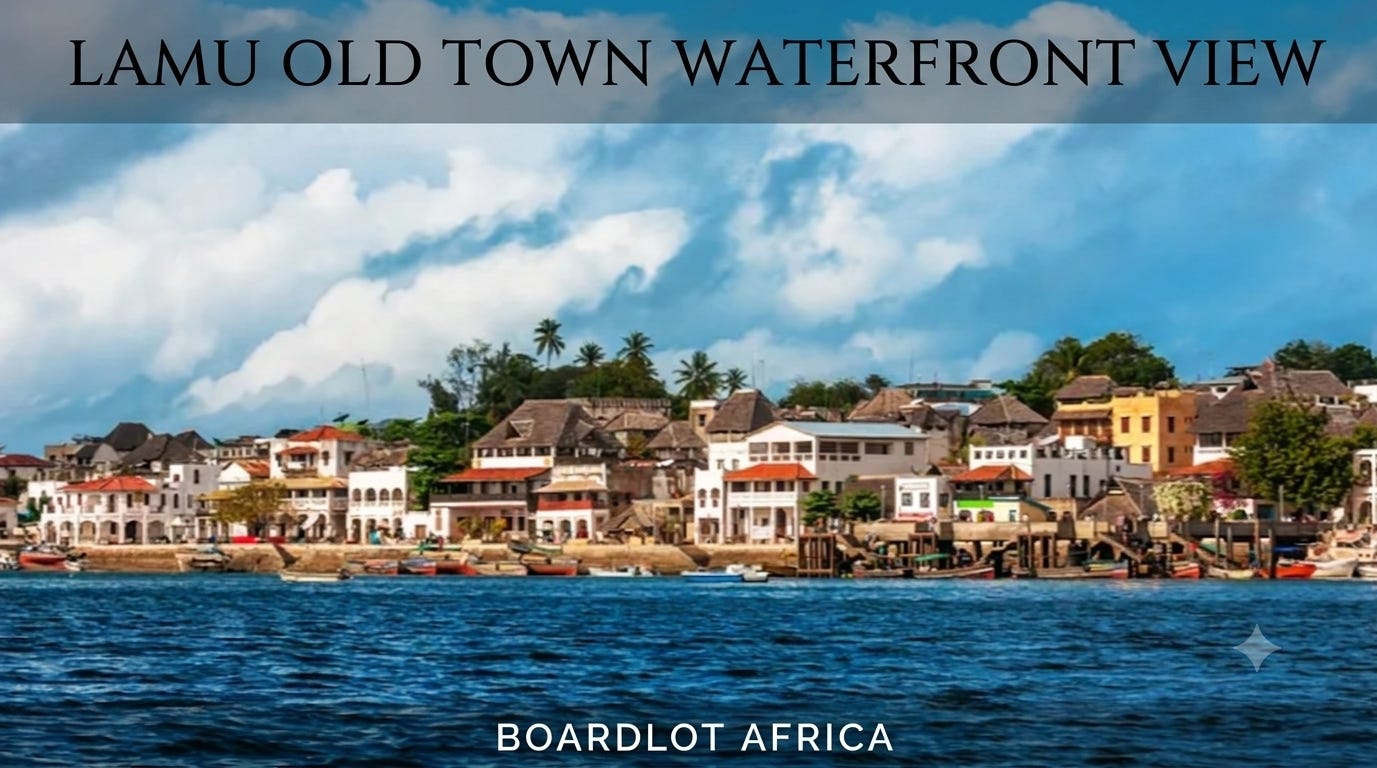
Yet Lamu is no ordinary construction site. Its Old Town is a UNESCO World Heritage treasure, a living museum of Swahili civilisation with coral-stone buildings, intricately carved wooden doors, and a centuries-old maritime culture that blends African, Arab, and Indian influences. The island and its surrounding archipelago boast rich mangroves, marine biodiversity, and a fragile ecosystem that has sustained fishing communities for generations. Past large-scale infrastructure proposals under the LAPSSET corridor — including port expansions and a now-halted Amu Power coal plant, by Centum Investments PLC — have already raised alarms about cultural erosion, environmental damage, and threats to the Outstanding Universal Value that earned Lamu its UNESCO listing.
This is not just another refinery story. It is the intersection of two grand ambitions: Dangote’s vision of African industrial self-reliance and Kenya’s long-stalled dream of turning Lamu into the eastern anchor of the Lamu Port–South Sudan–Ethiopia Transport (LAPSSET) corridor. The deep-water port, potential pipelines, roads, and special economic zones could finally come alive around the refinery, positioning Lamu as a true regional energy and logistics hub serving Kenya, Uganda, South Sudan, DRC, and beyond.
The stakes are high. Done right, the project could deliver sustainable development while respecting heritage. Done poorly, it risks repeating familiar patterns where big investments leave local communities and irreplaceable cultural assets on the losing side.
As soil testing begins on Lamu Island, the question facing Kenya is clear: Can one of Africa’s most ambitious industrial projects coexist with one of its most precious cultural landscapes?

Part 2: The Heritage at Stake
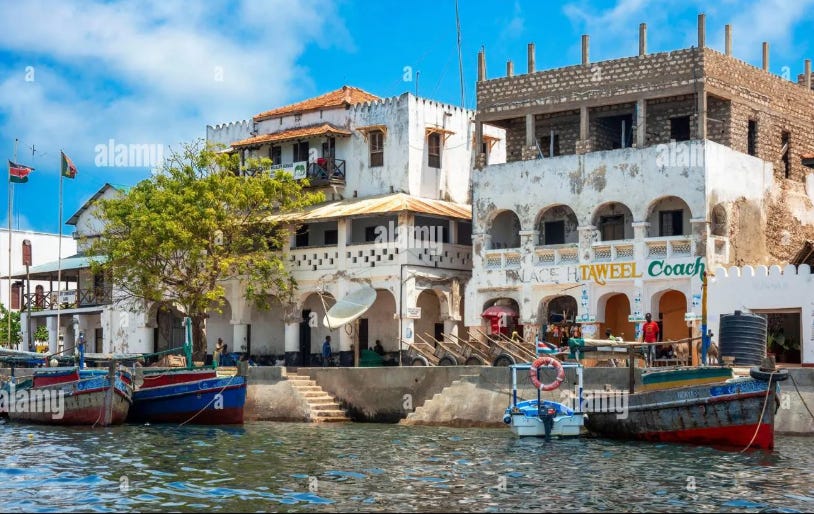
Lamu Old Town is not merely a tourist attraction — it is a living testament to over 700 years of Swahili coastal civilisation. Recognised by UNESCO as a World Heritage Site since 2001, the town features narrow winding streets, coral-stone houses with intricately carved wooden doors, and a unique architectural blend of African, Arab, Persian, and Indian influences. Its mosques, markets, and waterfront remain active centres of daily life, while traditional dhow-building and fishing practices continue much as they have for centuries. The surrounding archipelago, with its mangroves, seagrass beds, and marine life, forms an integral part of this cultural landscape.
UNESCO has repeatedly expressed concern about large-scale developments in the Lamu area. Previous components of the LAPSSET corridor — including the new port at Magogoni, proposed highways, a railway, and an earlier coal-fired power plant (now on hold) — triggered warnings about pressure on the Outstanding Universal Value (OUV) of the site. Issues flagged include urban encroachment, impacts on buffer zones (which should encompass parts of Lamu Island, Manda Island, and key mangrove areas), water shortages, waste management, and the risk of irreversible damage to the fragile coral-stone structures and cultural practices.
A refinery of this magnitude — one of Africa’s largest — brings even greater scale. Located on Lamu Island, the project sits in close proximity to sensitive ecosystems and heritage zones. Potential risks include industrial emissions, ballast water or oil-spill threats to marine life, increased shipping traffic that could affect traditional fishing grounds, and accelerated urbanisation as workers and service industries arrive. Past community campaigns under slogans like “Coastline not oilline” have highlighted fears that rapid industrialisation could erode the very character that makes Lamu unique, displacing local livelihoods and altering the social fabric of one of Kenya’s most culturally distinct regions.
National Museums of Kenya and local heritage committees have been involved in LAPSSET planning before, pushing for detailed Heritage Impact Assessments (HIAs) alongside Environmental Impact Assessments (EIAs). Yet with construction timelines now accelerating, the pressure is on to ensure these safeguards are not afterthoughts but central to project design.
Lamu’s heritage is not frozen in time — the town has adapted before — but the speed and scale of a $17 billion refinery test whether adaptation can occur without irreversible loss.

Lamu Old Town’s Outstanding Universal Value (OUV)
Lamu Old Town was inscribed on the UNESCO World Heritage List in 2001 under three specific criteria that capture its global significance. It is the oldest and best-preserved Swahili settlement in East Africa, covering a core area of about 16 hectares with strong integrity in both tangible and intangible attributes.
UNESCO Criteria Defining Its OUV
Criterion (ii) – Interchange of Human Values
The architecture and urban structure of Lamu graphically demonstrate the fusion of cultural influences over several centuries from Europe, Arabia, and India. Traditional Swahili building techniques (using coral stone and mangrove timber) combined with these external elements to create a distinct coastal culture. This is visible in the narrow streets, multi-storey stone houses with inner courtyards, carved wooden doors, and intricate plasterwork.
Criterion (iv) – Outstanding Example of a Building Type or Ensemble
Lamu represents a significant stage in human history: the growth and eventual decline of East African seaports and the intensive interaction between Bantu peoples, Arabs, Persians, Indians, and Europeans. It stands as the most outstanding surviving expression of this cultural and economic phase along the Swahili coast, illustrating centuries of trade, migration, and exchange that shaped the Indian Ocean world.
Criterion (vi) – Association with Ideas or Beliefs of Outstanding Universal Significance
Lamu served as a paramount trading port and a major centre of Islamic scholarship and education in East and Central Africa. It attracted scholars and teachers and continues to host important religious and cultural events, such as the annual Maulidi festival. The town remains a living hub for the transmission of Swahili and Islamic knowledge and traditions.
Key Attributes of OUV
Tangible: Coral-stone buildings, traditional urban layout (no cars — movement by foot or donkey), waterfront, mosques, and the overall historic fabric.
Intangible: Living Swahili culture, maritime traditions (dhow building and sailing), social practices, and festivals.
Setting: The surrounding archipelago, mangroves, and marine environment that supported the town’s historical prosperity and continue to sustain local livelihoods.
UNESCO emphasises that any development must protect these attributes, including through appropriate buffer zones (covering parts of Lamu Island, Manda Island, and mangrove areas) and careful management of infrastructure pressure. Past LAPSSET-related projects have already triggered UNESCO monitoring and calls for thorough Heritage Impact Assessments (HIAs) alongside EIAs.

Relevance to the Dangote Refinery Context
The refinery’s location on Lamu Island places it near this sensitive cultural landscape. While industrial growth could bring infrastructure improvements, it also risks increased shipping traffic, pollution, urban encroachment, and changes to the traditional way of life that form part of the OUV. Successful integration would require designs that respect buffer zones, minimise environmental footprints, and ensure community benefits — turning potential threats into opportunities for sustainable heritage-led development.
This OUV makes Lamu globally significant, not just nationally important. Any major project must demonstrate it will sustain, rather than diminish, these values for future generations.
Part 3: The Dangote Refinery – Scale, Promises, and Location Rationale
Africa’s richest man, Aliko Dangote, is bringing one of the continent’s most ambitious industrial projects to Kenyan soil. The proposed refinery will have a capacity of 700,000 barrels per day — matching the scale of his flagship facility in Lagos, Nigeria, and making it East Africa’s largest and Africa’s second-largest refinery once operational. The estimated investment reaches up to $17 billion (approximately KSh 2.2 trillion), with construction potentially beginning later in 2026 and taking three to five years to complete.
Dangote Industries has outlined a diversified financing plan to spread risk: internal cash flows from its existing portfolio (cement, fertiliser, sugar, and the Lagos refinery), issuance of bonds, and proceeds from a planned Initial Public Offering (IPO) of the Nigerian refinery. This approach avoids over-reliance on a single lender and signals confidence in the project’s long-term viability.
The choice of Lamu Island was not accidental. Company officials, including Oil & Gas Vice President Edwin Devakumar, cited strong commercial, technical, and logistical advantages. Lamu’s deep-water port facilities and large land availability (including areas linked to the LAPSSET corridor) provide ideal conditions for a mega-refinery that will require substantial crude imports initially and efficient product distribution. Compared to competing sites in Tanzania, Kenya offered a larger domestic fuel market, better existing infrastructure links, and stronger overall economic fundamentals.
Key Promises
Energy Security: The refinery is expected to supply refined petroleum products to Kenya and neighbouring countries (Uganda, South Sudan, DRC, and others), significantly cutting the region’s dependence on imported fuel from the Middle East.
Job Creation: Industry estimates and project-related discussions point to approximately 30,000 direct jobs during peak construction and operations, with potential for up to 100,000 indirect jobs in logistics, services, supply chains, and downstream industries. These figures would make it one of the largest employment drivers in coastal Kenya in decades.
Economic Impact: Beyond jobs, the project is positioned as one of the largest private investments in Kenya’s history, with significant forex savings from reduced fuel imports and stimulation of local businesses.
Regional Hub Potential: When combined with Lamu Port and LAPSSET infrastructure, it could transform the area into East Africa’s premier energy and logistics centre.
President William Ruto’s government has moved quickly, appointing Deputy President Kithure Kindiki to coordinate the government’s role. For many Kenyans, especially along the coast, the project represents a long-awaited dividend from Vision 2030 and the LAPSSET dream.
Yet scale and job numbers alone do not guarantee success. The real test will lie in how this massive facility coexists with Lamu’s fragile heritage and environment — the very issues explored in the previous section.
Notes on Job Numbers:
The 30,000 direct / 100,000 indirect figures are commonly cited in project discussions and social media commentary around similar mega-refineries in Africa. They are estimates and should ideally be attributed to “project proponents and industry analysts” in the final article.
If you have official Dangote or government sources with different numbers, we can refine further.
Dangote Lagos Refinery – Job Creation Breakdown by Numbers and Cadres
Below is a tabulated summary based on official Dangote Group statements, project reports, and reliable media sources. Figures are estimates/projections and can vary by phase (construction vs operational) and scope (core refinery vs full value chain).
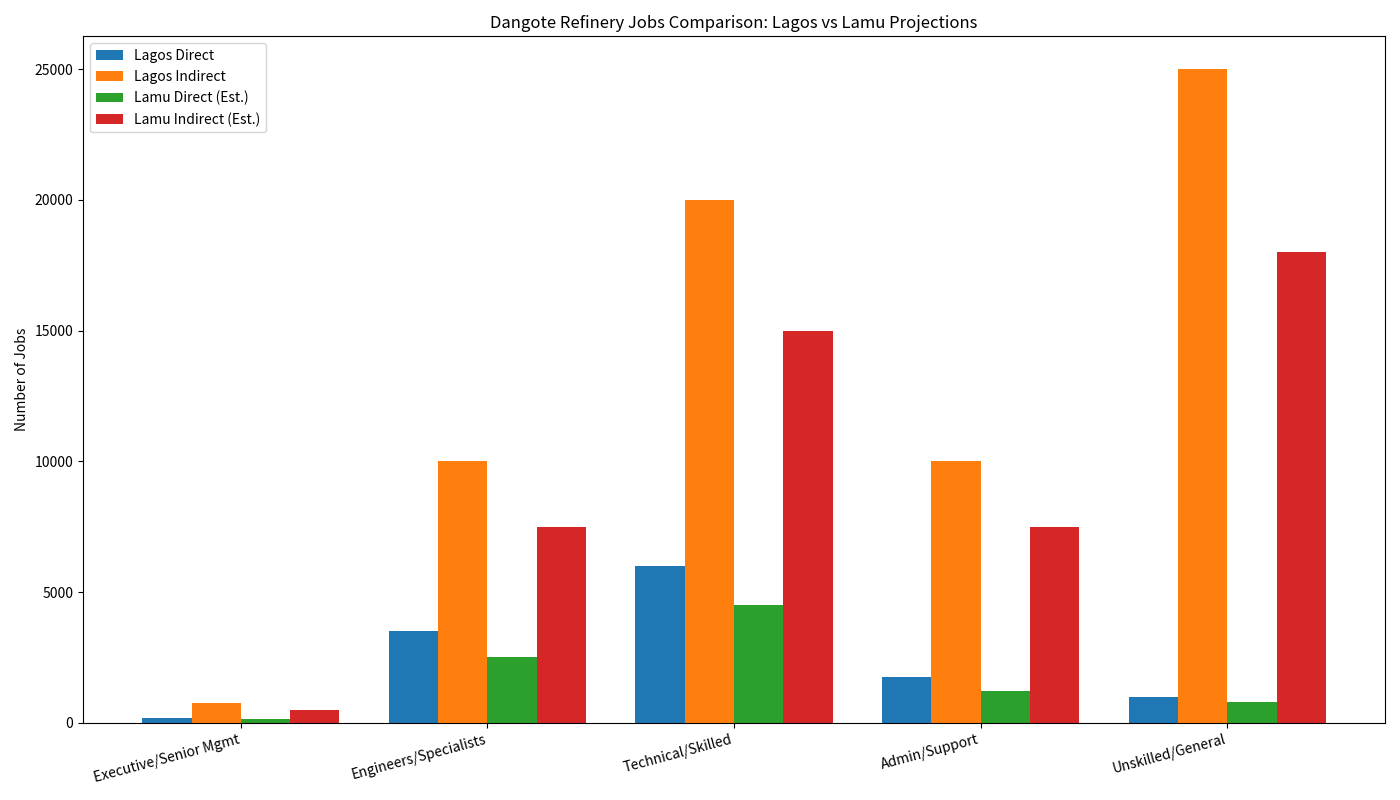
Executive / Senior Management100 – 300500 – 1,000600 – 1,300CEOs, GMs, Directors, Technical Advisors
Professional / Engineers & Specialists 2,000 – 5,000/ 5,000 – 15,000/ 7,000 – 20,000/ Process Engineers, Mechanical/Electrical/Chemical Engineers, HSE Specialists, IT/Systems Analysts
Technical / Skilled Workers 4,000 – 8,000/ 10,000 – 30,000/ 14,000 – 38,000/ Technicians, Welders, Fitters, Operators, Maintenance Crews, Laboratory Analysts
Administrative & Support 1,000 – 2,500/ 5,000 – 15,000/ 6,000 – 17,500/ HR, Finance, Admin, Logistics, Security, Supply Chain Staff
Unskilled / General Labour 500 – 1,500/ 10,000 – 40,000/ 10,500 – 41,500/ General workers, cleaners, drivers, casual support roles
Total (Core Refinery) 9,500 – 135,000 (broad estimates) 25,000 – 100,000/ +100,000 – 300,000
Full ecosystem including petrochemicals and distribution
Additional Context (Construction Phase)
Peak Construction: Over 30,000 workers on site through various contractors (engineers, artisans, labourers, etc.).
Expansion Phase: Up to 95,000 skilled workers projected for capacity increase to 1.4 million bpd.
Sources: Dangote Group statements, project updates, and reports (e.g., 9,500 direct / 25,000 indirect for core operations; broader claims of 135,000 permanent jobs when fully ramped up).
These numbers highlight the refinery’s emphasis on skilled technical roles and local content. For the Kenya Lamu project, similar ratios are expected but scaled to local context (earlier estimates: 30k direct / 100k indirect).
Part 4: LAPSSET Synergy – Reviving Kenya’s Ambitious Corridor Dream
The Dangote refinery is not arriving in isolation. It lands squarely within the long-planned Lamu Port–South Sudan–Ethiopia Transport (LAPSSET) corridor — Kenya’s flagship Vision 2030 infrastructure programme designed to open up northern Kenya and link the country to its landlocked neighbours.
Lamu’s deep-water port, already partially operational with its first berth handling vessels, provides the perfect maritime gateway. The refinery can process crude delivered via the port while exporting refined products efficiently across the region. When integrated with other LAPSSET components — the crude oil pipeline from South Sudan and Kenya’s Turkana fields, standard gauge railway, highways, and special economic zones (SEZs) — the project has the potential to unlock the corridor’s full potential after years of slow progress.
Strategic Advantages
Logistics Hub: Refined products can be distributed quickly to Uganda, South Sudan, DRC, Ethiopia, and beyond, reducing transport costs and turnaround times compared to current import routes.
Industrial Catalyst: The refinery could anchor a petrochemical cluster, attracting downstream industries (plastics, lubricants, fertilisers) and creating a true value chain.
Regional Integration: It strengthens Kenya’s position as East Africa’s energy and trade gateway, especially after Kenya secured the project over Tanzania.
For Lamu County, this means more than a single factory. It could accelerate development of the Lamu Metropolis, new airports, and ancillary infrastructure, transforming a historically underserved area into a major economic node.
However, success depends on coordinated planning. Past LAPSSET delays stemmed from funding, security concerns, and community engagement issues. With the refinery providing a strong private-sector anchor, the government now has a rare opportunity to fast-track the corridor while ensuring local benefits.
The refinery + LAPSSET combination could deliver the multiplier effect Kenya has long envisioned — but only if infrastructure rollout, land use, and community inclusion keep pace with the refinery timeline.
Beyond Fuel – Building a Petrochemical Cluster for Import Substitution in Lamu
The true game-changing potential of the Dangote refinery lies not only in producing transportation fuels but in anchoring a petrochemical cluster — a network of downstream industries that convert refinery intermediates into higher-value products.
Dangote’s Lagos operation already demonstrates this model. The Nigerian refinery is expanding into petrochemicals, producing polypropylene for plastics, Linear Alkylbenzene (LAB) for detergents (one of the largest such plants globally), lubricants, sulfur, and other derivatives.
Kenya’s Petrochemical Gaps & Import Burden
Kenya has very limited domestic petrochemical production. The country relies heavily on imports for:
Plastics and articles — approximately US$952 million in 2024.
Fertilizers — around US$376 million in 2024, with volumes in the hundreds of thousands of tonnes annually (e.g., 443,701 metric tonnes valued at nearly Sh25.83 billion in the first half of 2025 alone).
Other synthetic chemicals, agrochemicals, detergents, and industrial products.
This dependence contributes to a significant foreign exchange outflow and exposes the economy to global price volatility.
Import Substitution Opportunity in Lamu
LAPSSET’s original master plan explicitly included petrochemical industries in Lamu and Isiolo. The 700,000 bpd Dangote refinery provides the perfect feedstock platform (naphtha, propane, propylene, etc.) to kickstart local manufacturing of:
Plastics and packaging materials
Fertilizers and agrochemicals
Detergents/surfactants (via LAB)
Lubricants and specialty chemicals
Key Benefits of Import Substitution:
Forex savings — Potentially hundreds of millions of dollars annually by producing locally what is currently imported.
Job creation — Downstream plants would add thousands of skilled manufacturing and technical roles beyond the refinery’s core workforce.
Value addition & resilience — Moves Kenya up the value chain, reduces vulnerability to global shocks, and supports food security (fertilizers) and manufacturing (plastics).
Regional hub potential — Supplies East Africa while strengthening LAPSSET’s industrial corridor.
Challenges to manage:
Attracting downstream investors.
Workforce skills in chemical engineering and process operations.
Strong environmental and heritage safeguards near Lamu’s sensitive ecosystems.
If successful, the Lamu project could mark Kenya’s meaningful entry into petrochemical production — converting a major import cost centre into a driver of industrialization, job creation, and economic sovereignty.

Part 5: Land Compensation – A Persistent Minefield for the Lamu Refinery and Its Infrastructure
Kenya has a well-documented history of challenges with compulsory land acquisition and compensation for large infrastructure projects. Delays, valuation disputes, lack of individual title deeds on communal land, allegations of excess acquisition, and slow or incomplete payments have repeatedly led to court injunctions, protests, cost overruns, and eroded public trust. These issues are particularly acute in Lamu and along the LAPSSET corridor, making land compensation one of the most critical minefields for the Dangote refinery project.
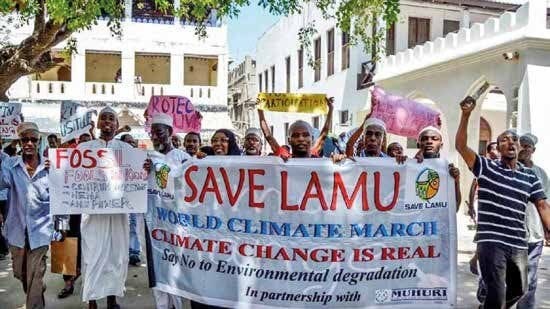
Historical Precedents in Lamu and LAPSSET
LAPSSET has faced multiple high-profile land disputes since its 2012 launch:
Mohamed Ali Baadi & Others v Attorney General & Others (Petition No. 22 of 2012): Residents and fishermen in Lamu challenged the project over inadequate public participation, environmental harm, and loss of traditional fishing grounds. In 2018, the Malindi High Court recognised traditional fishing rights as property and ordered approximately KSh 1.7 billion in compensation for around 4,600–5,000 affected fishermen. The government appealed, and parts of the order were suspended, but the case exposed major gaps in consultation and mitigation.
Ali Arumi Obo & 3 Others v National Land Commission & 5 Others (Constitutional Petition No. 16 of 2017): Petitioners from the Kililana area claimed that 1.3 km² of ancestral land was acquired for LAPSSET without proper compensation or issuance of title deeds. The case highlighted discrimination and violations of property and fair administrative action rights under the Constitution.
2014 Injunction by 146 Families: A group of families obtained a court injunction halting aspects of LAPSSET until compensation was resolved. The National Land Commission’s compensation list was later nullified by the then Lands Cabinet Secretary, further delaying the process.
Kililana Area Issues: Fishermen and farmers have repeatedly complained that more land was acquired than initially agreed upon for the Lamu Port and access roads. Some families displaced years ago are still awaiting compensation. As recently as 2026, additional concerns have arisen over Kenya Defence Forces (KDF) land acquisitions in the same area for military infrastructure.
Broader patterns along the corridor include:
Prolonged delays in payment (sometimes over a decade).
Complications from communal land tenure (many residents lack individual titles).
Allegations of opaque public inquiries and over-acquisition.
How This Will Impact the Dangote Refinery Project
The refinery site on Lamu Island and its supporting infrastructure will require significant new land acquisition:
Refinery Site: Substantial acreage for processing units, storage tanks, and associated facilities. Acquisition here risks repeating Kililana-style disputes, especially given existing grievances from prior LAPSSET acquisitions in the area.
Pipelines and Linear Infrastructure: Crude oil pipelines (in) and refined product pipelines (out), along with roads, power lines, and port expansions, will create long corridors across multiple counties and communities. Linear acquisitions are notoriously dispute-prone because they affect numerous individual or communal parcels, increasing the likelihood of holdouts, legal challenges, and fragmented claims.
Potential Consequences:
Project Delays: Court injunctions or prolonged negotiations could push back construction timelines and commissioning.
Cost Overruns: Higher compensation awards, legal fees, or redesigns to avoid contested areas.
Community Opposition: Loss of social licence, protests, or boycotts if locals perceive unfair treatment.
Supply Chain Risks: Delays in pipeline construction could force the refinery to rely on costlier temporary logistics (trucking or shipping) or operate below full capacity.
Path Forward and Mitigation
To avoid repeating history, the government and Dangote must prioritise:
Swift, fair, and transparent compensation based on current market values.
Clear public inquiries and community engagement from the earliest stages.
Resolving outstanding LAPSSET claims in Lamu to build trust.
Innovative approaches such as land-for-land swaps or community equity where appropriate.
Land compensation has derailed or significantly delayed many Kenyan mega-projects in the past. For the Lamu refinery to succeed on time and deliver its promised benefits, this minefield must be navigated with urgency, fairness, and accountability.
Part 6: Risks and Real Challenges
While the economic promise of the Dangote refinery and a potential petrochemical cluster is substantial, the project comes with significant risks that must be proactively managed if Lamu is to benefit without irreversible harm.
Environmental and Heritage Risks
Lamu’s UNESCO World Heritage status and fragile marine ecosystem (mangroves, coral reefs, biodiversity) are particularly vulnerable. A large refinery and associated industries could bring increased shipping traffic, potential pollution (air, water, or oil spills), and pressure on land and water resources. Past LAPSSET developments have already drawn UNESCO scrutiny over buffer zones and cultural integrity.
Community and Social Impacts
Rapid influx of workers could strain local infrastructure, housing, and services in Lamu. There are legitimate concerns around land acquisition, displacement of fishing communities, and whether locals will receive priority in jobs and contracts. Meaningful public participation — already called for by some voices — is essential to avoid elite capture or social tension.
Economic and Execution Risks
Crude supply logistics remain uncertain in the short term (reliance on imports vs regional pipelines).
Downstream petrochemical plants require additional capital and technical expertise.
Historical challenges with large Kenyan projects (delays, cost overruns, security in the region) could affect timelines and returns.
Potential for fuel price benefits to be limited if the refinery enjoys protective measures similar to other Dangote operations.
Geopolitical and Governance Considerations
Strong oversight is needed to ensure transparency in financing, local content requirements, and environmental compliance. The project’s success will also depend on smooth coordination between the private investor, national government, and Lamu County.
The coming months of soil testing, Environmental Impact Assessment (EIA), and Heritage Impact Assessment (HIA) will be critical. With robust safeguards, inclusive planning, and skills development programmes, these risks can be mitigated — turning potential pitfalls into a model of responsible mega-development.
Crude Oil Procurement: The Fundamental Supply Chain Challenge
One of the most critical — yet least discussed — minefields is crude oil procurement and logistics. The 700,000 bpd refinery will require massive volumes of feedstock, but Kenya’s domestic production (Turkana) remains underdeveloped and insufficient. Regional sources face their own hurdles:
Uganda’s oil is tied to the EACOP pipeline routing to Tanzania’s Tanga port, not Lamu.
South Sudan crude would require functional pipelines through the LAPSSET corridor, which has historically faced delays and security issues.
DRC production is small and logistically distant.
In the early years, the refinery is likely to rely heavily on imported crude via Lamu Port. This raises questions around:
Forex exposure and cost competitiveness if global crude prices spike.
Shipping logistics and port capacity upgrades needed for large tankers.
Long-term supply security — without secured regional pipelines, the project risks operating below capacity or depending on volatile spot markets.
Dangote has successfully navigated similar issues in Nigeria, but Lamu’s landlocked-neighbour dynamics and incomplete LAPSSET infrastructure add complexity. Ruto’s administration and Dangote will need clear, long-term crude supply agreements and accelerated pipeline development to avoid a situation where the refinery is built but struggles to run at full capacity.
This challenge directly impacts project viability, fuel price benefits for Kenyans, and the broader import substitution goals.
Regional Bloc Politics and the Tanzania Factor
Another significant post-approval minefield lies in East African Community (EAC) dynamics and regional competition. Although Dangote selected Kenya, the decision created ripples across the bloc, particularly with Tanzania, which had been a serious contender for the refinery.
Dangote’s Shuttle Diplomacy
In a clear effort to manage tensions, Aliko Dangote has engaged in active shuttle diplomacy. He recently met with Tanzanian President Samia Suluhu Hassan to explain the commercial and technical reasons for choosing Lamu and explicitly invited Tanzania to participate in the investment. Similar outreach has occurred with Uganda’s President Museni and other neighbours to secure buy-in and potential crude supply arrangements.
Key Remaining Tensions:
Competing Pipelines: Uganda’s oil is primarily tied to the EACOP pipeline ending at Tanga in Tanzania. Any shift toward Lamu could require delicate negotiations on routing or parallel infrastructure.
Resource Sharing: Neighbouring countries may seek favourable terms for supplying crude to the Lamu refinery or push for their own downstream benefits within the EAC framework.
Bloc Cohesion: Perceived “winner-takes-all” outcomes risk straining relations, even if Dangote’s diplomacy has softened immediate disappointment.
For President Ruto, this means continued high-level coordination is essential. While Dangote’s personal engagement helps, the Kenyan government must ensure the project strengthens rather than fragments EAC energy cooperation.
Handled well, regional diplomacy could turn potential rivalry into a win-win network of refineries and pipelines. Mishandled, it risks delays in supply agreements, political backlash, or slower cross-border infrastructure development.

Part 6: Charting a Balanced Path Forward – Conclusion
The Dangote refinery in Lamu represents one of the most significant private investments in Kenya’s history and a rare opportunity to realise long-held ambitions for the LAPSSET corridor. With the potential to deliver thousands of jobs, reduce regional fuel import dependence, anchor a petrochemical cluster for import substitution, and position Lamu as East Africa’s emerging energy and industrial hub, the project carries genuine transformative promise.
Yet its success will not be measured solely by barrels processed or dollars invested. It will be defined by how well Kenya balances ambitious development with the protection of Lamu’s UNESCO World Heritage status, fragile ecosystems, and local communities.
Key Recommendations for Responsible Execution:
Conduct thorough, independent Environmental and Heritage Impact Assessments with full public participation.
Prioritise local content, skills training, and job opportunities for Lamu and coastal residents.
Ensure transparent governance, clear benefit-sharing mechanisms, and environmental safeguards.
Align the refinery tightly with LAPSSET infrastructure to maximise synergies and minimise duplication.
Develop a clear roadmap for downstream petrochemical industries while attracting responsible investors.
If these foundations are laid properly, the Lamu project could become a model for Africa — demonstrating that large-scale industrialisation and cultural/environmental preservation are not mutually exclusive.
Lamu stands at a historic crossroads. The coming years will determine whether this $17 billion investment becomes a catalyst for inclusive, sustainable growth or a missed opportunity. With careful planning and genuine stakeholder engagement, Kenya has the chance to write a success story that benefits not only the present generation but preserves Lamu’s unique heritage for generations to come.
The refinery is coming. The real question is whether Kenya will be ready to make the most of it.

About Boardlot Africa Research
Boardlot Africa is a premier financial intelligence and corporate governance publication dedicated to unpacking the mechanics of capital, market strategies, and structural shifts across East Africa’s corporate landscape. By bridging the gap between raw economic data and actionable market intelligence, we deliver deep-dive research, independent corporate analysis, and policy insights designed for institutional investors, boardrooms, and sharp market observers.
Get in Touch
Email: boardlot.research@gmail.com
Phone: +254 753 133 901
Substack: Subscribe to Boardlot Africa
X (Twitter): BoardLotSultan