
The Lesson:
The core lesson here is simple: invest in AKFED companies strictly if you are playing the long-term game and are a non-income-first investor. If your portfolio requires immediate, high-velocity dividend streams to meet current operational expenses or capital payouts, counters like DTB and Jubilee will frustrate your cash-flow timelines.
However, if you are an accumulation-phase investor focused on intrinsic value compounding, this corporate architecture provides an exceptional margin of safety. Your capital is guarded by some of the most fortified, asset-backed balance sheets in East Africa. The clear, structural trade-off remains absolute: you must be entirely comfortable knowing that the vast majority of the wealth generated by these companies will stay locked safely inside the corporate vault, compounding under the hood rather than hitting your bank account at the end of the quarter.
🔍 Case-by-Case Breakdown: The Corporate Finance Reality
1. Diamond Trust Bank ($DTK) — Extreme Capital Preservation
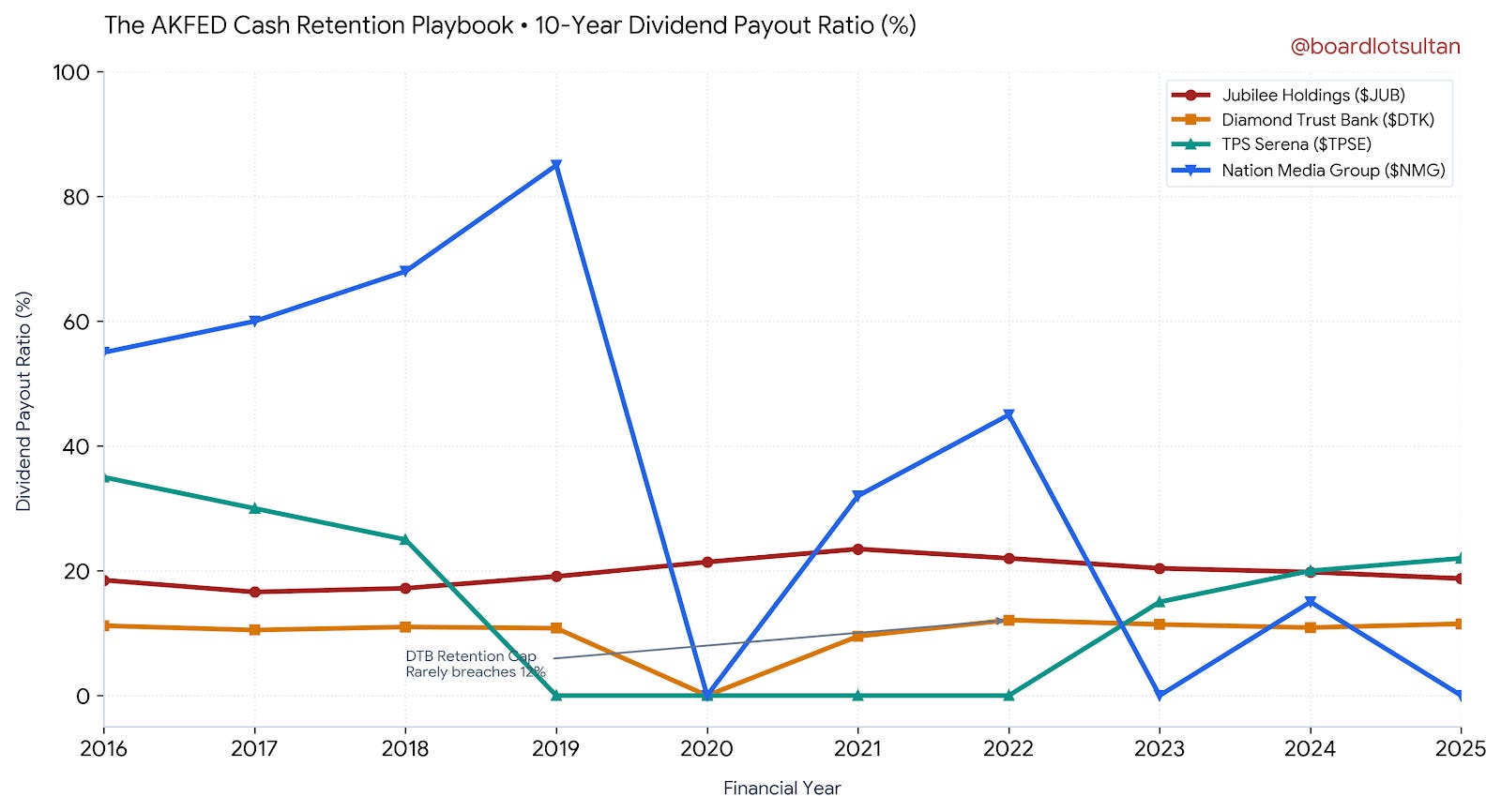
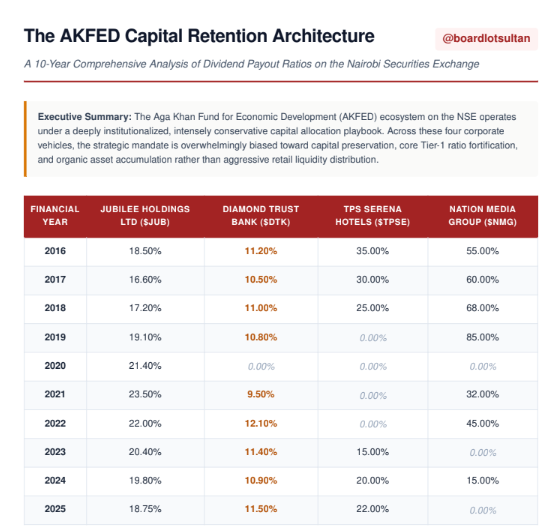
DTB serves as the ultimate institutional benchmark of the AKFED philosophy. Its payout ratio operates inside a rigid, self-imposed 10% to 12% corridor. Even as the lender regularly crosses the KES 6.0 Billion profit mark, parental governance dictates an aggressive starvation of cash distributions. Instead of handing out yields, profits are rechanneled straight back into retained earnings to build an unshakeable Tier-1 capital ratio buffer. The playbook prefers to organically fund aggressive cross-border asset expansions rather than rewarding the equity base with short-term retail liquidity.
2. Jubilee Holdings ($JUB) — The Low-Cost Float Insulation
At first glance, Jubilee appears to break the mold by printing the highest absolute payout in nominal shilling terms across the group, distributing a record KES 15.00 per share ordinary dividend. However, checking the actual payout ratio reveals that it remains tightly bound between 16% and 24%. Jubilee’s investment engine controls a massive KES 224.8 Billion asset pool, yet management intentionally shields roughly 80% of net earnings under the hood. This massive retained float is continually re-anchored into long-duration sovereign infrastructure paper and real estate, effectively insulating the group from under-the-hood operational pressures like corporate medical claims inflation.
3. TPS Eastern Africa ($TPSE) — Cyclical Risk Vulnerability
The Serena Hotels brand showcases what happens when a capital-retention playbook collides with severe cyclical economic shocks. Prior to the pandemic era, Serena maintained a moderate 25% to 35% payout ratio. However, when global tourism lines froze, management didn’t hesitate to deploy a multi-cycle 0% payout pause to aggressively protect cash reserves. Its gradual recovery back to the 15% - 22% zone underscores a protective corporate mandate: rebuild defensive balance sheet runways before returning cash upstream to minority holders.
4. Nation Media Group ($NMG) — Secular Disruption Strain
Nation Media represents the historical anomaly of the matrix. For decades, it was the premier, light-CapEx cash cow of the group, tracking an aggressive dividend distribution that peaked at 85% in 2019. However, as traditional media models ran face-first into secular digital migration, legacy advertising margins compressed faster than dividend policies could pivot. This created a highly warped, unsustainable payout ratio before forcing management into aggressive structural suspensions to conserve cash for its multi-million shilling digital transition strategy.
☕ The Sultan’s Portfolio Verdict
When assembling an equity allocation strategy on the NSE, you have to throw out the typical “high dividend yield” playbook when approaching AKFED-controlled entities.
You are not buying high-velocity cash pass-through engines. You are buying into multi-generational asset-warehousing vehicles designed to survive severe macro cycles.
For the long-term value investor, this architecture provides an exceptional margin of safety; your capital is guarded by some of the most fortified, asset-backed balance sheets in East Africa. However, that defense comes with a clear, structural trade-off: you must be comfortable knowing that the vast majority of the wealth generated by these companies will stay locked safely inside the corporate vault, compounding under the hood rather than hitting your bank account at the end of the quarter.