
This deep-dive analysis examines the structural shift in Kenya’s digital credit market as it transitions from a period of unregulated, high-velocity growth to a mature, CBK-supervised landscape. By deconstructing the divergent models of asset-backed financiers and pure-play digital lenders, this article illuminates the competing strategies of capital acquisition, risk management, and infrastructure investment that define the sector’s leading players.
Table of Contents
I. Introduction: The Maturation of the Market
From “Wild West” to 227 Licensed Providers
The Thesis: The Bifurcation of Digital Credit
II. The Capital Advantage: DFI and ESG Funding
The “Funding Moat” of Asset-Backed Players
Translating Capital into Competitive Edge
III. Financial Performance & Risk Dynamics
Portfolio Quality: Collateral vs. Predictive Analytics
The Operational Expenditure (OPEX) Profile
Comparative Financial Performance Summary (FY23/FY24)
IV. The Regulatory “Shield” and Market Dynamics
The Licensing Moat and Consolidation
Shift in Operational Focus: Compliance as a Moat
V. The Underbelly of the Boom: Predatory Lending and Usury
Common Predatory Tactics and the In Duplum Rule
The Impact on Household Welfare and Debt Cycles
VI. Strategic Outlook (2026 and Beyond)
Converging Models: Digital Wallets vs. Ecosystem Integration
The Role of Emerging Tech in Sustainable Credit
VII. Conclusion
I. Introduction: The Maturation of the Market
The narrative of Kenya’s digital lending sector has undergone a profound transformation. What began as a “Wild West” era—defined by rapid, largely unchecked growth, predatory interest rates, and aggressive, often unethical debt collection—has, by 2026, been fundamentally reshaped. Today, the Central Bank of Kenya (CBK) serves as the industry’s primary guardian, with a licensing framework that has pruned the market down to 227 authorized Digital Credit Providers (DCPs). This maturation, supported by robust regulatory oversight, has successfully transitioned the sector from an era of unchecked exploitation to one where transparency and consumer protection are no longer optional, but foundational.
However, beneath this veneer of uniform regulation, a significant structural divergence has emerged. The sector is no longer a monolithic block of “fintech apps”; it is actively bifurcating into two distinct financial models.
On one side, we have pure-play digital lenders like Tala and Branch, which continue to refine the art of velocity. These firms rely on high-frequency, data-driven underwriting, leveraging sophisticated AI to extend unsecured, short-term liquidity with near-instant turnaround. Their success is built on the speed of processing and the scalability of their algorithms.
On the other side, a rising cohort of asset-backed financiers—including Watu, M-KOPA, and MOGO—is shifting the focus from digital speed to physical integration. Rather than providing abstract cash, these lenders are embedding themselves into the real economy by financing productive assets like motorcycles, smartphones, and solar kits. By owning the collateral and building physical distribution networks, they are creating “phygital” ecosystems that significantly de-risk their portfolios compared to their unsecured counterparts.
The objective of this analysis is to deconstruct these two paths. By comparing their performance metrics, risk management appetites, and growth strategies, we seek to understand why the future of Kenyan credit is being fought on two different battlegrounds: one for the fastest click, and one for the deepest integration into the consumer’s livelihood.
II. The Capital Advantage: DFI and ESG Funding
A critical, often overlooked differentiator between Kenya’s asset-backed financiers and pure-play digital apps lies in the composition of their balance sheets. While both categories are highly capitalized, the nature of that capital creates a structural advantage for firms like Watu, M-KOPA, and MOGO.
The DFI/ESG “Funding Moat”
Asset-backed lenders have successfully positioned themselves as vehicles for developmental and climate-positive impact. By financing income-generating assets—such as e-mobility motorcycles, solar home systems, and smartphones that bridge the digital divide—these firms tap into dedicated pools of capital from Development Finance Institutions (DFIs) and ESG-focused impact investors.
This funding is fundamentally different from the venture debt or private equity typically used to scale pure-play digital apps:
Cost of Capital: Because DFI and ESG investors prioritize social and environmental “additionality” alongside financial returns, they often provide capital at more favorable interest rates and longer tenures than commercial debt markets. This creates a lower “cost of carry,” allowing these companies to fund operations more sustainably.
Stability and Tenure: Unlike venture debt, which may be subject to short-term interest rate volatility or the aggressive exit requirements of venture capital, DFI-backed facilities are often structured as multi-year facilities. This allows asset-backed lenders to plan their loan portfolios over the lifespan of the assets they finance (e.g., 18–36 months), rather than being tethered to the 30–90 day cycle of unsecured digital micro-loans.
Translating Capital into Competitive Edge
This structural funding advantage directly impacts market performance in two ways:
Product Pricing Power: Lower capital costs allow asset-backed lenders to offer competitive, transparent pricing. Because they are not solely reliant on high-interest, short-term “survival” lending to cover the high cost of their own debt, they can pass on more value to the borrower, often resulting in lower effective APRs on long-term assets compared to the high-fee models of some unsecured apps.
Margin Expansion: By aligning their business model with sustainable development goals, these lenders aren’t just attracting capital; they are attracting loyalty. ESG-mandated capital rewards these firms for maintaining low default rates and demonstrating clear socio-economic “lift” for their customers. As their portfolios grow, the compounding efficiency of their lower-cost debt contributes to healthier net margins compared to pure-play apps that must constantly reinvest high-cost capital into high-risk, high-velocity customer acquisition.
In short, while pure-play apps (Tala, Branch) play a game of data-science efficiency—where profit is a function of rapid turnover and tight credit scoring—asset-backed financiers (Watu, M-KOPA, MOGO) are playing a game of capital-structure optimization. By securing “cheaper” money, they don’t just lend; they build a sustainable, scalable infrastructure that is far more resilient to the market fluctuations that often plague unsecured digital credit.
III. Financial Performance & Risk Dynamics
The divergence between asset-backed financiers and pure-play digital lenders is most stark when examining how they manage their “Cost of Risk” and “Operational Overhead.” While all are subject to the same regulatory scrutiny, their internal mechanisms for survival are fundamentally different, as revealed by their distinct cost structures.
1. Portfolio Quality: Collateral vs. Predictive Analytics
Asset-Backed Lenders (Watu, M-KOPA, MOGO): These entities rely on the asset itself as a risk management tool. They utilize IoT technologies like GPS and remote kill-switches to maintain control. However, this model carries a heavy “Cost of Risk” in the form of debt collection and impairment. For instance, in FY23, Mogo reported over 2 billion KES in total impairments (bad debt written off and provisions for doubtful debt). Similarly, M-KOPA saw its expected credit losses increase from 35.4 million USD in 2023 to 63.0 million USD in 2024, highlighting the capital intensity of managing default risk in a growing portfolio.
Pure-Play Digital Lenders (Tala, Branch): Operating in a collateral-free environment, these firms manage risk through AI-driven credit scoring and behavioral analytics. Their performance is sensitive to the Probability of Default (PD) since they lack physical recourse, making their profitability highly dependent on the precision of their algorithms and the velocity of their loan turnover.
2. Operational Expenditure (OPEX) Profiles
Asset-Backed (High-Touch Infrastructure): These firms operate as infrastructure-heavy organizations. Mogo’s 2023 financials, for example, reveal significant fixed costs for essential asset-protection tools, such as 149 million KES for GPS and over 250 million KES for debt collection expenses. Watu Credit similarly emphasizes a physical presence, with wages and salaries increasing from 20.9 million USD to 30.9 million USD in 2024, signaling a commitment to expanding its human-capital footprint. M-KOPA’s “Selling and distribution” and “Other expenses” (totaling approximately 90 million USD in 2024) further underscore that these companies require massive physical networks to generate revenue.
Pure-Play Digital (Tech-Heavy Efficiency): In contrast, pure-play lenders maintain a lean physical footprint, concentrating their expenditure on customer acquisition costs (CAC) and digital infrastructure. Their profitability is a game of scale—they must process high volumes of micro-loans to offset the lack of physical collateral assets.
3. Sustainability and Growth Phases
Investment vs. Maturity: The financial data illustrates different growth stages. Watu Credit, for instance, has prioritized market share and infrastructure over immediate profit maximization, as evidenced by its stable net profit (6.7 million USD to 6.5 million USD) despite a sharp revenue increase.
Turnaround Potential: M-KOPA’s 2024 results highlight the “operating leverage” of their ecosystem model; by successfully pivoting, they swung from a 20.6 million USD net loss in 2023 to a 9.22 million USD net profit in 2024.
Analytical Summary: Profitability in this sector is a “hard-won outcome” of managing physical scale versus digital velocity. Asset-backed lenders accept higher operational overheads in exchange for the security of collateral, whereas pure-play lenders trade higher default risk for lower physical maintenance costs. Both models, however, are now proving that reaching scale is the only path to offsetting the inevitable costs of credit impairments and high customer acquisition.
Comparative Financial Performance Summary (FY24)
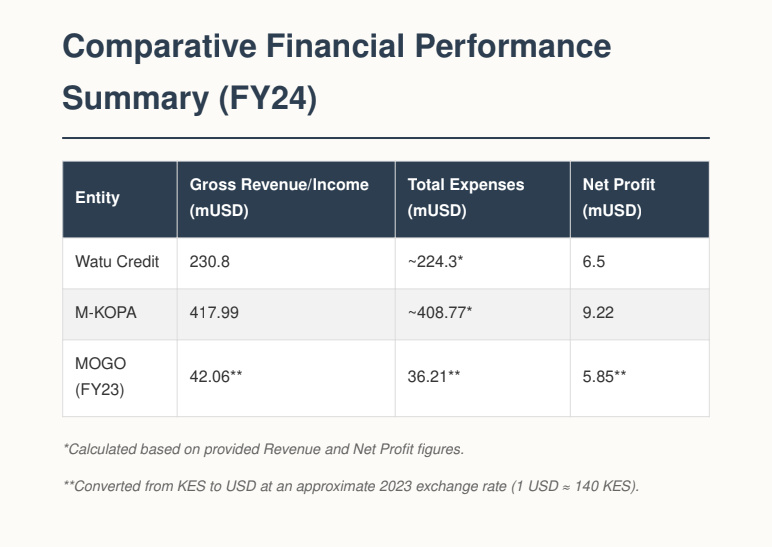
*Calculated based on provided Revenue and Net Profit figures.
Converted from KES to USD at an approximate 2023 exchange rate (1 USD ≈ 140 KES).
Key Analytical Insights
Scale vs. Margin: M-KOPA demonstrates the highest revenue generation at approximately $417.99 million. However, their total expenses are also the highest, reflecting the significant costs of maintaining an integrated ecosystem and physical distribution network.
Reinvestment Strategies: Watu Credit’s financial data shows a high expenditure ratio, with net profits remaining stable at $6.5 million despite significant revenue growth. This suggests a deliberate strategy of reinvesting gross income back into their asset-backed infrastructure, human capital, and operational footprint.
Operational Intensity: MOGO’s FY23 data highlights the structural costs inherent in the asset-backed model, specifically the high burden of impairment and debt collection expenses required to secure their portfolio. Their operating income of 822.7 million KES (approximately $5.85 million) demonstrates that while the model is profitable, it is highly sensitive to the cost of managing bad debt and physical asset maintenance.
IV. The Regulatory “Shield” and Market Dynamics
By 2026, the Kenyan digital credit landscape has transitioned from a fragmented, high-risk sector into a strictly supervised ecosystem. The Central Bank of Kenya (CBK) has successfully utilized its licensing mandate—empowered by the Central Bank of Kenya (Amendment) Act, 2021—to impose order on a market that previously struggled with predatory pricing, unethical debt collection, and data privacy abuses.
1. The Licensing Moat
Market Consolidation: As of April 2026, the CBK has licensed 227 Digital Credit Providers (DCPs). This rigorous process, which has involved reviewing over 800 applications since March 2022, has acted as a “flight to quality,” forcing non-compliant or undercapitalized players out of the market.
Compliance as a Barrier: The licensing requirements are exhaustive, demanding strict adherence to corporate governance, anti-money laundering (AML/CFT) policies, and data protection standards. For firms like Watu, M-KOPA, and MOGO, this regulatory burden is manageable due to their established infrastructure, but it serves as a significant barrier to entry for smaller, “app-only” lenders that lack the balance sheet strength to maintain compliance.
2. The Role of Industry Bodies
Collective Advocacy: The Digital Credit Providers Association of Kenya (DCPAK) has become a vital intermediary in this new environment. It serves as a unified voice for licensed lenders, facilitating policy dialogue between the government and the private sector while setting industry benchmarks for security and consumer protection.
Standardization: Beyond advocacy, the association works to ensure that its members—ranging from mobile app providers to auto-logbook financiers—adhere to ethical standards that exceed baseline regulatory requirements, thereby bolstering consumer trust in the digital credit brand.
3. Shift in Operational Focus
From “Growth at Any Cost” to “Consumer Protection”: Regulatory oversight has forced a pivot in business models. Lenders are no longer rewarded for aggressive, high-velocity disbursement if it comes at the expense of consumer welfare.
Data and Transparency: With the Office of the Data Protection Commissioner (ODPC) and the Financial Reporting Centre (FRC) acting as additional watchdogs, companies are now compelled to be more transparent about interest rates, terms, and the use of borrower data.
Analytical Summary:
Regulation is no longer a peripheral concern; it is the central framework defining market participation in 2026. For the “asset-backed” players, compliance is an extension of their high-touch business model. For the “pure-play” digital lenders, it is a necessary evolution to maintain their license to operate in an increasingly transparent and scrutinized credit environment.
V. The Underbelly of the Boom: Predatory Lending and Usury
While digital lending has democratized access to credit for millions, it has simultaneously facilitated the rise of predatory practices that threaten the financial health of the most vulnerable borrowers. Before formal oversight, the market was largely self-regulating, creating an environment where unscrupulous lenders exploited the speed and convenience of digital platforms to trap users in cycles of debt.
1. Common Predatory Tactics
Excessive Costs and Hidden Fees: Many digital lenders have been criticized for imposing interest rates and penalties that balloon rapidly. Some lenders have charged interest exceeding the original principal, effectively violating the in duplum rule—a legal principle that caps total interest and penalties at the value of the principal once it doubles. Borrowers often face “hidden” charges or compounding penalties buried in fine print, turning manageable short-term loans into crippling financial burdens.
Aggressive Debt Collection: A major point of contention has been the use of unethical collection tactics, including “debt-shaming”. Lenders have frequently contacted a borrower’s friends, family, or employers without consent to exert pressure, often resorting to threats or harassment. These practices, which violate the constitutional rights to dignity and privacy, have been a primary driver of consumer complaints to regulatory bodies like the Competition Authority of Kenya (CAK).
Data Misuse and Unauthorized Sharing: Digital lenders process vast amounts of personal data, and many have been cited for sharing this information with third parties without borrower consent. The Office of the Data Protection Commissioner (ODPC) reported that in 2025, over half of its lender-related complaints involved the misuse of personal data for marketing or aggressive debt collection purposes.
2. The Cycle of Debt and Financial Distress
The convenience of digital credit has, for many, become a double-edged sword. Research indicates that easy access to credit, combined with limited financial literacy, often leads to “loan stacking,” where borrowers take out multiple high-interest loans to pay off previous ones.
Blacklisting: Default rates in the digital sector are notably high. The consequences of these defaults are severe, with digital credit responsible for an overwhelming share of blacklistings at Credit Reference Bureaus (CRBs), effectively locking many borrowers out of the formal financial system for long periods.
Impact on Household Welfare: For low-income households, the result is often detrimental. Evidence suggests that reliance on these high-interest, short-term products can trap borrowers in a “vicious circle” of debt, often forcing them to sell household assets to meet repayment obligations, thereby reducing their overall long-term income and resilience.
3. The Regulatory Counter-Attack
To curb these practices, the government has moved from a permissive environment to a stringent regulatory regime.
Legal Protections: The in duplum rule has been formally extended to non-bank lenders through court precedents, providing a vital safeguard against runaway debt. Furthermore, proposed legislation like the Business Laws (Amendment) Bill aims to explicitly ban harassment and mandate the clear disclosure of loan terms.
Enforcement: The Central Bank of Kenya now requires all non-deposit-taking credit providers to be licensed, ensuring that only entities that adhere to data protection, anti-money laundering, and ethical lending standards can operate. These measures are critical to ensuring that digital credit serves as a tool for financial inclusion rather than a trap for the financially inexperienced.
VI. Strategic Outlook (2026 and Beyond)
As the Kenyan credit market matures, the distinction between “asset-backed” and “pure-play” models is beginning to blur, setting the stage for a new phase of strategic evolution.
Convergence of Models: We expect to see a hybrid trend where pure-play digital lenders (Tala, Branch) increasingly incorporate “productive asset” features into their apps to improve retention and reduce default rates, while asset-backed financiers (Watu, M-KOPA, MOGO) are expanding their digital wallets to capture daily transaction data, effectively becoming lifestyle platforms.
The Role of Emerging Tech: The integration of e-mobility data and blockchain-based asset registries will likely become the next “moat.” By securing real-time data on asset performance—such as the battery health of an e-motorcycle or the solar output of a home system—lenders will be able to refine their risk models to a level of precision previously impossible in the informal market.
Sustainability as a Market Standard: With ESG-mandated capital becoming the industry norm, future performance will be judged not just by loan book size, but by the measurable socio-economic impact on the borrower. Lenders who successfully prove that their credit products are “ladders out of poverty” will enjoy continued access to low-cost DFI funding, creating a self-reinforcing cycle of sustainability.
VII. Conclusion
The evolution of Kenya’s alternative lending sector—from the chaotic, high-velocity growth of its early years to the structured, regulated market of 2026—serves as a case study in financial maturation. Through this analysis, we have seen that the sector is defined by two fundamentally different paths: one rooted in the “phygital” integration of tangible assets (Watu, M-KOPA, MOGO), and another driven by the relentless, data-focused pursuit of digital velocity (Tala, Branch).
While the regulatory “shield” provided by the Central Bank of Kenya has successfully weeded out the most egregious actors, the core challenge remains: achieving sustainable scale in a market characterized by high operational costs and persistent credit risk. The future of this sector will not belong solely to those who can lend the fastest, but to those who can build the most durable, resilient, and ethically responsible relationships with the Kenyan consumer. As we look toward 2027 and beyond, the most successful lenders will be those that effectively balance the trade-offs between physical infrastructure, digital innovation, and, above all, the long-term financial health of their borrowers.