
The Kenyatta Blueprint: Inside the 11,000-Acre, 50-Year Bet Reshaping Nairobi’s Future
Modern business plans look toward quarterly earnings reports. Modern politicians look toward the next five-year electoral cycle. But true dynastic wealth operates on an entirely different plane of reality. It does not measure success in fiscal years or election returns; it measures it in epochs.
In the fast-growing sprawl of the Nairobi Metropolitan area, while competing commercial hubs scramble for immediate lease yields and short-term capital recovery, a quiet, staggering titan is playing a game that will outlive its current architects by decades. This is the story of Northlands City—an 11,576-acre masterwork conceptualized by the Kenyatta family, designed with a breathtaking 50-year horizon.
To look at Northlands is to look past the noise of daily headlines and witness the raw, terrifying mechanics of absolute patience: a multi-billion-shilling blueprint that treats time not as a constraint, but as its greatest asset.
I. The Geography of Power: Mapping an Empire in Concrete and Green
Drive along the Eastern Bypass or approach the arteries of the Thika Superhighway, and you cross the perimeter of a territory larger than many sovereign towns. Spanning over 11,500 acres in Ruiru, Northlands does not merely occupy land—it commands the literal throat of East Africa’s primary logistics and supply chain corridor.
The sheer scale of the allocation defies normal urban comprehension:
The Industrial & Logistics Spine: Over 1,300 combined acres are carved out exclusively for heavy-duty warehousing, manufacturing, and logistical processing, positioning the site to absorb the overflow of a congested Nairobi.
The Autonomous Enclave: Unlike typical residential developments that rely strictly on public infrastructure, the master plan integrates self-sustaining dimensions—including dedicated commercial districts, institutional zones like Amref International University, high-density student living blocks (such as the operational Northlands Heights Apartments), and even a private domestic aerodrome.
The Conservation Buffer: In a stunning display of long-term spatial control, over 5,100 acres—nearly half the entire footprint—remain dedicated to agriculture and wildlife conservation (anchored by Gicheha Farm), buffering the future metropolis in a massive sea of green.
To grasp the magnitude: this is not a housing estate. It is an entirely private, self-contained sovereign economic zone waiting to be woken up.
II. The Geography of Power: Mapping the Master Plan of an 11,000-Acre Metropolis
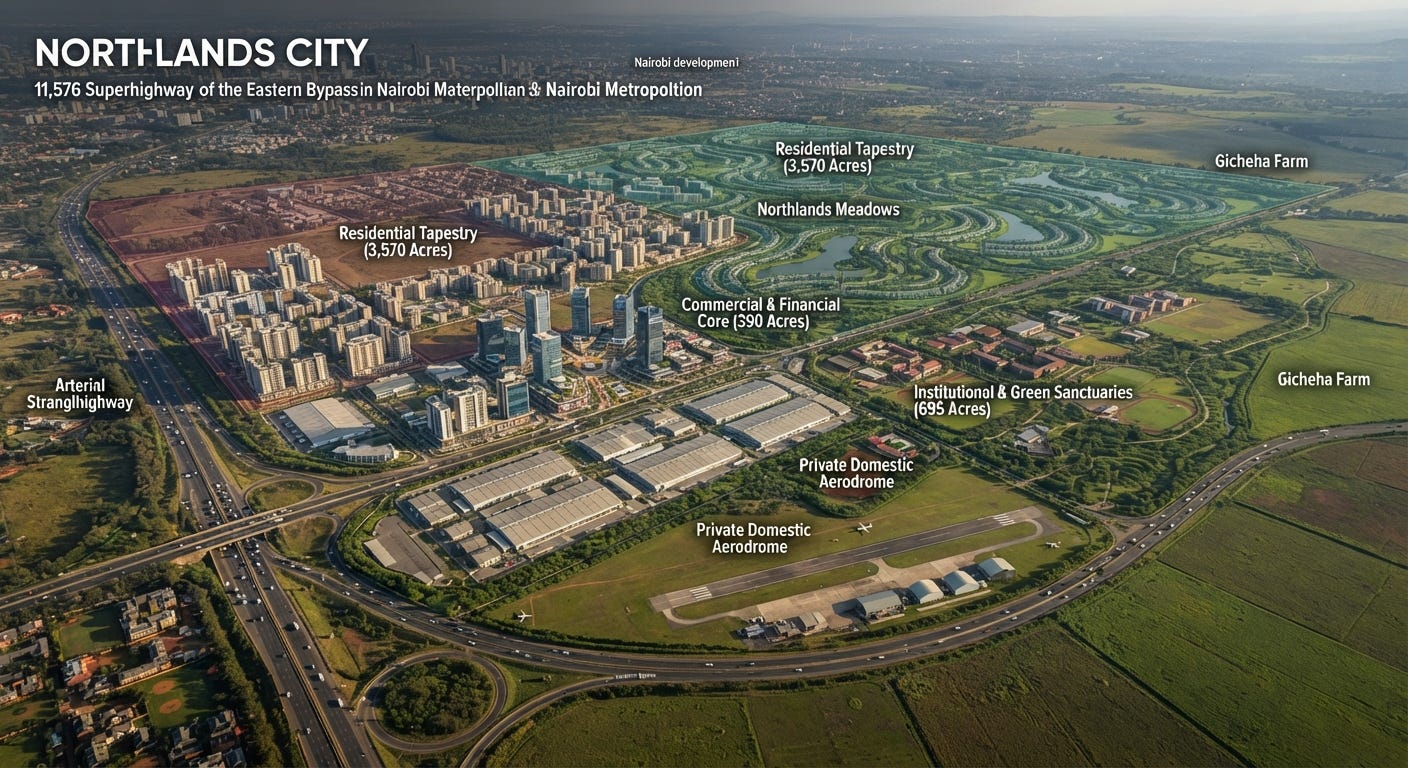
The Scale in Numbers: The Northlands Blueprint at a Glance
To fully comprehend the sheer magnitude of what is being engineered in Ruiru, the raw numbers tell a story that words alone cannot capture:
Land Size: 11,576 contiguous acres—a sovereign-grade landmass larger than the combined footprints of Nairobi’s Central Business District, Westlands, Kilimani, and Upperhill.
Target Population: Designed to house a self-sustaining community of 250,000+ residents upon full build-out.
Timeline & Horizon: A generational 50-year master plan broken into deliberate, long-horizon developmental phases.
Capital Valuation: Estimated at a staggering KSh 500 billion, positioning it among the largest private real estate investments on the continent.
Residential Allocation (3,570 Acres): Integrates 6,980 high-density apartments alongside 3,100 low-density luxury plots and townhouses (such as Northlands Meadows).
Commercial & Retail Core (390 Acres): Dedicated business districts, corporate offices, and central retail nodes, including 33 acres reserved for high-end hospitality and commercial malls.
Industrial & Logistics Hub (695 Acres): Dedicated entirely to heavy warehousing, manufacturing, and distribution infrastructure directly linked to the Thika corridor.
Conservation & Agriculture (5,156 Acres): Nearly half the entire footprint preserved as a massive green buffer and agricultural sanctuary under Gicheha Farm.
Recreational Infrastructure: 1,697 acres of parks and open spaces, featuring 266 acres dedicated to water features and artificial lakes.
Aviation Logistics: An internal, fully functional private domestic aerodrome bypassing public highway gridlock for executive and freight mobility.
To truly grasp the audacity of Northlands, one must look past the abstract concept of acreage and examine the meticulous blueprint carved across its 11,576 contiguous acres. In a crowded metropolitan landscape where ordinary developers fight for quarter-acre plots, holding a landmass of this scale allows for a level of master-planning that is entirely unprecedented in East Africa.
Rather than a haphazard collection of gated estates, the 50-year master plan is an exercise in total spatial engineering. The land is surgically divided into specialized economic and residential ecosystems designed to function as an independent, self-sustaining smart city:
The Residential Tapestry (3,570 Acres): The blueprint is heavily weighted toward diverse human settlement. It carves out over 3,100 acres exclusively for low-density, aspirational luxury neighborhoods (such as Northlands Meadows), balanced by high-density zones designated for vertical apartments, thousands of housing units, and townhouses to accommodate a multi-tiered workforce.
The Commercial & Financial Core (390 Acres): A massive 355-acre central business district is mapped out alongside dedicated commercial, hotel, and retail nodes. This is designed to pull corporate headquarters and financial services away from the suffocating congestion of Nairobi’s traditional CBD.
The Industrial & Logistics Engine (695 Acres): Anchored by a massive 630-acre logistics park and specialized industrial zones (including spaces integrated with Brookside operations), this zone positions Northlands as the premier supply-chain distribution hub of the region.
The Institutional & Green Sanctuaries: Moving beyond commerce, the plan integrates foundational pillars like the Amref International University campus and student housing blocks, all buffered by thousands of acres of agricultural and conservation land (anchored by Gicheha Farm) that ensure the city breathes.
Coupled with its strategic arterial stranglehold along the Thika Superhighway and the Eastern Bypass—and augmented by an internal private airstrip—this master plan isn’t just a layout for buildings. It is a sovereign-grade blueprint engineered to dictate the terms of Nairobi’s eastward expansion for the next half-century.
IV. The Art of OPM: Deploying Third-Party Capital on Family Land
True financial power is rarely about spending your own cash; it is about structuring an asset so that the world beats a path to your door—bringing their own capital to build it.
When evaluating the early physical layers rising across Northlands, a subtle masterclass in real estate strategy becomes apparent. The family portfolio is not financing every brick and mortar out of pocket. Instead, they are acting as the master sovereign landlord, deploying a classic land-lease model where third-party institutional capital builds out the infrastructure.
The Ground-Lease Engine: Rather than taking on heavy debt construction risks, the master plan relies on third-party developers and corporate partners who lease chunks of land and sink their own capital into vertical construction.
Institutional Anchors in Place: This strategy is already yielding physical results. High-density student housing networks like Qwetu student accommodations and the fully operational Amref International University campus are prime examples. These entities brought their own institutional capital to build, operate, and populate the ecosystem, while the underlying land value remains securely locked within the family’s holding framework.
The Developer Synergy: By inviting trusted external developers to fund residential projects—such as the structured blocks at Northlands Heights Apartments—the ecosystem expands organically without straining internal liquidity.
It is a brilliant decoupling of risk: external partners provide the construction CAPEX and operational financing, while the land asset appreciates passively in the background. The ultimate wealth strategy isn’t just owning the earth—it’s getting others to pay for paving it.
IV. The Architecture of Evasion: How Patient Capital Defies the Short-Term Cycle
To understand why Northlands induces a quiet awe among financial observers, one must look at how standard corporate developments operate. Conventional mega-projects are fragile engines; they are chained to debt service schedules, equity partner demands, and the immediate imperative to realize revenue. When interest rates spike or political winds shift, over-leveraged developments stall, forcing fire sales of land or painful equity restructurings.
Northlands operates under an entirely different set of physical laws.
Because the land was consolidated across generations and sits unencumbered by hostile debt covenants, its architects possess the ultimate luxury in modern economics: the weaponization of time.
The Power of Inaction: While ordinary developers bleed cash maintaining empty plots under high-interest loans, Northlands can afford to let thousands of acres sit dormant. It can remain a landscape of open fields, agricultural tracts (anchored by Gicheha Farm), and quiet greenery for ten, twenty, or thirty years without a single shilling of distress.
Bypassing the Market Cycle: Standard real estate is slave to the economic season. Northlands transcends it. By holding a contiguous block of over 11,500 acres directly in the path of Nairobi’s inevitable eastward expansion, the project doesn’t need to chase buyers. It simply waits for the city to grow old, congested, and expensive—until the market has no choice but to come to its doorstep.
This is not speculation; it is structural dominance. It treats land not as an inventory item to be flipped for next quarter’s profit, but as a permanent sovereign reserve.
V. The Logistics Stranglehold: Commanding the Arteries of East Africa
A city does not become a metropolis by accident; it becomes one because commerce has no other place to flow.
When looking at the macro layout of Northlands, the true brilliance of the master plan lies not just in its massive internal acreage, but in its absolute command of transport geography. Situated at the convergence of the Eastern Bypass and the Thika Superhighway, the project intercepts every major freight and commuter artery moving goods and labor into and out of the Nairobi Metropolitan area.
The Supply Chain Intercept: With hundreds of acres deliberately zoned for heavy warehousing and distribution terminals, future manufacturers will find themselves physically incapable of bypassing the node if they wish to supply East Africa efficiently.
The Private Aerodrome Advantage: The inclusion of an internal, fully functional private airstrip introduces a tier of executive mobility entirely unmatched by public urban developments. It bypasses Nairobi’s notorious highway gridlock entirely, catering directly to regional investors, corporate executives, and high-net-worth logistics operators.
This is infrastructure designed as a tollgate on the future of Kenyan commerce. Long after current market cycles have rotated and political administrations have come and gone, the physical flow of trade through the Nairobi corridor will be forced to negotiate with the spatial reality carved out here.
VII. Conclusion: The Blueprint That Outlives the Cycle
When history evaluates the urban transformation of East Africa in the 21st century, it will measure success not by the frantic pace of short-term construction, but by who controlled the map when the future arrived.
Northlands City represents the ultimate evolution of private capital in Kenya. By rejecting the fragility of high-interest debt and the limitations of ordinary real estate thinking, its architects have built something rare: a sovereign-grade ecosystem where time, space, and third-party capital work in permanent alignment.
It does not compete with Nairobi; it absorbs it. And long after the political cycles of today have faded into memory, the concrete, the commerce, and the cash flow of tomorrow will flow exactly where the blueprint decreed.
NORTHLANDS CITY: Inside Kenyatta’s Multibillion Real Estate Project
Boardlot Africa is a premier financial intelligence and corporate governance publication dedicated to unpacking the mechanics of capital, market strategies, and structural shifts across East Africa’s corporate landscape. By bridging the gap between raw economic data and actionable market intelligence, we deliver deep-dive research, independent corporate analysis, and policy insights designed for institutional investors, boardrooms, and sharp market observers.
Get in Touch
Email: sultan@boardlot.africa
Phone: +254 753 133 901/254181683210
Substack: Subscribe to Boardlot Africa
X (Twitter): BoardLotSultan
Linkedn:): BoardLot Sultan