
Welcome to Boardlot Africa, where we pull back the curtain to reveal the untold stories, power dynamics, and strategic maneuvers shaping the boardrooms of Corporate Africa—subscribe for free to join the conversation. Join 1000 other subscribers.
We publish:
Sultans weekly NSE Stock Picks, every Friday at 5pm
Kenya’s Most Consequential Legal, Governance & Labor Disputes
A Series on the 100 Most Influential Kenyan Captains of Industry
The Queens of East Africa Boardrooms
The Silicon Savana Chronicles, every Wednesday at 5.00pm
Sultan’s Farming Diary, every Monday at 5.00pm
The Monetization Matrix: Inside the Corporate Scalpel of Isis Nyong’o
I. Introduction: The Lineage of Institutional Precision
In the taxonomy of East African elites, the Nyong’o name is synonymous with two distinct, high-voltage registers: the intellectual and executive rigor of Governor Peter Anyang’ Nyong’o, a titan of Kenya’s political statecraft and academic philosophy, and the global, stratospheric cultural reach of his daughter, Lupita Nyong’o, whose Academy Award-winning trajectory redefined the optics of African excellence on the world stage. One commands the public square and the mechanisms of policy; the other commands the aesthetic and emotional currency of cinema.
Yet, to map Isis Nyong’o solely through the lens of this public-facing political and Hollywood dynasty misses the distinct, rigorous branch of the family tree from which she directly descends. Isis is the daughter of the late Dr. Aggrey J.O. Nyong’o—a pioneering pathologist and medical academic who brought clinical, analytical precision to Kenya’s healthcare history—and Verna Jean Nyong’o, an educator whose roots trace back to the industrial grit of Detroit, Michigan. It is this specific convergence of deep medical science and transatlantic exposure that informs her own operational DNA.
Nestled within this high-profile pedigree as the niece of the Governor and the cousin of the Oscar-winning actress, Isis emerged as the family’s most pragmatic operator. While her uncle navigated the friction of the electorate and her cousin captivated the lens of Hollywood, Isis constructed a sovereign moat based on cold, unyielding financial architecture. She is the hyper-rational corporate executioner who rejected the theater of politics and the glare of the spotlight to master the infrastructure of capital.
Her professional persona is not that of a romantic tech evangelist chasing speculative, venture-backed euphoria; she is a precise commercial operator who specialized in stepping directly into the chaotic, unmapped wilderness of early-stage African tech ecosystems. Her specific superpower lay in building the actual monetization plumbing—the complex, load-bearing transactional rails, mobile ad supply chains, and digital distribution frameworks—long before the mass market even understood the underlying product. Where others saw abstract digital possibilities, Nyong’o engineered the pipelines required to extract cash flow, permanently shifting the Silicon Savannah from a playground for humanitarian pilots into a high-yield beachhead for global institutional capital. She didn’t seek the applause of the crowd; she sought the mastery of the balance sheet.

II. The Elite Runway: Academic Pedigree and Cross-Border Calibration
Great commercial operators are rarely born in a vacuum; they are forensically assembled through deliberate intellectual engineering. For Isis Nyong’o, the construction of a lethal strategic toolkit began not in the corporate corridors of Nairobi, but on the pristine, high-octane campus of Stanford University. Pursuing a Bachelor of Arts in Human Biology, she chose a discipline that sat at the complex intersection of behavioral science, systemic data, and organizational evolution. This wasn’t a standard, generic pre-business track. By deeply analyzing how human systems behave, adapt, and scale under environmental pressure, Nyong’o was quietly decoding the core foundation of all future digital markets: user behavior and consumer psychology.
This analytical foundation was subsequently subjected to the ultimate global institutional refinement: earning an MBA from Harvard Business School. At Harvard, the raw behavioral data was cross-calibrated with rigorous financial modeling, corporate strategy, and the demanding case-study method that forces an executive to spot structural cracks in a business model within seconds.
However, her time in California did something far more profound than merely filling her resume with elite credentials—it embedded her directly within the epicenter of the late-1990s and early-2000s Silicon Valley tech boom. Nyong’o was an active witness to the foundational maturity of the world’s most aggressive tech ecosystem as it recovered from the dot-com crash and re-architected itself around real, scalable value.
This exposure permanently conditioned her strategic lens. While early African tech enthusiasts were looking at the internet through the romantic, hazy lens of humanitarian sentimentality—viewing computers as tools for development and NGOs as the ultimate ecosystem funders—Nyong’o looked at the digital horizon through the cold, unsentimental lens of Silicon Valley unit economics. She understood that a tech ecosystem cannot survive on donor grants or speculative idealism; it requires high-frequency user acquisition, measurable lifetime value (LTV), optimized customer acquisition costs (AC), and robust monetization rails. When she eventually turned her gaze back toward the African continent, she didn’t arrive as an aid worker looking to do good. She arrived as a cross-border calibrated corporate architect ready to build a high-yielding, self-sustaining digital empire.

III. The Corporate Vanguard: Engineering the Early Rails (MTV & Google)
The Cultural Pipeline: MTV Networks Africa
Before the global media landscape woke up to the high-yield commercial dominance of African pop culture, Isis Nyong’o was already in the trenches constructing the actual pipeline designed to export and monetize it. Stepping in as a pivotal member of the founding team for MTV Networks Africa, her mandate transcended the superficial boundaries of marketing music videos or managing local talent. She was brought in as a strategic architect to solve a highly complex, multi-market operational puzzle: how to transform the fragmented, localized creative outputs of African youth culture into a highly standardized, bankable mass asset that blue-chip global brands could comfortably underwrite.
Nyong’o engineered the cross-border media distribution networks and high-stakes corporate sponsorship frameworks that stitched together disparate broadcasting territories across the continent. She forced conservative multinational advertisers to realize that the booming African demographic was not a charity case to be patronized, but an aggressive, highly lucrative consumer base waiting to be captured. By establishing institutionalized advertising metrics and scalable syndication rails, she proved that localized content could drive predictable, high-margin corporate revenue. Long before streaming platforms and global syndication deals became standard industry practice, Nyong’o had already drafted the commercial playbook for African media monetization.

The Tech Titan Play: Google’s Commercial Weapon
By the late 2000s, global technology conglomerates realized that sub-Saharan Africa was the final unmapped frontier for user acquisition. However, possessing raw data was entirely different from extracting monetary value from it. In a decisive talent grab that defined the golden era of the Silicon Savannah, Google systematically headhunted Kenya’s top-tier intellectual elite to spearhead its continental footprint. Nyong’o was deployed into the apex of this elite corporate vanguard, stepping into the high-stakes role of Google’s Business Development Manager for Africa.
Operating alongside a formidable local cohort—which included tech strategist Joe Mucheru commanding regional enterprise operations and civic-tech icon Ory Okolloh steering public policy—Nyong’o was positioned as the sharp commercial weapon of the team. Her specific, high-pressure mandate was to answer the ultimate enterprise question: How do you monetize local search traffic in a market where digital advertising is completely alien?
Nyong’o spearheaded the infrastructure play to scale Google’s digital ad networks (AdSense and AdWords) across the region. This required an exhausting, high-friction educational campaign targeted directly at the gatekeepers of old money. She walked into the boardrooms of deeply conservative legacy banks, manufacturing blue-chips, and defensive telecom monopolies, methodically dismantling their reliance on traditional print and billboard media.
Nyong’o mathematically demonstrated the power of targeted, performance-based digital ad spend, gradually convincing these traditional marketing boards to decouple their massive corporate budgets from legacy media and deploy them into the digital cloud. By establishing the early commercial rails for digital advertising in Africa, she ensured that the underlying plumbing of the internet was not just functional, but profoundly profitable.

The iHub Era & Building the Silicon Savannah

As the digital ecosystem in Nairobi began to crystallize in the late 2000s and early 2010s, Isis Nyong’o Madison became a foundational pillar in transitioning Kenya from a regional market into the globally recognized “Silicon Savannah.” Her impact during this era was deeply intertwined with the launch and growth of iHub in 2010—Nairobi’s premier tech nexus—and her strategic leadership at Google Kenya and InMobi.
Rather than just occupying a corporate seat, Isis operated as an ecosystem builder, bridging the gap between multinational tech giants, local developers, and early-stage entrepreneurs who frequented the 4th floor of the Bishop Magua Centre on Ngong Road.
Personalities and Contemporaries
During this revolutionary window, Isis served, collaborated, and crossed paths with the definitive pioneers of East Africa’s tech landscape:
Joe Mucheru: Serving alongside him during the foundational years of Google Kenya, they were instrumental in structuring the private-sector partnerships and policy advocacy that brought reliable local internet connectivity, Google Maps, and YouTube localization to the region.
Erik Hersman, Juliana Rotich, and Ory Okolloh: The visionary co-founders of Ushahidi and iHub. Isis worked closely within the tight-knit ecosystem they built, helping mentor the influx of hackers, designers, and innovators who utilized the iHub space.
Mark Kaigwa & Moses Kemibaro: Key digital strategists and tech evangelists (with Kemibaro as m:lab co-convener) who, alongside Isis, helped shape early discourse around mobile advertising, content monetization, and digital media across the continent.
Sam Gichuru & Nikolai Barnwell: Contemporaries driving the incubator and funding pipelines (via Nailab and 88mph respectively) that turned the open-source community generated around iHub into venture-backed tech startups.

IV. The InMobi Apex: De-Capping the Mobile Monopolization Play
In February 2011, Isis Nyong’o executed what would become her most aggressive, ecosystem-altering career play: stepping into the role of Vice President and Managing Director for Africa at InMobi. At that specific moment in corporate history, the Indian-born company was rapidly scaling to become the world’s largest independent mobile advertising network, fueled by a massive, high-stakes $200 million funding war chest from SoftBank designed to break Google’s global dominance in the ad-tech space. By headhunting Nyong’o directly out of Google’s upper echelons, InMobi’s global founders—led by CEO Naveen Tewari—signaled a definitive intent to capture the unmonetized, high-velocity mobile traffic of the African continent before Big Tech could react.

The core strategic challenge Nyong’o faced was a severe infrastructure paradox. The global tech narrative was completely obsessed with the impending arrival of the smartphone revolution. However, the data on the ground across Nairobi, Lagos, and Johannesburg told a radically different story: the vast majority of the African consumer base was still locked behind the low-bandwidth, text-based rails of feature phones. In 2011, Nokia still reigned supreme, commanding over 61% of total mobile ad impressions on the continent, with Symbian completely overshadowing iOS and Android.
[Legacy Feature Phone / Nokia Traffic] -> [InMobi Data-Driven Ad Engine] -> [High-Velocity Corporate Revenue]
Rather than waiting for high-end devices to become affordable, Nyong’o launched a brilliant, unsentimental disruption: she weaponized feature-phone traffic. She unbundled the traditional mobile ad supply chain by treating basic web pages, WAP sites, SMS alerts, and primitive mobile browsers as premier, high-yield digital real estate. To secure a permanent moat over regional traffic, she engineered blockbuster exclusive partnerships with digital media giants like PERFORM Group, capturing over half a billion annual impressions from m.goal.com—the region’s absolute traffic powerhouse during the 2012 Africa Cup of Nations.
This aggressive land grab triggered a high-velocity pricing and inventory war across the continent. Nyong’o found herself locked in a fierce, multi-front commercial battle against formidable adversaries. Her primary competitor was her former employer, Google (with its newly acquired AdMob engine), alongside regional players like South Africa’s BuzzCity and Twinpine in West Africa, all fighting desperately to lock down premium publisher networks.
Nyong’o weaponized InMobi’s data engine to forensically categorize feature-phone user behavior, presenting it to global fast-moving consumer goods (FMCG) conglomerates as a clean, predictable, and highly targeted pipeline straight into the pockets of the mass market. The velocity of her execution was staggering: under her direct executive stewardship, InMobi’s network architecture exploded to process over 2.6 billion ad impressions per month in Kenya alone, alongside massive market captures in Nigeria, Egypt, and South Africa.
By the time she transitioned from the role, Nyong’o had effectively proven that the path to continental scale did not depend on foreign high-tech infrastructure templates. By engineering the mobile-first advertising plumbing that funds today’s regional app economy, she de-capped the true commercial potential of the African mobile screen—proving once and for all that on the frontier, the ultimate asset is not the sophistication of the hardware, but the absolute mastery of the monetization matrix.
V. The Sovereign Layer: Asphalt, Investments, and Institutional Governance
The Venture Build: MumsVillage and E-Commerce Realism

By the mid-2010s, having engineered the commercial pipelines for global tech and media titans, Isis Nyong’o executed a deliberate pivot toward domestic venture creation. In 2015, she co-founded MumsVillage, an online community and e-commerce platform dedicated to urban mothers and children. This wasn’t a sentimental lifestyle project; it was a cold tactical experiment in homegrown e-commerce execution, localized digital supply chains, and community-driven data aggregation.
Through MumsVillage, Nyong’o pressure-tested the raw realities of the African consumer market from the founder’s seat. She navigated the high-friction realities of last-mile logistics, payment fragmentation, and the steep consumer-education costs that define the frontier. More importantly, she proved a critical data thesis: that in an emerging market, highly engaged, niche digital communities hold massive value because they generate the deep consumer insights that legacy corporate brands are desperate to buy.
Boardroom Hegemony: Dictating the Rules of Capital
Having mastered the ground-level chaos of startups and the matrixed operations of multinationals, Nyong’o transitioned into her ultimate professional theater: heavy institutional governance and capital placement. As a Principal at the strategic advisory firm Asphalt & Ink and a Senior Advisor at Albright Stonebridge Group, she moved out of the operational trenches and into the macro-corridors where cross-border trade, regulatory frameworks, and sovereign investments are negotiated.
This strategic authority translated into powerful boardroom appointments across East Africa’s most consequential financial and corporate institutions:
The Capital Markets Moat: Stepping onto the board of the Nairobi Securities Exchange (NSE), Nyong’o assumed immense governance authority over the region’s premier gateway for public capital. Serving as the Chairperson of the Audit, Risk & Compliance Committee and the Self-Regulatory Organization and Listing Committee, she has operated directly alongside NSE Board Chairman Kiprono Kittony and newly appointed Chief Executive Officer Frank Mwiti, guarding the regulatory integrity and market architecture of the country’s listed equities.
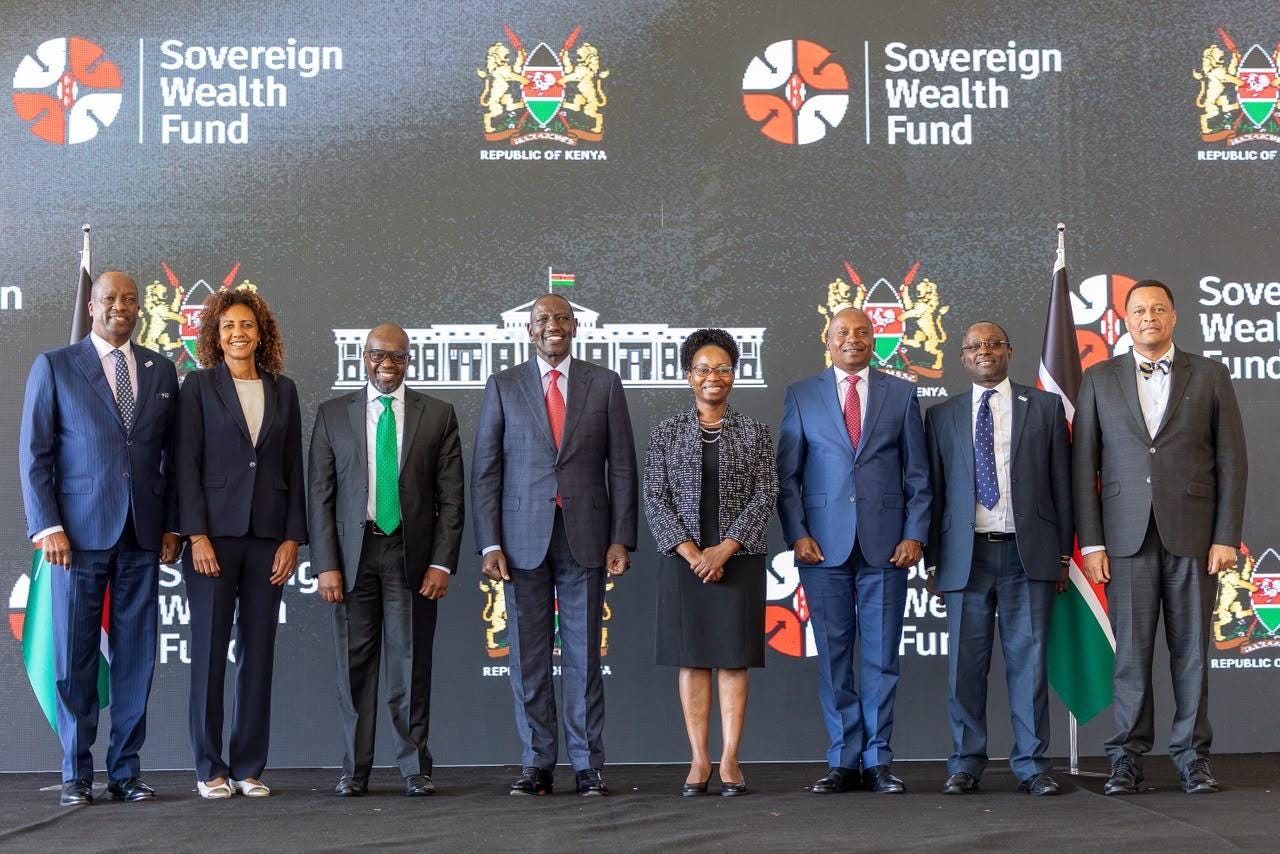
The Financial & Fintech Rails: Her governance footprint extended deep into the digital banking rails as a Non-Executive Director at Finserve Africa—the aggressive fintech and digital innovation arm of Equity Group Holdings. In this domain, her oversight aligned with the macroeconomic ambitions of Equity Group CEO Dr. James Mwangi, steering the transactional infrastructure that drives millions of mobile wallets across the region.
Pan-African Investment Banking: Nyong’o scaled her financial influence across borders by taking a seat on the board of Southbridge Group, the elite pan-African financial services and investment firm founded by former African Development Bank President Dr. Donald Kaberuka and former Prime Minister of Benin Lionel Zinsou. Standing alongside these heavyweights of continental finance, she helped direct high-level corporate advisory and restructuring frameworks for sovereign states and corporate conglomerates.

The Blueprint of Frontier Leadership: The Strategic Philosophy of Isis Nyong’o
When the World Economic Forum nominated Isis Nyong’o as a Young Global Leader (YGL) in 2012, it was a formal institutional recognition of a reality she had already spent a decade engineering. True insight into her executive DNA, however, is best captured by her 2015 diagnostic checklist for navigating the African corporate matrix. As a co-founder and Principal of the elite strategic advisory firm Asphalt & Ink, Nyong’o unbundled the exact intellectual raw materials required to transform the continent’s systemic friction into market-bearing commercial victories.
For Nyong’o, navigating the frontier requires a total rejection of passive compliance and the easy comfort of the status quo. Her leadership framework demands three non-negotiable structural qualities:
Cross-Border Integration: The immediate, matrixed capacity to relate to and seamlessly inspire diverse ecosystems across continental and global borders.
Total Professional Alignment: A singular, long-term operational commitment to the continent’s structural and economic advancement.
Intellectual Defiance: A sharp, permanent, and healthy skepticism for the status quo—the precise trait that allowed her to look at broken distribution networks and see clean, investable pipelines.
Even as her advisory architecture at Asphalt & Ink scaled—notably running a highly effective, elite team of female professionals—Nyong’o kept her strategic pulse calibrated to global distribution channels. When analyzing the shifting paradigms of African soft power and media export, she forensically tracked the macro-breakthroughs of her cousin Lupita Nyong’o and comedian Trevor Noah as definitive benchmarks of global scale. Her career remains an uncompromising lesson to the legacy elite: real influence is not inherited through a prominent name; it is ground out through disciplined cross-border calibration and an unyielding execution of the corporate matrix.

The Hard-Asset Realism
Isis Nyong’o’s career trajectory stands as a flawless validation of the core Boardlot thesis: that long-term commercial power on the African continent is not won through the speculative euphoria of startup hacking, but through the rigorous enforcement of corporate governance and institutional asset management.
She systematically converted her early-career tech credibility into permanent, load-bearing boardroom leverage. Her evolution demonstrates to a new generation of African operators that true ecosystem maturity requires moving past the vanity metrics of venture-backed software pilots. The ultimate game is played at the highest echelons of corporate oversight, where independent directors cross-examine corporate risk, enforce structural transparency, and dictate the flow of institutional capital that keeps the wider grid alive.
VI. Conclusion: The Living Blueprint of the Commercial Architect
In the final assessment, the legacy of Isis Nyong’o Madison stands as a sharp, corrective counter-narrative to the romanticized myths of the Silicon Savannah. While the conventional tech ecosystem often celebrates the starry-eyed pioneer, the charismatic front-facing founder, or the abstract elegance of software engineering, Nyong’o constructed her entire career on a vastly more permanent foundation. She is not a romantic tech pioneer; she is a precise commercial architect.
Her life’s work across MTV, Google, InMobi, and the sovereign boardrooms of the Nairobi Securities Exchange has been a masterclass in institutional anatomy. She systematically rejected the easy gravity of political and creative royalty to build an independent monument to economic leverage. Where others chased headlines, she quietly mapped out the underlying grid, establishing the very parameters by which digital and financial value is extracted from the African landscape.
The enduring lesson Nyong’o leaves for the next generation of African builders, investors, and operators is an uncompromising, hard-nosed decree: ideas and code are entirely vanity metrics. A beautiful user interface, a venture-backed startup pilot, or a revolutionary line of code is completely meaningless in a frontier market if it is disconnected from the mechanisms of transaction.
True power on the continent does not belong to those who merely create the content or write the apps. True, unassailable power belongs exclusively to the sovereign operators who control the distribution pipelines, enforce institutional corporate governance, and master the monetization matrix. Nyong’o’s trajectory remains the definitive blueprint for anyone who wishes to command the levers of capital and outlast the shifting tides of the Savannah.
About Boardlot Africa Research
Boardlot Africa is a premier financial intelligence and corporate governance publication dedicated to unpacking the mechanics of capital, market strategies, and structural shifts across East Africa’s corporate landscape. By bridging the gap between raw economic data and actionable market intelligence, we deliver deep-dive research, independent corporate analysis, and policy insights designed for institutional investors, boardrooms, and sharp market observers.
Get in Touch
Email: boardlot.research@gmail.com
Phone: +254 753 133 901
Substack: Subscribe to Boardlot Africa
X (Twitter): BoardLotSulta
A quick search shows that Isis and Lupita are not sisters.