

Boma Yangu: High-Yield Potential or Growing Warning Signs?
A Cautious Look at Kenya’s Affordable Housing Scheme Amid Mass Savings Withdrawals
Kenya’s housing deficit remains acute, and the government’s Boma Yangu platform is a major part of the response. The Tenant Purchase Scheme (TPS) offers a pathway to ownership with relatively low entry barriers. For investors, some analysts have highlighted modeled gross rental yields of 14–15% on certain units — well above typical Nairobi residential averages.
However, a significant development today (July 19, 2026) demands caution. Kenyans have withdrawn half of the Sh5.4 billion saved in the Boma Yangu scheme. This large-scale outflow raises serious questions about participant confidence, fund liquidity, and the program’s ability to deliver on its promises. Here is a balanced, data-driven assessment.
The Modeled Investment Case
Under the TPS, savers can contribute flexibly toward a deposit (often around 5% of unit value) and then make monthly payments over up to 25 years to gain ownership. Units are generally priced in the KES 1M–3M range.
For those who successfully secure allocation and rent out the property at market rates, the numbers can appear attractive on paper:
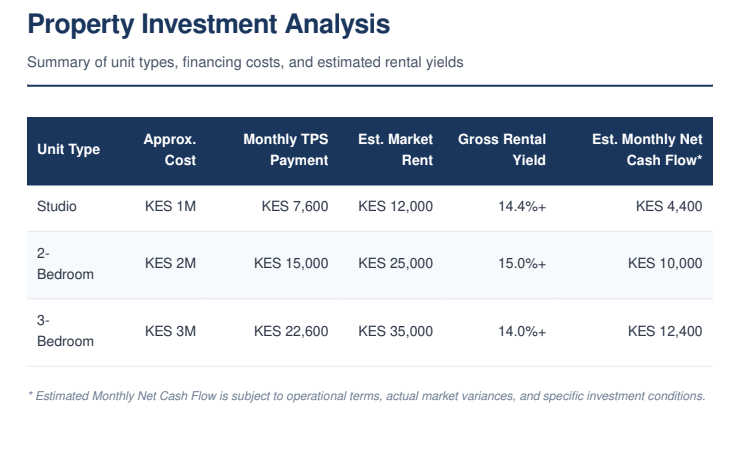
*Net cash flow = estimated rent minus TPS installment. These figures rely on specific assumptions about location, occupancy, and market rents that may not hold in practice.
The structure could theoretically provide positive cash flow while building equity, with the benefit of long-term fixed payments in an inflationary environment. Projects often target job-rich areas and include basic amenities such as security walls, paved driveways, and green spaces.
Why Caution Is Warranted: Expanded Risks
Recent events have heightened several material risks. The program’s challenges appear more pronounced than many initially anticipated.
1. Fund Liquidity & Saver Confidence Risk (Major Red Flag)
This is currently the most pressing concern.
According to today’s Daily Nation report, savers have already withdrawn half of the Sh5.4 billion accumulated in Boma Yangu. This substantial outflow — confirmed amid rising refunds in audits — points to widespread frustration, likely stemming from slow allocations, project delays, or doubts about delivery.
Implications for potential investors:
Reduced liquidity in the Housing Fund could constrain funding for ongoing and future projects.
It signals eroding trust, which may slow momentum, reduce new supply, or lead to policy adjustments.
If withdrawals continue, the program’s ability to complete units on schedule becomes even more uncertain.
This development alone warrants a significant reassessment of timelines and reliability.
2. Allocation Uncertainty
Even reaching the deposit threshold does not guarantee a unit. Criteria include timing, family status, social factors, and high demand (especially for family-sized homes). Many participants wait extended periods with no allocation.
3. Project Completion & Construction Delays
Government-led housing initiatives have historically faced funding gaps, contractor issues, and delays. With savings flowing out, the risk of stalled projects increases.
4. Quality, Maintenance & Operational Risks
Affordable units often use cost-effective finishes that may require earlier and higher maintenance. Common-area management (security, waste, infrastructure) could deteriorate post-handover, pressuring rental income and property values.
5. Political & Policy Risk
As a high-profile government program, Boma Yangu remains vulnerable to shifts in leadership, budgets, or priorities. Allocation processes are not fully insulated from political influence.
6. Location & Tenant Demand Risk
Success depends heavily on transport links and proximity to employment. Weaker locations could see lower occupancy or rents than the optimistic estimates above.
7. Liquidity & Exit Challenges
TPS-acquired units may be harder to resell quickly compared to conventional properties, especially if the broader program faces headwinds.
Verdict: Proceed With Extreme Caution
The modeled yields are eye-catching and could work in theory for specific, well-located units with strong execution. Positive cash flow and long-term leverage are theoretically appealing in Kenya’s economic context.
However, the combination of high modeled returns and the very real execution risks — now underscored by the rapid withdrawal of half the savings pool — makes this a high-risk proposition. The recent data suggests the program is facing meaningful challenges with confidence and delivery.
This is not a straightforward or low-risk investment. It may only suit a narrow group of sophisticated investors who:
Have high risk tolerance
Can perform thorough, project-specific due diligence
Are prepared for delays, potential policy changes, and capital being tied up for years
Accept that outcomes could deviate substantially from the optimistic models
For most readers, the prudent approach right now is to monitor developments closely rather than rush in. Watch how the Housing Fund responds to withdrawals, track actual project completion rates, and assess new allocations before committing capital.
Strongly recommended: Visit bomayangu.go.ke directly, review the latest project statuses, understand full TPS terms, and consult independent professionals. This is not financial advice. Real estate investments, especially those linked to government programs, carry substantial risks of loss or underperformance.
The Boma Yangu story is still unfolding. The high-yield narrative exists — but current signals suggest investors should treat it with considerable skepticism until execution improves.
Boardlot Africa is a premier financial intelligence and corporate governance publication dedicated to unpacking the mechanics of capital, market strategies, and structural shifts across East Africa’s corporate landscape. By bridging the gap between raw economic data and actionable market intelligence, we deliver deep-dive research, independent corporate analysis, and policy insights designed for institutional investors, boardrooms, and sharp market observers.
Get in Touch
Email: boardlot.research@gmail.com
Phone: +254 753 133 901
Substack: Subscribe to Boardlot Africa
X (Twitter): BoardLotSultan