
Innovation or Imitation? What Safaricom’s 15-Year IP Battlefront Teaches Corporate Giants and Innovators
For years, a silent but high-stakes war has been raging in Kenya’s technology and entertainment sectors. It is a war fought not on product shelves, but in the corridors of the High Court and the Industrial Property Tribunal. At the center of this storm sits Safaricom PLC, the region’s undisputed telecommunications and mobile money giant.
The relationship between corporate monoliths and independent innovators has reached a critical turning point. The landmark billion-shilling ruling in May 2026 has sent shockwaves through the corporate landscape, exposing a stark reality: intellectual property (IP) protection is no longer just a legal footnote—it is a high-impact financial risk.
For large corporates, this historical trend is a stern warning to respect external IP and implement strict, airtight procurement and disclosure boundaries. For independent innovators, it is a masterclass in why meticulous, legal-grade documentation of presentations, code, and concepts is the only way to survive the corporate boardroom.
1. Peter Nthei Muoki v. Safaricom PLC (M-Teen / M-Pesa Go)
The Case
The most devastating intellectual property blow in Kenyan corporate history occurred on May 8, 2026, when High Court Judge Josephine Mong’are ruled against Safaricom in Peter Nthei Muoki & Beluga Limited v. Safaricom PLC. The dispute began in 2021 when software developer Peter Nthei Muoki and his funding partner, Beluga Limited, pitched a parent-controlled youth mobile wallet concept titled “M-TEEN MOBILE WALLET USSD CODE” to Safaricom’s top brass. Safaricom verbally rejected the proposal, claiming it faced insurmountable regulatory hurdles regarding minor registration with the Central Bank of Kenya. However, in November 2022, Safaricom launched “M-PESA Go” (initially “Manage Child Account”) utilizing the exact USSD menu trees, sequence of operations, and reporting mechanisms the plaintiffs had disclosed.
The Ruling & Corporate Lesson
Safaricom argued that “parental control” was a generic industry idea, and copyright does not protect abstract business concepts. The Court systematically dismantled this defense, pointing out that while the idea of a youth wallet is common, the plaintiffs’ specific, documented USSD operational logic and flow charts constituted a protected expression under copyright law. Because the plaintiffs had registered their product with the Kenya Copyright Board (KECOBO) in 2020 and kept exhaustive records of their meetings, the evidentiary trail was airtight. Safaricom was ordered to pay a stunning KES 1.4 billion in general damages, plus a lifetime royalty of 0.5% of gross M-Pesa revenue generated by the parental control feature.
For corporates, this case destroys the “unprotectable idea” shield when dealing with detailed pitches. If you access a creator’s structured systems and subsequently launch a similar product, a bare claim of “independent development” without a meticulous paper trail will be treated as copyright infringement. For innovators, registering your work with KECOBO before pitching is a non-negotiable legal fortress.

2. Faulu Kenya v. Safaricom PLC (M-Shwari)
The Case
In late 2012, shortly after Safaricom and CBA (now NCBA) launched the revolutionary mobile savings and loan service “M-Shwari,” microfinance pioneer Faulu Kenya rushed to the High Court. Faulu claimed that the product was a direct clone of an innovation they had conceptualized and pitched to Safaricom. Crucially, the parties had executed a Non-Disclosure Agreement (NDA) to facilitate joint venture negotiations. Faulu argued that Safaricom breached trade secrets and copyright by taking their proprietary concept paper and developing M-Shwari in-house with a rival banking partner.
The Ruling & Corporate Lesson
Faulu Kenya sought a temporary injunction to freeze M-Shwari operations, which would have crippled the fast-growing service. While the High Court declined to grant the injunction—citing public convenience and the severe economic impact of halting active consumer accounts—it made a critical jurisdictional ruling. The court rejected Safaricom’s attempt to refer the matter to the Industrial Property Tribunal, asserting that the High Court possessed the proper authority to adjudicate copyright infringement and breaches of trade secrets arising from contractual NDAs.
This multi-billion shilling battle highlighted a massive lesson for corporate entities: NDAs are not merely procedural formalities to placate startups. Breaching the confidential terms of a pitch can expose a company to severe litigation. For innovators, the case proved that while getting an NDA signed is crucial, they must also ensure that the NDA specifically defines “Proprietary Information” to include the unique business model structures and concept papers being presented.

3. Popote Innovations Limited v. Safaricom PLC (Popote Pay / M-Pesa Super App)
The Case
In 2018, payments solution developer Sam Wanjohi, through Popote Innovations, engaged Safaricom in partnership discussions to launch “Popote Pay,” a specialized corporate payment application. The solution was fully customized and delivered to Safaricom. After Safaricom unilaterally walked away from the joint project, they proceeded to launch their own highly successful “M-Pesa Super App” and “M-Pesa Business App” in June 2021. Claiming the tech giant cloned his product features, Wanjohi initiated arbitration proceedings based on an arbitration clause contained in their draft, unexecuted partnership agreement. In November 2024, a sole arbitrator agreed with Popote, awarding them over KES 930 million in damages.
The Ruling & Corporate Lesson
Safaricom petitioned the High Court of Kenya to set aside the massive award. In Safaricom PLC v. Popote Innovations, High Court Judge Peter Mulwa completely set aside the arbitral award, handing Safaricom a total victory. The court ruled that because Safaricom had never actually signed or executed the 2018 partnership agreement, the arbitration clause was legally inoperative. Furthermore, the court criticized the arbitrator for relying on speculative calculations of damages and concluding that the apps were similar without any objective expert technical evidence.
The corporate lesson here is about execution hygiene: a draft contract, no matter how detailed, holds no weight unless signed. However, the innovator’s downfall was relying on an unsigned document. Innovators must insist that preliminary agreements, such as NDAs or Memorandums of Understanding (MOUs), are fully executed before any system, prototype, or proprietary code is delivered for testing.

4. Jonathan Gikabu v. Safaricom PLC (M-Pesa 1Tap)
The Case
In 2014, local innovator Jonathan Murangiri Gikabu approached Safaricom with an innovative “tap-and-go” payment system. Gikabu’s system utilized Near Field Communication (NFC) cards, wristbands, and stickers designed to allow non-smartphone users to execute fast M-Pesa transactions. Gikabu claimed to have invested millions in R&D and expected a KES 100 million return. When Safaricom eventually rolled out its proprietary “M-Pesa 1Tap” service, Gikabu filed a KES 209 million lawsuit for copyright infringement and breach of confidentiality.
The Ruling & Corporate Lesson
High Court Judge Grace Nzioka dismissed Gikabu’s case, ruling in Safaricom’s favor. The court noted that NFC tap-and-go technology was already heavily deployed worldwide and locally (such as in transport payment systems), meaning the abstract technology resided in the public domain. Most importantly, Gikabu failed to prove that Safaricom had copied his specific, proprietary code or technical expression. The judge observed that while pitching an idea only to see a corporate implement it independently can feel morally and professionally unfair, it does not constitute a legal copyright infringement unless actual copying of the unique expression is proven.
For innovators, this case serves as a stark warning: do not pitch generic concepts or open-standard technologies (like NFC, USSD, or QR codes) without a highly customized, legally protectable proprietary element. If your pitch is just a new way to use existing, publicly available technology, you have no legal recourse if a corporate giant implements it on their own.
5. JB Maina v. Safaricom PLC (Skiza Tunes)
The Case
In one of the most culturally significant copyright battles in Kenya, legendary Gikuyu musician JB Maina sued Safaricom in 2013 over its wildly popular “Skiza Tunes” ringback service. Maina claimed that Safaricom was distributing and selling his songs to millions of subscribers as ringback tones without his direct authorization, failing to pay him his rightful royalties. The case escalated dramatically when the High Court granted JB Maina an “Anton Piller” order—a rare and powerful legal tool that authorized the artist’s legal team to raid Safaricom’s offices and servers to secure evidence of the illegal music downloads.
The Ruling & Corporate Lesson
Facing the public relations disaster of having their servers raided and corporate executives threatened with contempt of court charges, Safaricom chose to settle the matter out of court. They agreed to pay JB Maina a KES 15.5 million settlement and restructured how Skiza royalties were paid, moving away from relying solely on middleman content service providers (CSPs).
This case forced Kenyan corporations to realize that licensing middleman networks does not automatically absolve them of copyright infringement. For innovators and content creators, the JB Maina saga proved that the Kenyan courts possess highly aggressive legal instruments, like Anton Piller orders, to force corporate giants to open their books and respect intellectual property rights.
6. Mr. Bamboo v. Safaricom PLC & Others (Skiza Tunes)
The Case
Following in the footsteps of previous music copyright battles, veteran Kenyan hip-hop artist Timsimon Kimani, popularly known as “Mr. Bamboo,” sued Safaricom, Liberty Afrika Technologies, and Pensoft Systems. Mr. Bamboo discovered that his popular songs, including “Mama Yaz” and “Compe,” were being sold as Skiza ringback tones to subscribers without his consent or compensation. Safaricom and the middleman distributors argued that they had acted in good faith, pointing to licenses issued by the Music Copyright Society of Kenya (MCSK)—the collective management organization (CMO) that claimed to represent the artist’s digital distribution rights.
The Ruling & Corporate Lesson
In a landmark 2023 judgment, the High Court ruled in favor of Mr. Bamboo, awarding him KES 4.5 million in statutory damages. The court made a monumental legal declaration: digital platforms and distributors cannot hide behind blanket licenses issued by third-party CMOs. The court established that corporate entities have an absolute, active duty to verify that the individual artist has signed an explicit contract authorizing the commercial digital exploitation of their specific work.
This case sent shockwaves through the digital publishing and telecommunications sectors. Corporates can no longer offload the legal liability of copyright clearance to intermediaries. For creators, the ruling highlighted the absolute necessity of retaining ownership of their digital rights and meticulously documenting any assignments they make to collection agencies or labels.
7. Dr. Peter Akuon v. Safaricom PLC (Fuliza)
The Case
Following the launch of Safaricom’s highly profitable “Fuliza” overdraft facility, university researcher Dr. Peter Odero Akuon filed an infringement claim. Dr. Akuon owned Patent No. KE 842, registered in February 2020 (with a priority date of April 2017), titled “Mobile Virtual Bank Account Management”. He claimed that Fuliza’s core operational mechanics—allowing M-Pesa users to complete transactions with an automatic, immediate overdraft—infringed upon his registered patent architecture. Safaricom and its banking partners, KCB and NCBA, counterclaimed, demanding the revocation of Dr. Akuon’s patent.
The Ruling & Corporate Lesson
The Industrial Property Tribunal (IPT) dismissed Dr. Akuon’s claim and completely revoked his patent. The Tribunal made several vital technical findings:
No Technical Overlap: Dr. Akuon’s patent described a “virtual bank account” model, whereas Fuliza operates as a ledger transactional overdraft on top of the pre-existing M-Pesa mobile wallet.
Business Methods are Unpatentable: Under Section 21 of Kenya’s Industrial Property Act, methods of doing business or financial schemes are strictly excluded from patent protection. The patent was deemed to be an unprotectable business scheme rather than a technical, scientific invention.
Lack of Novelty: Similar services (such as M-Shwari) existed prior to the patent’s filing date.
This ruling serves as an invaluable lesson in intellectual property categorization. Innovators must understand the difference between patents and copyrights. You cannot patent a financial business method or a marketing scheme. To protect financial software, creators must rely on copyrighting their unique code, system integrations, and flow diagrams rather than attempting to patent the abstract business concept of the financial service.
8. Davidson Ivusa v. Safaricom PLC (Reverse Call Feature)
The Case
In April 2021, innovator Davidson Ivusa filed a lawsuit against Safaricom, claiming that the company’s “Safaricom Reverse Call Feature” (launched in June 2019) was stolen from his unsolicited 2010 business proposal titled “Jichomoe”. “Jichomoe” was designed to enable callers to initiate calls that would be billed to the receiving party. Ivusa argued that Safaricom’s use of his concept breached a constructive trust and constituted the tort of passing off. Safaricom defended itself by showing that the concept of reverse calling was long-standing global technology, and that their specific feature had been developed independently using dial-in prefix codes.
The Ruling & Corporate Lesson
In February 2025, High Court Judge F. Mugambi dismissed Ivusa’s suit on all counts. The Court emphasized the fundamental “idea-expression dichotomy” of copyright law: copyright protects the specific physical or digital expression of an idea, not the abstract idea itself. Ivusa had merely pitched the broad concept of a reverse call via an unsolicited email without providing any proprietary source code, system wireframes, or working prototypes. Furthermore, because the proposal was unsolicited, the court ruled that no constructive trust or fiduciary duty existed between the parties.
This case is a cautionary tale for innovators sending unsolicited “cold emails” to corporates. If you send an unrequested business deck detailing a broad concept, you are effectively throwing your idea into the public domain. Corporates are legally free to build their own versions of that idea unless you can prove they copied your highly specific, proprietary implementation.
9. Kibo Capital v. Safaricom PLC (M-Pesa Bill Manager)
The Case
In September 2017, fintech firm Kibo Capital Group pitched an innovative digital billing and electronic receipting system to Safaricom’s M-Pesa product managers. While partnership talks progressed, Kibo Capital proactively registered their technology as a utility model with the Kenya Industrial Property Institute (KIPI) in November 2017. Despite the pitch meetings, no partnership was ever signed. Later, Safaricom launched “M-Pesa Bill Manager for Businesses,” which featured operational mechanics nearly identical to Kibo’s pitched system.
The Ruling & Corporate Lesson
Leveraging their officially registered utility model, Kibo Capital bypassed the standard civil courts and filed a swift infringement case before the Industrial Property Tribunal (IPT). Recognizing the strength of Kibo’s registered IP, the IPT issued a major interlocutory injunction, legally blocking Safaricom from marketing, distributing, or offering the “M-Pesa Bill Manager” product to the Kenyan public until the dispute was resolved.
This case illustrates the sheer legal power of a Utility Model—often called a “petty patent.” Because utility models are faster, cheaper, and easier to obtain than full patents, they are the ultimate legal weapon for software and fintech innovators. By registering their system architecture with KIPI before the corporate could launch their copy, Kibo Capital secured the leverage necessary to bring Safaricom’s product rollout to a grinding halt.
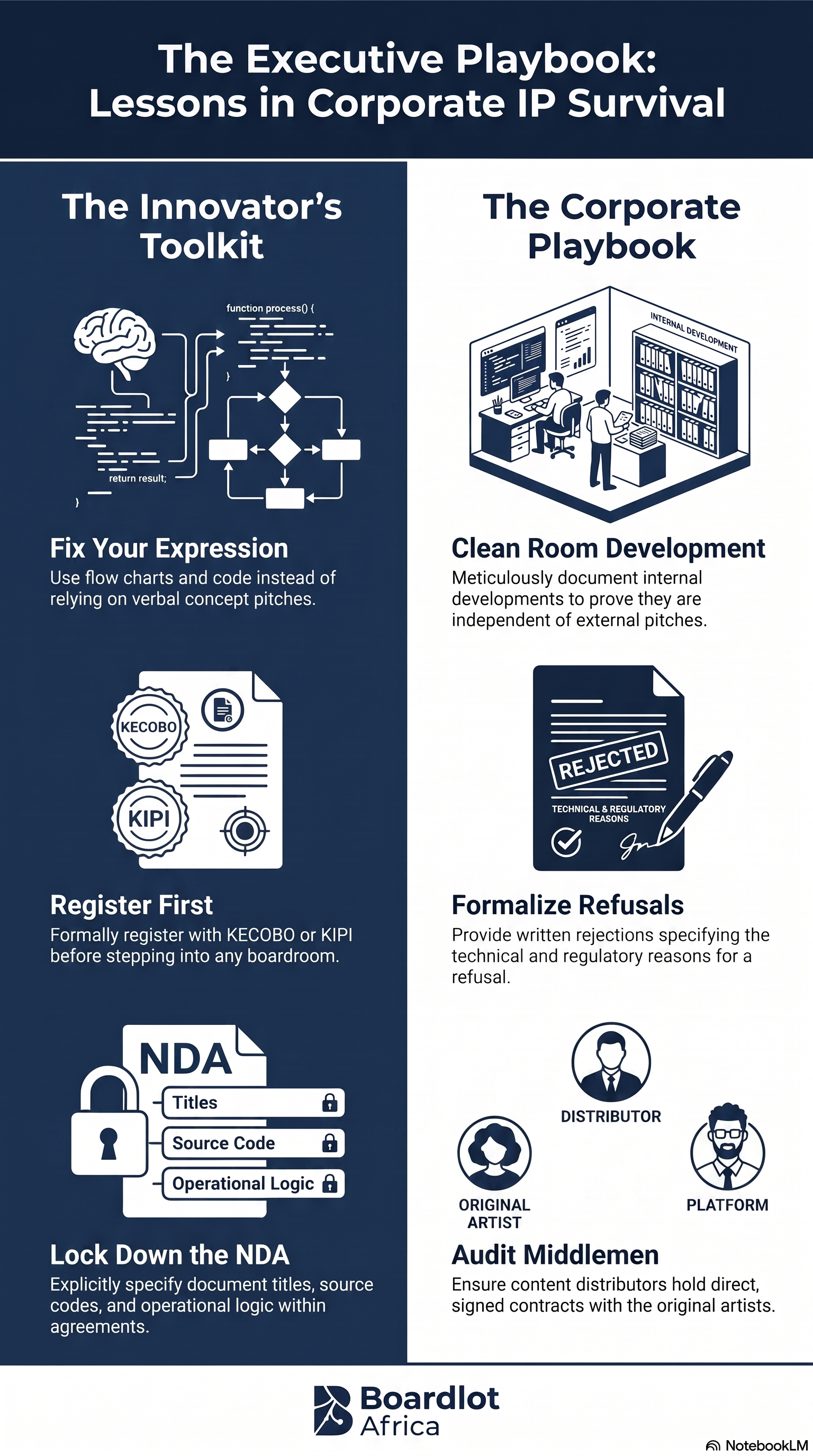
The Executive Playbook: Lessons in Corporate IP Survival
About Boardlot Africa Research
Boardlot Africa is a premier financial intelligence and corporate governance publication dedicated to unpacking the mechanics of capital, market strategies, and structural shifts across East Africa’s corporate landscape. By bridging the gap between raw economic data and actionable market intelligence, we deliver deep-dive research, independent corporate analysis, and policy insights designed for institutional investors, boardrooms, and sharp market observers.
Get in Touch
Email: boardlot.research@gmail.com
Phone: +254 753 133 901
Substack: Subscribe to Boardlot Africa
X (Twitter): BoardLotSultan