
How Centum traded a KES 1.7 Billion annual dividend yield for an eight-year dead-capital real estate play, and why paper fixes will no longer satisfy the market.
By @boardlotsultan
For nearly a decade, the Nairobi Securities Exchange (NSE) has borne witness to one of the most polarizing corporate case studies in East African financial history. Centum Investment Company PLC, once widely heralded as the “Berkshire Hathaway of East Africa,” has seen its stock price languish at a steep, punishing discount relative to its reported Net Asset Value (NAV).
To understand why the market has treated this corporate heavyweight so harshly, one must look past the polished annual reports and dive straight into the brutal mechanics of capital allocation. Between 2015 and 2019, under the leadership of Group CEO James Mworia, Centum dismantled an unrivaled private equity machine, liquidating premier, high-yielding consumer and financial assets. The strategy was clear: monetize mature assets to unlock capital. However, the subsequent rotation of those liquid billions into long-gestation, low-yield real estate projects stands as a defining turning point for the firm.
Now, the launch of the KES 4.8 billion ($37.3 million) TRIFIC Income REIT (I-REIT) represents an institutional attempt to engineer an escape hatch. But is this sophisticated financial instrument a genuine correction of historical capital allocation mismatches, or is it simply a face-saving liquidity play? More importantly, will long-suffering retail and institutional shareholders finally buy into the vision?
The Great Cash-Out: Liquidating the Yield Engines (2015–2019)
Before the property pivot, Centum’s balance sheet was anchored by an unquoted portfolio of corporate cash cows. These businesses shared distinct macroeconomic characteristics: they operated with immense pricing power, required minimal capital expenditure ($CapEx$) to sustain operations, and captured the daily transactional velocity of the East African consumer class. These assets did not just look good on paper; they funneled tangible cash directly to the parent company’s bottom line.
The systematic liquidation timeline unfolded with remarkable precision, unlocking an aggregate of KES 28 billion in gross exit proceeds:
UAP Holdings Limited [January 2015]: Centum kickstarted the mass divestment by selling its 23.7% stake in the regional insurance giant to UK’s Old Mutual Group for KES 5.2 billion, locking in a spectacular gross Internal Rate of Return (IRR) of 39.9%.
Aon Minet Insurance Brokers [2015]: The quiet, capital-light brokerage engine was fully unloaded, with Centum selling its 22% minority block for KES 1 billion to prepare the path for Capitalworks’ network buyout.
GenAfrica Asset Managers [March 2018]: Centum sold its 73.35% controlling stake in GenAfrica (one of East Africa’s largest pension fund managers with over KES 157 billion in Assets under Management) to New York-based private equity fund Kuramo Capital Management. The sale pocketed Centum KES 2.3 billion on a historical investment of KES 1.1 billion, representing a gross IRR of 24.4%.
Almasi Beverages & Nairobi Bottlers [2019]: The ultimate consumer-staple portfolio exit. Centum bundled its controlling 53.9% stake in Almasi and its 27.6% stake in Nairobi Bottlers, unloading them to Coca-Cola Beverages Africa (CCBA) for a massive KES 19.5 billion in gross proceeds.
Sidian Bank Divestment [March 2026]: Centum finalized the complete disposal of its long-struggling equity stake in Sidian Bank, cleanly recovering KES 5.2 billion in liquid capital. This exit marks the definitive closure of a challenging banking chapter and immediately arms the parent company with a massive cash windfall that the market expects to see distributed, rather than trapped in further long-gestation real estate pipelines.

The Rotation Mismatch: Swapping Flow for Concrete
The fatal flaw in Centum’s strategy was not the liquidation of these premier assets, but the permanent destruction of the company’s structural yield. Combined, this basket of consumer-facing powerhouses generated a predictable, highly liquid stream of over KES 1.7 billion in annual dividend cash flows directly to the parent entity. This was defensive, inflation-hedged liquidity that could be redistributed to shareholders as dividends or used as a nimble war chest for quick-turnaround private equity plays.
Instead of preserving this yield, the cash was rotated away from high-velocity consumer sectors and poured into funding the immense, non-earning concrete footprint of the 106-acre Two Rivers urban master plan and the expansive land banks of Vipingo Development.
Large-scale commercial real estate developments suffer from notoriously long gestation periods. For eight long years, the capital deployed into Two Rivers effectively became “dead capital.” Rather than producing immediate operational returns, it swallowed further parent liquidity to cover heavy infrastructure costs, master-planning fees, and high debt service obligations on the underlying property vehicles. While Centum’s financial statements continuously reported multi-billion shilling revaluation gains—boosting the book value of the land—the actual cash flow running up to the parent company dried up.
The public market on the NSE penalized this asset-liability mismatch severely. Retail and institutional investors, recognizing that paper asset revaluations cannot pay cash dividends, exited the stock. Centum’s share price entered a multi-year decline, eventually trading at a steep discount of over 60-70% against its published Net Asset Value per share.
Centum’s Energy Sector Adventure: A Corporate Infrastructure Disaster
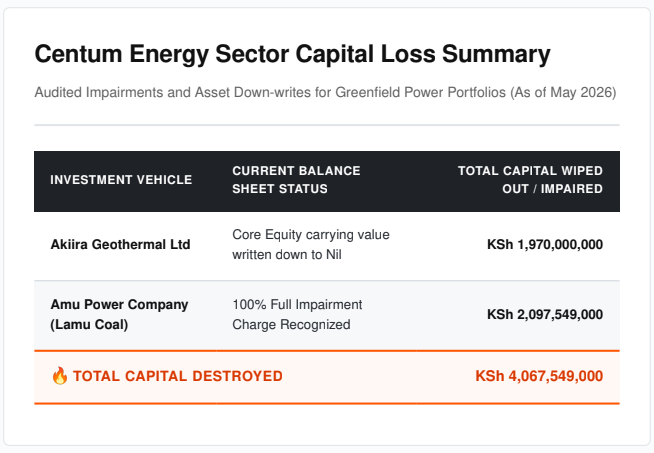
Anatomy of a KSh 4.07 Billion Capital Destruction Campaign in Greenfield Power
In the playbook of private equity and infrastructure investment, diversification into heavy utility and energy projects is traditionally viewed as a defensive, long-term yield strategy. However, when an investment firm ventures heavily into large-scale, unhedged greenfield projects, the risk profile shifts from defensive to highly speculative.
For Centum Investment Company, its aggressive foray into the Kenyan energy sector via Akiira Geothermal and Amu Power represents one of the most severe chapters of capital destruction in its modern corporate history. What was engineered to be a dual-engine power portfolio delivering close to 1,050 Megawatts (MW) to the national grid instead devolved into a multi-billion-shilling graveyard of impaired equity, stranded shareholder loans, and legal quagmires.
In total, Centum’s balance sheet has absorbed a crushing KSh 4,067,549,000 ($4.07 billion) in direct capital losses and value obliteration.
📊 Sector Impairment Dashboard
Akiira Geothermal Capital Lost: KSh 1,970,000,000 (Equity carrying value down to Nil)
Amu Power (Lamu Coal) Write-Off: KSh 2,097,549,000 (100% full impairment)
Total Energy Capital Destroyed: 🔥 KSh 4,067,549,000

1. Akiira Geothermal: The Subterranean Capital Sinkhole
Centum entered the 70 MW greenfield Akiira Geothermal project, located in the geologically active Greater Olkaria area near Naivasha, by acquiring a 37.5% equity stake.
The investment structure was routed through a complex offshore holding architecture: Centum held its stake via Investpool Holdings (a Mauritius vehicle), which in turn wholly owned Mvuke Limited, the domestic Kenyan Special Purpose Vehicle (SPV). Centum partnered alongside international co-sponsors including DI Frontier of Denmark, RAM Energy of the United States, and Marine Power Generation.
While corporate disclosure history pages inconsistently cite an initial stake of 36.5%, project definitive legal files and the exact mathematical terms of the subsequent 2024 buyout establish the true operational stake at 37.5%. Rather than a single upfront entry payment, Centum deployed capital aggressively across multiple tranches, culminating in a massive cumulative capital expenditure of approximately KSh 1.97 billion.
The physical exploration proved disastrous:
The Sunk Cost: Beginning in 2015, two major exploratory wells were steam-drilled at an astronomical cost of roughly KSh 1.2 billion per published industry reporting.
The Outcome: Neither well succeeded in intersecting commercial-grade geothermal reservoirs or reaching production-yielding capacity.
The geological failure effectively wiped out the economic viability of the initial phase. By the financial year ended March 31, 2025, Centum was forced to structurally admit defeat: the carrying equity value of Akiira was written down to nil on its books. The remaining exposure was completely reclassified into KSh 1.095 billion of stranded shareholder loans, signaling a complete destruction of core equity capital before later consolidation maneuvers took place.
2. Amu Power: The Defunct Coal Dream
If Akiira was a failure of physical geology, the Amu Power Company venture was a catastrophic miscalculation of environmental governance, geopolitics, and global capital shifting away from carbon-heavy infrastructure.
Formed as a joint venture between Centum (holding a 51% majority controlling stake) and Gulf Energy (acting as the co-sponsor and developer at 49%), Amu Power was set up as the SPV to construct a massive 981.5 MW coal-fired power plant in Lamu County. This was a flagship megaproject originally awarded by the Government of Kenya in September 2014, with Centum deploying KSh 2,100,000,000 in equity and early development capital.
The project encountered successive, fatal structural shocks that permanently derailed its execution:
Regulatory & Legal Collapse: In June 2019, Kenya’s National Environment Tribunal issued a landmark ruling revoking Amu Power’s environmental impact assessment licence, citing severe omissions in public participation and local community consultation.
Capital Flight: In November 2020, the Industrial and Commercial Bank of China (ICBC), which had committed a vital USD 1.2 billion debt financing package to fund construction, formally withdrew from the project under intense global ESG policy shifts.
Technical Partner Exit: General Electric, the designated technical anchor, subsequently announced its complete exit from the global coal-fired power generation market, leaving the project without an equipment supply or turbine pipeline.

3. The Financial Reckoning: FY2020 Full Impairment
The writing on the wall turned into a direct balance sheet hit in the financial year ended 31 March 2020 (FY2020). As audited and reported in Centum’s annual report, the board recognized a full, unhedged impairment provision of KSh 2,097,549,000 against its entire investment in Amu Power Company.
The loss was total; every single shilling committed by the investment house to the Lamu coal project was completely wiped from the asset columns.
Premature Exits in the Financial Sector: Leaving Alpha on the Table (Platinum & GenAfrica)
While Centum’s greenfield energy bets were swallowing billions of shillings in unrecoverable capital, a different kind of value destruction was quietly playing out in its financial services portfolio: the tragedy of the premature exit.
Under James Mworia’s tenure, Centum repeatedly liquidated high-performing, cash-generative financial assets just as they were entering their prime growth phases. Driven largely by an urgent corporate need to raise liquidity to support other bleeding parts of the group, Centum walked away from compounding engines that went on to achieve stellar operational and financial performance post-exit.
1. GenAfrica Asset Managers: Selling a Cash-Compounding Engine
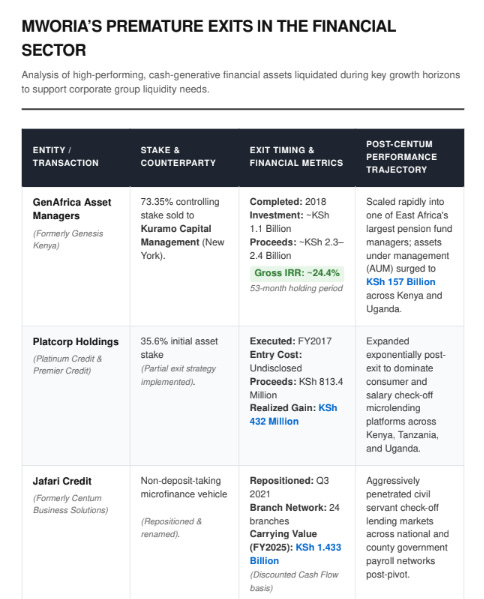
Centum’s exit from GenAfrica is perhaps the clearest example of sacrificing long-term compounding for short-term liquidity. Sold to New York-based Kuramo Capital, the transaction generated an initial gross Internal Rate of Return (IRR) of ~24.4% on a KSh 1.1 billion initial outlay.
While a 24.4% IRR looks respectable on a spreadsheet, the exit proved to be highly premature. Post-Centum, GenAfrica capitalised heavily on the regional pension fund boom, scaling its Assets Under Management (AUM) to an astronomical KSh 157 billion across Kenya and Uganda. Centum captured the early runway but forfeited the massive, highly predictable fee-income scaling that followed.

2. Platcorp Holdings: Truncating the Micro-Lending Boom
In FY2017, Centum executed a partial exit from Platcorp Holdings, the parent financial vehicle behind household microfinance brands Platinum Credit and Premier Credit.
The partial sale yielded KSh 813.4 million in proceeds, handily netting Centum a quick financial gain of KSh 432 million. However, by treating Platcorp as a short-term trading asset rather than a foundational tier-1 financial anchor, Centum checked out early from a highly lucrative credit machine that went on to dominate consumer and check-off lending across Kenya, Tanzania, and Uganda.
3. Jafari Credit: The Belated Pivot to Civil Servant Payroll Lending
Even when Centum recognized the lucrative margins of micro-lending, its execution was heavily delayed. Centum Business Solutions sat underutilized in the portfolio from at least FY2016 before it was finally renamed and repositioned as Jafari Credit around Q3 2021.
Licensed by the Central Bank of Kenya to provide check-off loans to national and county government civil servants, Jafari’s explosive post-relaunch growth highlights exactly what Centum was missing during its years of stagnation. By FY2025, Jafari had rapidly scaled to 24 branches with a discounted cash flow (DCF) carrying value of KSh 1.433 billion—proving that while Mworia was hunting elusive infrastructure returns, the real money was in local, agile financial services.
The data reveals a stark strategic irony: Centum excelled at picking and incubating high-growth financial service winners (GenAfrica, Platcorp), yet consistently cut those lines short. By cash-out timing that favored immediate liquidity over long-term ownership, Centum systematically left billions in post-exit alpha on the table for foreign private equity funds and new buyers to harvest.
The Failed Shield: De-Leveraging and the Buyback Shortfall
Management aggressively defended their capital allocation path, arguing that a significant portion of the Coca-Cola proceeds (KES 11.3 billion) was deployed to retire expensive dollar-denominated bank loans, thereby protecting the company from currency fluctuations and saving hundreds of millions in annual interest expenses. While technically accurate, this de-leveraging exercise merely served as a financial defensive shield. It kept the parent entity stable but failed to replace the lost core operational cash flow engine.
In a further attempt to restore investor confidence and signal value, Centum launched an ambitious, high-profile three-year share buyback program, intending to repurchase up to 10% of its issued shares (targeting 66.5 million shares) from the open market. However, when the program officially concluded on March 31, 2026, it had only managed to secure 10.8 million shares—a major shortfall against its target. The program was consistently hampered by strict regulatory market price caps and low investor liquidity on the NSE, leaving the share price largely un-defended.
The TRIFIC I-REIT Escape Hatch: Turning Concrete Back to Cash
This brings us to the launch of the Two Rivers International Finance and Innovation Centre (TRIFIC) Income REIT. To unlock the dead capital trapped within the commercial properties, Mworia and his team orchestrated a pivot: converting 64 acres of the development into a Special Economic Zone (SEZ) to attract tax-exempt, US dollar-earning multinational corporations, and subsequently packaging the fully occupied TRIFIC North Tower into a listed property fund.
The mechanics of the KES 4.8 billion ($37.3 million) I-REIT transaction reveal exactly how Centum intends to pull cash out of this asset class:
Asset Monetization: The I-REIT raises $37.3 million from public and institutional investors to fully acquire the physical asset of the TRIFIC North Tower from Centum. This replaces the static concrete on Centum’s balance sheet with debt-free cash liquidity.
Development Rollover: A portion of the proceeds is retained within the SEZ vehicle to fund the construction of a second, 22-storey commercial tower to satisfy an un-met demand backlog, where occupancy for Grade A office space has hovered above 90%.
Retained Dividend Funnel: Crucially, Centum retains an 80.5% parent controlling stake in the underlying TRIFIC SEZ entity. This allows the firm to hand off the heavy lifting of physical property ownership to public unit-holders while ensuring that 80.5% of the stable, tax-exempt, US dollar-denominated rental dividends flow right back into Centum’s coffers.
Will the Shareholders Like It?
Whether shareholders accept this latest strategic pivot depends entirely on whether they look at Centum through an institutional lens or a retail lens.
1. The Institutional/Analytical View: A Necessary Architecture
For fund managers and long-term analysts, the TRIFIC I-REIT is a highly rational, structurally sound framework. It represents the only viable path to correct the real estate over-concentration without executing fire-sales of prime property. By tapping into the SEZ tax-exempt framework and creating a dollar-denominated yield instrument, Mworia is attempting to recreate the low-$CapEx$, high-margin fee engine that Centum lost when it sold GenAfrica and Aon Minet. It provides an immediate injection of cash to clear remaining parent debt and establishes a predictable cash pipeline.
2. The Retail View: Fatigue and Delayed Gratification
For retail investors who bought into Centum during its growth phase, the sentiment is heavily colored by fatigue. Shareholders have watched the company liquidate world-class consumer franchises only to wait eight years for real estate to achieve monetization readiness. While a USD-denominated REIT dividend stream sounds highly attractive, retail investors are fully aware that this cash must first satisfy remaining parent-level obligations before trickling down into meaningful dividend payouts per share at the listed Centum level.
The Boardlot Verdict: Show Us the Money
The TRIFIC I-REIT is, without question, James Mworia’s structured attempt to fix the capital allocation mismatch that has weighed on Centum’s valuation for a decade. It is a sophisticated, well-engineered mechanism designed to convert illiquid, dead property capital back into a cash-generative yield engine.
However, the market’s patience with paper valuations and accounting re-engineering has completely run out. If Centum intends to restore investor confidence and repair its damaged equity valuation on the NSE, the market will demand two non-negotiable actions: hard, liquid cash dividends.
First, shareholders expect the newly structured dollar-denominated rental yields from the TRIFIC REIT to bypass development/debt rollovers and flow directly out to investors as immediate cash distributions. Second, following the recently concluded complete divestment of Centum’s long-struggling stake in Sidian Bank [March 2026]—which finally recovered KES 5.2 billion in pure liquidity—the investment community will not tolerate another capital rotation trap into land banking or physical brick-and-mortar pipelines.
The market’s verdict is clear: Centum must use the KES 5.2 billion cash windfall from the Sidian Bank exit alongside the incoming TRIFIC REIT distributions to pay a direct, substantial cash dividend. Until shareholders see the color of that cash hitting their bank accounts, the massive discount on Centum’s share price will remain firmly locked in place.

The Isuzu Holding: A Masterclass in Annuity Capital Patience
While critics of Centum’s capital allocation strategy often point to the missed upside or complex execution timelines of past exits like Almasi Beverages, UAP Holdings, and AON Minet, James Mworia’s decision to stubbornly hold onto the Isuzu East Africa stake serves as a powerful counter-argument to the narrative of compounding mistakes. In those classic private equity setups, Centum’s value realization was tied to definitive, one-off liquidity events. However, by maintaining its steady 17.8% equity position in Isuzu East Africa through a turbulent decade of corporate transitions and macro shocks, Centum unlocked a phenomenal, recurring cash engine. Instead of chasing a premature exit valuation, this patience was rewarded with an estimated KES 2.02 billion in cumulative gross dividends flowing directly into the holding company’s bank accounts. This massive cash haul effectively vindicated the long-term “annuity income” model, proving that sometimes the best capital allocation decision an investment manager can make is refusing to sell an elite physical asset that keeps paying the rent.

Timeline of Centum’s Investment in Isuzu East Africa
The Baseline Block: Centum establishes and builds its foundational minority equity position in General Motors East Africa (GMEA), long before the pivot to large-scale real estate projects.
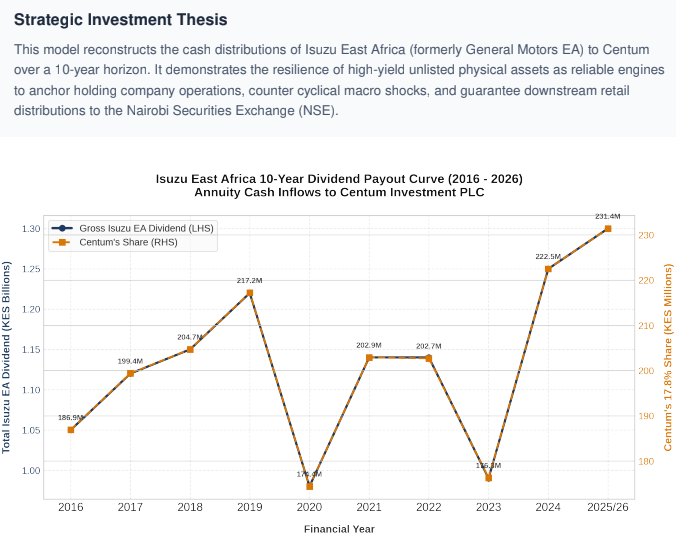
2016 (Peak GM Era): GMEA rides a massive infrastructure and construction boom in Kenya. The business commands the commercial truck and matatu sectors, delivering KES 186.9 million in cash dividends to Centum.
2017 (The Strategic Shift): General Motors exits the region, selling its entire 57.7% controlling stake to Isuzu Motors Japan. Amid market uncertainty regarding the restructuring, Mworia holds the line and maintains Centum’s 17.8% block. The newly rebranded Isuzu East Africa yields KES 199.4 million in dividends.
2018 – 2019 (The Assembly Peak): Accelerated by national vehicle localization policies, local Completely Knocked Down (CKD) assembly thrives. Dividends push past the KES 200 million mark annually, peaking at KES 217.2 million in 2019 to help fund Centum’s master-planned developments.
2020 (The Supply Chain Shock): The COVID-19 pandemic triggers global semiconductor shortages and brings fleet purchases to a crawl. Isuzu preserves capital, and Centum’s share drops slightly to KES 174.4 million.
2021 – 2022 (The Post-Pandemic Rebound): Logistics, e-commerce, and public transport bounce back fast. Isuzu rewards Centum with consecutive, stable annual payouts of KES 202.9 million and KES 202.7 million.
2023 (The FX Crucible): Rapid depreciation of the Kenyan Shilling escalates CKD assembly kit import costs. While budgeted for a higher payout, the board prudently slashes distributions to preserve raw material working capital, yielding Centum KES 176.3 million. Mworia absorbs the hit without panic-selling.
2024 – 2026 (The Yield Normalization): Backed by government public sector localization directives and a stabilized Shilling, manufacturing margins return. Annual dividends climb safely to KES 222.5 million and KES 231.4 million, solidifying Isuzu as Centum’s premier remaining private equity cash cow.

The KES 7.5 Billion Valuation: What Isuzu is Worth Today
While Isuzu East Africa remains a phenomenal dividend engine, analyzing Centum’s portfolio requires looking past the historical cash flow and pricing the asset’s true market valuation if James Mworia chose to execute an exit today. On paper, Centum conservatively carries its 17.8% stake in the automotive assembler at an audited book value of KES 5.62 Billion on an EBITDA multiple basis, valuing the entire enterprise at roughly KES 31.5 Billion.
However, according to transaction modeling from leading investment banks like Sterling Investment Bank (SIB), this asset would easily command a premium strategic exit value between KES 7.0 Billion and KES 8.5 Billion in a real-world liquidation scenario. Just as Coca-Cola paid an outsized institutional premium to mop up the remaining blocks of Almasi Beverages, the dominant majority shareholder, Isuzu Motors Japan, would likely pay a steep control premium to completely centralize the Kenyan cap table. A premier industrial monopoly yielding over KES 230 Million in annual annuity cash flow commands a massive 10x to 12x multiple in private equity markets.
Offloading the stake today would gift Centum a monumental one-off capital gain of nearly KES 2 Billion over its current book value. Yet, doing so would permanently sacrifice their strongest remaining non-real estate cash engine, forcing Mworia to weigh a massive headline windfall against the steady recurring distributions that keep the holding company’s operational bills paid.
About Boardlot Africa Research
Boardlot Africa is a premier financial intelligence and corporate governance publication dedicated to unpacking the mechanics of capital, market strategies, and structural shifts across East Africa’s corporate landscape. By bridging the gap between raw economic data and actionable market intelligence, we deliver deep-dive research, independent corporate analysis, and policy insights designed for institutional investors, boardrooms, and sharp market observers.
Get in Touch
Email: boardlot.research@gmail.com
Phone: +254 753 133 901
Substack: Subscribe to Boardlot Africa
X (Twitter): BoardLotSultan
Thoroughly researched! You should have done speculation on the new partnership between Centum and Arise IIP to unlock value in the Vipingo land.
Great article and keep on sharing insights. We need more people with an astute crirical analysis of our companies.
One small aside on the centum playbook: if one looks back at the point of when Centum floated their ELN, there was a significant match between their pipeline of projects and their cash available of investment. This is when the rain started beating them...