
The Outsider Who Taught Us to Lead: Why Bob Collymore Remains the Benchmark
Can an outsider ever truly understand the heart of a nation? When Bob Collymore sensed that Safaricom had disconnected from its customers, he carried out a brutal executive purge to realign the company’s vision, and the following table of contents maps his journey as he transformed the organization from a dominant utility into a social and corporate moral compass.
For many Kenyans, the corporate office is often viewed with skepticism—a place where profit margins are prioritized over progress, and where leaders remain insulated from the realities of the mwananchi. Yet, Bob Collymore, a man born in Guyana and shaped by the global corridors of London and Tokyo, managed to do what few local executives have ever achieved: he became a national icon.
How did a man from a small country thousands of miles away manage to surpass our own business leaders in public affection? How did he transform a corporate monopoly into a national utility that felt—and acted—like a member of the family? As we explore his life and legacy, we must ask ourselves: Was his success due to his radical authenticity, his refusal to hide behind corporate jargon, or his bold belief that a CEO’s primary responsibility is to the people, not just the shareholders?
Table of Contents
Part I: The Outsider as a National Icon
Part II: Roots & The Global Wanderer (Early Career)
Part III: The Safaricom Era: Scaling the “Purpose-Led” Business
Part IV: The “Boys Club”: Elite Influence & Cultural Soft Power
Part V: How Kenya Embraced Him
Part VI: The Legacy: A Blueprint for Corporate Leadership
I. Introduction: The Outsider as a National Icon
In the rigid hierarchy of corporate Kenya, where leadership often wears the mask of distant, suit-and-tie formality, Robert William “Bob” Collymore was a profound anomaly. Born in Guyana and shaped by the streets of London, he arrived in Nairobi not merely as a CEO, but as an unlikely bridge between the sterile efficiency of global telecommunications and the raw, vibrant pulse of the Kenyan people. By the time of his passing in 2019, he had achieved a rare social alchemy: the Guyanese-British expatriate was viewed by millions not as a corporate transplant, but as a quintessential Kenyan, a son of the soil whose adopted citizenship was cemented not by a passport, but by a shared purpose.
The paradox of Bob Collymore’s tenure at the helm of Safaricom is a study in leadership. Safaricom, a company that serves as the inescapable nervous system of the Kenyan economy, was – and remains – a target of intense public scrutiny, often criticized for its market dominance and the sheer scale of its reach. Yet, under Collymore’s stewardship, the company’s “face” never became that of a soulless monopoly.
Instead, he humanized the machine. He moved with an accessibility that defied the traditional trappings of his office, choosing to engage with the public not through curated press releases, but through the candid language of authenticity. Whether he was championing financial inclusion for the unbanked, dancing to local hits on live television, or speaking with quiet dignity about his battle with leukemia, he dismantled the wall between “corporate executive” and “citizen.” He left behind a legacy that transcended balance sheets and dividends: he proved that even the largest, most scrutinized institutions could be led with a gentle hand, a listening ear, and an unwavering commitment to the people they served. Bob Collymore was the rare corporate titan who, in his pursuit of profit, never lost sight of the human project.

II. Roots & The Global Wanderer (Early Career)
Bob Collymore’s trajectory to the summit of East African corporate life was not paved with the traditional markers of elite schooling. His worldview was forged in the melting pot of his early years in Guyana, where he was raised by his grandparents—an experience that instilled in him a resilience and a deep-seated empathy for the “everyday person.” This childhood, far removed from the boardrooms he would later dominate, taught him to view technology not as an abstract set of protocols, but as a tool for connection in challenging environments.
I. The Crucible of the “School of Life”
At age 16, Collymore moved to the UK to rejoin his mother, a transition that proved to be his first encounter with the cold realities of systemic exclusion. A defining moment in his early life was his acceptance into Warwick University—a gateway to the British establishment—only to see his path blocked by a lack of funding. It was a failure of the system, not of his ambition.
Rather than succumbing to this setback, Collymore entered what he often called the “school of life.” He bypassed the traditional academic conveyor belt, choosing instead to learn the mechanics of the burgeoning telecommunications industry from the ground up. He did not arrive at Safaricom as a theorist; he arrived as a veteran of the trenches.
II. A Global Operator
His career path read like a map of the telecommunications revolution. At British Telecom and Cellnet, he cut his teeth in the competitive, fast-paced world of mobile infrastructure during its infancy. Later, his tenure at Vodafone—specifically his time in Japan—was transformative. In Japan, Collymore witnessed firsthand how high-tech infrastructure could be seamlessly integrated into the fabric of daily urban life, moving from a luxury to a basic human utility.
These experiences refined his philosophy: he learned that the most successful technology is that which disappears into the user’s workflow. By the time he was tapped to lead the Safaricom transition, he had already mastered the art of managing complex, high-pressure environments. He was a global operator who understood the granular details of mobile networks, but more importantly, he possessed an intuitive grasp of how to adapt those networks to the unique, localized needs of the consumer. This was the foundation of his leadership—he was a technician of technology, but a student of humanity.
III. The Safaricom Era: Scaling the “Purpose-Led” Business
When Bob Collymore assumed the role of CEO at Safaricom in 2010, the company was already a success story, but it was at a crossroads. It risked being perceived merely as a utility provider—an extraction machine for airtime and data revenue. Collymore recognized that for Safaricom to survive the next decade of market saturation, it had to undergo a radical identity shift. He redefined the company’s internal compass through his “Three Ps” leadership model: Purpose, People, and Profit.
I. The Three Ps: Redefining Corporate DNA
Collymore’s philosophy was deceptively simple but structurally transformative. He argued that if a company pursued “Purpose” (solving real societal problems) and invested in “People” (empowering both employees and customers), the “Profit” would naturally follow as a byproduct rather than the sole objective. He moved the corporate culture away from the quarterly obsession with dividends and toward long-term systemic impact. Under his leadership, Safaricom ceased to be just a telco; it became a catalyst for national development.
II. Financial Inclusion as a Human Right
The defining achievement of the Collymore era was the aggressive scaling of M-Pesa. Where others saw a basic money-transfer service, Collymore saw a gateway to dignity. He treated financial inclusion not as a corporate social responsibility initiative, but as a fundamental human right.
By spearheading the integration of banking infrastructure with mobile technology, he turned M-Pesa into the central nervous system of the Kenyan economy:
M-Shwari: Demystified micro-savings and credit for those who had never stepped foot in a traditional bank branch.
Fuliza: Revolutionized short-term liquidity, allowing the average worker to navigate daily financial shocks.
M-Tiba: Extended the reach of health insurance to those in the informal economy, literally saving lives through mobile-linked medical credit.
III. Economic Democratization: Building the Decacorn
Collymore’s leadership transformed Safaricom into a “Decacorn”—a company valued at over $10 billion—but the true metric of his success was the democratization of the Kenyan economy. By lowering the barriers to entry for financial services, he brought millions of unbanked Kenyans into the formal financial ecosystem.
He effectively digitized the informal economy, ensuring that a vegetable vendor in a rural market had the same access to credit, insurance, and payment security as a high-net-worth investor in Nairobi. By the time he stepped back, Safaricom was no longer just a telecommunications firm; it was the essential economic infrastructure of the nation. Collymore had built a machine that didn’t just profit from the Kenyan people—it powered them.

In an unexpected display of corporate diplomacy, former Safaricom CEO Bob Collymore famously paid a visit to his fierce competitor, Airtel Kenya. Collymore broke from traditional boardroom rivalry to engage directly with the staff at an Airtel shop, an act that signaled a departure from the typical hostilities of the telecommunications market. By choosing to step into the "Network of Friends"—Airtel's own branding—Collymore utilized his platform to humanize the competition, turning a potential PR standoff into a moment of mutual professional respect that remains a distinct memory in the history of Kenyan corporate relations.
The Timeline of the Siege (2010–2015)
Phase I: The Landing (November 2010) Collymore arrived at Safaricom House to find a frozen reception. The senior leadership—the “Old Guard”—stood as a phalanx of veterans who had built the company alongside Joseph. At the time of the transition, the key figures held critical portfolios:
Peter Arina: General Manager, Consumer Business.
Rita Okuthe: Head of Marketing.
Joe Ogutu: Chief Human Resources Officer.
Steve Chege: Head of Regulatory and Public Policy.
Nzioka Waita: Director of Corporate Affairs.
Chris Tiffin: Chief Financial Officer.
Betty Mwangi-Thuo: General Manager, Financial Services.
Ivor Wekesa: Director, Risk Management.
Pauline Warui: Director, Customer Management.
Sylvia Mulinge: Head of Enterprise Business.
They viewed themselves as the natural successors and saw Collymore as a corporate transplant lacking the local context to lead.


Phase II: The Triple-Front War (2011) Collymore quickly realized he was surrounded on three fronts:
The Executive Insurgency: Senior managers actively resisted his agenda, treating his new initiatives with calculated inertia.
The Dealer Cartel: Established airtime dealers, acting as a powerful oligarchy, resisted any attempts to reform tariffs or modernize trading rules.
The Contractor Barrier: Long-term suppliers made procurement a battlefield, meeting attempts at transparency with bureaucratic sabotage.
Phase III: The Stabilization Strategy (2011–2012) To prevent collapse, Collymore played a masterstroke of diplomacy: he kept Michael Joseph on the Board. By tethering the man who built the empire to his own administration, Collymore gained the temporary legitimacy needed to survive the initial hostility while he planned the dismantling of the internal resistance.
Phase IV: The Great Purge (2013–2015) Realizing he could not reform Safaricom with an insurgency in his own boardroom, Collymore initiated a swift, clinical purge. The exit of senior managers was largely acrimonious, leaving the hallways of Safaricom House echoing with tension. The most dramatic moment occurred with the departure of Peter Arina; in a move that shocked the corporate world, Arina—one of the most powerful figures in the “Old Guard”—was removed from the building by security. This served as a final, public signal that the era of the Old Guard was over and the era of the Collymore-led “Safaricom 2.0” had officially begun.
The Great Purge of Safaricom: The Night of Long Knives
In March 2015, Safaricom House became the theater for perhaps the most brutal executive cleansing in Kenyan corporate history—a calculated, clinical “Night of the Long Knives” designed to shatter the remnants of the Michael Joseph-era “Old Guard.” Bob Collymore, having spent years navigating the suffocating inertia of a leadership team that viewed him as an illegitimate outsider, finally moved to break the siege.
The climax was as visceral as it was sudden: Peter Arina, the titan of the Consumer Business division, was stripped of his authority over 90% of the company’s revenue and escorted from the building by security, accompanied by the swift termination of Customer Management Director Pauline Warui. This was no mere personnel shuffle; it was a total architectural demolition of the company’s internal power structure. Collymore dismantled the monolithic, siloed fiefdoms that had held the firm hostage for years, aggressively balkanizing them into agile, specialized Strategic Business Units (SBUs).
By elevating a new, loyalist generation of “Chief Officers” like Sylvia Mulinge and Rita Okuthe, Collymore effectively purged the boardroom of its insurgent elements, ending the era of the General Manager-titan. In their place, he installed a “purpose-led” regime, finally clearing the runway to anchor the company in his own image—a modern, customer-obsessed corporate state where institutional power was decentralized, but Collymore’s vision remained absolute.

This video provides personal context from Pauline Warui, one of the executives affected by the 2015 leadership purge, regarding her departure from the company.
Executive Transitions and Legacy
The leadership landscape at Safaricom underwent significant transformation between Collymore’s arrival in 2010 and his passing in 2019. By the time of his death, the original “Old Guard” had largely dispersed, with the company’s executive composition reflecting the results of his long-term restructuring.
Those who remained in 2019: Several key figures from the early Collymore years, including Joe Ogutu, Sylvia Mulinge, Rita Okuthe, and Steve Chege, continued to serve in critical leadership capacities, having successfully integrated into the “Safaricom 2.0” vision.
Those who exited early: Early architects of the resistance, such as Peter Arina and Chris Tiffin, had long since departed the firm. Nzioka Waita eventually pivoted into high-level public service, leaving the corporate sector.
Those who were lost: It is important to note the tragic passing of Ivor Wekesa, who served as the Director of Risk Management and was a member of Collymore’s original post-reorganization executive team; he passed away in October 2012.
Other key tenures: Betty Mwangi-Thuo, who played a pivotal role in the early expansion of M-Pesa as General Manager of Financial Services, eventually transitioned out of the company in the years following the initial consolidation phase to pursue other interests.
By 2019, the executive team had evolved into a cohort defined more by Collymore’s “purpose-led” ethos than the traditional departmentalism that characterized the transition era of 2010.
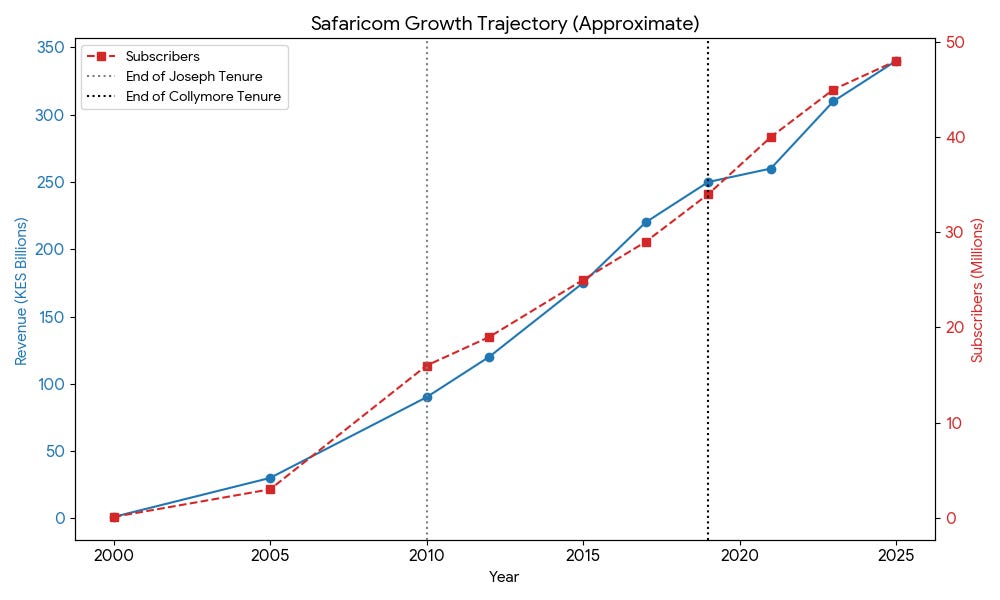
Key Phases of the Growth Trajectory
The Michael Joseph Era (2000–2010): The Foundation
This period established Safaricom from a departmental appendage into the market leader. The rapid climb in both subscribers and revenue during these early years reflects the infrastructure rollout, the battle for billing dominance, and the successful lobby for M-Pesa.
The Bob Collymore Era (2010–2019): The Scaling
Following Joseph, Collymore’s tenure saw the transformation of the company from a traditional telco into a digital and financial services ecosystem. This phase is characterized by sustained revenue growth as M-Pesa matured from an experiment into the backbone of Kenya’s financial economy.
The Current Tenure (Peter Ndegwa, 2020–Present): The Expansion
The post-2020 phase has been defined by further diversification, including the expansion of M-Pesa’s digital lending products, data growth, and regional expansion, maintaining the company’s trajectory as a central pillar of the Nairobi Securities Exchange.
Context on the Successions
Financial Leadership: When Chris Tiffin departed in 2011, John Tombleson was brought in from Vodafone Qatar to stabilize the finance function. This was a critical appointment for Collymore, as it brought in a trusted hand who understood the Vodafone-Safaricom governance expectations.
Corporate Affairs & Regulation: The appointment of Stephen Chege to replace Nzioka Waita in 2015 was a textbook example of Collymore’s strategy to promote from within. Chege, who had grown through the ranks starting as in-house counsel, provided the institutional continuity and deep regulatory knowledge that Collymore needed to manage the company’s complex government relationships.
The SBU Pivot: The departure of executives like Peter Arina did not always result in a direct “one-to-one” replacement. Under the Safaricom 2.0 model, Collymore reorganized the company into Strategic Business Units (SBUs). This meant that the responsibilities once held by a single General Manager (like Consumer Business) were often split or re-integrated into new “Chief Officer” roles, such as Chief Consumer Business Officer, to better align with the new, agile structure.
This restructuring allowed Collymore to break the “power centers” of the Old Guard, effectively ending the era of monolithic departments and ushering in the era of specialized, cross-functional leadership teams.

The Collymore Doctrine: Architecting a Purpose-Led Culture
Bob Collymore fundamentally redefined Safaricom’s organizational ethos, transitioning the firm from a strictly profit-centric telecommunications operator into a “purpose-led” powerhouse. Grounded in his core philosophy—”Purpose, People, then Profit”—Collymore maintained that the company’s commercial sustainability was inseparable from the prosperity and well-being of the Kenyan society it served.
Key Cultural Shifts Under Collymore
Institutionalizing Purpose: Moving beyond traditional, peripheral Corporate Social Responsibility (CSR), Collymore formally anchored the United Nations Sustainable Development Goals (SDGs) into the company’s core strategic framework in 2016. This shift mandated that social impact metrics—spanning rural connectivity, gender equality, and poverty reduction—were monitored and reported with the same rigorous scrutiny as financial bottom lines.
Customer-Centric Innovation (”Safaricom 2.0”): Beginning in 2011, he dismantled entrenched internal silos by reorganizing the company into agile Strategic Business Units (SBUs). This structural overhaul forced staff to pivot away from protective departmentalism toward a unified, obsession-level focus on meeting diverse customer needs.
Emphasis on Ethics and Transparency: Collymore established a zero-tolerance policy toward corruption, systematically dismissing personnel involved in procurement fraud while enforcing a uncompromising code of conduct. He cultivated an environment where individual integrity was championed as the only viable long-term defense against systemic organizational rot.
Servant Leadership and Inclusivity: He consciously dismantled corporate hierarchy in favor of a relaxed, approachable, and “man-of-the-people” leadership style. By actively advocating for gender parity and fostering an open-communication culture, he created a psychological safety net where employees felt empowered to innovate and embrace failure as a necessary byproduct of growth.
Shared Value Thinking: Embracing the “Shared Value” framework, Collymore pushed the organization to generate mutual benefits for the entire value chain rather than engaging in purely extractive practices. This mindset shift spurred creative, long-term resource management, most notably exemplified by the company’s ambitious commitment to achieving net-zero carbon emissions.
By embedding these pillars into the company’s foundation, Collymore successfully transformed Safaricom into a “publicly palatable” institution. This strategic pivot secured profound public trust, ensuring the firm maintained its dominance not merely through raw market share, but through its cemented role as an indispensable architect of Kenya’s national progress.
The Integrity Gambit: The CEO as the Moral Arbiter
One of Bob Collymore’s most audacious contributions to Kenyan corporate culture was his decision to publicly declare his wealth and salary. In an era where corporate remuneration is often shrouded in secrecy and corruption is frequently dismissed as a “cost of doing business,” Collymore’s transparency was not just a PR move—it was a strategic weapon against the culture of impunity.
I. The War on Corruption
Collymore recognized that corruption was the single biggest “tax” on doing business in Kenya. For a firm like Safaricom, which relies on public trust and massive digital infrastructure, the shadow of corruption was a systemic threat. By publishing his own earnings, he sought to set a “moral floor” for corporate leadership. He was effectively challenging his peers: If you have nothing to hide, why are you hiding your worth?
His message was simple but piercing: transparency in the boardroom is the only antidote to opacity in the government. By exposing his own financial life, he forced a conversation about the disconnect between legitimate wealth creation and the illicit accumulation of capital that characterizes so much of the Kenyan political economy.
II. Shining a Light on the “Dark Money”
This move was a direct strike at the “hustle culture” that prioritized rapid wealth accumulation over ethical practice. For many Kenyans, the spectacle of public officials and corporate leaders flaunting unexplained wealth had become normalized. Collymore’s declaration served as a mirror; it allowed the public to see what a “clean” path to wealth looked like in the context of a high-stakes executive role.
Setting the Standard: He forced the corporate sector to confront the reality of their own internal pay structures.
The Ethical Contrast: His transparency highlighted the stark difference between those who built value through innovation (like M-Pesa’s contribution to the GDP) and those who extracted value through kickbacks and procurement fraud.
III. The Ripple Effect
While many of his peers in the boardroom initially viewed his transparency with unease, Collymore’s gamble paid off. He shifted the benchmark for “executive excellence.” After Collymore, a Kenyan CEO could no longer comfortably hide behind a veil of corporate secrecy. The public began to demand accountability as a default setting.
He proved that integrity was not a liability—it was a competitive advantage. In a market plagued by “dark money” and boardroom scandals, Collymore’s willingness to stand in the spotlight made Safaricom a beacon of institutional stability. He taught the nation that the most effective way to fight corruption is to make transparency the only acceptable standard of success.
IV. The “Boys Club”: Elite Influence & Cultural Soft Power
In the traditional corporate architecture of Kenya, the CEO is often a distant, impenetrable figure, sequestered behind layers of PR handlers and security details. Bob Collymore shattered this archetype through his membership in a tight-knit circle of prominent figures—a group the public affectionately dubbed the “Boys Club.”
I. Beyond the Old Boys’ Network
To view the “Boys Club” simply as an exclusionary power circle is to miss its sociological significance. Comprised of high-profile media moguls, corporate titans, and creative leaders—including figures like Jeff Koinange, Patrick Quarcoo, Joshua Oigara, Bharat Thakrar and Aly-Khan Satchu—this group served as a microcosm of Kenya’s modern meritocratic elite. It was a window into the intersection of media, finance, and culture. For Collymore, this wasn’t just a social gathering; it was a space where the barriers between “private citizen” and “public leader” dissolved. In a country where business deals are often finalized in hushed, elite settings, this group made their camaraderie visible, signaling a shift toward a more transparent, albeit highly influential, professional culture.

II. Humanizing the Titan
Collymore’s “humanization” was strategically and authentically executed through these friendships. Through frequent, candid social media posts—featuring jazz sessions, shared meals, and lighthearted banter—the Safaricom CEO was transformed into a relatable, culturally engaged Kenyan.
The Jazz Factor: His well-documented love for jazz provided a common language that transcended the boardroom. By participating in cultural events like the Safaricom International Jazz Festival, he used his personal passion to uplift the local arts scene, effectively linking his brand of leadership to creativity rather than just bottom-line metrics.
A Different Kind of Transparency: Whether he was discussing his life philosophy on live television with Jeff Koinange or sharing vulnerable moments during his health journey, these platforms humanized the man behind the Safaricom logo.
By allowing the public a glimpse into his “off-the-clock” hours, Collymore achieved something few executives ever do: he became a peer to the consumer. The “Boys Club” did not isolate him; it made him reachable. It proved that one could hold the most powerful corporate seat in the country while remaining a person who appreciated a good conversation, a glass of fine drink, and the transformative power of music. In doing so, he set a new benchmark for what it meant to be a leader in the public eye—one who leads not just by issuing mandates, but by building authentic, visible connections.
The Human Side: A Marriage, a Nation, and the “Common Touch”
Bob Collymore’s marriage to Wambui Kamiru was more than a personal union; for the Kenyan public, it was the final piece of the puzzle that cemented his status as “one of our own.” In a corporate culture where the private lives of executives are often kept behind high walls, the couple’s 2016 wedding was a rare, candid, and deeply human moment that generated an electric buzz across the country.

I. Breaking the CEO Archetype
For many Kenyans, the image of a multinational CEO is one of isolation—a life lived in gated communities, private clubs, and executive suites. When Bob, with his understated charm and love for jazz, married Wambui, a Kenyan artist and entrepreneur, it broke that archetype entirely. It wasn’t just a wedding; it was a visible commitment to the country he lived in. By choosing a partner who was deeply embedded in the local creative and cultural scene, he signaled that his life in Kenya was not a temporary assignment, but a permanent integration.
II. The “Wambui Effect”
The public fascination with their union was rooted in its relatability. Wambui brought a grounded, artistic, and intellectual perspective to his life that the public found refreshing. She became a bridge—not just to the Kenyan social scene, but to a side of Bob that the corporate world rarely saw. Through their shared interests in art, their candid interviews, and the way they navigated the public eye with quiet dignity, the couple became a symbol of modern, cosmopolitan Kenya.
III. The Resonance of Authenticity
This marriage humanized the “Safaricom Machine” in a way that no marketing campaign ever could. It transformed the “expat boss” into a man with a family, a home, and a stake in the future of the nation. For the average Kenyan, seeing the CEO of the country’s largest firm participating in the rituals and rhythms of local life—including the nuances of a cross-cultural marriage—made him feel accessible. It sparked a buzz because it was authentic; it showed that Bob wasn’t just here to manage the country’s telecommunications infrastructure, but to share in the daily, messy, and beautiful experience of life in Nairobi.
It was this capacity to be human—to love, to marry, and to grow a family in the full view of the public—that turned Bob Collymore from a corporate figurehead into a man the country felt they genuinely knew.
V. How Kenya Embraced Him
The relationship between Bob Collymore and the Kenyan public was defined by a rare quality in corporate life: radical transparency. In an environment where CEOs often curate a “stiff” persona—shielded by non-disclosure agreements and polished, lifeless public relations—Collymore chose to be vulnerable. He did not arrive with the detachment often expected of an expatriate executive; instead, he embraced the messy, vibrant, and deeply human realities of Kenyan life.
I. Authenticity Over Corporate PR
Collymore’s presence in Kenya was felt through his passions, not just his policy directives. Whether he was spotted enjoying live jazz at a local club, sharing his journey with the saxophone, or navigating the public complexities of his marriage to Wambui Kamiru, he lived in the open. Kenyans felt they knew him, not as a corporate “other,” but as a neighbor.
His most profound connection to the public came during his battle with Acute Myeloid Leukemia. When he chose to speak openly about his illness, he shattered the veil of corporate immortality. He transformed his health crisis into a dialogue about dignity, perseverance, and the fragility of life. By inviting the nation into his struggle, he moved from being the CEO of a telecommunications company to being a man fighting for the same things as the citizens he served: time, health, and family.
II. The Metric of Impact: A Nation in Mourning
The true testament to Collymore’s integration into the Kenyan fabric was the nature of his passing in July 2019. Corporate deaths in Kenya are often marked by formal statements, stock exchange filings, and brief mentions in the business news. The mourning of Bob Collymore was fundamentally different—it was a national wake.
The grief was universal and egalitarian. It spanned the entire spectrum of the Kenyan social order:
The Elite: State leaders, including the President, mourned him not just as a CEO, but as a crucial pillar of the country’s economic strategy and a trusted advisor.
The Entrepreneur: Business owners recognized him as the architect of the platform that allowed them to trade, pay, and grow.
The Everyday Citizen: For the duka owner in a remote village or the student in a Nairobi estate, the loss of Collymore felt personal.
This outpouring of grief was the ultimate metric of his impact. When an entire nation pauses to mourn a corporate leader, it is no longer about the services he provided; it is about the humanity he projected. Bob Collymore was embraced because he didn’t just operate in Kenya—he participated in it. He proved that corporate leadership, when tempered with humility and authenticity, can become a bridge that binds an entire nation together.
VI. The Legacy: A Blueprint for Corporate Leadership
Bob Collymore did not merely manage a company; he fundamentally altered the “operating system” for how major enterprises in East Africa define success. His departure did not leave a void of leadership, but rather a new set of expectations that all subsequent CEOs in Kenya are now measured against. He effectively raised the bar, shifting the focus from the singular pursuit of shareholder value to the broader, more complex mandate of stakeholder impact.
I. Diversity as a Strategic Imperative
Long before “diversity, equity, and inclusion” became standard corporate buzzwords, Collymore was treating them as core operational metrics. He was unapologetic in his push for gender parity, setting aggressive targets for a 50/50 gender balance within Safaricom’s workforce.
He recognized that the digital divide was not just an issue of connectivity, but of representation. By actively mentoring and empowering women in the male-dominated tech and engineering spaces, he ensured that the products Safaricom built—like the women-centric M-Mama initiatives—were designed with a deeper, more inclusive understanding of the consumer. His legacy is found in the boardrooms and technical teams today, where the push for gender equity is no longer an optional “initiative” but an established baseline for modern Kenyan corporate culture.
II. The “Purpose-Led” Benchmark
Perhaps the most lasting shift Collymore triggered is the “purpose-led” mandate. In the post-Collymore era, a Kenyan CEO can no longer justify their existence solely through dividend payouts. The public and the market now expect a visible, tangible commitment to the social good.
Social Impact as Strategy: Today’s leaders are compelled to integrate the Safaricom Foundation’s model of development—focused on education, maternal health, and economic empowerment—into their core business strategy.
Cultural Patronage: His success in linking corporate identity to the arts—most notably through the Safaricom International Jazz Festival—demonstrated that cultural investment is a legitimate and powerful form of brand equity.
Current CEOs now operate under a new “Collymore Standard.” Whether in banking, manufacturing, or retail, they are expected to be the architects of a broader ecosystem. They must engage with the national agenda, sponsor the arts, and demonstrate a commitment to the informal economy. Bob Collymore showed the market that a corporation’s influence is only as strong as the social fabric it supports. By doing so, he transitioned the role of the Kenyan CEO from a profit-maximizer to a national steward—a legacy that ensures he remains a permanent fixture in the history of the country’s markets.
Safaricom continues to honor the legacy of its former CEO, Bob Collymore, primarily through its ongoing support of the Bob Collymore Foundation (BCF).
Following his passing in 2019, his family established the Bob Collymore Foundation to continue the work he was passionate about, including integrity, arts, and music education for underprivileged youth. Safaricom frequently partners with and sponsors the foundation’s initiatives, most notably the Bob Collymore International Jazz Festival. For example, in early 2024, Safaricom announced a KES 2 million sponsorship for the festival, reinforcing its commitment to the arts and youth programs—causes that were central to Collymore’s leadership.
Immediately following his death, the company and the nation held various tributes and memorial services, including an online memorial jazz festival held on the first anniversary of his passing in 2020 during the COVID-19 pandemic. Today, his memory is kept alive through these collaborative events that blend his love for jazz with social impact.
Bob Collymore Foundation memorial
This video provides an overview of the launch of the Bob Collymore Foundation, which was established by his family to honor his values and ongoing commitment to the arts, integrity, and music.
He had so much soul. A great man indeed, even in his final days. Top read!