
The Legacy of the Gavel
Ronald Karauri’s journey from the cockpit to the boardroom, and finally to the floor of the National Assembly, serves as a masterclass in the realities of the Kenyan economic landscape. His career confirms a central, often uncomfortable truth: in a market where the state is the primary regulator, the largest contractor, and the ultimate arbiter of property rights, private wealth is inherently fragile. For the Kenyan titan, commercial success is rarely a final destination; it is an entry ticket into the political class. By seeking state power, Karauri transitioned from a participant in a volatile market to an architect of the very laws that govern it—proving that in Kenya, the most durable boardroom is not found in a private office, but within the walls of Parliament
The Political Novice: Captain Ronald Karauri
I. The High-Stakes Pivot: From the cockpit to the digital betting revolution.
II. The Engineer and the Pilot: Formative years, the “gambler’s mindset,” and early risks.
III. The SportPesa Effect: Building a Colossus: The SMS revolution, global branding, and massive market scale.
IV. The Storm: Legal, Tax, and Shareholder Intrigues: The 2019 KRA crackdown, internal boardroom wars, and the Milestone maneuver.
V. The New Frontier: From Boardroom to Parliament: Political metamorphosis, the “Captain” persona, and the 2026/2027 outlook.
VI The Market Architect: Conclusion: The convergence of power and the legacy of the gavel.
I. Introduction: The High-Stakes Pivot
The flight deck of a Boeing 737 is a place of rigorous order, defined by checklists, precise navigation, and the unwavering discipline required to command the lives of hundreds at thirty thousand feet. For Captain Ronald Karauri, the cockpit was a career—a high-flying, prestigious peak that few Kenyans ever reach. Yet, in 2015, Karauri did the unthinkable: he walked away from his captain’s seat at Kenya Airways to bet on a nascent, volatile idea that most of the financial establishment dismissed as a fleeting digital fad.
Karauri’s transition from the orderly world of aviation to the chaotic, high-stakes arena of sports betting was not merely a career change; it was a fundamental re-engineering of the Kenyan economy. By merging the reach of M-Pesa with the visceral passion of global football fandom, he didn’t just launch a company—he orchestrated a cultural shift. Under his stewardship, SportPesa evolved from a struggling startup into an economic juggernaut that, at its zenith, recorded annual revenues rivaling the largest blue-chip banks on the Nairobi Securities Exchange.
His journey is the definitive story of Kenya’s digital gambling revolution. Whether celebrated as a genius of financial disruption or critiqued as the architect of a national obsession, Karauri’s impact is undeniable. He transformed the “betting economy” from a back-alley pastime into a top-tier industry that reshaped how Kenyans spend their disposable income, forcing regulators, financial institutions, and even the government to adapt to a new reality where a single SMS could move billions.

II. Formative Years: The Engineer and the Pilot
Born into a political family—his father, Mathew Adams Karauri, served as the Member of Parliament for Tigania East—Ronald Karauri’s early trajectory seemed set for the structured path of engineering. He attended Mang’u High School before enrolling at the University of Nairobi to pursue a degree in Mechanical Engineering. However, the rigor of the classroom could not compete with the allure of the horizon. Driven by an ambition to command the skies, Karauri eventually made the bold decision to drop out of university in his third year, seizing a rare opportunity to join the Kenya Airways cadet pilot program.
It was this inherent comfort with high-stakes decision-making that would later define his professional life. His transition from the cockpit to the boardroom began not in a formal office, but at a casino table in Nairobi. As an active player in the city’s social and gaming scene, Karauri found himself uniquely positioned at a table alongside the Bulgarian entrepreneurs who were conceptualizing a platform for sports wagering. While most observers saw only a game of chance, Karauri saw a digital infrastructure play that could leverage Kenya’s burgeoning mobile money ecosystem.
His “gambler’s mindset” was not just metaphorical; it was a defining financial strategy. Convinced of the business’s potential when few others were, Karauri famously divested a piece of land he had purchased for Sh2 million, selling it for Sh25 million to acquire a six percent stake in what would become SportPesa. It was a classic “all-in” maneuver. By betting his own real estate wealth on an unproven SMS-based platform, he signaled a level of conviction that would ultimately see him lead one of the most profitable—and controversial—corporate empires in Kenyan history.
Captain Ronald Karauri’s aviation and business journey
This video provides a deep dive into Captain Karauri’s transition from the flight deck to the boardroom, offering personal insights into the risks he took to build his betting empire.
The Union Crucible: Karauri’s Training Ground
Before he was the public face of the SportPesa empire, Ronald Karauri spent years navigating the high-stakes, pressure-cooker environment of the Kenya Airline Pilots Association (KALPA). His tenure as Secretary General was more than just a bullet point on a CV; it was the crucible where he developed the strategic grit and negotiation skills that would later define his leadership in the betting industry.
Learning to Fly Through Turbulence
While Karauri often emphasizes that his leadership at KALPA never resulted in a full-scale strike, it was far from a quiet tenure. As Secretary General, he was the primary point of contact between the pilots—a highly specialized, professional workforce—and the often-impenetrable wall of Kenya Airways’ management. He spent those years mastering the art of the “push-and-pull,” learning how to leverage collective bargaining power without grounding the airline.
During this period, he was deeply involved in some of the most contentious internal disputes at KQ, including public battles over fleet acquisition. Karauri was a vocal critic of management decisions regarding the procurement of specific aircraft models, which he and the union argued were fundamentally unsuited for the African market’s operational demands. These battles taught him a vital lesson: a leader is only as strong as the data they bring to the table. He realized early on that to challenge corporate giants, you don’t just need passion; you need a superior understanding of the operational mechanics.
The Transition to the Boardroom
His time at KALPA provided the perfect apprenticeship for his later pivot to SportPesa. As a union leader, he had already become accustomed to defending the interests of a group against powerful corporate interests and government-appointed boards. He learned how to navigate regulatory bureaucracies, manage high-stakes public relations, and maintain composure while under intense professional scrutiny.
When he later sat across the table from Bulgarian investors at the Finix Casino, the transition from “Captain” to “CEO” was not as jarring as his friends and family assumed. He had already spent a decade as the representative of a powerful, technical workforce, managing the complex intersection of aviation safety, labor regulations, and corporate politics. The “leaps of faith” that eventually turned him into a media darling and a political figure were, in many ways, just the final stages of a career path that had been forged in the union halls of KALPA.
It was here that he learned the most important rule of Kenyan business: if you aren’t the one setting the agenda, you will inevitably be the one being negotiated out of it.
The SportPesa Genesis: A High-Stakes Introduction
The rapid ascent of SportPesa was not solely a product of market demand; it was engineered through a series of high-level connections that tethered the betting venture to Kenya’s established corporate elite. A pivotal moment in this early trajectory was orchestrated by the late former Nairobi Mayor, Dick Wathika, who served as a critical bridge between the startup’s Bulgarian founders and the local capital market.
Recognizing the need for deep-pocketed, influential local support to navigate Kenya’s complex regulatory and political landscape, Wathika introduced the founders to tycoon Paul Wanderi Ndung’u. The meeting proved transformative for the company’s capitalization. Impressed by the firm’s vision, Ndung’u stepped in as a cornerstone investor, committing approximately Ksh100 million to acquire a 21 percent stake in Pevans East Africa, the holding company that would soon become a dominant force in the African betting landscape. This investment not only provided the necessary liquidity for SportPesa to scale its operations but also signaled the entry of one of the country’s most formidable business minds into the venture—a partnership that would, years later, dissolve into one of the most bitter corporate feuds in Kenyan history.
Formation and Early Years
The foundation of SportPesa began when Ronald Karauri, an avid poker player, met Bulgarian casino operator Guerassim Nikolov at the Finix Casino in Nairobi’s Hurlingham area. At the time, Karauri was at the pinnacle of his aviation career, having served as a Boeing 737 captain for Kenya Airways. After multiple interactions over poker games, the two discussed the potential of an online sports betting venture.
Despite the professional risks—leaving a stable, high-flying career—Karauri made the “leap of faith” to join the project as both a shareholder and CEO. He personally invested Ksh30 million into the venture, which had a total initial investment of approximately Ksh500 million. Launched in 2014, the company saw near-instant success, growing from a modest net profit of Ksh44.2 million in its first year to a peak of Ksh6.2 billion by 2016. This rapid growth, driven by aggressive branding and sports sponsorships, transformed the company into a juggernaut that would eventually become the second-largest firm in Kenya by revenue, just behind Safaricom.
III. The SportPesa Effect: Building a Colossus
The true genius of SportPesa was not in the gambling itself, but in its absolute mastery of the Kenyan mobile ecosystem. Before 2014, betting was a physical activity confined to casinos and dusty betting shops. Ronald Karauri and his partners effectively “democratized” the industry by stripping away these physical barriers. Through the SMS betting revolution, they turned every basic feature phone in the country—from the remote villages of Tigania to the bustling streets of Nairobi—into a potential casino. By integrating seamlessly with M-Pesa, SportPesa allowed users to place bets with a simple text message, making the thrill of the game as accessible as sending a greeting.
Marketing as Power
If the SMS platform provided the “how,” the brand’s marketing provided the “why.” Karauri understood early that to become a household name, he didn’t need to advertise to gamblers; he needed to integrate into the fabric of sports culture itself. The SportPesa logo became ubiquitous, gracing the jerseys of local giants like Gor Mahia and AFC Leopards, and eventually leaping onto the global stage.
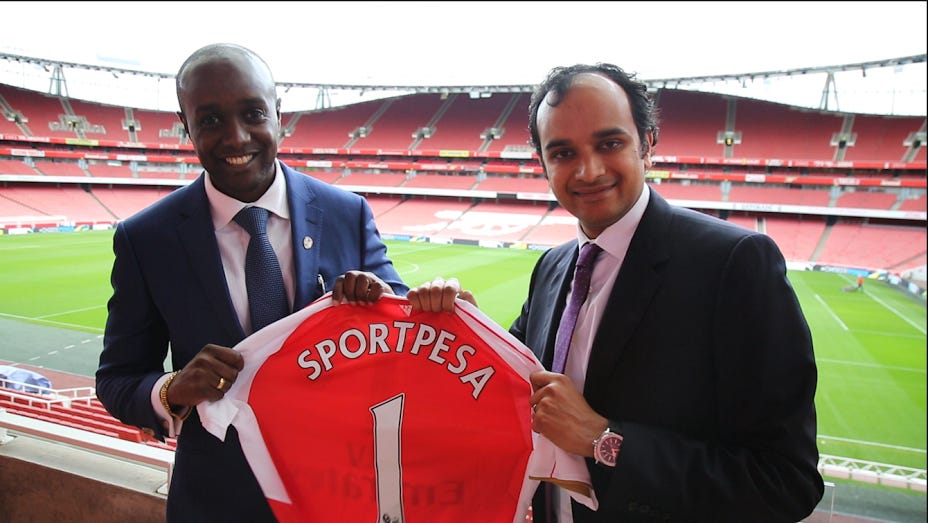
The company pulled off a marketing masterstroke by securing high-profile sponsorships with English Premier League clubs like Everton, Southampton, and Hull City. For a Kenyan consumer, seeing a local brand emblazoned on the chest of an Everton player was a powerful validation—a signal that SportPesa wasn’t just a local firm, but a global heavyweight. By even becoming the first betting company to title-partner a Formula 1 team (Racing Point), Karauri positioned SportPesa at the pinnacle of international sports, effectively buying a level of prestige that traditional Kenyan corporations could only dream of.
The Scale of the Colossus
The sheer magnitude of SportPesa’s growth was, by any metric, an anomaly. Court disclosures from the height of the firm’s operations revealed that in 2018 alone, the platform saw an staggering Sh149.7 billion in annual sales, with daily bets averaging Sh408 million. This scale was not just impressive; it was transformative.
To put this into perspective:
The Revenue Giant: SportPesa’s revenue frequently placed it as the second-largest company in Kenya by turnover, sitting just behind the telecommunications titan Safaricom.
The Economic Disrupter: Its annual revenue figures dwarfed the market capitalization of some of the country’s largest, long-established commercial banks.
The Flow of Capital: In a single year, the firm was paying out over Sh129 billion in winnings, creating a constant, rapid circulation of cash that turned the gambling platform into a shadow utility, deeply embedded in the daily financial liquidity of millions of Kenyans.
For the traditional corporate world, SportPesa was an “outlier”—a company that bypassed the conventional decades-long path to blue-chip status, instead opting for a model of hyper-growth fueled by the digital pulse of the nation.
IV. The Storm: Legal, Tax, and Shareholder Intrigues
If the ascent of SportPesa was marked by high-velocity growth, its maturity was defined by a brutal collision with the state. In 2019, the “betting economy” faced an existential reckoning. The Kenya Revenue Authority (KRA) launched a massive crackdown, accusing Pevans East Africa—the holding company behind SportPesa—of failing to remit billions in withholding taxes on winnings. The resulting license suspensions and the freezing of M-Pesa paybills were not just regulatory hurdles; they were lethal blows that forced the brand to halt its Kenyan operations. For months, the company that had seemed invincible was silenced, leaving thousands of jobs at risk and the firm’s future hanging by a thread.
The Shareholder War
Behind the regulatory smoke lay an even more vicious battle—a boardroom fallout that would fracture the company’s foundation. The Pevans ownership structure was a complex mosaic of interests: the Bulgarian tech pioneers led by Guerassim Nikolov (21%), alongside key local investors including Asenath Wachera Maina (21%) and Paul Wanderi Ndung’u (17%).

As the pressure from the government intensified, deep-seated tensions between these local shareholders and the foreign investors erupted. Ndung’u and Maina, who held a combined 38% stake, accused their partners—including CEO Ronald Karauri and the Bulgarian contingent—of running the business without board consultation and engaging in irregular international transfers. The rift became a public corporate war, with allegations of sidelined directors and financial opacity dominating court filings.
The Milestone Maneuver
Amidst this chaos, Karauri executed a strategic play that would define his legacy as a survivor: the rise of Milestone Gaming. In a move that left his Pevans partners reeling, a new entity—majority-owned by Karauri—secured the rights to operate the SportPesa brand. By transitioning the brand to Milestone, Karauri effectively bypassed the crippled Pevans entity, leaving his former partners to battle over the remains of what they claimed was an “empty shell.”
It was a masterclass in corporate survival that few in Kenya could have pulled off. While dozens of other betting firms were crushed by the regulatory crackdown, Karauri steered the SportPesa brand through a gauntlet of lawsuits, license cancellations, and public vitriol. By stringing together court injunctions and navigating the complex legal machinery of the Betting Control and Licensing Board (BCLB), he ensured the SportPesa name stayed alive. He emerged from the battlefield not just as a CEO, but as the singular architect of a brand that proved, for better or worse, it was too resilient to die.

V. The New Frontier: From Boardroom to Parliament
Ronald Karauri’s transition from the CEO of Kenya’s largest betting empire to the Member of Parliament for Kasarani represents one of the most intriguing political metamorphoses in modern Kenyan history. By leveraging his massive business celebrity, he successfully bypassed the traditional party-nomination machine, securing his seat as an Independent candidate. This independence has become his signature; in the National Assembly, he positions himself not as a partisan foot soldier, but as a “Captain”—a pragmatic, results-oriented voice who often balances his corporate background with the grassroots demands of one of Nairobi’s largest and most densely populated constituencies.
The “Captain” Persona
Karauri’s political capital is rooted in his ability to “speak the language of the street” while maintaining the stature of a boardroom titan. His campaign success was a direct conversion of the SportPesa brand’s visibility into electoral votes. In Parliament, he serves on the Housing, Urban Planning and Public Works committee and the Public Investments Committee on Commercial Affairs and Energy, where he applies his experience in managing high-velocity, high-capital ventures to the oversight of state enterprises. His political identity is anchored in the belief that the state should operate with the efficiency of a well-run corporation, a philosophy he consistently brings to legislative debates.
2026 Outlook: From Betting to Development
As of 2026, Karauri is pivoting toward a broader national narrative. While his history with SportPesa remains the defining element of his public profile, his current work is heavily focused on the “Tujiamini” (Believe in Ourselves) initiative. By shifting the focus from “betting” to “sports development,” he is attempting to rebrand his legacy from one of gambling disruption to one of national empowerment.
The initiative, which supports grassroots athletes, clubs, and creative talents with professional equipment and funding, serves as his primary vehicle for community engagement. Beyond his constituency work in Kasarani, Karauri is already signaling higher ambitions. With his eyes firmly set on the 2027 Nairobi gubernatorial race, his legislative agenda is increasingly focused on legal certainty, economic accountability, and the transformation of Nairobi’s sports and talent economy. For Karauri, the goal for the remainder of the 13th Parliament is clear: to move beyond the controversies of the “betting boom” and solidify his standing as a serious, long-term architect of Kenya’s development.
Kasarani MP Karauri gubernatorial bid
This video confirms Captain Karauri’s current political trajectory and his declaration of intent to run for the Nairobi gubernatorial seat in the 2027 general elections.
The boardroom war about Definite Assurance Company Limited.
The controversy you are referring to involves a high-stakes, multi-million shilling dispute over the ownership and management of a fledgling insurance firm, Definite Assurance Company Limited.
The conflict is between Ronald Karauri, the Kasarani MP and former SportPesa CEO, and Peter Mbugua, the prominent owner of Quiver Lounge.
The Core of the Dispute
The Venture: The two businessmen were co-investors in Definite Assurance Company, which secured an insurance license from the Insurance Regulatory Authority (IRA) in December 2024 with a specific focus on the lucrative matatu industry.
The Conflict: The dispute revolves around an alleged “freeze-out” of Peter Mbugua from the company. Reports indicate a bitter standoff where Mbugua, who claims to have invested Sh175 million for a 22% stake, is being pressured to exit the venture.
The Financials: The firm’s management reportedly offered Mbugua Sh195 million to relinquish his shares—a figure he has flatly rejected. Mbugua is demanding Sh500 million, arguing that the valuation of the firm changed significantly once the regulatory license was granted. He contends that asking him to sell at his initial investment price is akin to selling a luxury car “without an engine, tires, and gearbox” only for the buyer to demand the same price after all the parts are installed.
The Accusations: Mbugua has publicly pointed the finger at Ronald Karauri for his troubles, while other shareholders (such as Kushian Muchiri, who holds a 30% stake) claim that Mbugua had already agreed to resign and transfer his shares, calling his current demands an attempt to hold the company to ransom.
This situation serves as a stark example of the “high-stakes” nature of elite Kenyan business deals, where the lines between personal friendship, political standing, and corporate governance frequently blur. It is a classic narrative of a falling-out among the country’s modern business elite, played out in the boardroom and the public eye.
VI. Conclusion: The Market Architect
Whether one views the SportPesa era as an engine of economic opportunity or a social hazard, Ronald Karauri’s impact on the Kenyan landscape is immutable. He did not merely launch a product; he dismantled the traditional barriers between casual fandom and financial speculation, creating a new digital utility that integrated itself into the daily lives of millions. By forcing the banking sector to embrace instant micro-transactions and demanding that regulators reckon with a globalized digital economy, Karauri reshaped the mechanics of consumer spending.
Ultimately, he remains a polarizing archetype of the modern Kenyan entrepreneur—a man who thrived on high-velocity risk and institutional friction. He took a niche, physical casino concept and, through sheer force of branding and technological integration, ballooned it into a national and regional economic force. His journey from the cockpit to the boardroom, and finally to the political dais, reflects a man who understands that in Kenya, true power is never found in just one arena.
The Governance Paradox: Why Parliament?
Why is it that in Kenya, nearly every individual who achieves massive commercial success eventually feels compelled to enter Parliament?
While in other jurisdictions, titans of industry might prefer to influence policy through philanthropy, lobbying, or think tanks, in Kenya, the path from the boardroom to the floor of the National Assembly is almost a rite of passage. This trend raises fundamental questions about the nature of our market:
Protection vs. Promotion: Is it that successful entrepreneurs enter politics to secure their business interests—viewing a seat in Parliament as the ultimate “insurance policy” against regulatory overreach?
The Power Vacuum: Does our market structure lack robust, independent institutional mechanisms to resolve disputes, forcing wealthy individuals to personally hold political office to ensure their sectors remain viable?
The Currency of Influence: Is political office, in the Kenyan context, the only way to attain the level of systemic influence that money alone cannot buy?

Conclusion: The Convergence of Power
Ronald Karauri’s journey from the cockpit of a Boeing 737 to the chambers of the National Assembly serves as the ultimate case study in the modern Kenyan political economy. His trajectory reveals a stark, inescapable truth about our market: in Kenya, the line between private enterprise and state power is not just blurred—it is frequently non-existent. For the country’s most ambitious “market architects,” commercial success is rarely the final destination. Instead, it acts as the primary fuel for a necessary migration into the halls of government.
The legacy of Karauri is not just the digitization of betting or the disruption of sports marketing; it is the definitive proof that state power remains the ultimate driver of wealth. In an economy where regulatory moods, licensing regimes, and tax policies can vanish billions overnight, political office is not a deviation from business—it is the ultimate insurance policy. When entrepreneurs become lawmakers, they transition from merely participating in the market to defining its very rules.
Ultimately, Karauri’s career illuminates a systemic reality: in a landscape where the state is the primary regulator, protector, and contractor, wealth is not merely earned through market competition—it is fortified through proximity to the state. Whether one labels this “political entrepreneurship” or “state capture,” the lesson for the next generation of Kenyan titans is clear: to truly shape the market, you must eventually hold the gavel that governs it. In Kenya, the most powerful boardroom isn’t in a skyscraper on Waiyaki Way; it is on the floor of Parliament.
Asante sana
Very insightful.