
Welcome to Boardlot Africa, where we pull back the curtain to reveal the untold stories, power dynamics, and strategic maneuvers shaping the boardrooms of Corporate Africa—subscribe for free to join the conversation. join 1000 other subscribers
We publish Kenya’s Most Consequential Legal, Governance & Labor Disputes and A Series on the 100 Most Influential Kenyan Captains of Industry
This series chronicles the strategic transformation of the Co-operative Bank of Kenya from a struggling institution into a regional financial powerhouse under the visionary leadership of Dr. Gideon Muriuki.
Table of Contents
Part 1: The Outsider’s Arrival – How Dr. Gideon Muriuki assumed leadership during the bank’s darkest hour in 2001.
Part 2: The Kingdom Culture – Cultivating a new moral and professional ethos to replace institutional inertia.
Part 3: The Great Restructuring – Consolidating the co-operative mandate and professionalizing boardroom governance.
Part 4: The Soaring Eagle – A chronicle of the financial turnaround, from 2002 losses to historic profitability.
Part 5: The 2008 IPO – Opening the vaults to the public and laying the foundation for long-term equity accumulation.
Part 6: The Long Game – Muriuki’s systematic, 18-year journey to becoming the bank’s largest individual shareholder.
Part 7: The Insurance Expansion – Integrating CIC Insurance into the “Kingdom” financial ecosystem.
Part 8: The Legacy of the Crusader – Cementing a lasting impact on Kenyan capital markets and regional banking.
1. The “Bank for Peasants”: Setting the Scene
Before 2001, the Co-operative Bank of Kenya was a relic of institutional inertia—a “bank for peasants” trapped in the amber of a bygone era. To walk into its branches during that time was to step into a space that felt less like a modern financial hub and more like a desk in a decaying government immigration department. The atmosphere was defined by paralyzing bureaucracy, a disorganized cooperative movement, and an operational culture that viewed customers as an inconvenience rather than the lifeblood of the institution.
The institutional rot reached a breaking point in 2000, when the bank recorded a staggering KSh 2.3 billion loss. For the financial elite and market observers, the writing was on the wall; the bank was widely dismissed as a failing entity, destined for inevitable collapse. Yet, it was from this abyss of loss that the institution would begin one of the most aggressive pivots in Kenyan history, setting the stage for a dramatic transformation from a loss-making hazard into a market-leading titan that would eventually post annual profits exceeding KSh 34 billion by 2024.

2. The Outsider’s Ascent: A Foundation of Hard Work and Numbers
Before he was the “Kingdom Crusader” reshaping Kenya’s financial landscape, Dr. Gideon Muriuki was a product of the hardworking, God-fearing environment of Mung’aria village in Tetu, Nyeri County. Born in 1964 to Ben Muriuki Gakenge and Beatrice Muthoni Muriuki, he was raised in a family of business people who held a deep, unshakable belief in the power of education. This upbringing instilled in him the discipline and character that would eventually define his career.
His path to the “high table” of finance was forged through academic excellence and a relentless focus on mathematics. After attending Kaigonde and Kiganjo Primary Schools, he excelled at the prestigious Kagumo High School before joining the University of Nairobi, where he graduated with a Bachelor of Science in Mathematics in 1988.
Muriuki entered the banking sector as a quintessential outsider, cutting his teeth at some of the most established institutions in the country. He began his career in 1989 as a Graduate Trainee at Barclays Bank of Kenya, serving there until 1992, before moving to Standard Chartered Bank, where he honed his craft from 1992 to 1996. By the time he joined Co-operative Bank in 1996 as a Senior Corporate Manager, he was already a seasoned professional with a clear understanding of what “best-in-class” banking looked like.
He did not simply stumble into the CEO’s office. He climbed the ladder methodically, serving as the Director of Corporate and Institutional Banking by 1999. When he was finally appointed Managing Director in 2001, he carried with him the rigorous training of his early years at Barclays and Standard Chartered, combined with an intimate knowledge of Co-operative Bank’s inner workings. It was this unique blend—the polished methodology of an international banker and the rugged determination of a son of Tetu—that allowed him to confront the bank’s historic losses and transform it into the market titan it is today.
This video provides additional context regarding Dr. Gideon Muriuki’s role in the successful turnaround of the Co-operative Bank of Kenya

4. The Great Restructuring: Reclaiming the Co-operative Mandate
The most profound transformation orchestrated by Dr. Gideon Muriuki was the radical surgery on the bank’s governance and ownership architecture. This was not a move made in his early years, but a strategic masterstroke executed as the bank prepared for its next phase of growth. Having stabilized the institution in the years following his 2001 appointment, Muriuki recognized by the mid-2000s that the bank could not reach its full potential while tethered to a disorganized and cumbersome co-operative ownership model.
Consolidation: The Birth of Co-op holdings (2008)
The defining action was the creation of Co-op holdings Co-operative Society Limited in 2008. This was implemented as a Special Purpose Vehicle (SPV) to consolidate the fragmented interests of over 3,800 individual co-operative societies. By the time this reform was launched, Muriuki had been at the helm for seven years.
This consolidation was a strategic prerequisite for the bank’s historic listing on the Nairobi Securities Exchange (NSE) later that same year. By funneling all co-operative shareholding into a single, unified block, Muriuki achieved three vital objectives:
Safeguarding Identity: It ensured the co-operative movement remained the majority and anchor shareholder (controlling 65% at the time), protecting the institution from being swallowed by aggressive institutional capital.
Operational Agility: It streamlined the previously chaotic voting structures, allowing the bank to operate with the corporate rigor required of a publicly listed company.
Strategic Stability: It created a powerful, unified bloc that could provide long-term stability and a coherent strategic direction.
Professionalizing the Board
Parallel to the formation of Co-opholdings, Muriuki overhauled the board appointment process. He shifted the culture away from one driven by political patronage or localized influence toward a professionalized, merit-based governance model. By fostering a board that valued fiscal discipline and commitment to the bank’s growth, he ensured that directors were aligned with the institution’s profit-oriented mandate.
The Chairmen Who Stood by the Crusader
This complex restructuring required immense political and institutional support. Muriuki found this partnership in steady leaders like John Murugu (OGW) and Macloud Malonza (MBS, HSC), who served in key leadership roles including Chairman and Vice Chairman. Their support provided the necessary stability to navigate the delicate transition. Together, they navigated the complexities of the Co-operative Societies Act and the regulatory demands of the Capital Markets Authority, ensuring the “crusader” could focus on executing his vision.
By the time the bank went public, the outsider who had arrived in 2001 to save a failing “bank for peasants” had successfully reclaimed the co-operative mandate, turning it into the bedrock of a modern, tier-one financial powerhouse.

How the Structure Works
Collective Ownership: The “shares” in Co-opholdings are held by these primary co-operative societies (such as agricultural cooperatives, dairy unions, and Saccos). These societies own Co-opholdings, which in turn owns a 64.56% majority stake in The Co-operative Bank of Kenya.
Representation: Because there are thousands of member societies, ownership is distributed based on the participation and contributions of these individual cooperatives. There is no single “Top 10” list of these primary societies that is typically disclosed in public banking reports, as they act as a unified bloc under the Co-opholdings banner.
Governance: The member societies exercise their influence through a delegate system. They elect representatives who attend the Annual General Meetings (AGM) of Co-opholdings, where they vote on matters concerning the bank, such as the appointment of directors.
In summary, Co-opholdings is the institutional mechanism that allows the broader co-operative movement to maintain a controlling interest in the bank. If you are looking for the top shareholders of The Co-operative Bank of Kenya Limited itself, the list is led by Co-opholdings, followed by individual investors like Dr. Gideon Muriuki and various custodial/nominee accounts, as shown in the bank’s regulatory filings.
Co-operative Bank Ownership History
This video provides historical context on how the Co-operative Bank was established by the cooperative movement in 1965 and the role of the government in its early formation.
Here are the top 10 shareholders of The Co-operative Bank of Kenya (as of January 2026):
Co-opholdings Co-operative Society Limited: 64.56%
Gideon Maina Muriuki: 2.30%
Baloobhai & Amarjeet Baloobhai Patel: 1.70%
Standard Chartered Nominees RESD A/C KE11443: 1.32%
NIC Custodial Services A/C 077: 1.00%
NCBA Custodial Service ACC 325: 0.83%
Kenya Commercial Bank Nominees Limited A/C 915B: 0.69%
Standard Chartered Nominees RESD A/C KE11401: 0.53%
Stanbic Nominees Limited R6631578: 0.48%
Kenya Commercial Bank Nominees Ltd A/C 1094A: 0.46%
5. The Masterstroke: Ruthless Execution and the Cost of Power
The genius of Gideon Muriuki’s tenure lay not just in his vision, but in his predatory sense of timing. When he arrived in 2001, the bank was a bloated, loss-making carcass. To the political establishment and the “big men” of the era, it was an irrelevant institution—a “bank for peasants” that wasn’t worth the trouble of a takeover. Muriuki exploited this institutional invisibility with ruthless efficiency, launching a blitzkrieg of reforms that moved faster than the political class could process.
Weaponizing the Church to Bypass Politics
Knowing that the co-operative movement was historically a hotbed of political patronage, Muriuki did something unprecedented: he introduced a shared “Kingdom” culture. As an active deacon and treasurer at CITAM, he used his faith networks to provide a moral, non-political gravity for his staff. This created a protective barrier; it was difficult for a career politician to openly oppose a mandate that was being framed as “God’s work.” By the time the political class realized that the “Kingdom Bank” had become a regional financial fortress, Muriuki had already secured the institutional infrastructure.
The Darker Side of the Reorganization
However, the transformation was far from a peaceful boardroom evolution. Consolidating the power of 3,800 co-operative societies into a unified block was an existential threat to the “gatekeepers” who had profited from the chaos of the old system. The reorganization of shareholding and the imposition of new, merit-based board standards triggered intense friction.
Insiders and historical accounts suggest that the process was fraught with peril. There were persistent allegations of bribery intended to influence the voting delegates and, more alarmingly, reports of death threats leveled against those spearheading the transition. Muriuki navigated this minefield with calculated coldness, refusing to negotiate with the old guard.
Speed as a Defensive Shield
Muriuki treated the restructuring as a defensive war. While his detractors were distracted by the bank’s historic losses or bogged down in bureaucratic inertia, Muriuki was:
Centralizing ICT: Digitizing the bank’s heart before opposition could coalesce.
Forcing Consolidation: Pushing through the creation of Co-opholdings with a speed that left local political brokers scrambling to understand the new voting math.
Listing on the NSE (2008): By taking the bank public, he effectively “locked” the ownership structure in the public eye. Once the shares were traded on the open market, the bank became too transparent and too big for any single political faction to dismantle or capture without triggering a national scandal.
By the time the political headwinds finally picked up, Muriuki had finished the job. He had turned a weak, politically ignored union into a professional titan. The man who arrived as an outsider had become the most powerful banker in the region, having survived a gauntlet of bribery, intimidation, and high-stakes corporate warfare.

5. The 2008 IPO: Opening the Vaults
By 2008, seven years into his crusade, Dr. Gideon Muriuki had achieved the impossible: he had turned a “bank for peasants” into a profit-generating machine. But to cement this transformation and secure the capital required for the next phase of expansion, he needed the public markets. The Initial Public Offering (IPO) of 2008 was the final gate to pass.
While the IPO was marketed as a way to raise KSh 6.7 billion to modernize infrastructure and launch mortgage products, it served a more strategic purpose for Muriuki. It was the moment he invited the public into his “Kingdom,” and crucially, it was the moment he began his own long-term accumulation of equity.
The IPO Mechanism
In October 2008, the bank floated 701 million shares at KSh 9.50 each. While the IPO was designed to keep the co-operative movement in control—anchoring them with a 65% stake—the entry into the Nairobi Securities Exchange (NSE) created a liquid market for the bank’s stock.
For the first time, the “outsider” who had saved the bank had a legitimate, transparent avenue to stake his claim. While the co-operative societies remained the primary owners, the IPO diluted the old-guard structure just enough to allow individual investors—including Muriuki himself—to build positions. This was not just a capital-raising exercise; it was the start of a multi-decade accumulation strategy.
A Foothold at the Table
The IPO acted as a catalyst. Before 2008, Muriuki was a CEO employee, albeit a powerful one. After the listing, he became a shareholder. By inviting the public to buy in, he normalized the idea of private ownership alongside the co-operative movement. This provided him with the institutional cover to purchase shares on the open market, moving from a manager-leader to an owner-manager.
He didn’t just steer the ship; he started buying parts of the vessel. The 2008 IPO was the foundational moment for his personal equity buildup, a process that would continue relentlessly over the next 18 years, eventually elevating him to the bank’s largest individual shareholder. The crusader was no longer just preaching from the pulpit; he was putting his own capital on the line, signaling to the market that his belief in the bank was more than just professional—it was personal.

6. The Long Game: The Systematic Accumulation of Power
The 2008 IPO was merely the starting gun. In the years that followed, Dr. Gideon Muriuki executed one of the most disciplined and patient wealth-accumulation strategies in Kenyan corporate history. While the average investor saw the bank’s stock as a volatile play, Muriuki saw it as the bedrock of his legacy. Over the last 18 years, he has moved with surgical precision to transform his status from a high-performing CEO into the bank’s undisputed largest individual shareholder with 2.3% stake worth about 4.8b and 6% stake in CIC insurance worth 800m (Total 5 billion)
The Strategy: The “Insider’s Buy”
Muriuki’s accumulation strategy was a masterclass in reading market sentiment. He didn’t just buy; he bought with conviction during periods of market apathy and held through the turbulence.
The Dividend Reinvestment: A core part of his strategy was the systematic reinvestment of his dividends. By funneling his own payouts back into the bank’s stock, he effectively utilized the power of compounding. Every KES paid out to shareholders was, for Muriuki, an opportunity to increase his voting power and capital stake without the need for fresh external liquidity.
Buying the Dips: During market corrections—whether triggered by global shocks or local political cycles—Muriuki consistently increased his position. While others panicked and offloaded shares, he accumulated. This served a dual purpose: it signaled total confidence in the “Kingdom” to the market, and it allowed him to consolidate his holdings at highly favorable price points.
From Employee to Principal
This accumulation was never about a quick exit; it was about permanent institutional alignment. By steadily increasing his stake from his initial post-IPO footprint to his current position as the largest individual shareholder, Muriuki achieved a rare alignment of interests in the boardroom:
Founder-Manager Synergy: As a major shareholder, his interests became identical to those of the co-operative societies. When the bank performed, he benefited; when the bank faced risk, he felt the pain directly.
Boardroom Dominance: His growing equity gave him undeniable leverage. It shifted the power dynamic in the boardroom from “Management vs. Shareholders” to a unified leadership front where the CEO was also a principal investor.
A Calculated Evolution
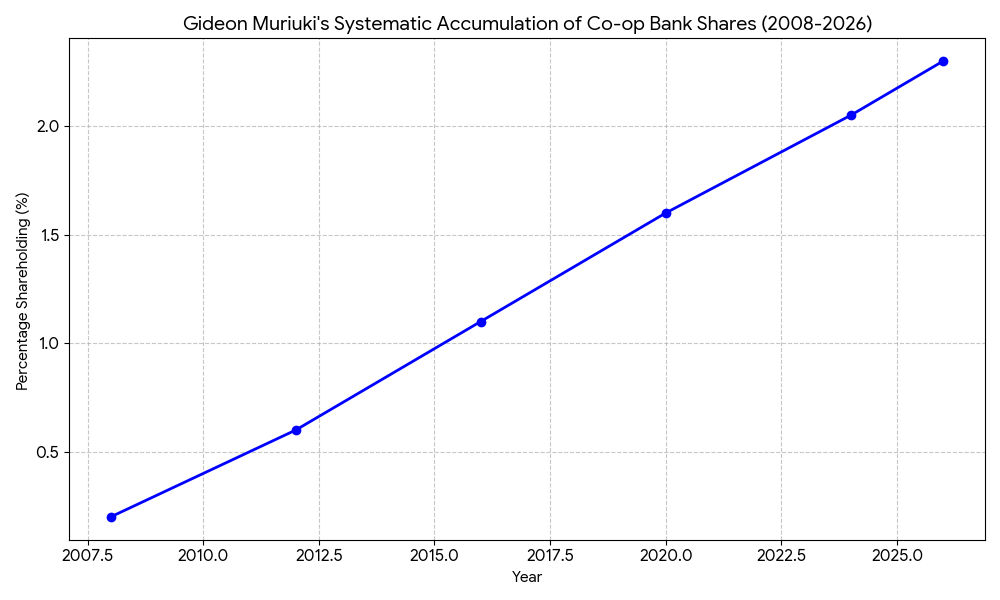
The transition was subtle but absolute. Year by year, regulatory filings reflected the slow, rhythmic crawl of his shareholding percentage upward. What began as a modest individual holding has grown into a substantial, multi-billion shilling position that now cements his role at the “high table” of the Nairobi Securities Exchange.
Muriuki’s buildup of his stake is the final piece of his “crusader” narrative. He didn’t just inherit a legacy or take a seat provided for him; he systematically purchased the right to lead by betting his own capital on the bank he had resurrected from the ashes of the KSh 2.3 billion loss. He transformed from the “outsider” who came to save the bank into the “insider” who now owns the lion’s share of the vision.
Dr. Gideon Muriuki’s accumulation of shares, a Linear Trend Curve or a Step-Chart is the most effective.
Why a Linear Trend Curve: Because Muriuki’s strategy has been marked by “patient, disciplined, and systematic accumulation,” a line graph clearly shows the upward trajectory over time, emphasizing the consistency of his strategy rather than sporadic, aggressive jumps.
Why a Step-Chart: If you want to emphasize specific, deliberate acquisition milestones (e.g., buying in blocks at different intervals), a step-chart better reflects the “ratcheting up” effect of his ownership.
The chart below illustrates this systematic growth from his post-IPO position in 2008 through his current status as the largest individual shareholder in 2026.

7. The “Soaring Eagle”: A Legacy of Prosperity
The turnaround of the Co-operative Bank was not merely a survival story; it was a masterclass in aggressive institutional re-engineering. By 2002, just one year after Muriuki’s appointment, the bank reversed its catastrophic KSh 2.3 billion loss, posting a maiden profit of KSh 103 million. This was the first signal of the “Soaring Eagle” era, proving that the bank could be both profitable and purpose-driven. This financial recovery famously ended a seven-year dividend drought, restoring hope to the millions of ordinary Kenyans and co-operative society members whose livelihoods were anchored in the institution.
The Consulting Scalpel: McKinsey and the Cost of Change
Muriuki’s path to profitability was paved with hard, often polarizing decisions. To shed the “immigration office” mentality, he leveraged the cold, clinical expertise of global consultancies, most notably McKinsey & Company. These consultancies provided the structural “cover” required to carry out the necessary “dirty work”—including the deep, painful redundancy programs that pruned the bank’s bloated workforce to match its new, lean, and high-performance requirements. These measures were met with internal resistance and industry criticism, but Muriuki held his ground, arguing that the survival of the institution—and the protection of the members’ capital—required a shift from a social-welfare model to a meritocratic financial powerhouse.
Cementing the Capital Markets Legacy
The culmination of this transformation was the historic 2008 listing on the Nairobi Securities Exchange (NSE). This was more than a fundraising exercise; it was a foundational contribution to the Kenyan capital markets. By bringing a revamped, profitable, and technologically advanced bank to the public bourse, Muriuki helped deepen the exchange and provided a liquid avenue for ordinary members to unlock the value of their holdings.
The “Crusader” Legacy
Today, the bank stands as one of the largest and most stable financial institutions in East Africa, a regional titan that transitioned from the brink of collapse to a market-leading entity. Muriuki’s legacy is not defined merely by the billions in annual profit the bank now generates, but by his role as the architect who convinced the co-operative movement that they could compete with international capital giants. He proved that the “bank for peasants” could evolve into a blue-chip stock, securing generational wealth for the millions of smallholder farmers, Sacco members, and investors who trusted his vision. The “Crusader” effectively turned an ailing union into a permanent fixture of Kenya’s economic landscape, ensuring that the Co-operative Bank would remain a “Soaring Eagle” for decades to come.
8. The Insurance Expansion: Closing the Financial Loop
Following the successful stabilization of the Co-operative Bank, Dr. Gideon Muriuki turned his attention to a critical missing link in the movement’s financial ecosystem: insurance. Recognizing that the millions of co-operative members he served were losing value by seeking protection elsewhere, Muriuki leveraged his deep-rooted experience in the co-operative movement to professionalize and scale the CIC Insurance Group.
Integrating the “Kingdom” Financial Ecosystem
Muriuki viewed the insurance sector as a natural extension of the bank’s retail dominance. By aligning the bank’s interests with the insurance group, he effectively closed the loop on the financial services provided to smallholder farmers and co-operative members. His strategy involved:
Strategic Shareholding: The Co-operative Bank of Kenya acquired a substantial stake—reaching 24.8% by 2022—positioning the bank as the anchor shareholder and ensuring the insurance firm remained firmly within the “Kingdom” fold.
Cross-Pollination of Services: By leveraging the bank’s massive branch network, CIC Insurance was able to penetrate the grassroots market more effectively than any competitor, turning a former department of the Kenya National Federation of Co-operatives into a leading regional insurance titan.
Governance and Market Professionalization
Much like his approach at the bank, Muriuki did not merely participate in the insurance sector; he sought to modernize it. By placing experienced directors and insisting on the same corporate rigors applied at the bank, he helped guide CIC Insurance through its restructuring, preparing it for its successful debut on the Nairobi Securities Exchange (NSE) in 2012.
Muriuki’s Personal Stake
Beyond the institutional stake held by the bank, Dr. Muriuki also moved to personally align his wealth with the insurer’s long-term success. Over the years, he has systematically increased his individual position in CIC Insurance. By mid-2024, his holdings had risen to 158 million shares, representing a 6% stake in the company. This personal investment, coupled with his significant holdings in Co-operative Bank, cements his status as the leading individual investor in the insurer and reinforces his role as the primary architect of this unified financial ecosystem.
By ensuring both the bank and himself maintained a major footprint in CIC, Muriuki reinforced the institution’s control over the insurance value chain, ensuring that the wealth generated from insurance premiums flowed back to the broader co-operative movement, rather than to external underwriters. This move cemented the “Kingdom” as a comprehensive financial force, leaving no room for market fragmentation.
Based on the market data as of June 26, 2026, here is the calculation for the value of Gideon Muriuki’s shareholdings:
Co-operative Bank of Kenya (COOP)
Stake: 2.30%
Total Shares Outstanding: Approximately 5.87 billion
Current Share Price: KES 34.50
Calculation: (2.30% × 5.87 billion shares) × KES 34.50 per share
Estimated Market Value: KES 4.66 billion
CIC Insurance Group (CIC)
Stake: 6.00%
Total Shares Outstanding: 2.88 billion
Current Share Price: KES 4.47
Calculation: (6.00% × 2.88 billion shares) × KES 4.47 per share
Estimated Market Value: KES 0.77 billion
About Boardlot Africa Research
Boardlot Africa is a premier financial intelligence and corporate governance publication dedicated to unpacking the mechanics of capital, market strategies, and structural shifts across East Africa’s corporate landscape. By bridging the gap between raw economic data and actionable market intelligence, we deliver deep-dive research, independent corporate analysis, and policy insights designed for institutional investors, boardrooms, and sharp market observers.
Get in Touch
Email: boardlot.research@gmail.com
Phone: +254 753 133 901
Substack: Subscribe to Boardlot Africa
X (Twitter): BoardLotSultan
You have not talked about the fraud allegations around acquisition of shares by senior employees during the initial IPO. And secondly, why he doesn't quit and trust others to occupy the C suite. And lastly, what will happen when he will eventually exit the scene as he shall surely will either naturally or voluntary?
This in my opinion is the grand theft of the wanjikus bank - he is basically intimidating the numerous, illiterate representatives if Saccos who purport to sit in the board.
This account is a hidden gem 🤲