
Beyond Monopoly Rents: Institutionalizing Kenya’s Shared Payment Infrastructure
Author: Sultan Mwangi
Target Policy Audience: Central Bank of Kenya (CBK) Policy Directors, National Treasury Strategists, Parliamentary Committees on Finance & National Planning / Communication, Information & Innovation, and Financial Sector Executives.
Part 1: Executive Summary, Macro Paradigm & CBK 2025 Empirical Analysis
1. Executive Summary & Policy Paradigm
Kenya’s digital financial ecosystem, long celebrated globally as a pioneer of mobile-driven financial inclusion, has reached a critical structural junction. What began as a transformative retail tool driven by Safaricom’s M-Pesa has gradually evolved into a high-margin, closed-loop extraction mechanism. Today, the country’s retail economy finds itself trapped between two suboptimal payment architectures: global card schemes (Visa and Mastercard) whose 2.0% to 5.0% Merchant Discount Rates (MDR) make them economically unviable for mass domestic retail, and M-Pesa—which commands roughly 89% to 90% of all mobile money transactions—levying progressive, tier-based micro-taxes on daily retail liquidity.
As payment processing costs globally trend toward zero—driven by open API architectures, real-time gross settlement (RTGS) innovations, and national clearing switches—Kenya’s payment layer remains artificially fragmented around M-Pesa’s dominant walled garden. M-Pesa is monetized as a primary commercial profit driver for Safaricom rather than operated as a non-rivalrous public utility.
This policy paper asserts that payment routing and ledger settlement must be decoupled from commercial rent-seeking. Realizing maximum capital velocity, fostering micro, small, and medium enterprise (MSME) resilience, and protecting lower-income consumers requires treating payment infrastructure as a shared national utility.
To achieve this, Kenya must enact dedicated legislation—a National Payment Infrastructure Act—to expand the mandate of PesaLink (Integrated Payment Services Ltd) beyond an interbank consortium into a legally governed, multi-sector National Payment Switch connecting Commercial Banks, M-Pesa and other mobile wallets, Microfinance Institutions (MFIs), and Savings and Credit Cooperative Organizations (SACCOs). This infrastructure should be overseen by an autonomous, specialized National Payments Division within the Central Bank of Kenya (CBK) to enforce volume-driven, cost-reflective tariff caps that dismantle M-Pesa’s monopolistic tariff drag.
2. CBK 2025 Data Analysis: M-Pesa Expansion vs. Transaction Volume Fatigue
Recent empirical data published in the Central Bank of Kenya Bank Supervision Annual Report 2025 provides undeniable market evidence of growing consumer fatigue over closed-loop wallet friction, particularly within the ubiquitous M-Pesa ecosystem. A critical divergence has emerged between account expansion and transaction frequency, signalling an urgent policy imperative.
The Empirical Paradox
According to the CBK Bank Supervision Report 2025:
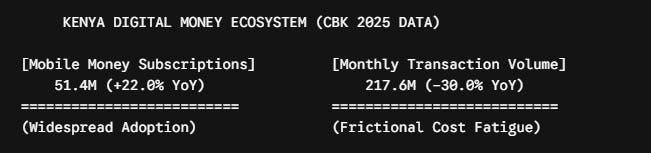
Infrastructure & Accounts: Mobile phone penetration reached 149.5% with 78.4 million active mobile subscriptions as of December 2025. Active mobile money subscriptions expanded rapidly by 22 percent, growing from 42.3 million in 2024 to 51.4 million in 2025, driven almost entirely by M-Pesa’s deep market reach. Simultaneously, the active mobile money agent network expanded by 24 percent from 381,116 to 473,536.
Volume & Value Contraction: In stark contrast to account expansion, active mobile money usage experienced a severe contraction. Monthly transaction volumes plummeted by 30 percent, dropping from 309.3 million transactions in 2024 down to 217.6 million in 2025. Total monthly transaction values also contracted from KSh 753.5 billion to KSh 722.5 billion.
Policy Takeaways from the CBK Data
The Central Bank explicitly notes in its report that this sharp reduction in transaction frequency reflects a fundamental shift in consumer behavior: users are actively curtailing low-value micro-transfers and consolidating payments into fewer, larger sums, or migrating to alternative banking and merchant rails to escape cumulative M-Pesa tariff drag.
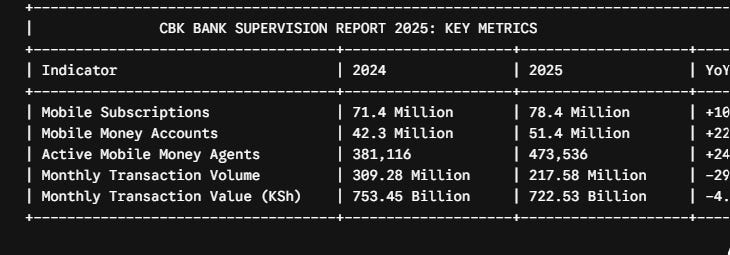
Because M-Pesa controls up to 90% of these transactions, this 30% collapse in monthly transaction velocity is direct empirical proof of M-Pesa frictional drag[cite: 4, 5, 6]. When M-Pesa’s basic transaction ledger levies percentage-heavy tariffs on micro-transfers (e.g., KSh 13 to send KSh 600), economic actors rationally alter their behavior—slowing money velocity, hoarding cash, or delaying payments. High M-Pesa tariffs are no longer just an enterprise pricing matter for Safaricom; they have become an artificial ceiling on retail commerce and capital velocity across the Kenyan economy.Part 2: Fee Disparity Across Payment Rails & The Shared Infrastructure Blueprint
1. Empirical Cross-Rail Fee Disparity Analysis
A comparative assessment of Kenya’s major payment rails reveals severe structural distortions. Money processing cost does not correlate with technical transmission expenses; instead, pricing reflects closed-loop network lock-in and monopoly market power.
The Cross-Rail Pricing Disparity (2026 Metrics)
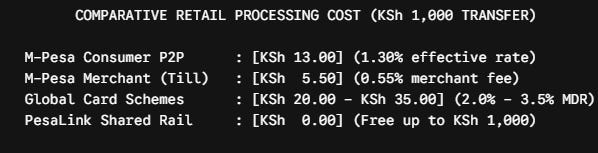
M-Pesa Wallet Transfers: Sending KSh 1,000 via M-Pesa incurs a KSh 13 consumer transfer fee (1.30% effective extraction). Mid-tier transfers like KSh 10,000 incur KSh 90 to send, plus up to KSh 115 for agent cash-out, resulting in a total transactional friction of KSh 205 (over 2.0% of the principal value).
Merchant Acceptance (M-Pesa Lipa Na M-Pesa vs. Card Schemes):
M-Pesa Buy Goods (Till): Safaricom levies approximately 0.55% on merchants (capped at KSh 200). While lower than card processing, this fee directly reduces net operating margins for low-margin retail sectors like supermarkets, fuel stations, and wholesalers.
Cards (Visa/Mastercard): Card schemes charge domestic merchants between 2.0% and 3.5% in Merchant Discount Rates (MDR) due to complex multi-party interchange fees (Issuer, Acquirer, Card Scheme, Gateway).
PesaLink (Interbank Shared Rail): Standardized bank-to-bank transfers under PesaLink’s revamped framework are FREE for transfers up to KSh 1,000, with a flat fee of KSh 20 for transactions between KSh 1,001 and KSh 999,999 across major participating banks.
Cross-Rail Fee Comparison Table
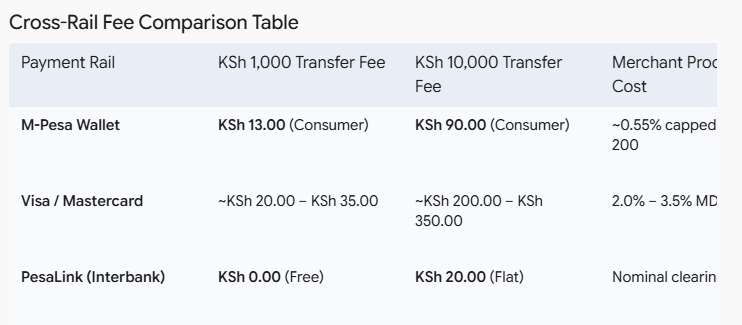
The comparison is clear: processing a KSh 10,000 transaction over M-Pesa costs KSh 90, whereas processing the same value over a shared bank switch costs KSh 20 flat. Telco-led payment rails extract more than four times the fee of an open clearing switch, demonstrating the clear economic cost of monopoly market power.
2. Architectural Blueprint: The National Payment Switch
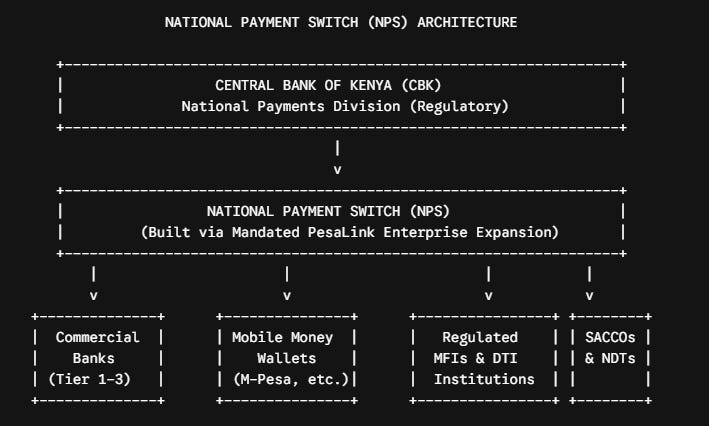
To move beyond M-Pesa’s monopoly rents, Kenya needs a unified, non-discriminatory clearing architecture. The proposed National Payment Switch (NPS) will unbundle payment routing from mobile connectivity, establishing a single infrastructure layer for all financial service providers.
Core Structural Requirements
Mandatory Multi-Sector Onboarding: Mandate direct integration into the National Payment Switch for Commercial Banks, Mobile Money Operators (M-Pesa, Airtel Money, T-Kash), Microfinance Banks (MFBs), and Deposit-Taking SACCOs (SASRA-regulated).
Unified Interoperable Addressing Layer: Eliminate closed-loop wallet identifiers (such as M-Pesa Paybill numbers and Till numbers) in favor of a National Alias Mapper. Consumers and merchants can link any phone number, National ID, or Tax PIN directly to their choice of bank account, M-Pesa wallet, or SACCO account for instant settlement.
Decoupled QR & Merchant Standards: Implement a mandatory unified National QR Code Standard (KE-QR), making merchant QR codes payment-rail agnostic. A customer scanning a merchant QR code can pay instantly using M-Pesa, a mobile banking app, or a SACCO wallet without paying cross-network surcharge penalties.
3. Legislative & Regulatory Framework: The National Payment Infrastructure Act
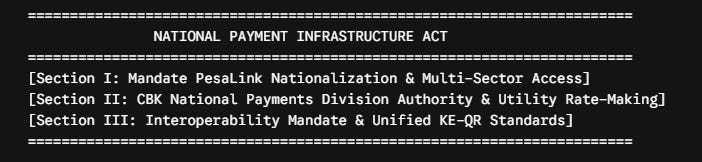
Institutionalizing shared infrastructure requires enacting a dedicated legislative framework: the National Payment Infrastructure Act.
Key Legislative Provisions
Expanding PesaLink into a Public Utility National Switch:
Transition Integrated Payment Services Ltd (IPSL/PesaLink) from a commercial bank-owned consortium into a publicly monitored, multi-shareholder utility co-owned by Banks, Mobile Money Operators, SACCOs, and the Central Bank of Kenya.
Statutory Authority for Cost-Reflective Price Caps:
Empower the CBK National Payments Division to regulate transaction fees using a Cost-Plus Economic Utility Model.
Impose direct regulatory price caps on basic P2P transfers and merchant payments across all rails, forcing M-Pesa and commercial banks to align transaction fees with actual technical processing costs.
Unbundling Mobile Money Ledgers from Telco Infrastructure:
Require telcos to legally and operationally separate their network infrastructure from their financial services ledgers. M-Pesa’s underlying payment ledger must operate independently of Safaricom’s cellular SIM network, preventing preferential access or bundled pricing advantages.
Zero-Rating Low-Value Public Utility Payments:
Mandate zero transaction fees for micro-payments under KSh 1000 across all payment rails, ensuring lower-income households can conduct basic daily trade without paying micro-taxes to dominant wallet operators.
Part 3: Operational Fragility, Systemic Gatekeeping & The Judicial Imperative
1. Everyday Operational Fragility & The “Poor Man’s Tax”
Beyond pure payment processing costs, M-Pesa’s market dominance imposes severe structural and operational risks on Kenya’s everyday economy.
Macro Economic Paralysis During Outages: Unlike standard banking downtimes—which isolated corporate transfers or specific ATM networks—an unannounced M-Pesa server outage or maintenance window brings the retail economy to a sudden halt. Matatu operators cannot collect fares, petrol stations cannot clear pumps, emergency hospital admissions face delays, and corner kiosks are forced to halt sales. Because over half of Kenya’s GDP flows across M-Pesa’s single proprietary ledger, operational glitches in one corporate server room ripple out as nationwide economic shutdowns.
The “Poor Man’s Tax”: M-Pesa’s tier-based fee structure acts as a regressive tariff on lower-income earners. A user making a low-value withdrawal of KSh 200 pays up to KSh 29 in fees—an immediate 14.5% tax on micro-liquidity. Compounded across monthly peer-to-peer (P2P) transfers, Paybill charges, and agent cash-outs, M-Pesa continuously extracts critical capital from households at the bottom of the economic pyramid.
Delayed SMS Receipts & Point-of-Sale Disputes: Network or SMS delivery bottlenecks frequently debit a consumer’s wallet without delivering real-time payment confirmation to the merchant. This asymmetry creates immediate friction at point-of-sale terminals, forcing informal traders and small shopkeepers to withhold goods from customers who have already been charged.
Fraudulent Reversals & Small Business Vulnerability: Informal traders, retail vendors, and gig-economy workers (such as Uber and Bolt drivers) face ongoing exposure to reversal fraud. Scammers trigger rapid reversal requests post-sale, taking advantage of delayed dispute resolutions and leaving small merchant owners to absorb operational losses.
2. Regulatory Benchmark: Scoring M-Pesa Against CBK D-SIB Criteria
The Central Bank of Kenya evaluates systemically important financial entities using five weighted metrics: Size (40%), Interconnectedness (30%), Substitutability (15%), Importance to the Domestic Economy (10%), and Complexity (5%).
Benchmarking M-Pesa against these explicit criteria demonstrates that it meets—and exceeds—every threshold of a Domestic Systemically Important Bank (D-SIB):
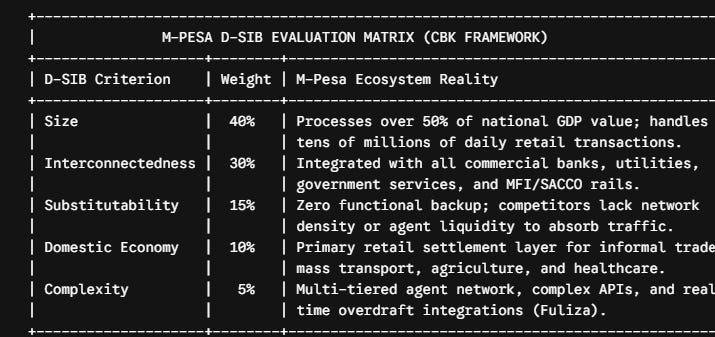
Despite satisfying all five structural criteria of a systemic financial institution, M-Pesa remains regulated primarily under telecommunications-derived payment service provider guidelines rather than rigorous prudential banking supervision.
3. The Substitutability Fallacy: Infrastructure Capacity Bottlenecks
The core pillar of the CBK’s D-SIB evaluation framework is Substitutability—the capacity of rival institutions to absorb a dominant entity’s transaction volume without triggering macro collapse.
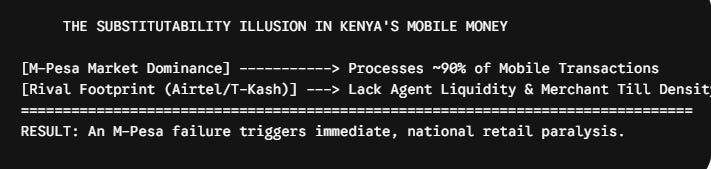
Market Share Asymmetry: M-Pesa commands roughly 90% of Kenya’s mobile money transaction volume. Competitors like Airtel Money and T-Kash exist, but they lack the agent cash-in/cash-out (CICO) liquidity, merchant till coverage (Lipa Na M-Pesa), or enterprise Paybill integrations needed to take over national flows. If M-Pesa experiences a multi-day infrastructure collapse, no secondary mobile network can absorb 30 million active users overnight.
The Interoperability Fallacy: Mandatory merchant and agent till interoperability connects software pipes, but it does not expand server capacity or agent float for rival networks. Forcing national retail commerce onto alternative mobile wallets during an M-Pesa blackout would trigger cascading server overloads across the entire telecommunications sector.
4. Innovation Gatekeeping & Corporate Survival: The SportPesa Case Study
Beyond daily retail trade, M-Pesa acts as an unregulated gatekeeper for Kenya’s startup ecosystem. For consumer fintechs, e-commerce platforms, and digital service providers, integration with M-Pesa API rails, Paybill channels, and USSD codes is an existential requirement.
The SportPesa Case Study: Paybill Manipulation as Corporate Execution
The high-profile corporate dispute surrounding the SportPesa brand illustrated the systemic dangers of private Paybill ownership:
Infrastructure as the Business: Over years of operation, SportPesa’s original operating entity (Pevans East Africa) built its entire commercial footprint around specific M-Pesa Paybill numbers (955100 and 955700). The Paybill was the business. When regulatory and tax disputes emerged, cutting off access to those M-Pesa Paybills instantly froze company cash flow—demonstrating that revoking a Paybill is the operational equivalent of corporate execution.
The Allocation Dispute: During internal leadership wrangles over brand ownership and migration to a new operating entity (Milestone Games Limited), the primary contest centered on who controlled routing for those established Paybill numbers.
Weaponization Risk: Because Paybill numbers are treated as private commercial contracts between Safaricom and an enterprise—rather than open, neutral infrastructure—the entity controlling the Paybill holds complete operational sway over enterprise value. Whichever faction secures active Paybill routing retains control, leaving corporate governance and court proceedings secondary to platform access.
5. Quasi-Judicial Imperative: M-Pesa as Kenya’s Primary Digital Witness
M-Pesa has quietly evolved into a central evidence carrier, digital witness, and de facto arbiter of fact within Kenya’s judicial system.
In Kenyan courtrooms, prosecution and defense strategies rely heavily on M-Pesa transaction metadata—timestamped till receipts, peer-to-peer logs, agent withdrawals, and geo-located SIM pings—to establish guilt or innocence:
High-Profile Criminal Proceedings: Courts have repeatedly relied on M-Pesa statements as decisive evidence to establish financial links, trace suspect movements, map terror-financing networks, and corroborate physical timelines.
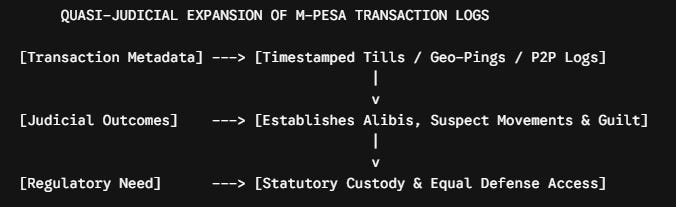
Why Judicial Centrality Demands D-SIB-Grade Prudential Oversight
Evidentiary Integrity and Tamper-Proof Custody: Because M-Pesa logs carry life-and-death consequences in court, the underlying databases cannot operate as proprietary corporate software subject to internal discretion, unannounced data purges, or unverified system updates. The platform requires statutory evidentiary standards, strict chain-of-custody protocols, and independent auditability.
Asymmetrical Access to Justice: Law enforcement agencies can rapidly pull M-Pesa transaction statements through state apparatus. In contrast, individual citizens and defense teams often encounter administrative delays, bureaucratical hurdles, or high costs when attempting to pull their own transaction logs to establish an alibi or confirm payments.
Data Integrity and Reversal Vulnerabilities: Because M-Pesa records serve as evidence in both civil and criminal matters, rapid transaction reversals and customer care overrides introduce legal risks. Without strict oversight, altering or reversing transaction logs outside a judicial framework compromises the integrity of Kenya’s primary digital evidence pool.
Part 4: Implementation Roadmap, Risk Mitigation & Policy Matrix
1. Phased Implementation Roadmap (2026–2028)
Transitioning Kenya’s payment ecosystem from a closed-loop monopoly into a shared national utility requires a structured execution strategy. This phased timeline aligns legislative reform, technical deployment, and regulatory enforcement.
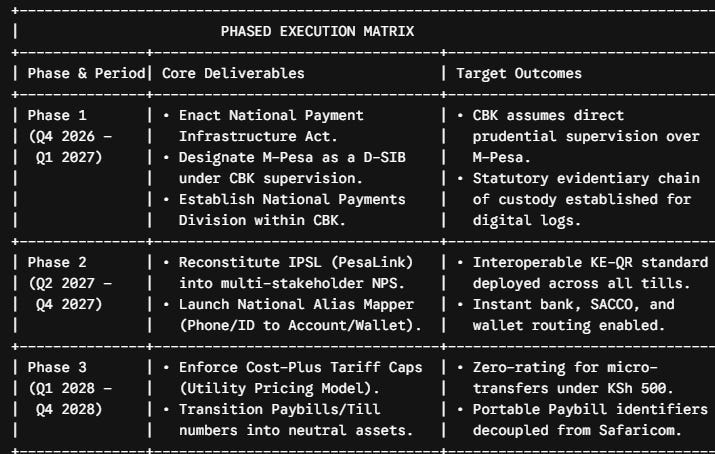
2. Strategic Risk Matrix & Mitigation Strategies
Decoupling Kenya’s primary payment rail carries macro, technical, and regulatory risks. Addressing these challenges proactively is essential to safeguard financial stability.
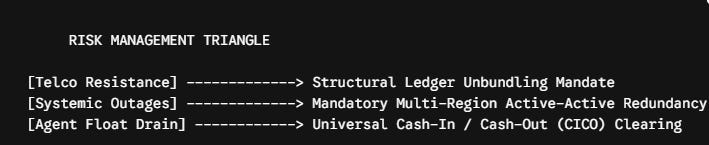
Telco Resistance & Enterprise Valuation Impact:
Risk: Safaricom and telecom shareholders may oppose regulatory unbundling, citing reduced non-interest revenue and lower commercial valuations.
Mitigation: Allow mobile operators to retain a minority equity stake in the National Payment Switch entity (similar to bank ownership in IPSL/PesaLink) while transitioning their revenue focus from transaction fees to volume-driven API services and value-added credit intelligence (e.g., Fuliza/KCB M-Pesa).
Technical Failure & Network Congestion During Migration:
Risk: Routing tens of millions of daily transactions through a centralized switch could create technical bottlenecks or single-point-of-failure risks.
Mitigation: Mandate an Active-Active multi-datacenter architecture distributed across diverse physical locations, backed by real-time transaction mirroring and strict 99.999% SLA uptime mandates enforced directly by the CBK.
Agent Network Liquidity & Cash-Out Disruption:
Risk: Capping micro-tariffs could compress agent commissions, leading to agent attrition and reduced cash liquidity in rural areas.
Mitigation: Transform the national agent network into a Universal Agency Banking & Cash Clearing Model, allowing agents to serve customers across all banks, SACCOs, and wallets under a standardized, volume-subsidized commission framework.
3. Policy & Legislative Action Plan for Stakeholders
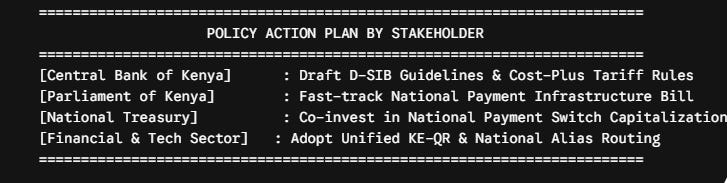
Central Bank of Kenya (CBK):
Issue formal regulations designating M-Pesa as a Systemically Important Financial Institution under D-SIB prudential frameworks.
Establish the National Payments Division to supervise digital clearing rails, enforce SLA uptime requirements, and audit ledger databases for judicial compliance.
Parliament of Kenya (Committees on Finance & ICT):
Draft and fast-track the National Payment Infrastructure Bill into law.
Pass statutory amendments to the Evidence Act to govern digital transaction custody, ensuring equal, affordable log access for all citizens and legal proceedings.
National Treasury & Economic Strategy Teams:
Capitalize the transition of PesaLink into the National Payment Switch as a core public utility asset under the Vision 2030 digital infrastructure strategy.
Financial Sector (Banks, SACCOs & Telcos):
Integrate core banking systems and mobile ledgers directly into the National Alias Mapper and adopt the unified KE-QR merchant standard.
Conclusion: Restoring Economic Velocity Through Shared Utility
Kenya’s leadership in mobile financial inclusion was built on bold experimentation. However, sustaining economic growth requires evolving past closed-loop payment models. Treating payment routing as a commercial profit driver creates high transaction costs, systemic fragility, and market barriers for startups and low-income citizens.
Transitioning payment processing to a non-rivalrous National Payment Switch—backed by cost-reflective utility pricing, D-SIB prudential supervision, and neutral public infrastructure—will dismantle monopoly rents. Decoupling digital money rails from telecom lock-in will lower costs for micro-enterprises, protect lower-income households, and secure Kenya’s position as a dynamic, resilient digital economy.
Boardlot Africa is a premier financial intelligence and corporate governance publication dedicated to unpacking the mechanics of capital, market strategies, and structural shifts across East Africa’s corporate landscape. By bridging the gap between raw economic data and actionable market intelligence, we deliver deep-dive research, independent corporate analysis, and policy insights designed for institutional investors, boardrooms, and sharp market observers.
Get in Touch
Email: sultan@boardlot.africa
Phone: +254 753 133 901/254181683210
Substack: Subscribe to Boardlot Africa
X (Twitter): BoardLotSultan
Linkedn:): BoardLot Sultan