
The Captains of Capital: Stanley Munga Githunguri — The Titan of Kiambu, Lilian Towers, and the National Bank Apex
I. Introduction: The Legend of “Mr Chairman”
Picture a titan of industry sitting casually at his private bar inside the iconic Lilian Towers, sharing drinks, banter, and stories with subalterns, politicians, and friends who affectionately and reverently cheered him on as “Mr Chairman”.
In the grand, often turbulent theater of post-independence Kenyan capitalism, few figures embodied the archetype of the audacious, self-made elite quite like Stanley Munga Githunguri. He was the quintessential post-independence capitalist—a brilliant financial administrator turned multi-billionaire titan whose extraordinary career spanned the heights of state power, high-stakes real estate development, fierce political friction, and a complex web of family succession battles that would echo long after his final curtain call.
He did not merely participate in Kenya’s economic evolution; he helped build its scaffolding, navigating the delicate and often dangerous intersection of state patronage and ruthless private entrepreneurship.
II. Early Life, Education, and Early Career Rise
Long before he became a household name synonymous with vast wealth and political influence in Kiambu, Githunguri’s foundation was forged in the rural setting of Gachie village in Kiambu County.
Humble Roots and Hardship: Born in 1945, Githunguri experienced a starkly modest and challenging upbringing. Following the death of his father when Stanley was only 14 years old, his mother, Lilian Nyagaki, was left to raise the family single-handedly. To survive, a young Githunguri labored as a coffee picker earning meager wages (about three shillings a day), facing a childhood where meals were scarce and formal schooling seemed an impossible luxury.
The Lifeline of Education: Driven by his mother’s staunch belief in education and aided by a local priest who noticed his sharp intellect, Githunguri scraped together support from well-wishers to attend Gacharage Primary School and Karura Intermediate School, later proceeding to St. Mary’s School, Nairobi. Through a community fundraiser, he eventually traveled abroad to the United States, earning a degree in Political Science and Economy from Alaska Methodist University.
Entering the Public Service: Armed with an international education, Githunguri returned to Kenya during its formative post-independence years. Eschewing purely private paths initially, he entered the public service, cutting his teeth as a District Officer (DO) and moving through the administrative ranks of government financial governance.
The Protege of Power: Possessing a sharp, analytical mind for finance, administration, and macroeconomic realities, his competence in the civil service quickly drew the gaze of the state’s inner circle, setting the stage for his meteoric leap into the apex of national banking.
III. The Apex: Managing Director & Executive Chairman of National Bank
When Founding President Jomo Kenyatta looked for a steady, fiercely loyal, and commercially sharp hand to steer the state-owned National Bank of Kenya (NBK), he was placing his trust in arguably the most critical financial pillar of the young republic. Established in 1968, NBK was far more than a commercial lender; it was the primary institutional weapon deployed by the state to break the stranglehold of British and foreign-owned colonial banks that systematically denied credit to indigenous Africans.
Stepping into the role of Executive Chairman and Managing Director, Stanley Munga Githunguri found himself sitting at the absolute apex of national capital formation.
The Engine of Economic Liberation: During an era when wealth was heavily concentrated in expatriate hands, NBK under Githunguri served as the financial anchor for the government’s Africanization policy, channeling vital capital into local businesses, agricultural enterprises, and indigenous industrial ventures.
State Power Meets Corporate Control: Githunguri wielded immense influence from the executive suite, managing the delicate intersection between national developmental priorities and the political demands of the ruling machinery. He navigated this high-stakes portfolio with absolute authority, cementing his reputation as a financial strategist capable of wielding state-backed banking to build both national economic scaffolding and his own formidable commercial standing.
The Turning Tides: Following the death of Mzee Jomo Kenyatta in 1978 and the gradual shift in political alignments under the incoming Moi administration, the corporate landscape transformed overnight. The powerful figures of the Kenyatta era faced institutional headwinds, and Githunguri’s tenure at NBK eventually drew to a close, setting off a protracted season of political restructuring, intense scrutiny, and complex legal battles that would trail his business dealings for decades.
IV. Proximity to Power: The Kiambu Mafia and the Financial-Security Nexus
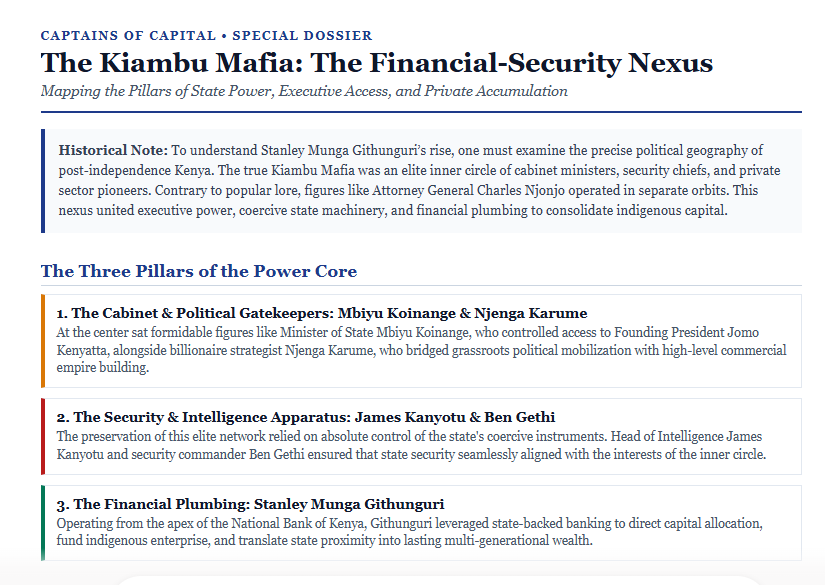
To understand Stanley Munga Githunguri’s meteoric rise and the vast fortunes he amassed, one must look beyond standard corporate balance sheets and examine the political geography of post-independence Kenya. Githunguri was a central, trusted cog in the elite inner circle of power widely referred to in political history as the “Kiambu Mafia.”
It is a common historical misconception to lump all senior government officials of that era into the same faction; in reality, figures like the powerful Attorney General Charles Njonjo operated within entirely different political orbits and often clashed with the Kiambu inner circle. The true Kiambu Mafia was a tightly knit alliance of political operators, cabinet ministers, security chiefs, and private sector pioneers whose core mission was absolute: to wrest control of the newly liberated state’s economic and administrative apparatus from departing colonial interests and ensure that indigenous capital, prime land, and institutional muscle remained firmly in trusted hands.
The Cabinet and Executive Statecraft: At the heart of executive decision-making sat formidable figures like Mbiyu Koinange (Minister of State in the Office of the President), who wielded immense administrative gatekeeping power over Jomo Kenyatta, managing the inner workings of state power.
The Security and Intelligence Apparatus: The preservation and expansion of this elite’s influence relied on absolute control of the state’s coercive instruments. This pillar was anchored by powerful security heads, including James Kanyotu (the long-serving and feared Head of Intelligence) and Ben Gethi (who held commanding roles within the police and paramilitary forces), ensuring that state security aligned seamlessly with the political and economic interests of the inner circle.
The Private Sector Financial Hub and Commercial Pioneers: Within this intricate network, private capital and institutional finance formed the bedrock of the elite’s long-term dominance.
Njenga Karume: Operating firmly within this private sector nexus, Karume served as the quintessential grassroots strategist and billionaire entrepreneur who bridged populist mobilization with high-level commercial accumulation and syndication.
Stanley Munga Githunguri: Leveraging his apex position as the head of the National Bank of Kenya, Githunguri acted as the vital financial plumbing—directing capital allocation, funding indigenous enterprise, and translating state proximity into lasting multi-generational wealth alongside commercial heavyweights like Karume.
V. Empire Building: Real Estate, Hospitality, and Equities
With his formidable standing cemented through state banking and deep political alliances, Stanley Munga Githunguri transitioned from managing institutional credit to erecting a sprawling, physical empire of his own. His capital deployment spanned prime real estate, luxury hospitality, and strategic corporate equities, reshaping the urban landscape of Nairobi and the agrarian wealth of Kiambu.
Lilian Towers and Nairobi’s Skyline: The crowning jewel of his real estate portfolio was Lilian Towers on University Way, a striking architectural landmark conceived and named in honor of his mother, Lilian Nyagaki. Designed with twin cylindrical towers resembling maize cobs, the project became a symbol of audacious indigenous capital. However, its construction was marred by tragedy during a severe 1982 collapse that claimed workers’ lives, followed by years of intense legal and financial maneuvering to complete and stabilize the asset.
Land and Agricultural Holdings: Beyond the urban skyline, Githunguri built vast land reserves and agricultural estates across Karen, Limuru, Kihara, and prime corridors of Kiambu Road—including major commercial developments like Ridgeways Mall. These assets served both as long-term inflation hedges and as physical testaments to his deep-rooted connection to his ancestral home district.
Diversified Corporate Portfolios: His commercial footprint extended far beyond concrete and mortar. Githunguri held substantial equity stakes across vital sectors of the Kenyan economy, including insurance through Geminia Insurance and Geminia Life Insurance, hospitality via Mukawa Holdings, commercial agriculture through Tassia Coffee Estate, and strategic shareholdings in blue-chip corporations like East African Breweries Limited (EABL).
Legend has it that when Stanley Munga Githunguri sought to acquire the prime plot on University Way for Lilian Towers, he initially attempted formal banking compliance by depositing the payment directly into President Jomo Kenyatta's personal account at the National Bank of Kenya, When he presented banking evidence to Mzee, Kenyatta dismissed the paperwork and instructed him to return with hard, physical cash money as a true testament face-to-face settlement. That is how transactions were handled then.
VI. The Political Arena: Member of Parliament for Kiambaa
Having established a formidable reputation as a titan of finance, real estate, and state patronage, Stanley Munga Githunguri eventually stepped out of the corporate boardroom and into the bruising arena of elective politics.
Claiming Kiambaa: Capitalizing on his deep grassroots roots in Kiambu County and his legendary philanthropic footprint, Githunguri contested and won the parliamentary seat for the Kiambaa Constituency, stepping directly into the legislative theater that had long been shaped by his late mentor, Njenga Karume.
The Populist-Patrician Paradox: As a Member of Parliament, Githunguri cut a unique figure—part wealthy patrician philanthropist who bankrolled local harambees, church constructions, and community projects, and part combative political operator. His tenure in the National Assembly was marked by fierce loyalty to his political faction and a readiness to defend the commercial interests of the Kiambu elite against shifting national tides.
The Crucible of Public Office: Navigating the shifting political dynamics of multiparty democracy and post-Moi transitions proved far less predictable than running a state bank or building skyscrapers. His time in Parliament cemented his status as an enduring political elder of Kiambu, even as legal battles, corporate restructuring, and health challenges began to cast long shadows over his twilight years.
VII. Legal Battles and the Famous “Face Mount Kenya” Ruling
The twilight of Stanley Munga Githunguri’s career was defined by high-stakes legal combat, most notably his historic clash with the state over exchange control violations.
The Exchange Control Prosecution: In the mid-1980s, the state moved to criminally prosecute Githunguri under the Exchange Control Act for financial transactions spanning from 1976 to 1979. The attempt by the Attorney General to revive these historical charges triggered a landmark constitutional battle over prosecutorial overreach and individual rights.
The Landmark Ruling: In the celebrated Stanley Munga Githunguri v. Republic constitutional case, a bench featuring prominent jurists—including Chief Justice C.B. Madan—ruled decisively in Githunguri’s favor, issuing an order of prohibition that permanently barred the state from prosecuting him on stale, politically-charged counts.
The Origin of “Face Mount Kenya”: Popular political discourse in modern Kenya has sometimes loosely attributed the iconic phrase “face Mount Kenya” to later political figures like former Deputy President Rigathi Gachagua. Historically, however, the phrase is rooted deeply in the annals of the Kenyan judiciary. Judicial lore and legal retrospectives recount that upon concluding the Githunguri matter, Chief Justice C.B. Madan delivered a legendary directive to a relieved Githunguri, telling him to walk away, go home, face Mount Kenya, and enjoy his wealth in peace.
The Quotation and Judicial Legacy
“Go to Mount Kenya, face it, and enjoy your wealth.” — Chief Justice C.B. Madan (addressing Stanley Munga Githunguri upon concluding the landmark 1985/1986 constitutional judgment).
This historic judicial sign-off captured an era where the high bench occasionally intertwined poetic local gravity with sweeping legal protection, shielding an untouchable titan of the Kenyatta era from the long arm of a shifting state apparatus.
Sources & Reference Material
STANLEY MUNGA GITHUNGURI V R (1985) KLR 91 (Case summary and historical context)
Historical legal retrospectives on Chief Justice C.B. Madan’s tenure and the Githunguri v. Republic ruling.
VIII. The Final Legacy: Succession Battles, Court Filings, and the Boardlot Verdict
Following Stanley Munga Githunguri’s passing in November 2022, the final chapter of his life transitioned from the high court battles of his past into an unprecedented and aggressive theater of family litigation.
The Weight of a Multi-Billion Shilling Empire: Githunguri left behind a sprawling portfolio valued at an estimated KSh 1.8 billion, spanning prime urban real estate like Lilian Towers and Ridgeways Mall, corporate stakes in insurance and banking, and vast landholdings across Kiambu and Nairobi.
The Test of the Strict Testament: He attempted to safeguard his legacy by appointing his daughters, Lilian Joy Nyagaki and Claire Njeri, as executors and inserting strict “hostile beneficiary” penalty clauses warning that any heir who challenged his will would forfeit their inheritance.
Pre-Mortem Fractures and Unusual Litigation: Unusually for elite wealth management, the fractures within the dynasty ran so deep that legal skirmishes and court applications—such as actions involving his eldest son, Joseph Munga, seeking clarity and accountability on asset structures—erupted even while the patriarch was still alive, forcing the High Court to rule on probing an aging titan’s estate long before his final breath.
The Post-Passing Escalation: Following his death, these tensions immediately spilled into formal succession proceedings before the High Court (presided over by judges such as Justice Grace Sitati), progressing from routine probate filings by the executors to bitter inter-family contests over asset control, corporate governance, and execution compliance.
IX. Comprehensive Timeline: Succession Cause E574 of 2023 (Estate of Stanley Munga Githunguri)
The following chronological record details the formal court filings, interim agreements, and key rulings governing the estate litigation under Succession Cause E574 of 2023 before the High Court of Kenya at Nairobi (Family Division):
Pre-Cause Background & Filing
9 June 2017: Stanley Githunguri executes his last will and testament, naming daughters Claire/Clare Njeri and Lilian Joy Nyagaki as executors and trustees, reserving the Karen home for his widow Elizabeth Karungari, and embedding a strict “hostile beneficiary” penalty clause targeting any heirs who challenge the will’s validity.
29 November 2022: Stanley Munga Githunguri passes away in his late 80s.
2023: Succession Cause E574 of 2023 is officially opened in the High Court at Nairobi (Family Division). The probate petition and formal objection process begin, placing the contested will on the court record while interim support for dependants becomes a contested daily reality. (Note: Pre-death family litigation, such as attempts by son Joseph Munga to examine his living father regarding asset ownership, run on separate tracks and are distinct from this cause).
Interim Management and Litigation Milestones
3–4 December 2024 (Consent Recorded): All participating parties and their legal representatives endorse an operative handwritten consent order before the court. Its core provisions establish that:
Estate administrators will continue paying school fees for the children of Lilian Wanjiru Githunguri, pegged specifically to an amount equivalent to fees previously paid at Kivukoni School.
Allowances payable to beneficiaries remain frozen at the exact amounts provided by the deceased prior to his death.
All parties retain the liberty to apply for future adjustments.
16 September 2025 (Application to Vary Consent): Lilian Wanjiru Githunguri files an application seeking to review and vary the 3 December 2024 consent. She cites a lack of regular income or employment, requesting full actual tuition coverage for Braeburn School (Arusha), additional monthly personal allowances, university funding for Siaka Munga, and broader property-related provisions.
8 October 2025 (Respondents’ Reply): Lilian Joy Nyagaki Githunguri and family member Francis Wanjihia Githunguri file replying affidavits strongly opposing the variation. They argue that a consent order functions as a binding contract and can only be set aside on classic grounds such as fraud, collusion, mistake, or non-disclosure—asserting that changed financial circumstances alone are insufficient. Only the applicant files written submissions.
16 December 2025 (Ruling by Justice H.K. Chemitei): Justice Chemitei delivers an interim ruling via video link from Nairobi. Key holdings include:
School Fees Clarification: Estate administrators are ordered to pay school fees for Lilian Wanjiru’s children at Braeburn Arusha, strictly capped at the equivalent Kivukoni School benchmark; any excess must be covered by the applicant personally.
Arrears: Any resulting school fee arrears must be settled within 14 days of calculation.
Allowances & University Fees: The applicant’s prayer for personal monthly allowances is disallowed, and Siaka Munga’s university fees are rejected due to insufficient particulars and a lack of formal proof of enrolment.
Operative Baseline: The handwritten court consent of 3 December 2024 remains the only valid governing baseline.
Costs: Costs are ordered to be in the cause. (The matter is technically recorded as “Allowed” only because limited school fee clarification was granted, rather than the comprehensive variation sought).
Status of Parallel Files & Unresolved Core Issues
Parallel Environment and Land Court (ELC) Actions: In ELC E330 of 2024, estate personal representatives Clare N. Githunguri and Lilian N. Githunguri sued third parties (including William Langat Somoe and Gulf African Bank) over disputed estate property, with related contempt applications dismissed by May 2025.
Outstanding Core Matters: As of late 2025 and moving into 2026, the overarching succession cause remains open. The fundamental validity of the 2017 will, the final confirmation of executors, the complete distribution of the multi-billion-shilling estate (including Lilian Towers, Ridgeways Mall, and corporate/land holdings), and the potential enforcement of the “hostile beneficiary” forfeiture clause all remain undetermined and actively contested.
The Boardlot Perspective: The Intersection of Wealth and State Power
The Boardlot Verdict: In Kenya, the intersection between high politics and private capital is remarkably close.
The life, empire, and posthumous battles of Stanley Munga Githunguri encapsulate a defining structural reality of East African capitalism: fortunes of this magnitude are rarely built on market forces alone. From securing prime state-allocated plots and leveraging the National Bank of Kenya as an engine for indigenous accumulation, to surviving politically motivated prosecutions with the poetic shield of Chief Justice C.B. Madan’s “Face Mount Kenya” directive, Githunguri’s trajectory demonstrates that capital accumulation and statecraft are two sides of the same coin. Ultimately, while a titan can orchestrate the rise of skyscrapers and political dynasties during a lifetime, keeping that sprawling fortress intact against the pressures of succession and shifting state corridors remains the ultimate test.
Boardlot Africa is a premier financial intelligence and corporate governance publication dedicated to unpacking the mechanics of capital, market strategies, and structural shifts across East Africa’s corporate landscape. By bridging the gap between raw economic data and actionable market intelligence, we deliver deep-dive research, independent corporate analysis, and policy insights designed for institutional investors, boardrooms, and sharp market observers.
Get in Touch
Email: sultan@boardlot.africa
Phone: +254 753 133 901/254181683210
Substack: Subscribe to Boardlot Africa
X (Twitter): BoardLotSultan
Linkedn:): BoardLot Sultan