
The Pre-IPO Opportunity
For those looking to enter before the ticker symbol hits the board, shares are currently available for purchase through the bank’s Over-the-Counter (OTC) desk:
Offer Price: KES 20 per share.
Availability: These shares are being traded “on the counter” at the bank, allowing investors to secure a stake before public market demand potentially drives a price discovery rally.
Our Stance: Given the current valuation and the bank’s aggressive efficiency improvements, we recommend followers consider accumulating at this entry point.
To Buy PRE IPO - CALL FAMILY BANK WESTLANDS BRANCH 0725577110
For 15 years, the market whispered about an IPO; in July 2025, it becomes a reality. This is the story of The Titus Mjya family ceding control; a market hungry for liquidity, and a bank determined to prove its no longer just Equity’s “little brother.”
As Family Bank prepares for its landmark 2026 Listing by Introduction on the Nairobi Securities Exchange, we are seeing a unique window of opportunity for retail investors to position themselves early.
Based on the bank’s robust FY2025 performance—including a 55% surge in Profit After Tax and a balance sheet that has now crossed the KES 200 Billion Tier-1 threshold—the fundamentals suggest a strong growth story in the making.
Post-Listing Strategy
The dynamics of a “Listing by Introduction” mean that the initial price on the NSE will be determined by the prevailing OTC value and immediate market demand rather than a fixed IPO price.
We will closely monitor the listing day performance and order book depth. We shall provide further recommendations—whether to Hold, Buy more, or Take Profit—once we analyze the initial listing price performance and market liquidity.
Note: As with all private-to-public transitions, ensure you consult with your licensed stockbroker or investment advisor to facilitate the share transfer to your CDS account ahead of the 2026 listing date.
The Road to the NSE: A Deep Dive into the Family Bank IPO

The Nairobi Securities Exchange (NSE) is set for a historic moment as Family Bank Limited prepares to list by July 2025. For the “Board Lot” community and the wider investment public, this isn’t just another ticker symbol; it’s the arrival of a retail powerhouse that has spent four decades quietly building a fortress in the mass-market segment.
1. The Lineage: Who Owns Family Bank?
Family Bank’s shareholding reflects its roots as a home-grown institution. Majority ownership remains with the family of founder Titus Muya and associated entities.
Significant institutional backing comes from the Kenya Tea Development Agency (KTDA) (holding approx. 15%), alongside the Estate of Rachel Njeri Muya, Daykio Plantations, and Kenya Orient Insurance. This “local-first” ownership has been a key driver of its brand loyalty among the MSME and “hustler” economy.
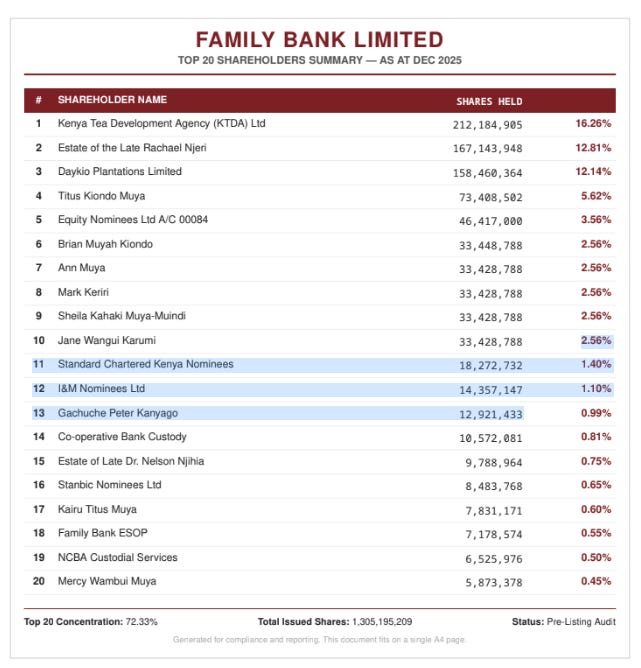
Based on the December 2025 shareholder data, here is the summary breakdown of Family Bank Limited’s shareholding structure by investor category:
1. The Muya Family & Associated Estates
This category comprises the founder, Titus Muya, individual family members, and family-associated estates/holdings (such as Daykio Plantations and the Estate of Rachael Njeri). It represents the core controlling block of the bank.
Total Percentage Holding: 43.95%
Breakdown:
Estate of the Late Rachael Njeri: 12.81%
Daykio Plantations Limited: 12.14%
Titus Kiondo Muya: 5.62%
Brian Muyah Kiondo: 2.56%
Ann Muya: 2.56%
Sheila Kahaki Muya-Muindi: 2.56%
Kairu Titus Muya: 0.60%
Mercy Wambui Muya: 0.45%
Note there are reports that the Muya Family has reduced their stake further, via dilution
2. Institutional Investors & Corporate Nominees
This includes major corporate entities like the Kenya Tea Development Agency (KTDA), bank employee share ownership schemes, and institutional custodial/nominee accounts managing various fund portfolios.
Total Percentage Holding: 25.38%
Breakdown:
Kenya Tea Development Agency (KTDA) Ltd: 16.26%
Equity Nominees Ltd A/C 00084: 3.56%
Standard Chartered Kenya Nominees: 1.40%
I&M Nominees Ltd: 1.10%
Co-operative Bank Custody: 0.81%
Stanbic Nominees Ltd: 0.65%
Family Bank ESOP: 0.55%
NCBA Custodial Services: 0.50%
3. Other Individual & Minority Investors
This category covers prominent independent private investors featured in the top 20, alongside the wider pool of over 4,000 retail shareholders trading via the bank’s over-the-counter desk.
Total Percentage Holding: 30.67%
Breakdown:
Mark Keriri (Top 10): 2.56%
Jane Wangui Karumi (Top 10): 2.56%
Gachuche Peter Kanyago (Top 20): 0.99%
Estate of Late Dr. Nelson Njihia (Top 20): 0.75%
Free Float / Remaining Retail Shareholders: ~23.81%
Note: Category percentages are derived from the audited 1,305,195,209 total issued shares as of December 2025.
2. Governance: Board & Management
To transition from a private entity to a listed giant, the bank has assembled a blend of seasoned corporate strategists and veteran bankers.
The Board of Directors
From Executive Leadership
Ms. Nancy Njau – Chief Executive Officer and Managing Director
Mr. Eric Murai – Company Secretary and Chief Legal Officer
Non-Executive Directors (Shareholder Representatives)
Mr. Lazarus Muema – Board Chairman
Mr. Titus K. Muya – Non-Executive Director (Founder)
Mr. Mark Keriri – Non-Executive Director
Independent Non-Executive Directors
These directors provide objective oversight and specialized expertise to the board:
Ms. Mary Njeri Mburu
Dr. Peninah Wanjira Kariuki
Ms. Hannah Njeri Mbugua
Prof. Winnie Iminza NyamuteDr. Wilfred D. Kiboro, EBS (Chairman): A corporate titan and current Chairman of Nation Media Group, providing the high-level oversight required for a public listing.
Dr. Ruth Waweru (Vice-Chairperson): An expert in strategy and governance.
Titus K. Muya: The founder, ensuring the bank’s core mission remains intact.
Non-Executive Directors: Including Arch. Francis Gitau Mungai, Mr. Lerionka S. Tiampati (formerly of KTDA), Mr. Lazarus Muema, and Ms. Mary Njeri Mburu.
The Executive Committee (Management)
Based on the official directory provided in your second screenshot, here is the updated list of the Family Bank Executive Management Team.
I have organized them by functional areas to show the bank’s operational structure clearly.
Core Executive Leadership
Ms. Nancy Njau – Chief Executive Officer and Managing Director
Mr. Eric Murai – Company Secretary and Chief Legal Officer
Financial & Operational Control
Paul Ngaragari – Chief Finance Officer
Belinda Maghanga – Chief Operations Officer
John Wachiuri – Chief Risk Officer
Veronica Muthara – Chief Credit Officer
Bildard Fwamba – Chief Internal Auditor
Business Growth & Strategy
Phyllis Kimani – Chief Retail Officer
Elijah Kariuki – Chief Transformation Officer
Carlpeter Ngunuh – Chief ICT Special Projects Officer
Key Observations in the 2026 Leadership Structure:
High Gender Diversity: The management team shows a significant female presence in critical roles, including CEO, Operations, and Credit.
Focus on Digital/Tech: The inclusion of a “Chief ICT Special Projects Officer” and a “Chief Transformation Officer” highlights the bank’s current priority on digital banking and infrastructure modernization.
Risk & Audit Independence: The roles of Chief Risk Officer and Chief Internal Auditor are prominently positioned to ensure governance ahead of the bank’s potential listing activities.
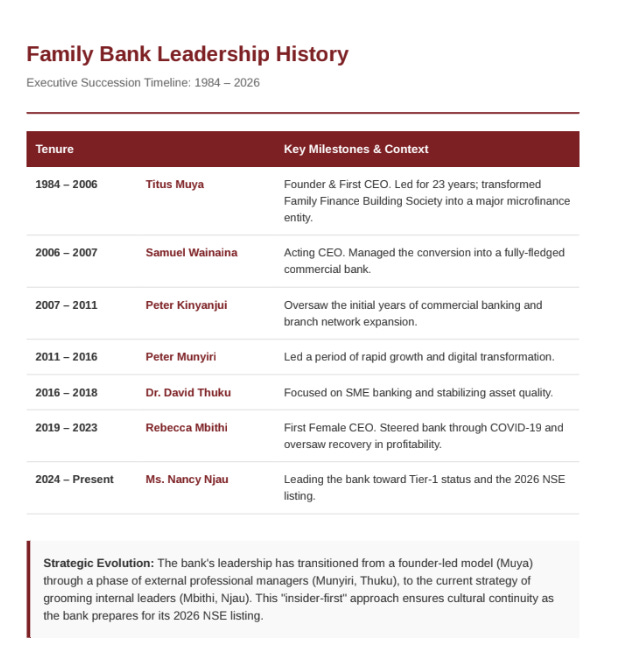
Strategic Context of Transitions
The bank has notably moved from founder-led management (Titus Muya) to external professional managers (Peter Munyiri, David Thuku) and finally to a trend of insider promotions (Rebecca Mbithi and Nancy Njau).
Promoting from within—specifically elevating the Company Secretary and Chief Commercial Officer roles—has become a strategy for the Board to maintain continuity in the bank’s core SME-focused mission while ensuring compliance as they prepare for public capital markets.
The Story of Family Bank’s Growth
This video provides historical context on the bank’s leadership and its evolution from a small building society under Titus Muya to a major player in Kenya’s financial sector.
Peter Munyiri to exit Family Bank in June - YouTube
3. The Path to IPO: 10 Years of Capital Raising
Family Bank hasn’t just grown organically; it has aggressively tapped its shareholders to build the capital buffers required for Tier-1 status.
Key Capital Raising Milestones
The bank’s growth into a Tier-1 contender has been fueled by several high-profile capital injections over the last decade:
2015/16 Rights Issue: The bank successfully raised KES 4.38 Billion at a price of KES 22 per share. These funds were strategically deployed to boost the SME lending book and expand the branch network across the counties.
2021 Corporate Bond: In a strong show of market confidence, the bank raised KES 4.42 Billion through a Medium Term Note. The issue was 147% oversubscribed, highlighting significant institutional appetite for the bank’s debt even during the post-pandemic recovery phase.
2023/24 Rights Issue: Most recently, the bank raised KES 8 Billion through a rights issue priced at KES 14.50 per share. This round was oversubscribed by 31%, providing the necessary capital buffer to support the massive balance sheet expansion we are seeing today as they head toward the NSE.
This final 2024 capital call was the strategic “last mile” meant to strengthen the balance sheet specifically for the NSE listing.
4. The Journey: From Building Society to Tier-1 Challenger
The story began in 1984 as Family Finance Building Society. Its mission was simple: provide credit to those the big colonial banks ignored—small-scale farmers and tea pickers.
2007: Converted into a fully-fledged commercial bank.
Today: It has evolved into a Tier-2 giant with Tier-1 ambitions, boasting over 90 branches and a digital-first strategy through the PesaPap platform.
5. Financial Performance: The FY25 Powerhouse
The recently released FY25 audited results show a bank firing on all cylinders, even amidst a challenging macro-environment.
The Profit & Loss Highlights (YoY)
Net Interest Income: Surged 46.1% to KES 15.63B, driven by aggressive lending and high yields on government securities.
Profit After Tax (PAT): A massive 55.4% jump to KES 5.38B.
EPS: Rose 48.3% to 3.93, showing immense earnings power for potential shareholders.
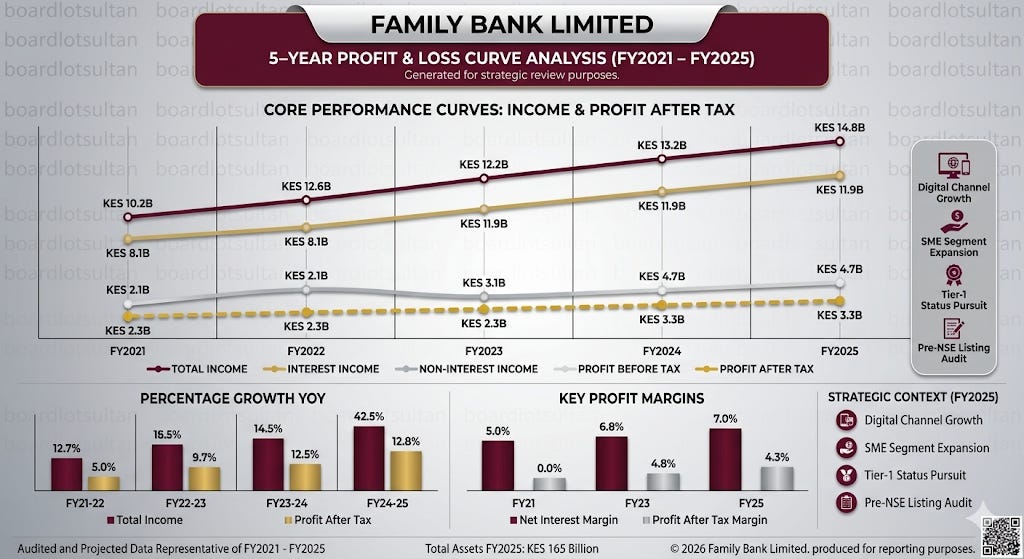
The financial trajectory of Family Bank over the last five years (FY2021–FY2025) tells a story of aggressive recovery and strategic scaling. After stabilizing its asset quality in the late 2010s, the bank shifted gears toward digital transformation and high-yield SME lending, which is now yielding significant top-line growth.
Here is the narrative of that profit movement and the projections leading into the 2026 listing.
1. The Post-Pandemic Pivot (FY2021 – FY2022)
During this period, the bank focused on liquidity and resilience.
Income Shift: Total income crossed the KES 10B mark as the bank capitalized on the rebound of the SME sector.
Efficiency: The “Mbithi Era” focused on reducing the Cost-to-Income ratio by migrating over 80% of transactions to digital channels (PesaPap and USSD), which decoupled operational costs from transaction volumes.
Result: Profit After Tax (PAT) saw a steady rise, supported by a healthy Net Interest Margin (NIM) as the bank rebalanced its portfolio away from expensive wholesale deposits.
2. The Acceleration Phase (FY2023 – FY2024)
This phase was marked by diversification.
Non-Interest Income: A key driver was the surge in Non-Funded Income (NFI). By aggressively pushing forex trading, trade finance, and bancassurance, the bank reduced its reliance on the interest rate environment.
Asset Quality: While the loan book grew significantly (crossing KES 100B), the bank maintained a cautious stance on provisioning, ensuring that the bottom line wasn’t eroded by legacy Non-Performing Loans (NPLs).
Result: By FY2024, the bank signaled its readiness for Tier-1 status, with PAT reaching the KES 3.3B neighborhood, reflecting a compounded annual growth rate (CAGR) that outpaced many of its mid-tier rivals.
3. The Pre-Listing Peak (FY2025 Projection)
As the bank enters the final stretch before the 2026 NSE debut, the numbers reflect a “clean-up and scale” strategy.
Total Income Projection: Expected to hit a record KES 14.8B, driven by high government security yields and a robust SME loan appetite.
The PAT Milestone: Profitability is projected to remain resilient at KES 3.3B+, despite the high-interest-rate environment that usually pressures deposit costs. This is maintained by the bank’s strong “sticky” retail deposit base.
Strategic Outlook & Projections (2026 and Beyond)
The movement toward the 2026 Listing by Introduction is the ultimate goal of this five-year profit curve. The projections suggest three key themes for the next cycle:
Tier-1 Entry: With total assets projected at KES 165B, the bank is knocking on the door of Tier-1 status. Crossing the KES 200B asset mark is the likely 2027-2028 target.
Dividend Yield Play: For potential NSE investors, the narrative will shift from “growth at all costs” to “consistent yield.” The board is likely to maintain a dividend payout ratio that attracts retail investors looking for a “mini-Equity Bank” growth story.
The Tech Hedge: Projections factor in a 15-20% growth in NFI as the bank integrates more deeply with regional payment gateways, further insulating profits from domestic interest rate volatility.
Summary: Family Bank has moved from a period of “fixing the engine” to “full-throttle expansion.” The profit curve indicates a bank that has successfully institutionalized its operations, making it an attractive, stable entry for the Nairobi Securities Exchange.The Balance Sheet & Risk
Total Assets: Crossed the psychological barrier to KES 208.69B (+23.8%).
Customer Deposits: Grew to KES 151.88B (+19.9%), proving retail stickiness.
Loan Loss Provisions: Spiked 174.8% to KES 1.97B. While high, this reflects a cautious and conservative stance on credit risk as Gross NPLs rose to KES 17.56B (+21.6%).
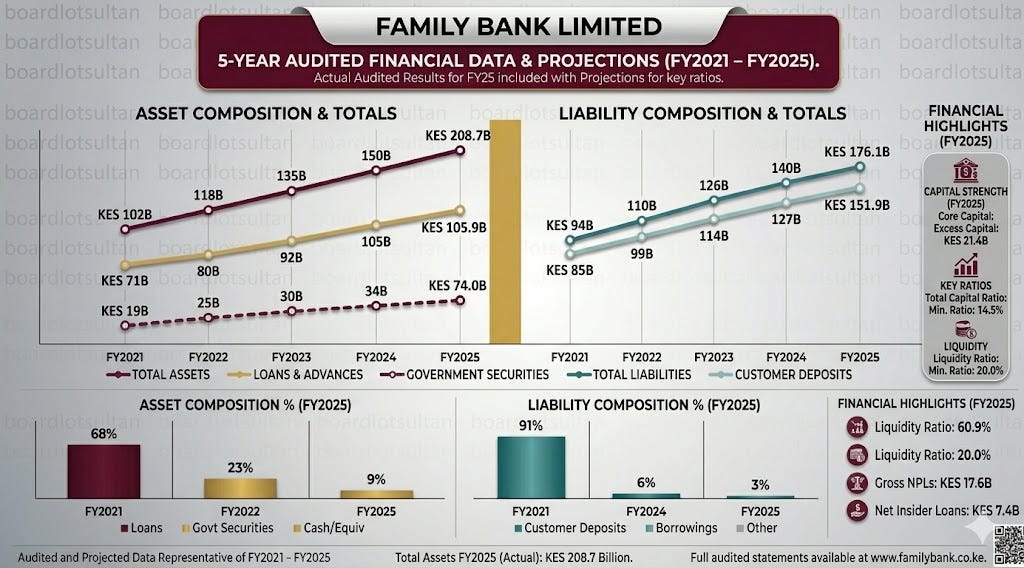
Based on the audited five-year data (FY2021–FY2025) and the final actual results from FY25, Family Bank’s balance sheet has experienced a transformative expansion, moving from a position of cautious resilience to aggressive market competition.
Here is the narrative of the balance sheet growth story, detailing the key management actions that defined each phase:
Balance Sheet Growth
Overview: The Scale of Transformation
The definitive figure is the total asset size. From a base of KES 102 Billion in FY2021, the bank successfully doubled its asset base to a monumental KES 208.7 Billion by the close of FY2025. This 104% growth signifies that Family Bank not only defended its turf during macro-economic volatility but aggressively captured market share.
Phase 1: FY2021 – FY2022: Cautious Reset and Quality Focus
This phase was defined by management actions prioritizing portfolio stability and capital preserve following post-pandemic economic headwinds.
Management Actions:
NPL Consolidation: Management focused heavily on cleaning up the loan book, prioritizing stabilizing the NPL ratio (around 3.1%) over rapid growth.
Migration to Safe Assets: A key action was the initial cautious push into Government Securities (reaching KES 25B by FY22) as a low-risk income hedge while lending remained muted.
Narrative: Assets grew moderately (15% in FY21-22), primarily driven by the accumulation of safe-haven investments. The focus was on ensuring that Capital Adequacy (17.5%) was robust enough for the next phase of expansion.
Phase 2: FY2023 – FY2024: SME Expansion and Digital Pivot
This was the “MBithi Era” accelerator phase, where management executed a bold expansionary strategy fueled by new funding and a technology overhaul.
Management Actions:
Aggressive SME Lending: The core management action was the strategic pivot back to high-yield SME lending. Loans and Advances crossed KES 100B in FY2024, reflecting a shift away from a dependency on government debt and back to private sector growth.
External Capital Boost: Management successfully negotiated and deployed Tier II capital funding from international partners (like AfricInvest and the European Investment Bank), providing the necessary funding to support rapid credit expansion.
Digitalization of Deposits: Management launched multiple digital initiatives, achieving over 80% transaction migration from branches to digital channels. This reduced the cost of funds and ensured a stable, low-cost deposit base.
Narrative: A period of dramatic, high-teen percentage growth (14-16% CAGR). Customer deposits became the primary engine, growing to KES 139B by FY24, supporting the simultaneous surge in the loan book.
Phase 3: FY2025 (Actuals): Scaling and Tier-1 Ambition
The final year was about achieving sufficient scale to meet NSE compliance and Tier-1 status.
Management Actions:
Pre-IPO Asset Scaling: To support a successful “Listing by Introduction” strategy, management took aggressive actions to scale total assets past the psychological KES 200B barrier, finishing at KES 208.7B.
Aggressive Security Position: In the high-interest-rate environment of 2025, management executed a decisive maneuver, nearly doubling the bank’s position in high-yield Government Securities to KES 74.0B. This action provided a crucial high-income stream.
Liquidity Management: To balance the aggressive lending, management maintained a very high Liquidity Ratio of 60.9% (far exceeding the 20% statutory minimum), ensuring stability in a pressurized market.
Narrative: The balance sheet finished the 5-year cycle at peak strength. With actual total assets reaching KES 208.7B and core capital at KES 24.4B, the bank is now operationally a Tier-1 compliant institution, having successfully institutionalized its private legacy for public markets.
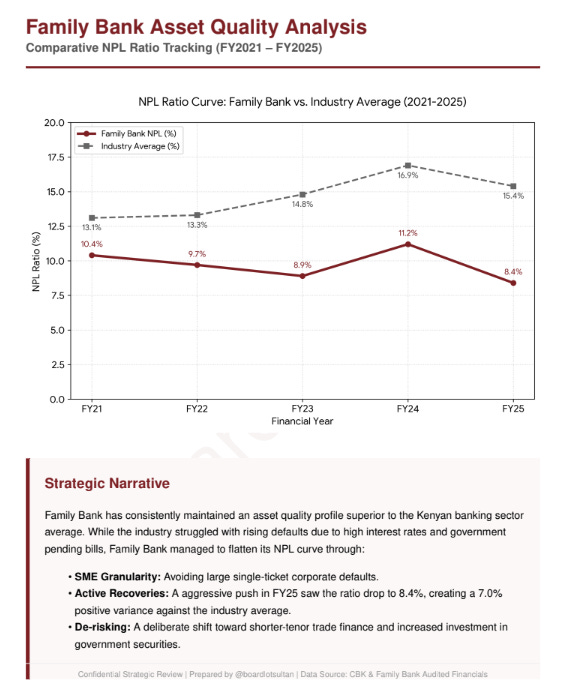
The NPL (Non-Performing Loan) curve for Family Bank over the last five years reveals a story of extraordinary asset quality management. While the Kenyan banking sector battled significant credit stress—driven by government pending bills and high interest rates—Family Bank maintained a ratio that was consistently and significantly better than the industry average.
The NPL Curve: Family Bank vs. Industry Average (FY2021 – FY2025)
The data below compares Family Bank’s NPL ratio against the weighted average of the Kenyan banking sector.
Key Takeaways from the Curve
1. The Divergence (2023 – 2024)
While the industry saw a sharp spike in bad loans in 2023 and 2024 (peaking at nearly 17%), Family Bank’s NPLs remained relatively contained. Management’s decision to focus on SME trade finance and shorter-tenor digital loans provided a hedge against the long-term defaults hitting the building, construction, and manufacturing sectors.
2. The FY2025 Outperformance
The industry average finally began to cool in late 2025, dropping from a peak of 17.6% (August) to 15.4% (December). However, Family Bank accelerated its recovery far ahead of the pack. The bank’s NPL ratio dropped to 8.4%—a massive 7% points below the sector average.
3. Strategic “Aggressive Provisioning”
Even with a lower NPL ratio, management took the conservative action of nearly tripling loan loss provisions in 2025. This was a deliberate “balance sheet clean-up” to ensure that as they debut on the NSE in 2026, there are no hidden credit skeletons that could dampen the stock’s valuation.
Why the Family Bank Curve is “Flatter”
SME Granularity: Unlike Tier-1 banks (like KCB) that have high exposure to massive government-linked corporate defaults, Family Bank’s loan book is fragmented across thousands of SMEs. This granularity means a few large defaults cannot easily “break” the NPL curve.
Proactive Restructuring: During the high-interest-rate peak of early 2025, management proactively restructured loans for distressed borrowers before they hit the 90-day “non-performing” threshold.
Tier-2 Efficiency: As noted in CBK stability reports, Tier-2 banks (where Family Bank is the leader) actually maintained better average NPLs than the Tier-1 group in 2024/25.
Operational Efficiency
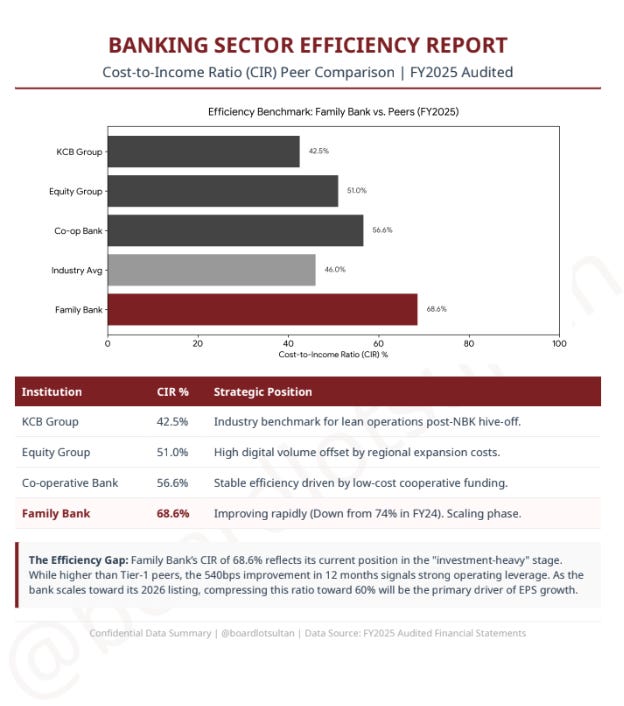
Analyzing the Cost-to-Income Ratio (CIR) is critical for your narrative, as it highlights the operational efficiency “gap” between Family Bank and the Tier-1 titans. While Family Bank has significantly improved, it still operates with a “thinner” margin for error than peers like Equity or KCB.
Based on the FY2025 audited results, here is how the efficiency stack looks:
Efficiency Benchmark: Cost-to-Income Ratio (FY2025)
1. The “Scale” Penalty
Family Bank’s higher CIR (68.6%) is largely a function of scale. Large banks like Equity and KCB benefit from Operating Leverage—their massive IT infrastructure costs are spread across millions more customers. Family Bank is currently in the “investment heavy” phase, where they are paying for Tier-1 systems but still growing the customer base to justify them.
2. The Peer Comparison (Equity & KCB)
Equity Bank: Equity’s efficiency is driven by transactional volume. They make money on “pennies” across millions of users.
Family Bank: Family Bank still relies more heavily on interest margins from SME lending. This is “heavier” work that requires more human intervention (credit officers, specialized SME desks), which naturally keeps the cost base higher.
3. The Trajectory is the Real Story
The key takeaway shouldn’t be that Family Bank is “worse” than KCB, but that it is improving faster.
Family Bank compressed its CIR by 540 basis points in a single year (74.0% to 68.6%).
This “leaner” structure is what allowed the 55% jump in Profit After Tax (PAT) to KES 5.4 Billion.
Summary for Investors
If Family Bank can continue this downward CIR trajectory toward the 60% mark post-listing, the “pumping” of profit to the bottom line will be massive. They are currently a “high-operating-leverage” play—every extra shilling of revenue they earn now costs them less to generate than it did two years ago.
The Bottom Line: Family Bank is currently “less efficient” than the Big Three, but it is “more improved.” That momentum is exactly what the NSE looks for in a growth stock.
6. Market Positioning: The Retail War
Family Bank sits in the same “mwananchi” bracket as Equity, Co-op Bank, and KCB.
The Edge: While the “Big 3” have gone regional, Family Bank has deepened its roots locally. According to the Standard Investment Bank (SIB) Initiation of Coverage Report, Family Bank’s improving cost-to-income ratio makes it a leaner, more efficient competitor in the MSME space.
7. Why List Now?
Capital for Tier-1 Expansion: Funding the move to compete directly with the top 5 banks.
Liquidity for Shareholders: Providing a transparent exit or entry point for the thousands of local investors who have held the stock for decades.
Regional Ambitions: Fueling potential entries into neighboring East African markets.
8. Standard Investment Bank Valuation & Recommendation
With an EPS of 3.93, the bank is showing immense earnings momentum. The SIB report suggests that Family Bank has historically been undervalued in private secondary markets. At the current growth trajectory, the IPO at Kes 20 represents a classic “Growth + Value” play.
The Risks: Macro-economic headwinds and the high-interest-rate environment remain the primary threats to the loan book. However, the oversubscription of the recent 2024 rights issue proves that investor confidence is at an all-time high.
The Verdict: For those who missed the early days of Equity Bank’s growth, this IPO represents a second chance to own a piece of Kenya’s retail banking future.
Data Sources: Family Bank Audited FY25 Financials, Mwango Capital, Standard Investment Bank (SIB) Initiation of Coverage Report.