
Welcome to Boardlot Africa, where we pull back the curtain to reveal the untold stories, power dynamics, and strategic maneuvers shaping the boardrooms of Corporate Africa—subscribe for free to join the conversation. join 1000 other subscribers
We publish Kenya’s Most Consequential Legal, Governance & Labor Disputes and A Series on the 100 Most Influential Kenyan Captains of Industry
To understand how one of East Africa’s most respected corporate leaders built an unassailable fortress of financial integrity while simultaneously navigating a decade of aggressive domestic market shifts, this comprehensive analysis deconstructs the multi-layered legacy of Nasim Devji through the following thematic chapters
What’s In This Article?
1.0 Introduction: The Pioneer of the Defensive Balance Sheet
2.0 The Trailblazer’s Credentials: From London Public Practice to Group CEO
3.0 The Conservative Paradox: The Cost of Playing Defense
4.0 The Underutilized Matrix: Missed Regional Opportunities
4.1 The Network Advantage Built on Sand:
4.2 Trailing the Giants:
5.0 The Kenyan Market Scenario: Surrendering the Domestic Crown
5.1 Domestic Realities: How DTB Lost Its Market Lead (2015–2025):
5.2 The Asset Stagnation: Overtaken by Smaller Rivals:
The NCBA Leap:
The I&M Convergence:
6.0 First-Mover Advantage vs. Scale Efficiency: The Regional Performance Paradox
6.1 The Absolute Profit Gap (FY2025):
6.2 Squandering the First-Mover Advantage:
7.0 Non-Banking Subsidiary Performance & The Ecosystem Trap
7.1 The “Banking-Only” Trap vs. Ecosystem Building:
7.2 Ignoring the Wealth Management Boom:
7.3 Low Inherent Cross-Selling Velocity:
8.0 Conclusion: The Duality of her Banking Legacy
8.1 The Safety Dividend vs. Lost Alpha:
8.2 The Benchmark for the Next Generation:
1.0 Introduction: The Pioneer of the Defensive Balance Sheet
1.1 The Institutional Lone Ranger
In the hyper-competitive arena of the Nairobi Securities Exchange (NSE) and the broader East African banking sector, corporate power is traditionally concentrated within a tightly knit, male-dominated executive inner circle. Against this backdrop, Nasim Devji stands as an undeniable anomaly and a towering trailblazer. For over two decades, as the Group Chief Executive Officer and Managing Director of Diamond Trust Bank (DTB) Group, she has occupied a rare position: she is one of the very few female CEOs steering a listed company in Kenya, and an even rarer fixture at the apex of a commercial bank. Her long survival at the top of a Tier-One financial institution demands immense respect. She carved out a path for executive gender representation long before modern environmental, social, and governance (ESG) boardroom mandates made diversity a corporate box-ticking exercise.

1.2 The Investor Paradox
However, for the fund managers, institutional investors, and financial analysts tracking the NSE banking books, the appraisal of Devji’s long tenure is defined by a deep paradox. While the market widely respects her personal integrity and status as a pioneer, investors increasingly view her through a critical lens: that of a hyper-conservative manager who prioritized capital preservation over aggressive market-share capture.
During an unprecedented two-decade window of financial sector deepening in East Africa—where liquidity exploded and bold banks built empires—Devji operated a defensive playbook. This profile explores that tension: how a trailblazing chief executive successfully protected her bank from toxic credit cycles, yet ultimately watched as nimbler, more aggressive rivals extracted the premium alpha from the regional banking ecosystem.
2.0 The Trailblazer’s Credentials: From London Public Practice to Group CEO
2.1 Geographic Origins and the Ismaili Foundation
To understand the bedrock of Devji’s executive philosophy, one must look at her distinct cultural and geographic roots. Born in Kenya and raised across East Africa—completing her high school education in neighboring Tanzania—she is a prominent and deeply respected member of the Shia Imami Ismaili community. This alignment is foundational to her career trajectory. Diamond Trust Bank, alongside sister corporate giants like Jubilee Holdings and Industrial Promotion Services (IPS), operates as a core financial pillar under the umbrella of the Aga Khan Development Network (AKDN). Immersed in a community culture that fiercely values institutional custody, social responsibility, and long-term generational wealth compounding over short-term speculative gambling, Devji naturally internalized the traits of a defensive, risk-averse asset manager.

2.2 The London Accounting Pipeline
Before she ever stepped into an East African banking hall, Devji spent a quarter of a century sharpening her technical capabilities in the world’s most demanding financial arena. Moving to the United Kingdom in 1971, she spent approximately 25 years living, practicing, and dominating within the complex legal, auditing, and corporate tax frameworks of London.
She forged her core professional credentials as a heavy-hitting financial engineer:
Fellow of the Institute of Chartered Accountants in England and Wales (ICAEW): Developing a forensic mastery of international corporate accounting and systemic risk management.
Associate of the Chartered Institute of Taxation: Equipping her with a highly sophisticated understanding of cross-border fiscal structures and asset optimization.
When she finally returned to East Africa in 1996, she did not enter DTB as a conventional commercial banker. Instead, she entered directly through the bank’s operational plumbing as the Regional Financial Controller. For five years, she ran the back-office ledger, tightened internal audit lines, and strictly managed capital adequacy parameters during a highly volatile transition period in the regional banking sector. Her total mastery of the internal mechanics of the balance sheet proved to the board that she was the natural custodian of their capital.
2.3 A Historic Advancement
In 2001, the board handed her the keys to the entire empire, promoting her from Regional Financial Controller to Group CEO. This promotion shattered a decades-old corporate norm, making Devji the first female CEO of a listed commercial bank in Kenya. In a market where corporate credit committees and executive suites were heavily gatekept, Devji proved that absolute technical merit and financial precision could break through any barrier. For over twenty years, her presence at the head of DTB served as an important point of reference, proving to the entire African continent that women could successfully run multi-billion-shilling balance sheets through volatile economic cycles.
3.0 The Conservative Paradox: The Cost of Playing Defense
3.1 Overtaken by the Bold
While Devji’s technical capabilities and pioneering status are secure, her long-term strategic execution remains a major point of debate among market analysts. The core critique from growth-oriented investors is that DTB suffered from structural inertia during a golden era of banking consolidation. When Devji assumed command, DTB was perfectly positioned to cement an absolute chokehold on the lucrative corporate and Small and Medium Enterprise (SME) banking segments. Instead, a hyper-cautious approach allowed nimbler, strategically aggressive rivals to outmaneuver the bank.

The rise of competitors like NCBA Bank (fueled by aggressive mergers and digital lending dominance via M-Shwari) and I&M Bank (driven by seamless regional trade integration and rapid corporate onboarding) serves as a classic case study in missed momentum. While these rivals aggressively scaled their asset books, optimized their loan-to-deposit ratios, and hunted for market share, DTB remained tethered to a highly restrictive lending framework. Consequently, institutional investors watched as DTB was systematically overtaken in key profitability metrics and overall Tier-One market-share rankings by peers that were willing to price and absorb risk more dynamically.
3.2 The Capital Preservation Premium & The Shield of Integrity
In hindsight, however, Devji’s defensive playbook yields an entirely different valuation when viewed through the lens of banking stability. During the “dangerous days” of the mid-2010s Kenyan banking sector, the market was characterized by hyper-aggressive, opaque competition. DTB was locked in a fierce, head-to-head battle for the highly lucrative, affluent urban Asian and premium corporate clientele—primarily competing with the likes of Imperial Bank and Chase Bank.
To capture this upmarket segment, rival institutions offered unsustainably high interest rates on deposits and engineered creative, off-balance-sheet parallel banking structures. For a time, DTB looked flat-footed as depositors chased these artificially inflated yields. Yet, Devji stood firm. Her extreme focus on maintaining fortress-like Tier-One capital adequacy ratios and thick liquidity cushions meant DTB refused to match the reckless terms offered by competitors.
That refusal saved the institution. In 2015 and 2016, the music stopped:
The Imperial & Chase Implosions: Imperial Bank and Chase Bank collapsed under the weight of massive insider lending, systemic accounting fraud, and sudden bank runs, plunging into Central Bank receivership. Millions in premium urban deposits were instantly frozen.
The Flight to Safety: As panic gripped the banking sector, the market realized that Devji’s conservative approach was not structural inertia—it was deliberate, visionary risk mitigation.
Furthermore, DTB benefited immensely from the unassailable Aga Khan institutional integrity. In a market reeling from a total breakdown of corporate governance, the bank’s deep structural alignment with the Aga Khan Development Network (AKDN) acted as an elite reputational guardrail. Depositors knew that the AKDN framework treated fiduciary assets as a sacred trust, providing a psychological and financial backstop that no speculative rival could match.
While Devji’s capital hoarding did leave money on the table for growth-seeking shareholders in the short term, it ultimately secured a premium “safety dividend.” She proved that in a frontier financial market, surviving the culling of your peers is the ultimate form of long-term alpha generation
How Dusit attack funds flow shaped DTB CEO’s approach to MPESA
The shockwaves of the January 2019 dusitD2 terror attack forced a radical and immediate reckoning within Diamond Trust Bank’s compliance architecture, directly impacting corporate policy under Group CEO Nasim Devji.
When criminal investigations revealed that a staggering Ksh 34.7 million in terror funds had passed through a single local branch via rapid, high-volume M-Pesa transactions, the structural vulnerabilities of integrating mobile money platforms with traditional banking became glaringly apparent.
In response to the intense state scrutiny, regulatory fallout, and the arraignment of its Eastleigh branch manager, Devji oversaw a decisive operational pivot to shield the institution from systemic risk. DTB took the unprecedented step of halting cash deposits from M-Pesa Paybill accounts into bank accounts, a drastic move that signaled a fundamental shift in how the tier-1 lender balanced financial inclusion with aggressive anti-money laundering (AML) protocols.
4.0 The Underutilized Matrix: Missed Regional Opportunities
4.1 The Network Advantage Built on Sand
Perhaps the most glaring critique of the Devji era from the investment community lies in Diamond Trust Bank’s inability to convert an elite, pre-established regional network into absolute market dominance. Through its close structural ties to the Aga Khan Development Network (AKDN) and Industrial Promotion Services (IPS), DTB possessed a historic, built-in network advantage across East Africa. Long before local Kenyan banks began attempting to cross sovereign borders, the AKDN ecosystem had deep, multi-generational roots in regional manufacturing, tourism, infrastructure, healthcare, and insurance.
In theory, DTB should have effortlessly dominated cross-border transactional banking by serving as the primary corporate clearinghouse for these massive, high-value supply chains. In practice, however, under Devji’s centralized, risk-averse guidance, this network advantage was underutilized. Instead of executing a bold, market-disrupting corporate strategy that aggressively captured regional value chains, the bank treated its regional footprint with a tentative, slow-moving branch-expansion model. By moving at an institutional crawl, DTB left the door wide open for nimbler competitors to step in and aggressively poach the broader regional market.

4.2 Trailing the Giants
The real-world operational data from DTB’s regional subsidiaries reveals the true cost of this strategic caution. Across East Africa, DTB’s regional operations have consistently lagged behind the market:
The East African Subsidiaries: In Uganda, Tanzania, and Rwanda, DTB’s subsidiaries have historically failed to break into top-tier dominance. Instead, they remain trailing players, largely confined to niche communal corporate lending segments and conservative asset books.
The Burundi Closure: The ultimate symbol of this regional retreat was the total operational closure and exit from the Burundi market. This strategic exit represented a complete capitulation in a territory where early entry should have yielded a permanent, highly profitable transactional moat.
The Equity Bank Contrast: While DTB hesitated and calculated the downside of every cross-border move, aggressive tier-one juggernauts like Equity Bank systematically moved in. Equity Bank entered these identical regional markets with an aggressive, high-risk, high-reward model—acquiring local institutions, deploying massive digital infrastructure, and onboarding millions of retail and SME customers. Today, Equity Bank’s regional subsidiaries generate massive, multi-billion-shilling non-funded income streams that power its group market valuation, while DTB’s regional network remains a muted, underperforming line item on its consolidated balance sheet.

Domestic Realities: How DTB Lost Its Market Lead to Nimbler Local Rivals 2015-2025
While Nasim Devji successfully insulated the bank from systemic shocks, the domestic theater tells a stark story of surrendered momentum. In 2015, DTB stood as the undisputed heavyweight against its immediate peers. However, over the next decade, a hyper-conservative lending posture allowed nimbler, traditionally Tier-2 rivals to weaponize their balance sheets, execute bold mergers, and systematically strip DTB of its competitive edge in the Kenyan market
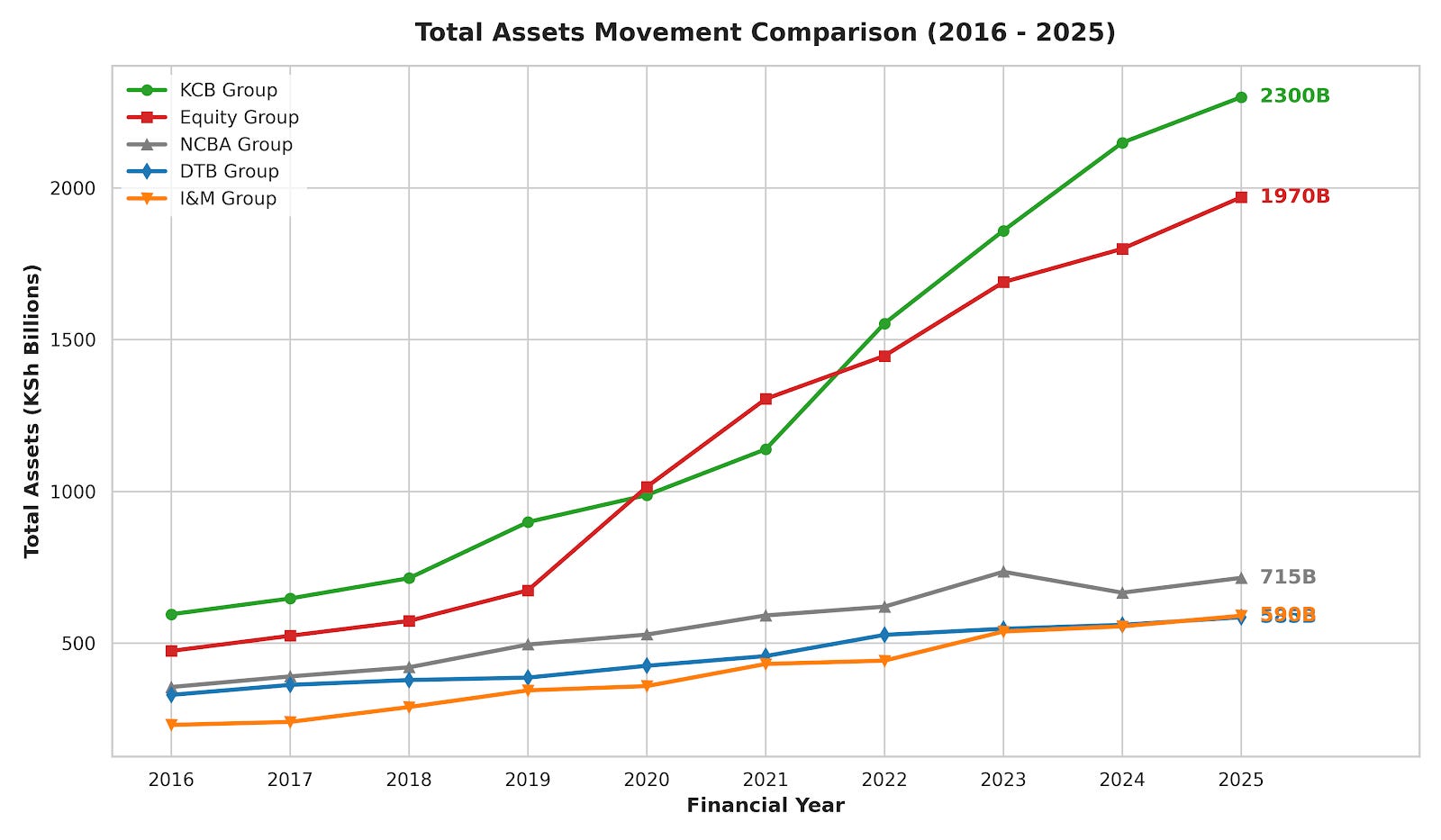

The Asset Stagnation: How DTB Was Overtaken by Its Smaller Rivals
A definitive look at the 10-year asset trajectory highlights that DTB has performed exceptionally poorly in terms of growth velocity, allowing itself to be systematically overtaken or caught by rivals that were historically much smaller.
The NCBA Leap (From Peer to Industry Dominance)
In 2016, DTB and NCBA’s predecessors operated in a similar weight class, with DTB holding a tight competitive position at KSh 329 Billion against NCBA’s combined baseline of KSh 355 Billion. However, through aggressive consolidation—most notably the marquee 2019 merger between NIC and CBA—NCBA structurally shifted its growth curve upward. By 2025, NCBA grew its asset base to KSh 715 Billion, leaving DTB far behind in the mid-tier rankings.
The I&M Convergence (Eroding a KSh 100 Billion Lead)
The most damning indictment of DTB’s conservative growth model is its trajectory relative to I&M Group:
The 2016 Baseline: DTB started the decade with a commanding KSh 100 Billion lead over I&M Group (KSh 329 Billion vs. KSh 230 Billion).
The 2025 Reality: Because DTB’s asset line remained the flattest on the entire chart, I&M maintained a steadier, more aggressive organic growth gradient. By 2025, I&M completely closed the historic gap, converging with DTB at the KSh 585–590 Billion mark.
The Takeaway: DTB entered the decade with a massive head start over I&M and sat neck-and-neck with NCBA. By maintaining a highly conservative organic strategy, DTB grew by just KSh 256 Billion over ten years—underperforming both smaller rivals, who each added KSh 360 Billion to their balance sheets in the same period.
The Paradox of DTB’s Regional Performance: First-Mover Advantage vs. Scale Efficiency
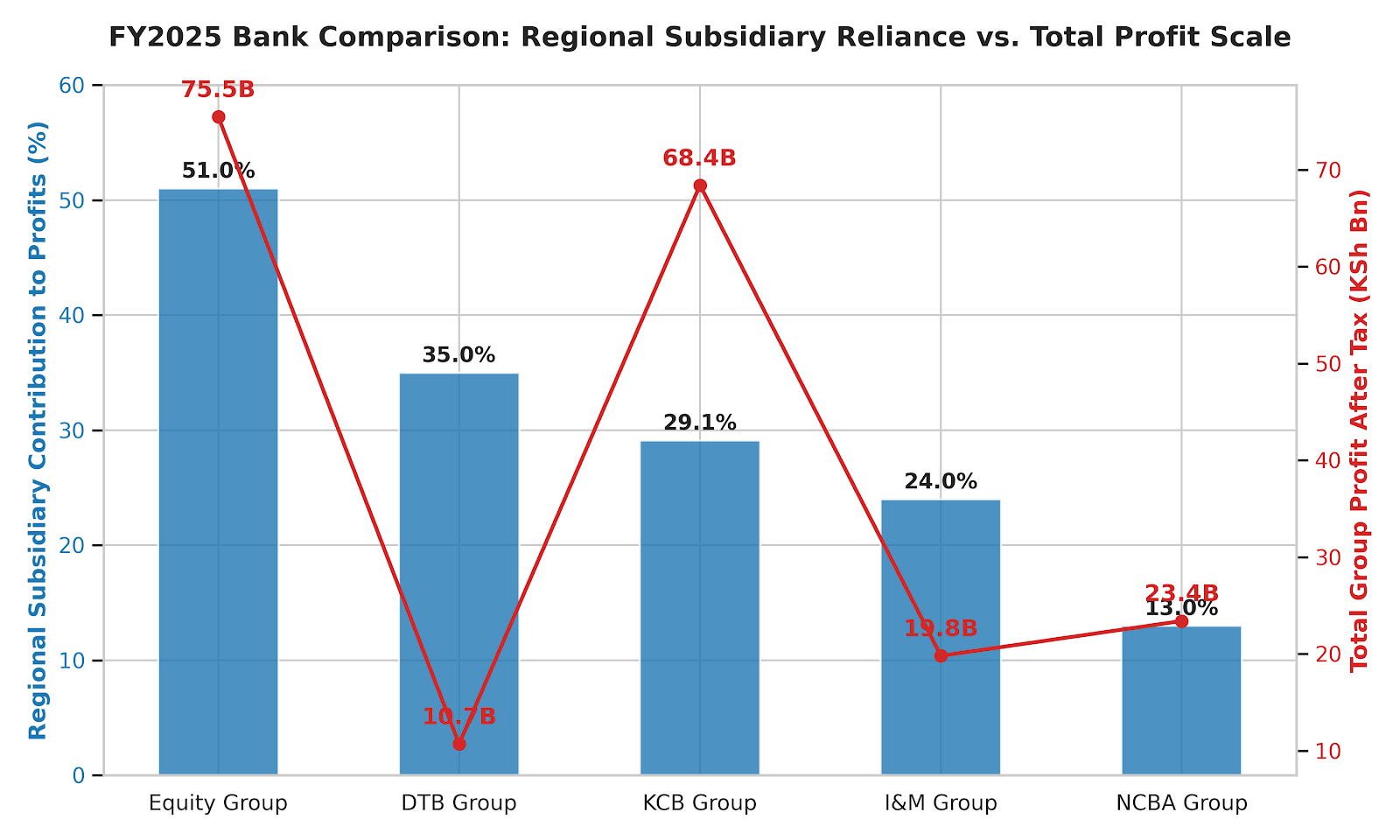
While Diamond Trust Bank (DTB) highlights its regional diversification with pride—noting that its subsidiaries contribute a commendable 35.0% to Group Profit Before Tax (PBT)—a deeper dive into absolute figures reveals a stark strategic vulnerability. In terms of actual financial value generated from outside Kenya, DTB is lagging significantly behind its Tier 1 rivals, exposing a failure to effectively monetize its historic footprint.
The Absolute Profit Gap (FY2025)
Percentages can be deceiving. While DTB outpaces banks like KCB, I&M, and NCBA in terms of reliance on regional units, the absolute value of those earnings is remarkably small due to the group’s lower overall profit base:
Equity Group: Generates an estimated KSh 38.5 Billion from its regional subsidiaries (anchored by a massive DRC operation).
KCB Group: Pulls in approximately KSh 19.9 Billion from its cross-border banking operations.
NCBA Group: Despite a low 13% strategic mix, its regional banking operations still yielded KSh 3.6 Billion in PBT.
DTB Group: With a total Group Profit After Tax of just KSh 10.7 Billion, its entire regional network across Uganda, Tanzania, and Burundi combined generates an estimated profit pool of only KSh 3.5 to 4.0 Billion PBT.
In absolute terms, Equity Group’s regional subsidiaries make more money in a single month than DTB’s regional network makes in an entire financial year.
Squandering the First-Mover Advantage
This valuation gap represents a severe underperformance when viewed through a historical lens. DTB is not a recent entrant to East African regional banking; it enjoyed a significant first-mover advantage, having established deep roots in markets like Uganda and Tanzania long before the aggressive regional expansion campaigns of Equity Bank or KCB began.
Ideally, decades of operational history should translate into dominant market share, unmatched local corporate relationships, and highly optimized cost-to-income ratios. Instead, DTB has allowed younger, more aggressive Kenyan competitors to enter these identical territories, rapidly scale up, and completely eclipse them in absolute profitability.
Why DTB is Being Left Behind
The data points to a clear structural issue: a lack of aggressive scaling and market capitalization. While rivals treated regional expansion as an opportunity to build dominant, systemically important banks locally (such as Equity in the DRC or KCB in Rwanda), DTB’s regional units have largely remained conservative, niche players.
By failing to scale up its balance sheet and push aggressively into digital retail and major corporate syndications regionally, DTB has turned what should have been a powerful, mature engine of growth into a quiet cushion—one that protects domestic earnings but fails to drive aggressive value creation for shareholders.
Non-Banking Subsidiary Profit & Strategic Comparison (FY2025)
When looking at performance outside of core commercial banking—specifically through non-banking subsidiaries like bancassurance, investment banking, asset management, digital fintech platforms, and custodial services—DTB’s structural underperformance becomes even more pronounced.
While its Tier 1 rivals have aggressively built non-banking financial ecosystems to diversify income streams, DTB has remained heavily tethered to traditional lending and trade finance.
Strategic Divergence: Why DTB Fails to Compete Here
1. The “Banking-Only” Trap vs. Ecosystem Building
Rivals like Equity and NCBA no longer view themselves as just banks; they operate as financial services conglomerates. When a client walks into NCBA or Equity, the group captures value through banking spreads, insurance premiums, asset management fees, and digital transaction fees.
DTB, by contrast, has stuck strictly to traditional corporate banking, retail banking, and trade finance. Because they haven’t built or acquired dedicated non-banking subsidiaries (like a standalone insurance underwriter or a major wealth management fund), they miss out on the high-margin, asset-light fee income that shields peers when interest rates fluctuate.
2. Ignoring the Wealth Management Boom
Over the last five years, there has been a massive shift of capital in Kenya toward Money Market Funds (MMFs), wealth management, and capital market products.
NCBA and I&M capitalized on this perfectly by scaling their investment banking and asset management arms to capture these flows.
DTB sat on the sidelines. By failing to build a robust wealth management subsidiary early on, they allowed smaller rivals like I&M to attract premium liabilities and investment fees that should have logically flown to DTB given its historical ties to wealthy entrepreneurial communities.
3. Low Inherent Cross-Selling Velocity
Even where DTB does have a presence, such as bancassurance, the execution strategy is passive. While Equity utilizes its massive agency banking network and retail tech to push insurance policies aggressively to the masses, DTB’s model relies heavily on traditional relationship managers manually cross-selling to an inherently smaller, conservative corporate clientele.
Summary Verdict
Just as DTB squandered its first-mover advantage in regional banking by being too conservative with its balance sheet, it has completely missed the non-banking diversification wave. By failing to aggressively set up or buy into insurance, digital tech, and asset management subsidiaries, DTB remains an analog player in a digital, multi-channel Tier 1 landscape—leaving it almost entirely reliant on traditional interest income to survive.
5.0 Conclusion: The Duality of her Banking Legacy
5.1 The Safety Dividend vs. Lost Alpha
Ultimately, the definitive evaluation of Nasim Devji’s multi-decade tenure at Diamond Trust Bank depends entirely on an investor’s appetite for risk. Her legacy cannot be painted in a single stroke; it is defined by a distinct duality. To credit managers, risk mitigators, and conservative depositors, she is an absolute hero—the steady hand who navigated DTB through decades of financial storms, built an unassailable fortress of Tier-One capital, and maintained a pristine culture of compliance, safety, and stability. To equity strategists and growth investors, however, her era represents a saga of lost alpha—a period where a blue-chip institution possessed the capital, the network, and the historic opportunity to become the undisputed financial king of East Africa, but chose instead to play a permanent game of defense.
5.2 The Benchmark for the Next Generation
Regardless of the market’s critique of her conservative lending books, Devji’s place in African corporate history is secure. She has provided an indelible benchmark for the next generation of corporate leadership. By proving that a woman could command a major listed financial institution for over twenty years with zero scandals, absolute regulatory compliance, and unwavering institutional integrity, she permanently re-wired the psychology of African boardrooms. As DTB prepares for its next strategic chapter, the foundation Devji leaves behind is undoubtedly safe, clean, and intact—leaving it to the next generation of leadership to decide whether to keep guarding the vault or finally deploy its massive trapped potential into winning the regional banking wars
About Boardlot Africa Research
Boardlot Africa is a premier financial intelligence and corporate governance publication dedicated to unpacking the mechanics of capital, market strategies, and structural shifts across East Africa’s corporate landscape. By bridging the gap between raw economic data and actionable market intelligence, we deliver deep-dive research, independent corporate analysis, and policy insights designed for institutional investors, boardrooms, and sharp market observers.
Get in Touch
Email: boardlot.research@gmail.com
Phone: +254 753 133 901
Substack: Subscribe to Boardlot Africa
X (Twitter): BoardLotSultan