
Every investor entering the Kenyan agricultural sector falls into the exact same trap when planning a dairy enterprise: they fall in love with sheer liquid volume.
The sight of a massive cow pumping out 35 to 40 liters of milk a day in a zero-grazing unit looks like a license to print money. You take that volume, multiply it by standard farm-gate prices, and your Excel spreadsheet paints a picture of instant prosperity.
But spreadsheets don’t buy dairy meal, and they don’t experience heat stress or mastitis.
To build a genuinely profitable commercial dairy enterprise, you must treat your herd as capital assets. You need to analyze initial asset acquisition costs, dry matter conversion efficiency, disease resistance overheads, and target market margins.
We have staged a direct, head-to-head audit of the six primary commercial cattle breeds utilized in Kenya today: Holstein, Friesian (Standard European), Ayrshire, Guernsey, Jersey, and the dual-purpose Sahiwal.
The Profiles: Understanding Your Asset Classes
Before looking at the ledger, we must define what each breed actually represents as a production engine.
1. The Holstein (The Industrial Heavyweight)
The Profile: The modern American/Canadian Holstein is the largest dairy animal on the planet, weighing up to 700kg. It is a genetically engineered metabolic machine designed for one thing: maximizing peak liquid volume.
The Catch: It has the highest maintenance overhead, zero heat tolerance, and requires flawless, world-class management. If your feed quality drops even slightly, her body condition collapses.
2. The European Friesian (The Dual-Purpose Heritage)
The Profile: Often conflated with the Holstein in Kenya, the standard European Friesian is shorter, blockier, and carries more flesh (550kg–600kg). It produces slightly less volume than the Holstein but offers better fertility and a higher beef salvage value at checkout.
The Catch: Still carries a heavy feed bill and suffers under high ambient temperatures.
3. The Ayrshire (The Resilient Mid-Cap)
The Profile: Originating from Scotland, the Ayrshire (450kg–500kg) is the traditional darling of the Kenyan highlands. It is an incredibly rugged, structurally sound animal with a tough udder conformation that naturally resists mastitis.
The Catch: It has a notoriously feisty temperament, making it difficult to handle in poorly designed, tight zero-grazing structures.
4. The Guernsey (The Forgotten Golden Middle)
The Profile: The Guernsey (450kg) is famous for its distinct golden milk, caused by high concentrations of beta-carotene. It is an exceptionally gentle animal that converts forage into high-butterfat milk with remarkable efficiency.
The Catch: Hard to source in Kenya. True pedigree Guernsey genetics are scarce, making herd expansion slow and initial heifer sourcing expensive.
5. The Jersey (The Margin Alpha)
The Profile: A compact, highly efficient powerhouse weighing just 350kg–400kg. It produces milk with the highest butterfat (5.5%+) and protein content in the industry.
The Catch: Calves are exceptionally small and fragile at birth, requiring intensive neonatal care during the first 30 days.
6. The Sahiwal (The Climate-Shielded Hedge)
The Profile: A specialized Bos indicus (zebu) breed originally from Pakistan. It carries a heavy hump, thick skin, and ticks slide right off it. It is highly resistant to East Coast Fever (ECF) and can walk miles for forage in arid zones.
The Catch: Low peak dairy yields and a short lactation cycle. It will dry itself up instantly if it doesn’t feel its calf suckling.
Round 1: The Revenue Engine (Bulk vs. Butterfat)
The biggest strategic mistake a dairy investor can make is assuming all milk is valued equally. The market bifurcates based on the breed you choose:
The Commodity Volume Track (Holstein, Friesian, Ayrshire): These breeds produce a higher water-to-solids ratio. If you milk them, you are dependent on mass-market cooperatives and heavy commercial processors (like Brookside or New KCC). They buy on a flat-rate volume pricing model, paying a base farm-gate price of roughly KES 50 per liter, completely ignoring milk quality.
The Premium Component Track (Jersey, Guernsey): Boasting high butterfat and total solids, this milk is highly sought after by premium processors (like Bio Foods) for specialized yogurts, cheeses, and barista-grade coffee accounts. Quality Jersey/Guernsey milk easily secures a premium farm-gate price of KES 65 per liter.
The Localized Informal Track (Sahiwal): Because Sahiwals are predominantly kept in extensive or semi-intensive setups (like Kajiado or Narok), their milk is typically sold direct-to-consumer in local townships or to artisanal milk bars at a stable KES 55 per liter.
Monthly Gross Revenue Showdown (Per Cow)
Holstein: 35L/day × 30 Days = 1,050 Liters × KES 50 = KES 52,500
Friesian: 28L/day × 30 Days = 840 Liters × KES 50 = KES 42,000
Ayrshire: 24L/day × 30 Days = 720 Liters × KES 50 = KES 36,000
Guernsey: 21L/day × 30 Days = 630 Liters × KES 65 = KES 40,950
Jersey: 20L/day × 30 Days = 600 Liters × KES 65 = KES 39,000
Sahiwal: 10L/day × 30 Days = 300 Liters × KES 55 = KES 16,500
Round 2: Feeding Economics & Maintenance Overhead (OPEX)
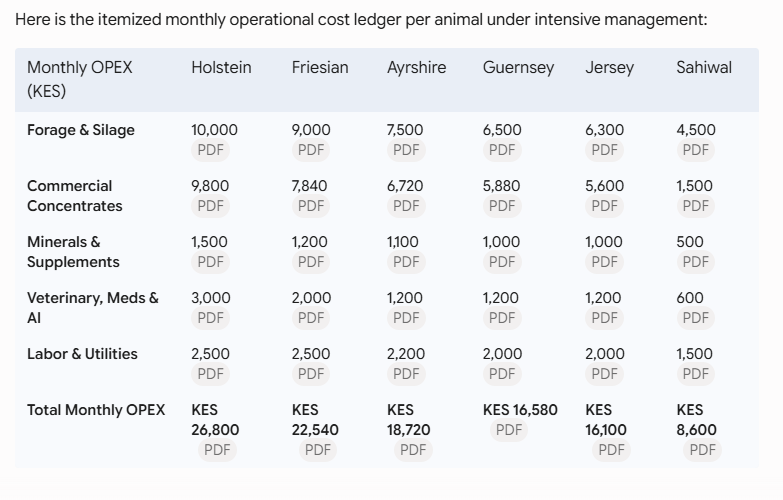
In Kenyan dairy farming, feed accounts for 60% to 70% of your total operational expenditure. This is where body weight becomes a massive financial liability.
A Holstein requires up to 110kg of fresh wet forage daily just to maintain her massive skeletal frame and drive her high metabolic throughput. Conversely, a Jersey or Sahiwal consumes 30% to 40% less total dry matter.
Furthermore, vet costs differ wildly: Holsteins are highly susceptible to mastitis and milk fever, while the Sahiwal and Ayrshire require minimal veterinary interventions.
Here is the itemized monthly operational cost ledger per animal under intensive management:
Round 3: Net Margins & Capital Return (ROI)
When we subtract Monthly OPEX from Gross Revenue, the illusion of the “high-yielding bulk producer” evaporates.
Monthly Net Profit = Gross Revenue - Total OPEX
Holstein: KES 52,500 − KES 26,800 = KES 25,700 (Net Margin: 48.9%)
Jersey: KES 39,000 − KES 16,100 = KES 22,900 (Net Margin: 58.7%)
Guernsey: KES 40,950 − KES 16,580 = KES 24,370 (Net Margin: 59.5%)
Friesian: KES 42,000 − KES 22,540 = KES 19,460 (Net Margin: 46.3%)
Ayrshire: KES 36,000 − KES 18,720 = KES 17,280 (Net Margin: 48.0%)
Sahiwal: KES 16,500 − KES 8,600 = KES 7,900 (Net Margin: 47.8%)
Capital Efficiency & Asset Costs
Because Holsteins and Friesians are the default choice in Kenya’s dairy hubs (Kiambu, Meru, Nyandarua), the market for premium heifers is hyper-inflated. Let’s look at the annualized cash-on-cash return based on what it actually costs to acquire a top-tier, pedigree in-calf heifer in Kenya today:
The Jersey: Cost: KES 140,000 | Annual Net: KES 274,800 196% Cash Return
The Guernsey: Cost: KES 150,000 | Annual Net: KES 292,440 195% Cash Return
The Holstein: Cost: KES 190,000 | Annual Net: KES 308,400 162% Cash Return
The Ayrshire: Cost: KES 130,000 | Annual Net: KES 207,360 159% Cash Return
The Friesian: Cost: KES 170,000 | Annual Net: KES 233,520 137% Cash Return
The Sahiwal: Cost: KES 90,000 | Annual Net: KES 94,800 105% Cash Return
The Strategic Verdict
Your choice of breed should match your infrastructure, location, and capital profile:
Go with Holsteins/Friesians only if you are in a cold, high-altitude zone, have fully mechanized your silage production to lower feed costs to the floor, and possess an ironclad bulk processing contract. This is a high-volume, capital-intensive commodity play.
Go with Jerseys/Guernseys if you are on a limited land footprint, buy a portion of your commercial fodder, and plan to maximize your margins by bypassing the mass cooperatives to target premium niches or direct retail. They offer the highest capital efficiency.
Go with Ayrshires if you want a robust, low-drama mid-cap asset. They are built for tough terrain, have excellent longevity, and tolerate minor management errors better than any other European breed.
Go with Sahiwals if your farm is located in semi-arid, hot regions (like Kajiado, semi-arid Machakos, or parts of the Rift Valley) where intensive zero-grazing is impossible. They are a defensive hedge asset—yielding lower dairy returns but protecting your capital against severe climate shock and disease wipeouts.
In the modern Kenyan agricultural landscape, the smartest money isn’t chasing the most liters. It’s chasing the most profitable ones.
Are you currently designing a dairy or livestock unit in East Africa? Drop a comment below with your biggest infrastructure or feeding bottleneck, and let’s unpack the numbers together in the next issue. Don’t forget to subscribe to @boardlotsultan for weekly data-driven insights into Kenyan agribusiness, livestock systems, and market policy