
What’s In This Article
1.0 Introduction: The Institutional Accumulator
1.1 The Pension Wild West
1.2 Enter the Regulator
1.3 The Core Thesis
2.0 The KRA Foundations: Coding the Tax Ledger
2.1 The Revenue Training Ground
2.2 The Enforcement Mindset
3.0 Building the RBA Firewall: Taming the Corporate Cowboys (2001–2017)
3.1 Enforcing Trust
3.2 The Trustee Revolution
3.3 Surviving the Executive Pull
3.4 Building the RBA Corporate Structure and Team
3.4.1 The Blueprint of the Pillars
3.4.2 Assembling the Core Team: The Technocrat Pipeline
3.4.3 How the Architecture Catalyzed Trillion-Shilling Institutional Growth
4.0 The Sovereign Liquidity Engine: Unlocking the NSE & Infrastructure Debt
4.1 The Market Maker
4.2 Going Global
5.0 The Corporate Governance Titan: Boardroom Stewardship
5.1 The Equity Group Footprint
5.2 The PSSS Framework
5.3 Academic and Literary Doctrine
6.0 Data & Asset Feature: The Growth Curve of a Giant (Referencing the technical layout detailed in
odundo_growth_curve.pdf)7.0 Conclusion: The Compounding Dividend of Trust
1.0 Introduction: The Institutional Accumulator
1.1 The Pension Wild West
To understand the quiet revolution orchestrated by Dr. Edward Odundo, one must first revisit the absolute chaos of Kenya’s pre-2000 pension landscape. Before the turn of the millennium, the retirement savings of millions of Kenyan workers existed in a regulatory wild west. There was no centralized, specialized oversight body to guard worker assets.
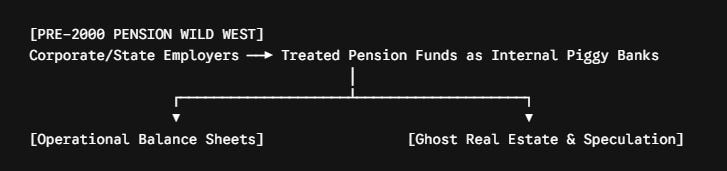
During this era, it was common practice for distressed companies to defer or completely skip remitting employee pension deductions to plug operational balance sheet holes. Worse, the accumulated funds were routinely mismanaged by untrained, politically appointed trustees who dumped liquid cash into highly speculative, illiquid ghost real estate or let it sit in compromised, politically connected banks that collapsed overnight. When a company went under, the workers’ retirement dreams vanished with it. The system was plagued by structural leakages, zero accountability, and a total lack of transparency that left the aging population completely exposed to poverty.
1.2 Enter the Regulator
In 2001, Dr. Edward Odundo was appointed as the founding Chief Executive Officer of the nascent Retirement Benefits Authority (RBA).
Odundo did not approach the RBA as a slow, paper-pushing civil servant. He approached it as an institutional builder. Over his historic 16-year tenure, he systematically transformed Kenyan pension funds from passive, vulnerable savings accounts into a highly aggressive, formal institutional asset class. Under his watch, the RBA became a formidable financial referee, turning what was once a highly fragmented and looted sector into a pristine, heavily fortified vault.
1.3 The Core Thesis
For value investors, market analysts, and asset managers tracking the Nairobi Securities Exchange (NSE), Odundo’s legacy provides the ultimate answer to how a frontier market matures. A capital market cannot achieve depth, absorb large corporate listings, or fund massive infrastructure projects if it relies solely on volatile foreign portfolio flows or erratic retail day-traders.
This brings us to the core thesis of his profile: long-term capital market depth requires predictable, automated retail capital aggregation. Odundo didn’t just protect retirees; he engineered the foundational institutional liquidity engine of modern East Africa. By creating a rigid, highly predictable framework that channeled millions of monthly paychecks into structured funds, he unlocked a multi-trillion-shilling capital pool.
2.0 The KRA Foundations: Coding the Tax Ledger
2.1 The Revenue Training Ground
Dr. Odundo’s ability to clean up the pension sector was not accidental—it was forged in the strict operational trenches of the Kenya Revenue Authority (KRA). Long before he took over the RBA, Odundo was a key architect in building the country’s early revenue-collection frameworks, most notably serving as the Commissioner of Value Added Tax (VAT) at the KRA.
The KRA of the 1990s was undergoing its own modernization phase, shifting away from manual, easily compromised tax tracking into an integrated, institutional tax ledger. As Commissioner of VAT, Odundo sat at the command center of corporate transactions.
2.2 The Enforcement Mindset
Working inside the KRA instilled in Odundo a rigid, data-driven enforcement mindset that would later define his regulatory philosophy at the RBA. Auditing corporate balance sheets to enforce tax compliance taught him a brutal truth about corporate behavior: if an asset pool is not aggressively monitored, audited, and ring-fenced by a central ledger, it will eventually be exploited.
📅 Timeline of Aggressive Regulatory Enforcement (2001–2017)
2002–2004: The Great Separation Order (Dismantling In-House Schemes)
The Action: Odundo issued a regulatory ultimatum ordering all companies to immediately stop holding employee pension cash on their operational balance sheets.
The Resistance: Major companies argued that moving billions into independent trusts would trigger immediate corporate liquidity crises.
The Outcome: The RBA stood firm, legally forcing the creation of independent corporate trusts.
2005–2007: The Trustee Cleanout & Asset Capping
The Action: The RBA aggressively enforced the RBA Investment Guidelines, placing a hard cap on real estate investments and illiquid holdings.
The Resistance: Politically connected trustees in state-owned schemes fought back, wanting to keep funding speculative, inflated land deals and uncompleted buildings.
The Outcome: Odundo disqualified non-compliant boards and mandated independent custodians and certified fund managers. This single move forced hundreds of billions out of “ghost property speculation” and directly into tradeable NSE equities and government bonds.
2008–2011: The War with the City Council of Nairobi
The Action: The RBA took direct regulatory and legal action against the City Council of Nairobi
The Resistance: City Hall claimed immunity due to its status as a critical local government entity, using political leverage to try and stall enforcement.
The Outcome: Under Odundo’s direction, the RBA rejected political compromises. The authority applied statutory penalties, leveraged its powers to demand asset swaps—forcing the council to surrender prime land holdings to the Local Authorities Pension Trust (LapTrust).
2012–2015: Clamping Down on State Parastatals
The Action: The RBA launched forensic audits into major state corporations, including the Kenya Ports Authority (KPA), Kenya Power, and the Postal Corporation of Kenya, for maintaining massive unremitted pension deficits.
The Resistance: Powerful managing directors tried to use bureaucratic channels to ignore RBA directives, attempting to treat employee deductions as a soft operational buffer.
The Outcome: Armed with an unassailable data trail, Odundo’s legal and supervision teams threatened to freeze parastatal bank accounts and institute direct penalties.
2016–2017: Blocking The National Treasury’s Executive Dip
The Action: As pension assets scaled past 900 Billion KES, the national government faced growing fiscal strain and sought avenues to access these funds with fewer regulatory hurdles.
The Resistance: Direct executive pressure was placed on the regulator to loosen investment restrictions, allowing pension schemes to buy into riskier, unvetted state projects.
The Outcome: Relying on the RBA’s institutional independence, Odundo defended the strict regulatory wall. He maintained rigid compliance standards until his retirement in 2017, handing over a highly fortified, pristine 1.08 Trillion KES institutional vault to his successors.
3.0 Building the RBA Firewall: Taming the Corporate Cowboys (2001–2017)
3.1 Enforcing Trust
When Dr. Edward Odundo assumed office in 2001, his immediate priority was to dismantle the systemic vulnerability where corporate and state-owned employers treated worker pensions as secondary cash reserves. He initiated an extensive administrative cleanout by enforcing a non-negotiable rule: the total structural segregation of pension fund assets from core corporate operational balance sheets.
Under Odundo’s direction, the RBA mandated that every pension scheme register as an independent legal trust, completely separate from the sponsoring employer. This meant that if a manufacturing firm or a state parastatal faced a liquidity crisis, executive management could no longer freeze, divert, or tap into the pension pool to fund daily operations or pay suppliers. By legally ring-fencing these funds, the RBA effectively insulated employee savings from the operational risks of the business, forcing corporate executives to treat pension contributions as sacred, un-touchable liabilities.
3.2 The Trustee Revolution
Separating the funds was only the first step; the next was taming the “Trustee Cowboy” culture. Historically, pension boards were staffed by well-connected political appointees or company insiders who lacked basic financial literacy, often making catastrophic investment decisions based on intuition rather than analysis. Odundo orchestrated a profound structural shift known as the Trustee Revolution.
The RBA introduced strict compliance guidelines that professionalized the entire management ecosystem:
Mandatory Independent Custodians: Schemes were legally barred from holding their own cash or titles. These had to be placed with licensed commercial banks acting as highly regulated custodians.
Certified Fund Managers: Investment decisions were stripped away from amateur board members and handed exclusively to professional, RBA-licensed fund managers.
Trustee Certification Programs: Odundo made it mandatory for trustees to undergo rigorous, continuous training on portfolio diversification, asset allocation, and fiduciary risk management.
This multi-layered firewall institutionalized the sector, converting pension management from a casual boardroom assignment into a highly structured, scientifically managed financial discipline.
Here is the chronological breakdown of the statutory evolution and legislative design that codified the multi-trillion-shilling RBA firewall under his watch.
Here is the chronological breakdown of the statutory evolution and legislative design that codified the multi-trillion-shilling RBA firewall under his watch.
📜 Timeline of Legal & Regulatory Framework Evolution (2001–2017)
Phase 1: Codifying the Foundational Rules (2001–2004)
2000–2001: Gazetting of the Subsidiary Regulations
The Legal Shift: While the Retirement Benefits Act was passed in 1997, it lacked operational teeth. Upon taking office, Odundo’s team aggressively operationalized the Retirement Benefits (Occupational Retirement Benefits Schemes) Regulations.
The Framework: This baseline piece of subsidiary legislation legally criminalized the commingling of corporate operational assets with worker retirement savings, forcing schemes to register as independent trusts.
2002–2003: Enforcement of the Independent Professional Triad
The Legal Shift: Statutory updates explicitly banned pension boards from managing their own investments internally.
The Framework: Amendments mandated a strict separation of powers. By law, schemes were required to hire an RBA-licensed professional triad: an independent Fund Manager (for investment selection), an independent Custodian Bank (to physically hold the securities/titles), and a certified Administrator.
Phase 2: Institutional Isolation & Investment Caps (2005–2009)
2005–2006: Introduction of Risk-Based Supervision Guidelines
The Legal Shift: The RBA shifted from a reactive compliance model to a proactive Risk-Based Supervision (RBS) framework via structural policy directives.
The Framework: Instead of evaluating schemes purely through end-of-year accounting audits, the law empowered RBA inspectors to conduct spot-inspections on corporate balance sheets, assigning risk scores based on asset-liability matching.
2007: Tax Exemption Integration for Retirees
The Legal Shift: Finance Act updates (driven by RBA technical advisories to the National Treasury) introduced aggressive tax cushions for the pension sector.
The Framework: Effective June 2007, retirement benefits and monthly annuities for all senior citizens above the age of 65 were rendered 100% tax-free. This massive structural incentive drastically accelerated voluntary, retail capital aggregation into private pension schemes.
Phase 3: Deepening Market Liquidity & Stopping Internal Plugs (2010–2014)
2010: The Statutory Amendment on Late Remittances
The Legal Shift: Amendments to Section 53 of the Retirement Benefits Act targeted delinquent employers, particularly municipal authorities and cash-strapped state parastatals.
The Framework: The law introduced compounding penal interest on any employer who deducted pension funds from worker paychecks but failed to remit them to the custodian bank within 10 days of the calendar month.
2013: The Re-Engineering of Public Pension Mandates
The Legal Shift: Legal shifts across the wider retirement space—including the overhaul of the National Social Security Fund (NSSF) Act—redefined the RBA’s statutory oversight boundaries over state pension monopolies.
The Framework: The RBA cemented its position as the ultimate regulatory referee, asserting auditing authority over statutory national funds to ensure adherence to professional fund management rules.
Phase 4: Structuring the Trillion-Shilling Vault (2015–2017)
2015–2016: Modernizing Alternative Asset Guidelines
The Legal Shift: Under Odundo’s guidance, the RBA Investment Guidelines Table was re-coded through the National Treasury to reflect a modern, maturing capital market.
The Framework: Total exposure to volatile or illiquid real estate was kept under tight structural caps. Concurrently, new investment asset classes were legally gazetted—allowing fund managers to cleanly deploy portions of their capital into Private Equity (PE) funds, Venture Capital, and long-term Public-Private Partnership (PPP) infrastructure bonds.
2017: The Codification of Umbrella Scheme Regulations
The Legal Shift: The introduction of the Retirement Benefits (Umbrella Retirement Benefits Schemes) Regulations.
The Framework: This landmark legal notice allowed small and medium-sized enterprises (SMEs) to pool their retirement funds into single, massive “Umbrella Funds”. This legally democratized institutional-grade asset management, scaling corporate pension access to millions of informal and semi-formal workers across Kenya and pushing industry total assets past the historic 1.08 Trillion KES mark right at his retirement
3.3 Surviving the Executive Pull
The toughest battles Odundo faced did not come from small private firms, but from powerful state corporations, local authorities, and strategic parastatals. For decades, massive entities like the Kenya Ports Authority (KPA), Kenya Power, and various cash-strapped municipal councils were accustomed to running massive unremitted pension deficits, using workers’ money to plug expanding fiscal holes or balance state books.
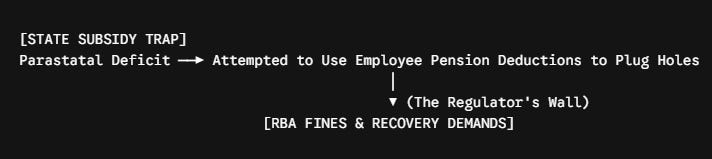
Odundo navigated immense political pushback when the RBA began clamping down on these institutions. When senior politicians and powerful managing directors tried to use their political leverage to bypass compliance, Odundo stood firm on the RBA Act.
3.4 Building the RBA Corporate Structure and Team
3.4.1 The Blueprint of the Pillars
When Dr. Edward Odundo walked into the Retirement Benefits Authority as its founding CEO, there was no pre-existing organizational flow chart to copy. He had to build a clean corporate structure from scratch that could actively police the chaotic pension landscape while steering asset growth.
To achieve this, Odundo designed a highly specialized, multi-tiered corporate structure anchored on three distinct regulatory directorates:
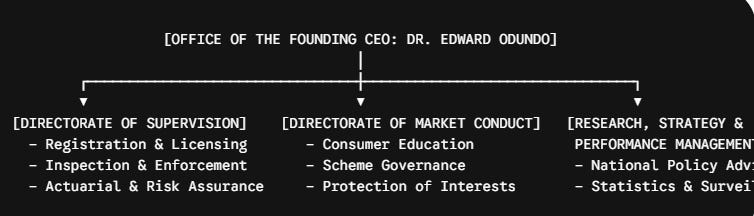
The Directorate of Supervision: This was designed as the enforcement division of the bank. It was divided into the Registration & Licensing Division (the strict gatekeeper evaluating whether schemes and managers were fit to operate) and the Inspection & Enforcement Department (the auditors who went onto corporate floors to fish out unremitted deductions).
The Directorate of Market Conduct and Industry Development: Odundo recognized that policing was useless without developing the market ecosystem. This directorate took over trustee education, consumer protection, and setting guidelines for transparent asset management.
The Directorate of Research, Strategy, and Performance Management: This division focused strictly on the macro-picture. It generated the continuous data, market surveillance, and industry reports needed to advise the National Treasury on national pension policies.
3.4.2 Assembling the Core Team: The Technocrat Pipeline
Odundo understood that an organizational structure is only as powerful as the specialists running it. Because the pension fund management profession was virtually non-existent in Kenya in 2001, he could not simply hire off-the-shelf talent.
Key industry veterans like Jackson Nguthu (who served for 15 years under various positions before eventually scaling to Director of Supervision) and Mr. Kiptanui (who joined at inception in 2000, mastering scheme registration before being deployed to lead the Market Conduct Directorate) were foundational blocks of the core team Odundo assembled.
By building a specialized legal team under seasoned counsel like Mrs. Praxidis Saisi (Corporation Secretary and Director of Legal Services), Odundo insulated the RBA’s technical rulings from being easily dismantled by aggressive corporate litigators in court.
3.4.3 How the Architecture Catalyzed Trillion-Shilling Institutional Growth
This carefully engineered corporate structure directly unlocked the historic growth of the institution, translating structural design into hard macroeconomic scale:
Elimination of Key-Man Risk: By moving away from a centralized, CEO-centric approval model and setting up functional directorates, the RBA could seamlessly process thousands of statutory scheme reviews simultaneously.
Risk-Based Supervision: The integration between the Actuarial teams and the Inspection department allowed the RBA to shift from reactive policing (waiting for a scheme to collapse) to proactive risk mapping. The team could spot systemic liquidity holes on a corporate balance sheet years before it impacted retirees.
Market Trust and Capital Pooling: Because the Market Conduct arm continuously professionalized trustees, corporate and formal sector employees felt safe routing their long-term savings into the system. This structural trust is what successfully converted a fragmented 40 billion KES market into a 1.08 trillion KES domestic liquidity powerhouse by 2017. The RBA did not grow via lucky market rallies; it grew because Odundo built a corporate machine engineered explicitly to aggregate and protect capital.
4.0 The Sovereign Liquidity Engine: Unlocking the NSE & Infrastructure Debt
4.1 The Market Maker
The real magic of Odundo’s regulatory framework was its profound macroeconomic impact on the broader capital markets. By cleaning up the system, pension assets under management (AUM) expanded exponentially skyrocketing from a mere 40 billion KES in the early 2000s to a colossal 1.08 trillion KES by the time of his retirement in 2017.

Odundo channeled this massive wave of domestic capital directly into Kenya’s economic engine by designing strict, prescriptive asset allocation guidelines (known as the RBA Investment Guidelines Table).
This forced fund managers to deploy hundreds of billions of shillings into two primary pillars:
NSE Equities: Providing stable, long-term institutional buying blocks for blue-chip companies like Safaricom, Equity Group, and KCB.
Government Fixed Income: Anchoring the domestic debt market by serving as the primary buyers for long-term Treasury and multi-billion-shilling infrastructure bonds.
Without this predictable pool of long-term domestic liquidity, Kenya’s capital markets would have remained overly dependent on volatile, short-term foreign investments.
4.2 Going Global
The stunning turnaround of the Kenyan retirement sector quickly caught the attention of global financial bodies. Under Odundo’s leadership, Kenya became a global case study on how to rapidly reform, clean up, and scale a pension ecosystem in a developing economy.
This institutional track record culminated in Dr. Odundo’s historic election as the President of the International Organization of Pension Supervisors (IOPS).
5.0 The Corporate Governance Titan: Boardroom Stewardship
5.1 The Equity Group Footprint
When Dr. Edward Odundo stepped down from the Retirement Benefits Authority (RBA) in 2017, his regulatory journey did not end—it shifted directly into the ultimate rooms of corporate decision-making. As an expert in risk mitigation and asset accumulation, he became a highly sought-after boardroom anchor within the East African banking oligopoly. His most notable post-RBA footprint was established within Equity Group Holdings Plc.
Odundo joined the board of Equity Group Holdings Plc as a Director, bringing his strict, data-driven KRA and RBA governance standards to one of the largest financial institutions in the region. Furthermore, he was tapped to serve as the Board Chairman of Equity Life Assurance Kenya (ELAK). Under his stewardship, the newly launched insurance and underwriting arm of Equity Group capitalized heavily on his structural design frameworks, allowing the startup entity to rapidly capture market share, deploy capital cleanly, and maintain pristine compliance with national regulatory codes.
5.2 The PSSS Framework
While his corporate footprint grew, the state called him back to solve its most critical macroeconomic vulnerability: the ballooning, unfunded civil service pension bill. Historically, government workers were paid under a non-contributory pension scheme funded directly from the Exchequer’s daily revenues—a system that was fast becoming fiscally unsustainable. Odundo was appointed as the pioneer Board Chairman of the Public Service Superannuation Scheme (PSSS).
As the founding Chairman of the PSSS, Odundo executed the massive task of migrating hundreds of thousands of civil servants, teachers, and disciplined forces into a modern, funded contributory pool. Under his watch, the PSSS was transformed from an abstract state liability into an active, multi-billion-shilling capital aggregator.
5.3 Academic and Literary Doctrine
Beyond the boardroom, Dr. Odundo transitioned his decades of field experience into elite academic spaces. Returning to his alma mater, the University of Nairobi (UON), he took up roles lecturing postgraduate and doctoral students on corporate governance, strategic planning, and public sector finance.
He formalized his regulatory and personal philosophies by authoring foundational business literature, including:
The Doctrine of Strategic Planning: A deep-dive operational blueprint used by corporate executives to design risk-proof organizational charts.
The 5 Mantras of Retirement: A highly relatable, consumer-facing guide designed to demystify financial planning and wealth preservation for ordinary citizens entering their sunset years.
6.0 Data & Asset Feature: The Growth Curve of a Giant
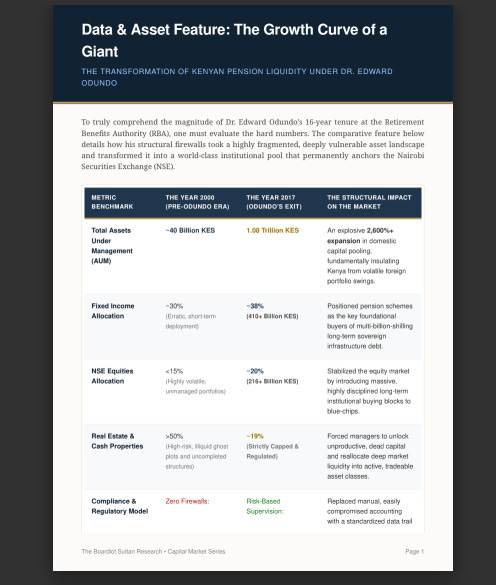
To truly comprehend the magnitude of Dr. Edward Odundo’s 16-year tenure at the RBA, one must evaluate the hard numbers. The table below outlines how his structural firewalls took a fragmented, highly vulnerable 40 billion KES market and turned it into a 1.08 trillion KES sovereign liquidity engine, drastically shifting asset allocation from speculative real estate into productive financial markets.
Case Study: The Telposta Rebalancing — Breaking the KES 11 Billion Real Estate Trap
To anchor these macroeconomic shifts in raw, operational reality, one needs to look no further than the structural overhaul of the Telposta Pension Scheme—a textbook case study of the pre-2000 “Pension Wild West” colliding with modern regulatory enforcement. Hghly distorted balance sheet where a 80% to 83% of its entire KES 14.1 billion portfolio was completely trapped in illiquid real estate, against RBA’s statutory 30% property cap.
Phase 1: Forensic Mapping & Legal Audits (The Recovery Backlog)
The Action: The scheme’s trustees, backed by specialized transaction advisors, launch a comprehensive forensic audit of all land parcels, commercial properties, and residential estates handed over by the original state monopolies.
The Findings: The audit exposes deep operational bleeding: over KES 276.9 million in uncollected rent, multiple properties compromised by illegal squatters, and prime land titles targeted by land-grabbers.
The Regulatory Trigger: Under RBA risk-based guidance, the board determines that holding 83% of assets in illiquid, high-maintenance brick-and-mortar is structurally unsustainable and aggressively violates statutory safety caps.
Phase 2: The Litigation Blitz & Title Reclamation
The Action: TPS launches a nationwide legal offensive to clean up its property ledger and evict illegal occupants.
The Milestone: The scheme successfully wins a series of high-stakes court battles to secure and refurbish its core real estate.
The Major Win: The fund aggressively repossesses a highly valuable, irregularly acquired prime asset on Muchai Drive in Nairobi, valued at KES 1 billion, proving that the trust can successfully claw back stolen capital from the market.
Phase 3: The KES 10 Billion Liquidation Approval
The Action: With clear titles established, the Board of Trustees and administrators formally approve a massive, structured exit plan to liquidate up to 70% of the entire scheme’s real estate holdings.
The Scale: KES 10 billion to KES 11 billion worth of property assets are earmarked for immediate divestment.
The Execution: To protect the market from real estate saturation and maximize valuation, the scheme places 64 distinct commercial and residential properties on the open market, rolling them out in strategic, advertised phases.
Phase 4: Rebalancing into the Sovereign Liquidity Engine
The Action: As the KES 10 billion in liquid cash starts flowing into the vault, the fund completely abandons immovable real estate and re-routes the capital into highly liquid, flexible financial instruments.
Asset Re-Allocation: The proceeds are systematically deployed across a modern, RBA-compliant matrix:
NSE Quoted Equities: Buying into high-yielding, blue-chip companies to capture compounding dividends.
Government Fixed Income: Purchasing long-term Treasury bonds to anchor stable, predictable monthly inflows.
The Infrastructure Shift: The board actively earmarks up to KES 2 billion to participate directly in the National Infrastructure Fund, roads, and airport debt.
Phase 5: Payout Stabilization and Retiree Dignity
The Target Execution: With liquidity constraints permanently resolved, the scheme shifts from surviving day-to-day to optimizing wealth distribution.
The Ultimate Outcome: The steady cash yield from bonds and equities allows the board to engage the sponsor and launch a formal 1-to-2-year review of monthly pension payouts. This structurally adjusts the baseline earnings for over 3,000 low-earning retirees, effectively completing the transition from a broken, illiquid “property trap” to a high-yield capital engine.