
The Fall of the Establishment’s Favorite: How Nik Nesbitt Traded Corporate Royalty for an Unlicensed Crypto Web
Part I: The Unlikely Defendant
For decades, the name Nicholas “Nik” Alexander Nesbitt carried an almost untouchable weight in the corridors of East African commerce. He was the consummate blue-blood corporate statesman: a Dartmouth- and Stanford-educated engineer, the founding CEO of KenCall, the former General Manager of IBM East Africa, the long-standing Chairman of the Kenya Private Sector Alliance (KEPSA), and eventually, the Presidentially appointed Chairman of the Capital Markets Authority (CMA)—the primary custodian of Kenya’s market integrity. When corporate Kenya needed a bridge to government, an ambassador to foreign investors, or a steady hand to lead public-private dialogue, Nesbitt was the default choice. His reputation was built on an unquestioned pedigree. Yet today, that carefully cultivated persona faces an unprecedented reckoning.
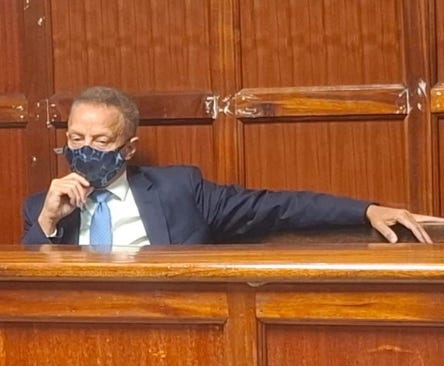
No longer a mere civil dispute behind closed arbitral doors, Nesbitt was formally arraigned at the Milimani Magistrate’s Court. In a criminal case that has sent shockwaves through the corporate elite, the former CMA Chairman now stands charged with conspiracy to defraud under Section 317 of the Penal Code. In September 2026, Bidco Chairman Dr. Vimal Shah took the witness stand to testify directly against his friend of two decades, detailing how Bidco lost KES 102.4 million ($745,000) in a failed off-market US dollar transaction. Shah testified that he relied strictly on Nesbitt’s personal word and reputation when introduced to Nesbitt’s business partner, Bulent Boytorun, and an unvetted crypto-and-stablecoin arbitrage scheme.
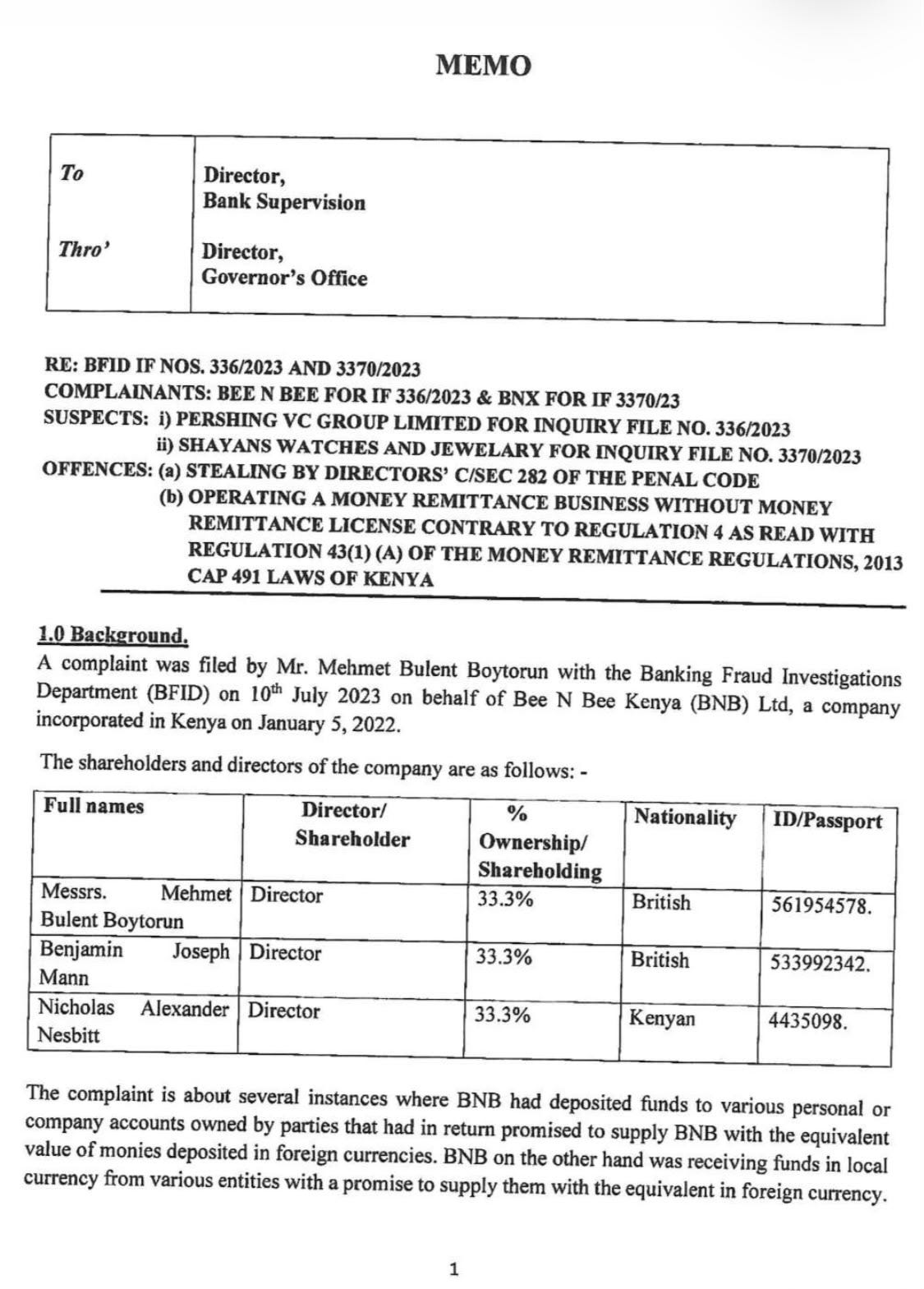
Behind the criminal charge sheet sits a far wider institutional dragnet. Leaked police memos from the Banking Fraud Investigations Department (BFID) submitted to the Central Bank of Kenya (CBK) show that Nesbitt’s entities—Bee ‘N Bee (KE) Limited and BNX Partners—did not just target Bidco. They pulled multiple regional blue-chips into an unlicensed foreign exchange and crypto-remittance web totaling over KES 322 million, with investigators citing statutory offenses including Stealing by Directors and Operating an Unlicensed Money Remittance Business.
This is the story of how an elite pedigree, decades of institutional trust, and an acute national dollar crisis collided to drag a titan of capital markets onto the criminal dock.
Part II: Pedigree, Power, and the Muthaiga Social Contract
Long before Nik Nesbitt ever set foot inside the boardrooms of IBM or the Capital Markets Authority, he was born into the upper crust of Kenyan society. The son of a prominent physician and descendant of British colonial-era industrialists, Nesbitt grew up surrounded by the quiet privilege of Nairobi’s elite circles. His childhood was spent navigating the verdant, gated estates of Muthaiga and the sprawling highland retreats of Nanyuki—enclaves where Kenya’s political aristocracy and corporate titans mingled over golf rounds, private dinners, and handshakes.
In these exclusive corridors, a deal was rarely just a transactional contract; it was a matter of honor, implicit social trust, and shared social standing.
Nesbitt’s academic journey only cemented his trajectory toward elite leadership. After completing his undergraduate and master’s degrees in engineering at Dartmouth College, he earned an MBA from Stanford University’s Graduate School of Business—a pedigree that positioned him among the most sought-after minds in global tech and management consultancy.
Upon returning to Kenya, he launched KenCall, East Africa’s first commercial BPO call center. The venture turned him into a celebrated poster child for Kenya’s emerging technology ecosystem. That success propelled him straight into corporate statesmanship: he took the helm as General Manager of IBM East Africa, served two terms as the influential Chairman of the Kenya Private Sector Alliance (KEPSA), and was ultimately appointed by the President to chair the Capital Markets Authority (CMA).
For a man of this standing, access was frictionless. When Nesbitt walked into a room, doorsteps opened.
It was precisely this unassailable currency of personal trust—forged over 20 years of shared social circles in Nairobi’s high society—that led Bidco Chairman Dr. Vimal Shah to welcome Nesbitt into his residence on May 18, 2023. Faced with a severe national dollar shortage, Shah did not ask for standard bank guarantees or institutional escrow accounts. He looked at Nik Nesbitt—the former CMA Chairman and KEPSA boss—and took him at his word. As Shah would later testify under oath in a criminal court, “Without the trust in Nesbitt, I would not have given this sort of money.” It was a social contract written in Muthaiga, signed on personal reputation, and destined to collapse into one of the biggest corporate fraud trials in modern Kenyan history.
Part III: The Crypto Liquidity Mirage and the Parallel FX Web
To understand how a respected former regulator ended up in a criminal dock, one must look at the digital architecture built behind the scenes as Kenya’s banking system suffocated under a severe dollar squeeze. By early 2023, official commercial bank channels were rationing US dollars, forcing major manufacturers into an existential scramble for hard currency to pay foreign suppliers. It was during this acute credit freeze that Nik Nesbitt and his British/Turkish associate, Mehmet Bulent Boytorun—a crypto and stablecoin promoter—began pitching off-market solutions through entities like Bee ‘N Bee (KE) Limited (BNB) and BNX Partners.
The digital footprint left on BNX Partners’ public portal framed their enterprise not as a shadowy black-market swap, but as a sophisticated institutional bridge. Promising custom cross-border liquidity, BNX boasted of its ability to move clients seamlessly between “exotic” local currencies and hard currencies or stablecoins at highly favorable rates, even advertising large-volume trades exceeding $1 million per day.
For corporate titans accustomed to formal banking, the pitch sounded like modern financial engineering. In reality, as Central Bank documents and court records reveal, the entire setup was built on an illegal foundation.
Official police filings from the Banking Fraud Investigations Department (BFID)—submitted directly to the Director of Bank Supervision at the Central Bank of Kenya (CBK)—explicitly cite BNB and BNX Partners for statutory criminal offenses. Chief among them was Operating a Money Remittance Business Without a License, directly violating Regulation 4 as read with Regulation 43(1)(a) of the Money Remittance Regulations, 2013 under Cap 491 Laws of Kenya. The CBK documents confirm that neither BNB nor BNX held the requisite regulatory licensing or mandates to conduct foreign exchange or remittance transactions in Kenya.
Before the multi-million shilling trap snapped shut on Bidco, a classic sequence of smaller, successful trial runs helped lay the groundwork. Bidco had already executed two smaller transactions with Nesbitt in March and April 2023. When those earlier trades encountered delays, funds were returned, establishing an illusion of good faith and risk-free execution.
Armed with this reinforced trust, Nesbitt brought Boytorun directly into Vimal Shah’s home on May 18, 2023. The pitch was simple: transfer local shillings, and BNB would leverage crypto stablecoin rails to deliver $745,000 within 24 hours. On May 23, Bidco wired KES 102,437,500.
The hard currency never materialized in full. Out of the KES 102.4 million handed over, BNB delivered only USD 300,000 in partial payouts before the pipeline froze completely, leaving USD 445,000 unaccounted for. The stablecoin arbitrage dream had dissolved, revealing a KES 322 million multi-company dragnet built on an unlicensed remittance enterprise that would soon draw the full force of the Central Bank’s anti-fraud unit.
HOW TRUST MADE BIDCO CEO VIMAL SHAH LOSE SH102
This video provides direct coverage of Bidco CEO Vimal Shah testifying in court regarding how personal trust in Nik Nesbitt led to the KES 102 million fraud case.
Part IV: The Fall from Muthaiga to Milimani’s Dock
When the full scope of the missing funds became clear, Nik Nesbitt moved swiftly to insulate himself from liability. His defense strategy relied heavily on formal corporate distance: pointing out that he had formally resigned as a director of Bee ‘N Bee (KE) Limited in March 2022, that his signature was absent from the written contract with Bidco, and that the agreement was technically executed between Bidco and Bulent Boytorun. His legal team sought to push the dispute into the quiet, confidential corridors of civil arbitration, attempting to quash criminal proceedings altogether. But the Office of the Director of Public Prosecutions (ODPP) refused to treat a KES 322 million multi-company dragnet as a mere contractual disagreement.
The legal shield shattered completely at the Milimani Magistrate’s Court.
Nesbitt was formally arraigned and charged with conspiracy to defraud under Section 317 of the Penal Code. His co-accused, Mehmet Bulent Boytorun, fled the country after securing police bail, leaving the former CMA Chairman standing alone in the dock. The drama reached its peak in September 2026, when Dr. Vimal Shah took the witness stand. In compelling testimony, the industrialist detailed how 20 years of friendship and shared pedigree were used as the primary collateral to induce the deal. When cross-examined on why he had not performed a routine company registry search or demanded board resolutions before wiring KES 102.4 million, Shah’s answer laid bare the weight of elite social capital: “I trusted him because he’s a friend... Without the trust, I would not have given this sort of money to a Mr. Bulent who I didn’t even know.”
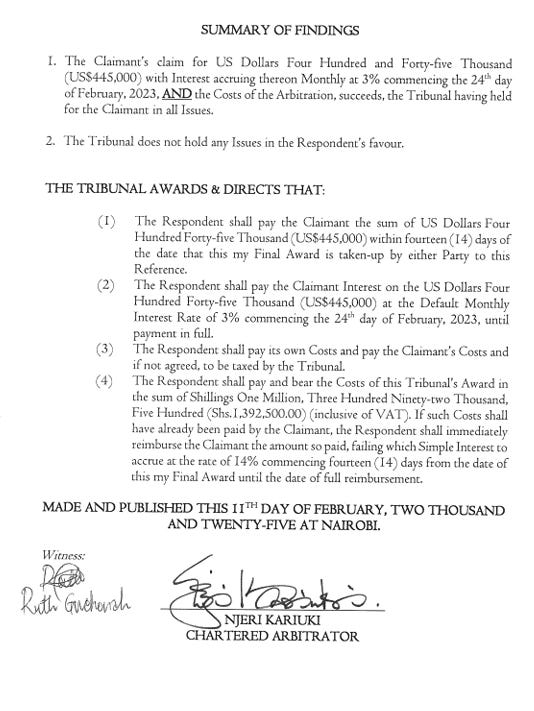
Simultaneously, the civil arbitration led by Sole Arbitrator Njeri Kariuki systematically dismantled Nesbitt’s arguments. The tribunal affirmed that Nesbitt acted as a de facto agent whose active presence and assurances directly induced the transaction. BNB was ordered to refund Bidco USD 445,000, compounded by a 3% monthly interest rate backdated to May 2023, along with KES 1.39 million in legal costs.
The fall was complete. The statesman who once shaped the regulations governing Kenya’s capital markets now awaits the continuation of his criminal fraud trial, offering corporate East Africa a chilling case study on the dangers of substituting institutional diligence with personal trust.
Part V: The Arbitration Award: Shredding the Corporate Shield
While the criminal proceedings at Milimani brought public exposure, it was behind the closed doors of domestic arbitration where the legal machinery first dismantled Bee ‘N Bee (KE) Limited’s defense strategy.
Faced with Bidco’s demand for the unpaid USD 445,000, BNB—represented by RONN Law Advocates LLP—attempted to mount a multi-layered shield. BNB argued that the transaction had been rendered impossible by “frustration” and “force majeure,” claiming they had simply acted as an intermediary, wiring approximately 94% of Bidco’s funds (KES 96.4 million) to an unvetted third-party vendor, Pershing VC Group, which then defaulted. BNB even pointed to a complaint they had lodged with the police against Pershing to prove their own status as a victim.
Concurrently, Nik Nesbitt sought to distance himself from the commercial contractual exposure entirely. His legal team stressed that his name was absent from the written Trade Finance Support Agreement, that the contract was executed strictly between Bidco and Bulent Boytorun on behalf of BNB, and that Nesbitt had formally exited BNB’s directorship in 2022.
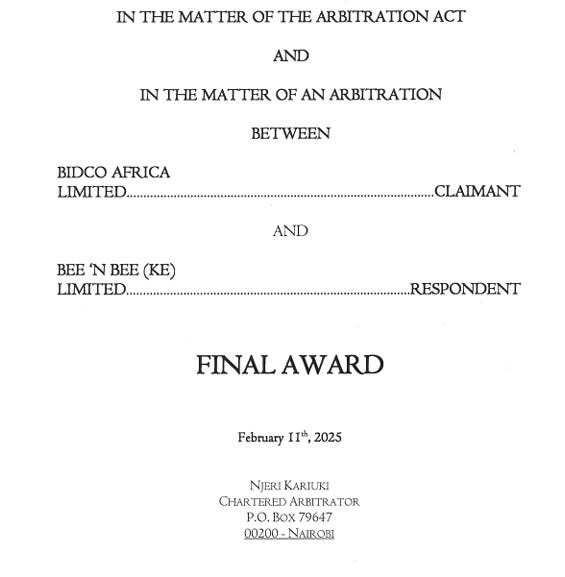
In a landmark final award issued on February 11, 2025, Sole Arbitrator Njeri Kariuki systematically dismantled every line of defense:
Third-Party Default is Not Legal Frustration: The tribunal ruled that Bidco was entirely foreign to BNB’s private arrangement with Pershing VC Group. A subcontractor or supplier defaulting constitutes commercial hardship, not an impossibility that discharges contractual obligations.
De Facto Agency and Induced Reliance: The arbitrator rejected the attempt to sever Nesbitt from the deal, confirming that even if his signature was omitted from the final document, Nesbitt acted as a de facto agent whose active presence, introductory role, and stature directly induced Bidco to enter the agreement.
Absolute Commercial Liability: The tribunal held BNB fully liable for the contractual breach, confirming that transferring client funds down an unvetted chain did not absolve the firm of its primary obligation to deliver foreign currency.
The Final Order
Sole Arbitrator Njeri Kariuki ruled overwhelmingly in favor of Bidco, ordering BNB to pay:
USD 445,000 in outstanding principal.
3% monthly interest on the principal, backdated to May 24, 2023, until full payment.
KES 1,392,500 in legal and tribunal fees.
The arbitral award established a clear civil judgment: the missing $445,000 was a binding corporate debt, setting the legal foundation that shattered the narrative of a victimless transaction and accelerated the Central Bank Anti-Fraud Unit’s criminal dragnet.
Legal Strategy and Procedural Moves
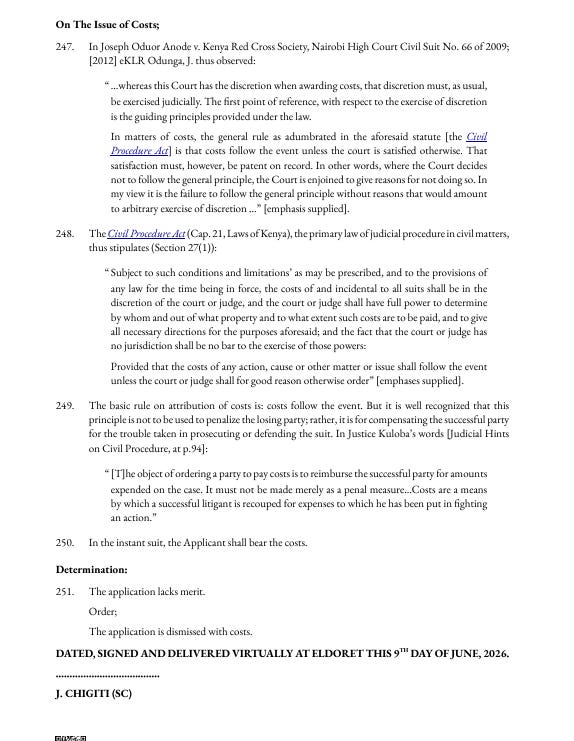
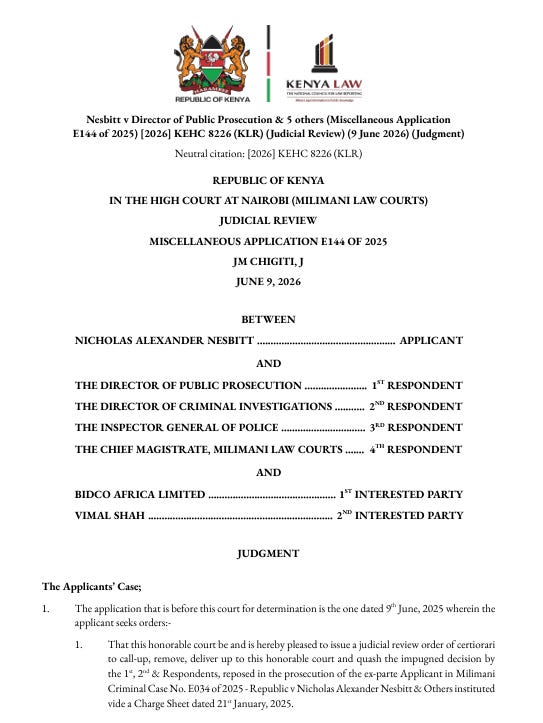
In an attempt to halt the criminal proceedings instituted against him in Milimani Criminal Case No. E034 of 2025, former KEPSA Chairman Nicholas Nesbitt initially sought to stop his prosecution by applying for a stay of prosecution via judicial review. Filed under High Court Miscellaneous Application E144 of 2025, Nesbitt petitioned the court for orders of certiorari and prohibition to quash the charge sheet and restrain the DPP, DCI, and Milimani Chief Magistrate’s Court from pursuing the criminal case. He argued that the matter stemmed from a purely civil dispute over a USD 745,000 Trade Finance Support Agreement between Bidco Africa Limited and Bee n Bee Kenya Limited—a contract to which he was not a party, having merely introduced the entities—and that the ongoing arbitration process made the criminal trial an abuse of prosecutorial discretion. However, on June 9, 2026, High Court Judge J.M. Chigiti dismissed the application, holding that parallel civil or arbitral proceedings do not bar criminal prosecution under Section 193A of the Criminal Procedure Code.
Alongside his efforts to quash his own charges, Nesbitt took steps to drag Bidco Chairman Vimal Shah into the criminal proceedings. In his court filings, Nesbitt highlighted that the complainant in the charge sheet was Vimal Shah in his personal capacity, rather than Bidco Africa Limited, which was the actual corporate entity that remitted the KES 102.4 million. Citing the fundamental principle of separate legal personality established in Salomon v Salomon, Nesbitt’s defense argued that Shah had no personal proprietary rights over the company’s funds. By challenging the legitimacy of Shah acting as the primary complainant while asserting that Shah personally executed the underlying agreement, Nesbitt sought to establish that if any criminal or financial accountability was to be apportioned regarding the transaction’s authorization and execution, Shah and Bidco held the direct contractual role, thereby attempting to turn the legal focus back onto Shah’s own standing and participation in the transaction.
Part VI: The Anatomy of Governance Breakdown and the Corporate Cautionary Tale
The downfall of Nik Nesbitt is more than the story of a single executive’s legal troubles; it is a case study in how institutional oversight breaks down when confronted with elite social capital and systemic economic pressure.
At its core, the entire collapse hinged on three systemic vulnerabilities that reverberated across Kenya’s corporate landscape during the 2023 currency crunch:
The Myth of Institutional Immunity: Corporate Kenya operated under an unwritten assumption that pedigree guarantees compliance. A former Capital Markets Authority Chairman was presumed to embody the very regulatory framework he once enforced, allowing blue-chip firms to bypass baseline due diligence—such as verifying basic Central Bank remittance licensing or conducting formal registry searches.
Macro Crises Drive Dangerous Compromises: When acute dollar rationing paralyzed traditional supply chains, established industrialists turned to unregulated Over-the-Counter (OTC) channels. The promise of 24-hour stablecoin liquidity overshadowed the glaring operational risks of third-party siphoning and unvetted intermediaries.
Personal Relationships as Counterparty Risk: As Dr. Vimal Shah’s testimony laid bare at Milimani Magistrate’s Court, two decades of boardroom camaraderie replaced hard legal protections. Trust was treated as an asset class, creating a vulnerability that unraveled the moment the underlying capital vanished
The Central Bank’s Banking Fraud Investigations Department has signaled that the era of informal off-market currency arrangements among corporate elites is over. By recommending criminal charges for both statutory remittance violations and director liability, regulators are enforcing a hard boundary: no amount of corporate stature exempts an entity from financial market laws.
As the criminal trial resumes at Milimani, the case stands as a warning for East Africa’s C-suite. When formal market mechanisms strain, substituting regulatory rigor with personal prestige does not mitigate risk—it simply compounds the fallout.
Part VI: Governance Breakdown, Fiduciary Duty, and the Public Market Reckoning
The downfall of Nik Nesbitt is more than an elite scandal—it is a case study in governance failure across different corporate structures. As Central Bank anti-fraud documents reveal, the off-market web did not just snare prominent family-run businesses like Bidco Africa and Tiles & Carpet Center; it reached into the balance sheet of a publicly listed firm, Car & General.
Family Empires vs. Listed Giants
For family-owned enterprises like Bidco and Tiles & Carpet Center, committing KES 102.4 million and KES 45 million respectively to an unlicensed entity was a painful lesson in relying on personal trust over institutional due diligence. In these closely held businesses, capital belongs to founding families who often make swift, rapport-based decisions in moments of operational crisis.
However, when Car & General Tanzania committed KES 175 million—the largest single chunk in the BFID dragnet—the governance implications shifted dramatically. Car & General is a publicly traded company listed on the Nairobi Securities Exchange (NSE). Its funds do not belong to a private patriarch; they belong to retail shareholders, institutional investors, and pension funds.
The Question of Director Liability
The involvement of a listed company in an off-market, unlicensed remittance scheme raises urgent regulatory questions: Who should be held accountable when board-approved or executive-sanctioned capital is lost in a reckless manner?
Under the Kenyan Companies Act (2015) and Capital Markets Authority guidelines, corporate directors owe strict fiduciary duties:
Duty of Care and Diligence (Section 143): Directors must exercise reasonable care, skill, and diligence. Forwarding KES 175 million of public corporate funds to an unlicensed, unvetted entity operating without Central Bank authorization breaches fundamental risk-management standards.
Personal Liability for Negligence: While the Business Judgment Rule protects executives making reasonable commercial bets, committing funds to an entity operating in violation of the Money Remittance Regulations (Cap 491) strips away that immunity. Shareholders can rightfully question whether management acted with gross negligence.
Public Market Disclosure: As a listed company, material financial losses from unauthorized forex transactions require explicit market disclosure. Siphoning capital into an unlicensed parallel market subjects the board to scrutiny from both the CMA and NSE.
The Ultimate Takeaway
The Banking Fraud Investigations Department’s probe marks a turning point for East African commerce. By recommending criminal charges for statutory remittance violations and director liability, regulators have sent a clear message.
When formal banking channels freeze, substituting regulatory compliance with elite social capital isn’t just a misstep—it is a breach of fiduciary duty. For family enterprises, it risks generational wealth; for publicly listed companies, it opens the door to shareholder lawsuits and regulatory sanction.
About Boardlot Africa Research
Boardlot Africa is a premier financial intelligence and corporate governance publication dedicated to unpacking the mechanics of capital, market strategies, and structural shifts across East Africa’s corporate landscape. By bridging the gap between raw economic data and actionable market intelligence, we deliver deep-dive research, independent corporate analysis, and policy insights designed for institutional investors, boardrooms, and sharp market observers.
Get in Touch
Email: boardlot.research@gmail.com
Phone: +254 753 133 901
Substack: Subscribe to Boardlot Africa
X (Twitter): BoardLotSultan
How many more deaths occur in legislation thanks for shedding light on this Law can be interesting if one has imagination 😂