
Table of Contents: Cyrus Jirongo – The Billion-Shilling Battle
I. The Rise of the “Cash Czar”
The YK ‘92 Machine: Weaponizing Patronage in 1992
The “Jirongo” Note: Symbolism of the 500-Shilling Infusion
Business vs. Patronage: The Myth of the “Midas Touch”
II. The Hazina Estate Saga
The Sololo Outlets Contract: Anatomy of a Disputed Deal
The NSSF Tussle: Escalating Costs and Ejection
The Long Shadow of Litigation: From South B to the Supreme Court
III. The Banking Collapse & Debt Legacy
Postbank Credit Ltd: Collateral, Default, and Institutional Failure
The KES 40 Billion Question: Taxpayer Loss and the Recovery Struggle
Land as Currency: The Ruai and Industrial Area Collateral Disputes
IV. Legal Jurisprudence & Institutional Impact
Advancing the Law: Setting Precedents on Criminal Prosecution and Delay
Defining Corporate Liquidation Rules: Jirongo’s Role in Restraining Liquidators
The Long-Term Effect on Pension Regulation and Institutional Safeguards
V. Private Life: The Complexity of Family and Legacy
The Patriarchal Footprint: A Legacy Revealed in Mourning
Wives, Children, and the “Jirongo” Lineage
The Funeral as a Societal Mirror: Balancing the Public and Private
VI. The Verdict: A Legacy of Excess
Political Weaponization: The Blueprint for Modern Campaign Machines
The Price of Ambition: How Patronage Ravaged the Economy
Final Outlook: Lessons for Modern Capital Market Transparency
I. The Rise of the “Cash Czar”
The YK ‘92 Machine: Weaponizing Patronage in 1992
In the landscape of 1992, the Youth for KANU ‘92 (YK ‘92) movement was not merely a political lobby group; it was a sophisticated, state-sanctioned financial apparatus designed to maintain the status quo. Cyrus Jirongo, at the helm, turned political mobilization into a high-octane industry. The movement operated on a philosophy of “total patronage,” where the machinery of the state was used to funnel resources into a campaign engine that could outspend any opposition. By positioning himself as the youthful, flamboyant face of the ruling party, Jirongo redefined political engagement. He demonstrated that in an era of precarious democratic transition, political loyalty could be commodified and sold on a massive, systemic scale. The movement effectively weaponized the state’s resources, creating a blueprint for political campaign machines that prioritized cash-flow volume over ideological substance.
The “Jirongo” Note: Symbolism of the 500-Shilling Infusion
The introduction of the 500-shilling note in 1992 became the ultimate symbol of that era’s economic distortion. So pervasive was the movement’s spending power that the note was instantly dubbed “the Jirongo.” This was not just a nickname; it was a stinging indictment of how political patronage had triggered inflationary pressures and a perceived debasement of the currency. The “Jirongo” note symbolized a period where liquidity was abundant but disconnected from production, reflecting a time when the government’s political survival was bought with an infusion of cash that rippled through the economy. For the average Kenyan, the sight of the new denomination became synonymous with the raw power of YK ‘92, marking the moment when the line between national fiscal policy and private political spending became dangerously blurred.
Business vs. Patronage: The Myth of the “Midas Touch”
For years, the public narrative surrounding Cyrus Jirongo was one of a “self-made” business genius—a young man with a Midas touch who could command markets and secure multi-billion-shilling contracts. However, the subsequent decades revealed that this success was inextricably linked to the political patronage of the 90s. The “Midas touch” was, in reality, the ability to leverage state-controlled institutions—such as the NSSF—to secure contracts and credit facilities that would have been inaccessible to any standard entrepreneur. The distinction between business acumen and political access was almost nonexistent; his business empire was built on the foundation of government contracts, many of which lacked the competitive rigor of a transparent capital market. When the political winds shifted, the fragility of this patronage-based empire was exposed, revealing that the “wealth” was often predicated on public debt and institutional risk rather than organic, value-driven market growth.
II. The Hazina Estate Saga
The Sololo Outlets Contract: Anatomy of a Disputed Deal
The Hazina Estate project in Nairobi’s South B was intended to be a flagship investment for the NSSF, aimed at providing affordable housing while generating steady returns for workers. In the early 1990s, the contract for its development was awarded to Sololo Outlets, a company linked to Cyrus Jirongo. On paper, it was a standard construction agreement; in practice, it became a masterclass in how procurement processes could be distorted to favor political allies. The project was riddled with anomalies from the start—inflated costs, unverified progress payments, and a lack of competitive oversight. Sololo Outlets became the conduit through which NSSF funds, meant for the secure housing of contributors, were funneled into a venture where the line between “contractor” and “political beneficiary” was completely erased.
The NSSF Tussle: Escalating Costs and Ejection
As the project progressed, the NSSF-Sololo relationship quickly devolved into a bitter financial conflict. The project costs skyrocketed due to constant variations and claims for extra works, leading to allegations of systematic bill-padding. When the NSSF, under subsequent management, attempted to rein in these expenses, Jirongo’s firm responded by asserting tight legal control over the site. The standoff reached a boiling point when the Fund sought to eject Sololo from the estate, leading to a paralysis of the project. The NSSF found itself in a precarious position: it owned the land but had effectively lost control over the construction process to a contractor who claimed the Fund owed him billions in unsettled invoices. This tussle became the definitive example of an institutional “hostage situation,” where the NSSF’s ability to protect its assets was crippled by a web of complex, politically charged contractual obligations.
The Long Shadow of Litigation: From South B to the Supreme Court
The dispute over Hazina Estate did not end with the departure of the contractor; it migrated into the courtrooms, where it would linger for decades. The litigation became a perpetual drain on both the Fund’s resources and the legal system’s bandwidth. Jirongo launched a series of aggressive lawsuits against the NSSF, claiming outstanding payments, while the NSSF attempted to recover funds citing breach of contract and overpayment. The case meandered through the High Court, the Court of Appeal, and eventually the Supreme Court, serving as a landmark saga that defined Jirongo’s relationship with the capital markets. These court battles forced the judiciary to grapple with the limits of institutional liability—specifically, how to handle claims that originate from political patronage-driven contracts. Even after the dust settled on the construction site, the “Hazina litigation” continued to cast a long shadow, forcing the NSSF to maintain massive legal provisions and serving as a cautionary tale on the catastrophic risks of abandoning transparency in favor of political convenience.
III. The Banking Collapse & Debt Legacy
Postbank Credit Ltd: Collateral, Default, and Institutional Failure
The collapse of Postbank Credit Ltd in the mid-1990s remains one of the most prominent institutional failures in Kenya’s financial history, with Cyrus Jirongo’s business empire—specifically his company, Offshore Trading Company—at the center of the storm. Jirongo’s firms had secured substantial credit facilities, notably a KES 1.1 billion loan in the early 90s, ostensibly to fund large-scale developments. When the bank succumbed to insolvency, it triggered a massive recovery effort by the Kenya Deposit Insurance Corporation (KDIC). This failure exposed a toxic environment where state-linked entities could secure massive loans against assets of questionable title or valuation, leaving the taxpayer to absorb the losses once the “political” bank could no longer sustain its non-performing loan (NPL) book.
The KES 40 Billion Question: Taxpayer Loss and the Recovery Struggle
The figure of KES 40 billion has become synonymous with Jirongo’s debt saga—a staggering amount that reflects the explosive growth of interest on his original 1990s borrowings. While Jirongo has consistently disputed this figure, arguing that his actual borrowing was significantly lower and that the “KES 40 billion” tag is a politically motivated exaggeration, the recovery struggle has lasted over three decades. The KDIC, tasked with salvaging assets from collapsed banks, found itself locked in a perpetual stalemate. Because the original debts were incurred during an era of blurred lines between private interest and state mandate, recovery efforts became entangled in endless litigation, with the debtor successfully utilizing legal injunctions to stall the auction of his properties, effectively shielding his assets from the state for a generation.
Land as Currency: The Ruai and Industrial Area Collateral Disputes
Jirongo’s business strategy frequently utilized land as a “currency”—securing massive loans against large parcels of land, only for the ownership of those parcels to become the subject of intense state scrutiny. A primary example is the 1,000-acre parcel in Ruai, initially offered as collateral for the Postbank Credit loan. The land, which Jirongo claimed to legally own, was later repossessed by the government on the grounds that it had been illegally excised from Nairobi Water and Sewerage Company (NWSC) reserves. Similar patterns emerged in his Industrial Area and Mukuru kwa Reuben holdings, where property used as security for loans became disputed land after it was discovered to be public utility space. This “land as currency” model created a vicious cycle: the collateral was often as legally precarious as the loans themselves, turning simple debt recovery into a complex battle over land rights, constitutional mandates, and historical land grabbing that spanned from the High Court to the Supreme Court.
The KES 40 Billion Man: Cyrus Jirongo’s Life and Debt
V. Legal Jurisprudence & Institutional Impact
Advancing the Law: Setting Precedents on Criminal Prosecution and Delay
Cyrus Jirongo’s litigation history—particularly his battles with the Director of Public Prosecutions (DPP)—became a cornerstone for Kenyan jurisprudence regarding the “right to a fair trial.” His Supreme Court victory established a critical legal boundary: while the state has a broad mandate to prosecute crimes, it cannot use the criminal justice system as a tool of coercion to settle civil debts or resolve commercial disputes. The Court ruled that unreasonable delay, especially when it hinders a suspect’s ability to mount a credible defense, is a fatal flaw that warrants the intervention of the High Court. This precedent now serves as a shield against the weaponization of the criminal process, requiring the state to act with promptness and transparency rather than allowing stale allegations to be revived as leverage in ongoing civil stalemates.
Defining Corporate Liquidation Rules: Jirongo’s Role in Restraining Liquidators
Jirongo’s high-stakes litigation against collapsed institutions like Postbank Credit Limited forced a rigorous clarification of corporate liquidation law. In his efforts to restrain liquidators from auctioning his properties to recover debts, the courts established that strict adherence to procedural requirements is mandatory even during liquidation. Specifically, the courts affirmed that legal “leave” (formal permission) must be obtained before initiating proceedings against a company under liquidation. This clarified the “stay of execution” protocols, ensuring that liquidators cannot act arbitrarily and that debtors—even those in default—retain procedural rights that safeguard against predatory asset stripping during the chaotic wind-up of a failed financial institution.
The Long-Term Effect on Pension Regulation and Institutional Safeguards
The protracted Hazina Estate and Postbank Credit disputes exposed deep systemic vulnerabilities within the NSSF’s governance and procurement frameworks. These cases were not just individual financial struggles; they were institutional “stress tests” that highlighted the absence of robust checks and balances in state-managed pension investments. The legal fallout pressured the NSSF to shift toward:
Stricter Procurement Transparency: The courts’ scrutiny of the “Sololo Outlets” era necessitated a move toward more transparent, competitive bidding processes, ensuring that large-scale infrastructure projects are subjected to rigorous commercial vetting rather than political patronage.
Institutional Asset Protection: Jirongo’s success in stalling debt recovery through litigation taught the NSSF the high cost of weak contracts. This catalyzed a shift toward better-secured lending, improved collateral valuation processes, and a more aggressive legal stance in protecting the Fund’s assets from being used as political “hostage” capital.
Regulatory Independence: By demonstrating how political influence can paralyze a public institution, these cases reinforced the necessity for the Retirement Benefits Authority (RBA) to maintain a stricter oversight role, ensuring that NSSF board decisions are governed by fiduciary duty rather than executive whim.
VI. The Ruai Land Battle: A Final Legal Stand
At the time of his passing in December 2025, Cyrus Jirongo was deeply embroiled in one of the most contentious legal battles of his career: the recovery and ownership of the expansive Ruai sewage treatment land. This parcel of approximately 1,643 acres—part of a larger 4,200-acre block originally intended for the expansion of Nairobi’s sewerage system—became a point of intense friction between the state, private entities, and squatters.
The Joint Claim and the Web of Ownership
The core of the dispute lay in competing title deeds. Jirongo’s business entity, Offshore Trading Company, asserted ownership over portions of the land, claiming valid historical acquisition. Crucially, the litigation also involved entities linked to President William Ruto, specifically Renton Company Limited. The legal landscape was mired in complexity, with the government contending that the entire area was public utility land illegally excised for private development. Jirongo’s final years were defined by his persistent efforts to defend his interests in these parcels against the state’s aggressive repossession campaign, led by the Ministry of Water, Sanitation, and Irrigation.
Institutional Gridlock and the Court’s Verdict
The litigation had become a microcosm of the systemic issues Jirongo faced throughout his career. While the government sought to repossess the land to fulfill its obligations to the Africa Development Bank for sewerage expansion, Jirongo and other claimants argued that their titles were indefeasible. The court proceedings were marked by forensic examinations of land registries, with the government successfully arguing in subsequent rulings that the titles held by the private firms were acquired procedurally irregularly.
For Jirongo, the Ruai case was more than a commercial dispute; it was a final defense of his “land as currency” model. As he fought to maintain his stake alongside other high-profile figures, the case drew significant public attention, highlighting the blurred lines between high-level political influence and the management of public resources. His death left these proceedings in a state of legal flux, with his estate and legal team navigating the complexities of his outstanding liabilities and contested assets in the wake of the Ruai rulings.
DP Ruto, Jirongo linked to a land grabbing case in Ruai
VII. Private Life: The Complexity of Family and Legacy
The Patriarchal Footprint: A Legacy Revealed in Mourning
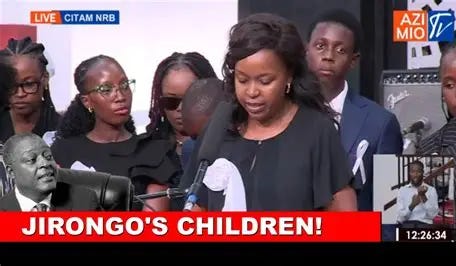
Cyrus Jirongo’s private life was as expansive and intricate as his public career. Known for a lifestyle that commanded both awe and controversy, his approach to family and relationships was deeply traditional yet strikingly public. At the time of his passing in December 2025, the depth of his family network—long speculated upon in political circles—was brought into full public view during his funeral proceedings. The event served not only as a final farewell but as a formal unveiling of a complex family structure that he had managed with the same deliberate, multifaceted approach he applied to his political and business ventures.
Wives, Children, and the “Jirongo” Lineage
Jirongo was known to be a man of wide-reaching connections, and his family life reflected this breadth. Over the course of his lifetime, he entered into multiple unions, with four wives—Christine Nyokabi Kimani, Anne Kanini, Anne Lanoi Pertet, and Joan Chemutai Kimeto—being widely recognized as the primary matriarchs of his family. During the funeral committee meetings and the final rites, the introduction of his thirty-eight children to the public marked a significant moment of transparency. This public acknowledgment was seen by many as a final act of consolidation, ensuring the legacy of the “Jirongo” name was clearly defined and unified.
The Funeral as a Societal Mirror
The introduction of his extensive family at his funeral became a focal point of discussion across the country, serving as a mirror to the societal expectations and debates surrounding polygamy and the visibility of one’s progeny in Kenya. For Jirongo, who had spent decades operating in the shadows of “kingmaking” and high-stakes finance, the formal introduction of his children was a departure from his usual guardedness. It underscored the duality of his existence: the powerful, often impenetrable political operator, and the patriarch of a vast, private household. This moment, caught between public scrutiny and private mourning, solidified his place not just as a financial and political titan, but as a man whose personal narrative was as vast and complex as the capital markets he once sought to influence.
Cyrus Jirongo three official wives introduced at his Gigiri home by funeral committee