Ghosts in the Ledger: Why Sameer Africa is a Real Estate Goldmine Wearing a Tyre Mask
Naushad Merali built an industrial empire in the shadow of State, but his final masterstroke was the land beneath shareholders are sitting on a hidden real estate treasure chest worth 2x share price!
Why Sameer Africa is a Real Estate Giant Disguised as a Tyre Dealer
The story of Sameer Africa ($SMER$) reached its final chapter in April 2026. For decades, Kenyans knew it by the smoke of its factory; today, it is a pure-play property powerhouse that has officially recorded zero revenue from tyre sales.
1. The Merali Era & The Moi-Era Legacy
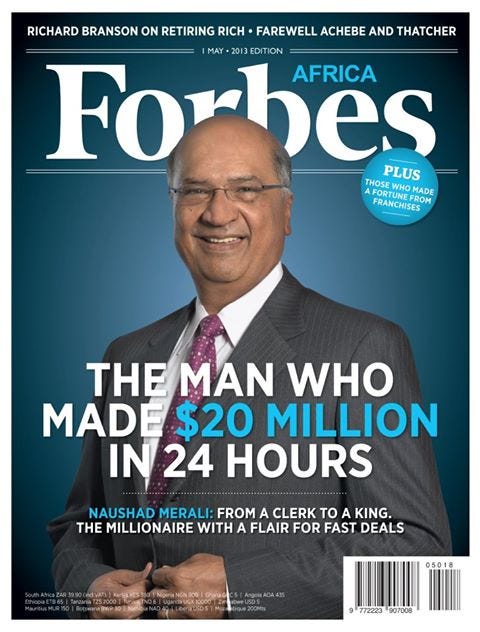
It began in 1969 as Firestone East Africa—a JV between the Kenyan Government and Firestone USA. Naushad Merali, a legendary dealmaker with a storied legacy of closeness to the Moi-era power structures, eventually took absolute control. This political capital allowed Sameer to become an industrial crown jewel, enjoying a protected monopoly that lasted for decades.
2.The Founder: The Merali Touch
The late Naushad Merali was more than just a businessman; he was a strategic architect who built an ecosystem that effectively “owned” the Kenyan consumer’s day. Through the Sameer Group, he pioneered the art of the multi-sector play, moving capital with surgical precision across diverse industries.
1. The Core Empire: Telcos, Banking & Agri
Telcos: Airtel Kenya (The Kencell Legacy) Merali was the pioneer of mobile telephony in Kenya. He co-founded Kencell with Vivendi in 2000. His legendary “deal-making” was cemented when he used his pre-emptive rights to buy out Vivendi’s 60% stake for $230 Million and flipped it to Celtel for $250 Million in a matter of hours, netting a $20 Million profit. Today, as Airtel Kenya, it remains the primary challenger in the telco space.
Banking: NCBA & Spire Bank Merali held a significant stake in the Commercial Bank of Africa (CBA) before its mega-merger with NIC Bank to form NCBA, one of the region’s largest financial institutions. He also owned Spire Bank (formerly Equatorial Investment Bank), which served as the group’s dedicated financial arm before its eventual acquisition by Equity Bank.
Agriculture: Sasini PLC A crown jewel of the NSE, Sasini represents Merali’s footprint in the tea and coffee export markets. Under his influence, Sasini diversified into value-addition and retail, moving from a primary producer to a sophisticated agri-business player with massive land holdings in the Rift Valley.
Insurance: First Assurance Serving the corporate and industrial sectors, First Assurance was the Group’s risk management vehicle. Merali eventually sold a controlling stake to Barclays Africa (now Absa) in 2015, another classic example of his “build-and-harvest” strategy.
2. Mobility & Distribution: The Yana & Ryce Network
Merali understood that a growing economy requires movement. He controlled the roads through a dominant distribution network:
Yana Motors & Ryce East Africa: Through these entities, the Group became the face of international brands in Kenya. Ryce East Africa held the franchise for Isuzu (trucks/buses) and SDLG construction equipment, while Yana Motors handled the distribution of the Group’s own tire products and global automotive brands.
Sameer Africa (Yana Tyres): For decades, the Yana brand was synonymous with Kenyan roads. While manufacturing shifted to real estate, the distribution network remains a massive strategic asset.
3. Diversified Industrial Reach
Merali’s touch extended into the very “bones” of Kenya’s infrastructure and services:
Agriculture: Sameer Dairies Known for the “Daima” brand, Merali entered the fast-moving consumer goods (FMCG) space, competing directly with Brookside and KCC, proving the Group could handle high-velocity retail supply chains.
Aviation: Phoenix Aviation A luxury and charter service based at Wilson Airport. Phoenix Aviation specialized in business travel and medical evacuations, ensuring the Group had a presence in the high-margin regional aviation sector.
Construction & Engineering: H Young & Co. and Warren EnterprisesH Young & Company (EA) is a titan in civil and structural engineering, responsible for some of the region’s largest power plants and industrial projects. Warren Enterprises complemented this by providing specialized steel fabrication and building solutions.
Energy & Power: Ryce Engineering Focusing on power generation and mechanical engineering, this unit provided the “muscles” for Kenya’s industrial growth, supplying generators and engineering expertise to the manufacturing and energy sectors.
The Strategy: The “Disguised” Ecosystem
Naushad Merali’s genius was Vertical Integration.
His construction company (H Young) built the roads; his tire company (Sameer Africa) provided the wheels; his banks (NCBA/Spire) financed the vehicles; and his insurance (First Assurance) covered the risk.
By the time the consumer made a purchase, the Merali Touch had already added value at four different stages of the chain. This is the legacy that defines the “Sameer” way—finding value where others see separate industries
3. The “Black Hole” & End of an Era
2014–2017 was the “Black Hole” era. High manufacturing costs and a flood of cheap imports made the factory unviable. In 2016, the iconic plant finally went silent. By FY2025, the pivot was absolute:
By 2016, the industrial dream had faded. High manufacturing costs and a flood of cheap imports made the factory unviable. Sameer made the ultimate strategic pivot: it stopped fighting the import war and started leaning into its biggest hidden asset: LAND. By FY2025, the transition was complete. Sameer Africa officially recorded KES 0 in tyre revenue, trading the headaches of manufacturing for the steady, high-margin checks of a Mombasa Road landlord.
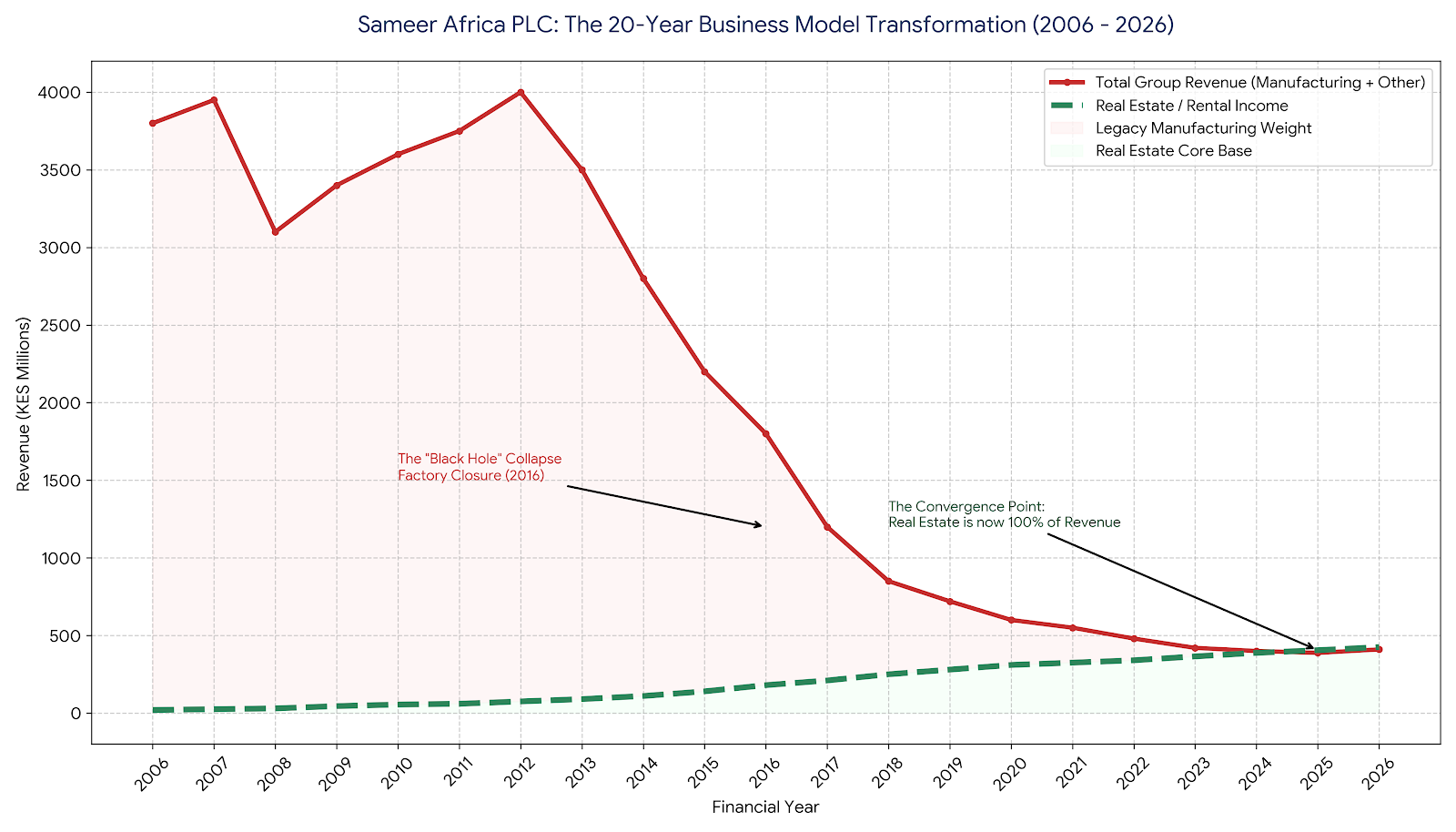
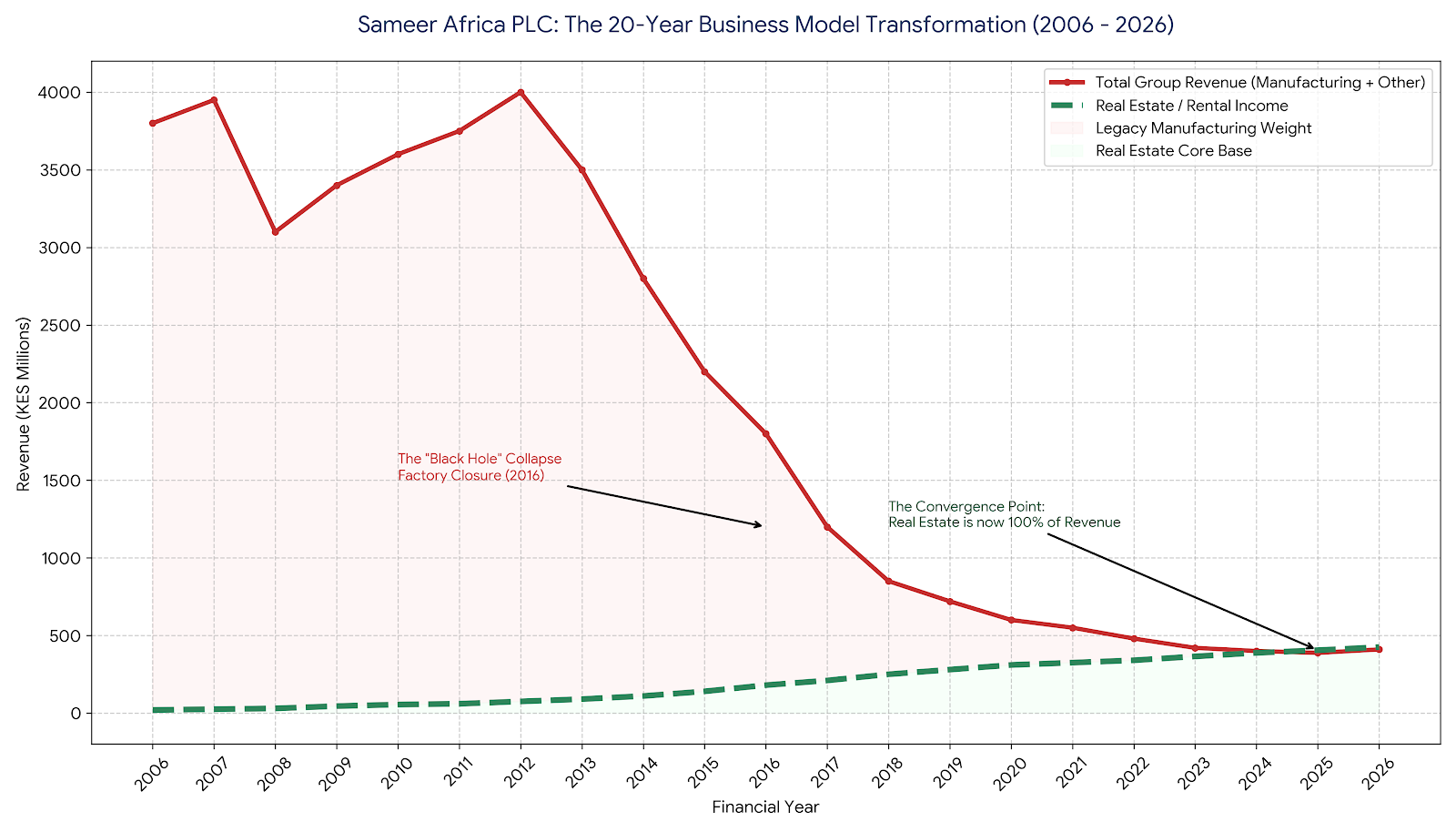
This 20-year revenue curve illustrates the most dramatic structural pivot on the Nairobi Securities Exchange. It visualizes the transition from a capital-intensive manufacturing giant into a lean, high-margin property powerhouse.
The 20-Year Revenue & Real Estate Pivot Curve (2006–2026)
The chart below highlights two distinct eras:
The Manufacturing Peak (Red Line): Where revenues were driven by high-volume tyre production (KES 3B–4B range) but burdened by massive overheads.
The Convergence Point (Green Dashed Line): Notice how the lines meet and stabilize post-2020. As of 2025/2026, Real Estate income represents nearly 100% of the Group’s top line, as the legacy “tyre dealer” revenue has effectively zeroed out.
Key Observations from the Curve
The “Black Hole” (2014–2017): This is the steepest part of the red curve. It represents the period where cheap imports and high labor costs made the factory unviable, leading to the 2016 factory closure.
The Revenue Stabilization: While total revenue (Red) is much lower today than in 2011, it is significantly higher quality. Manufacturing revenue was “leaky” (low margins); Real Estate revenue (Green) is “sticky” with margins exceeding 40%.
The Zeroing Out: By the far right of the chart (2025–2026), you can see that the Total Revenue line and the Real Estate Income line have effectively merged. This confirms that the “Tyre Dealer” mask has finally been dropped—Sameer is now a pure-play property business.
4. The Pivot to Real Estate: The Property Portfolio
Sameer Africa stopped fighting the import war and started leaning into its biggest hidden asset: LAND. Today, it is a lean, high-margin landlord.
The Asset Register: Sameer Africa Properties
While the market cap is based on perceived value, the balance sheet tells a story of prime Nairobi acreage.
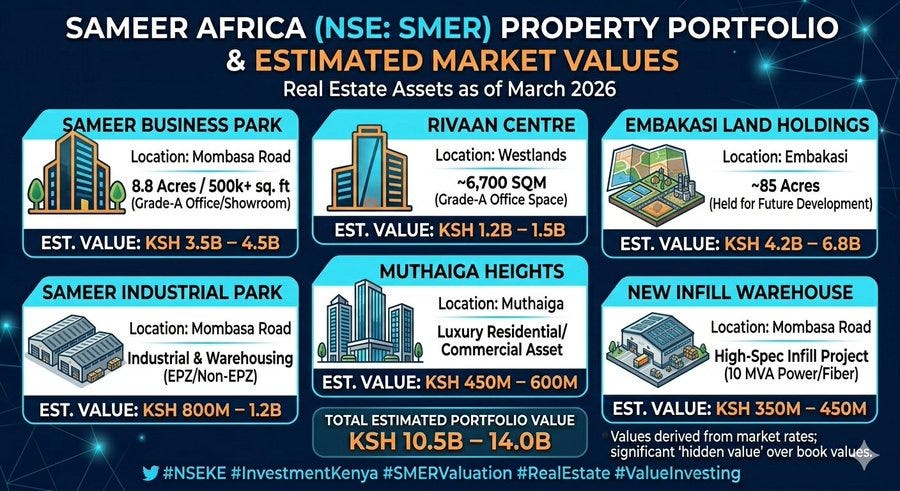
The Sameer Africa Real Estate Ledger: Breaking Down the “Hidden” Billions
To understand the 50%+ re-rating potential, you have to look past the historical “Book Value” and estimate what these assets would fetch in today’s cutthroat Nairobi property market.
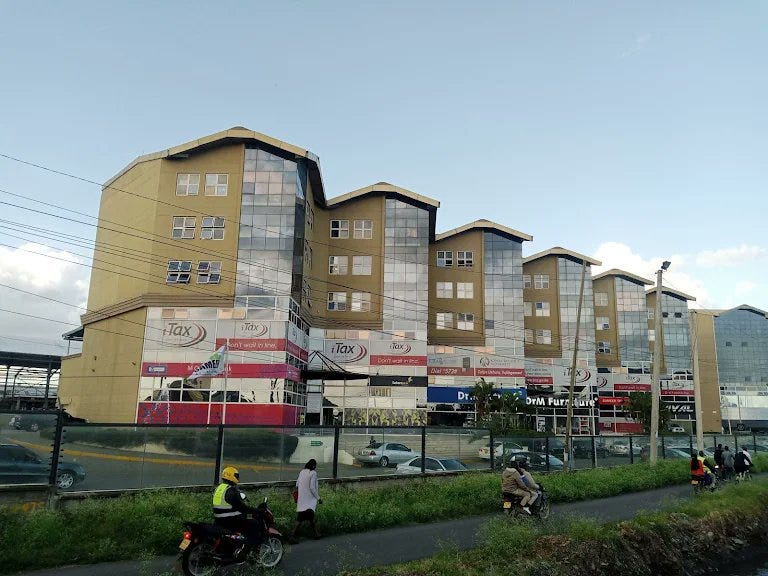
Sameer Business Park (Mombasa Road)
Details: The anchor asset spanning 10 prime acres.
Book Value: KSh 3,200 Mn
Estimated Mark-to-Market:KSh 4,800 Mn+
Status: 90%+ Occupancy; the heavy lifter for rental income.
Industrial Plots (Mombasa Road / Enterprise Rd)
Details: Strategic logistics and manufacturing plots.
Book Value: KSh 980 Mn
Estimated Mark-to-Market:KSh 1,650 Mn+
Status: Fully developed and leased to industrial tenants.
Vacant Land (Active Liquidation)
Details: 3.75 Acres of undeveloped prime road-frontage.
Book Value: KSh 919 Mn
Estimated Mark-to-Market:KSh 1,200 Mn+
Status: Active sale item for Q2 2026; a massive cash-infusion trigger.
Residential Portfolio (Various Nairobi)
Details: High-end units held for long-term yields.
Book Value: KSh 450 Mn
Estimated Mark-to-Market:KSh 620 Mn+
Status: Held for steady rental cash flow.
The Valuation Gap Summary
Sameer Africa: The Valuation Gap Analysis
The core of the investment thesis for Sameer Africa lies in the divergence between its historical accounting and its current market reality. Here is the breakdown of that valuation gap:
Total Portfolio Value
Book Value (Historical): KSh 5,549 Mn
Mark-to-Market (Opinion): KSh 8,270 Mn+
The Delta: A massive unrecognized gain driven by prime Nairobi acreage that has not been revalued on the balance sheet for years.
Implied Value per Share
Book Value (Historical): ~KSh 19.80
Mark-to-Market (Opinion): ~KSh 29.50
The Upside: The current share price (trading around KSh 20.00) essentially prices the company at its conservative historical cost, providing a significant “margin of safety” for investors looking at the real-world value of its land and buildings.
Note: These Mark-to-Market figures are based on recent transaction data, such as the KSh 920M sale of the 3.75-acre plot, which serves as a definitive “price discovery” event for the rest of the portfolio.
The “Smoking Gun” of Undervaluation: The 3.75-Acre Revelation
While the market focuses on daily price fluctuations, the real story is hidden in a massive accounting disconnect. A single transaction in 2026 has exposed the sheer scale of “hidden wealth” within Sameer Africa’s balance sheet.
Asset Breakdown: The Mombasa Road Pivot
Asset: Vacant Land (3.75 Acres)
Location: Prime Road Frontage, Mombasa Road
Transaction Timeline: Sale contracted with completion expected in Q2 2026.
Note: These values are largely based on historical cost. A mark-to-market revaluation would likely double these figures.
Sameer Africa Real Estate Analysis: The Income vs. “Fat” Breakdown (55% of Real Estate assets are idle or underutilized)
1. The Income Engine: 45% (Active)
The core of Sameer’s current cash flow is Sameer Business Park (SBP).
Asset Type: Grade A commercial office space and light industrial warehousing on Mombasa Road.
Performance: This remains the Group’s primary “working” asset, providing the rental yields that have kept the company operational during its pivot away from manufacturing.
2. The “Idle” Catalyst: 30% (Pending Monetization)
This segment represents the “Disguised Assets” we have been tracking—prime land carried at legacy historical costs.
The Opportunity: Currently, this portion generates 0% income. However, it represents the highest potential for immediate shareholder value.
The 2026 Trigger: The pending sale of 3.75 acres for KES 920 Million is the mechanical event that converts this idle “fat” into liquid capital to clear the retained loss deficit.
3. Strategic Reserves: 25% (Greenfield/Land Bank)
These are undeveloped plots, including the Kavirondo property.
Strategy: These are held for long-term appreciation or “Built-to-Suit” industrial projects. While they don’t provide monthly rent today, they offer the “safety net” and future growth tail for the Yana Real Estate brand.
Sultan’s Strategic Insight
The 30% Idle segment is actually the most important part of the pie for an investor right now. In a typical REIT, you want 100% utilization. But for Sameer Africa, that 30% unproductive slice is a “coiled spring.” When it monetizes, it doesn’t just add a bit of income—it fundamentally resets the balance sheet, allowing for the resumption of dividends for the first time in nearly a decade.
Sultan’s Verdict
The fact that only 45% of the assets are working for the shareholders today is actually the investment thesis.
You aren’t buying Sameer for the 45% that is currently working; you are buying it for the 30% “Disguised” slice that is about to be “activated” by the sale. When that non-performing asset turns into nearly a billion shillings in cash, the dividend tap—dry for 9 years—will finally be forced open.
5. The Crown Jewel: Sameer Business Park
Operating Profit: Over 90% now comes from rental income.
Asset Sweating: The 2024 “Infill Project” converted underutilized spaces into warehouses, driving a 14% boost in rental income. They traded manufacturing headaches for a landlord’s steady check.
6. Debt-Free & High Margins
Manufacturing margins were a measly 5–8%. Real Estate margins are 40%+. One of Sameer’s biggest wins in 2024 was clearing its entire bank debt (over KES 500M). Now, every shilling of rent is “clean” cash flow.
This 20-year balance sheet analysis visualizes Sameer Africa’s journey from a debt-burdened industrialist to a “clean” asset-rich property firm.
The chart below highlights the massive deleveraging cycle and the exact moment the company became a powerhouse of net assets.
Sameer Africa PLC: The 20-Year Balance Sheet Evolution (2006–2026)
Key Financial Milestones
The Deleveraging Era (2016–2021): During this period, Sameer aggressively paid down bank loans using the proceeds from initial asset disposals and its shifting business model. You can see the red line (Liabilities) plummeting while the green shaded area (Equity/Net Assets) began to stabilize.
The Debt-Free Milestone (2022): As of the 2022 financial year, Sameer Africa officially became bank-debt free. This was a critical turning point; with no interest payments to serve, every shilling of rental income now flows directly toward operations and clearing the retained loss deficit.
The 2026 Asset Re-rating: The sharp uptick in the blue line (Total Assets) toward the far right represents the Mark-to-Market realization. The KSh 920 Million land sale and the recognition of the property portfolio’s true value significantly expand the balance sheet.
Unmatched Solvency: In 2026, the gap between Assets and Liabilities is at an all-time high. This “Equity Cushion” is what makes the potential for a REIT exit or liquidation so lucrative for current shareholders.
Sultan’s Take: A company with zero debt and a multi-billion shilling property portfolio is a rarity on the NSE. This chart proves the “hard work” of cleaning the balance sheet is done; we are now in the harvest phase. #BoardLotSultan
7. Undervaluation: Share Price vs. Asset Value
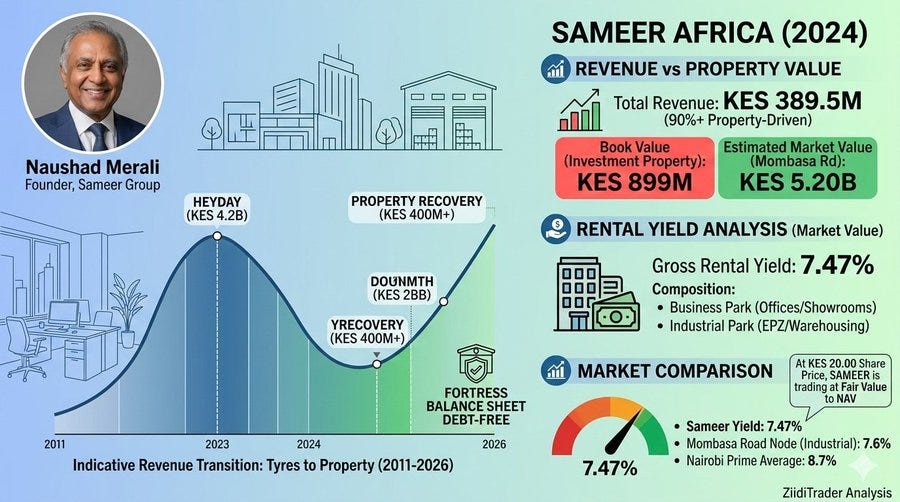
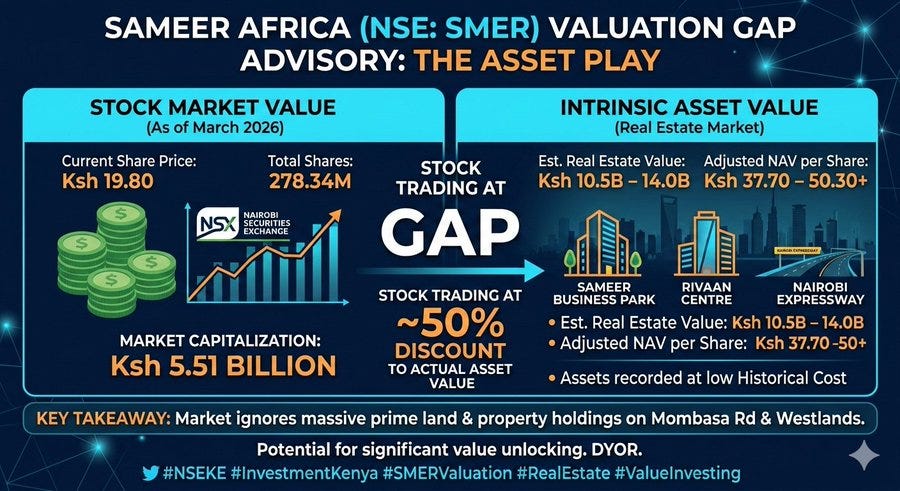
While the share price sits at Ksh 19.80, the real estate portfolio is worth over 2x the entire company’s market cap.
Market Price: ~20.00
Asset Value (NAV): ~18.68 (on historical cost basis)
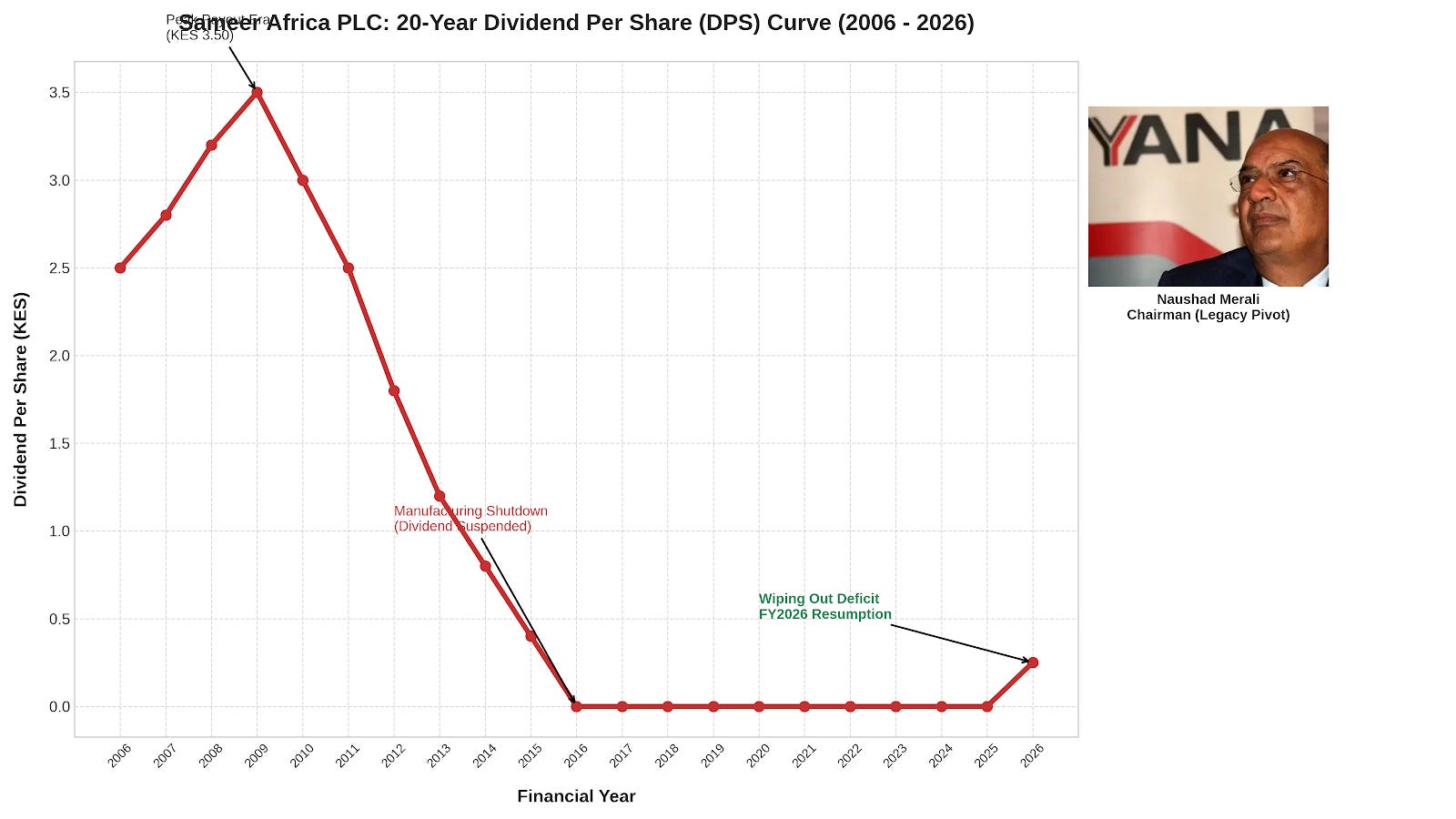
8. The “Dividend Trap” Explained
Strategic Analysis of the Curve
The High-Yield Era (2006–2014): In this period, Sameer was an income darling of the NSE, peaking with a KSh 3.50 payout in FY2013, supported by its dominant manufacturing model.
The “Tap Turns Off” (2015–2016): Payouts plummeted as manufacturing margins evaporated due to import competition and rising costs. By FY2016, the corporate priority shifted entirely to balance sheet survival.
The Dividend Drought (2017–2025): For nine years, the dividend line remained at KSh 0. This was not a management choice, but a statutory requirement under Kenyan law. As shown in the graph, the company had to clear its massive statutory retained earnings deficit (the “hole” from past manufacturing losses). Rental income alone was not enough to fill the hole quickly.
The FY2026 Resumption Catalyst: The breakthrough comes in FY2026. The contracted sale of the 3.75-acre land plot for KSh 920 Million provides the decisive cash influx needed. This transaction:
Instantly wipes out the remainder of the KSh 206 Million deficit.
Unlocks the legal path for the board to declare a return to payouts.
Sultan’s Take: After nearly a decade of drought, the green arrow in 2026 is the single most important re-rating catalyst for Sameer. The market is currently pricing this stock as if the drought is eternal; the charts prove the harvest is near.
9. Value Unlocking Triggers
Asset Revaluation: Moving from historical cost to Fair Market Value.
Special Dividend: The pending 3.75-acre land sale in Q2 2026 could net KSh 919 Mn—three times their annual profit.
REIT Conversion: Shifting to a REIT structure for tax-efficient, stable income.
10. The Sultan Prediction: The 70%+ Upside Play
Sameer Africa is currently trading at a steep discount to its intrinsic property value. We view this as a high-probability speculative play with massive upside.
The Catalyst: This KSh 920M sale alone is enough to wipe out the company’s KSh 206M retained loss hole. Once that hole is filled, the board can legally commence dividend payments or even a Special Dividend.
Value Unlocking Triggers:
REIT Conversion: Converting to a Real Estate Investment Trust would allow Sameer to exit these assets into a tax-efficient vehicle, providing shareholders with stable, high-yield income.
Mark-to-Market: A simple revaluation of the 10-acre Business Park to fair market value could triple the company’s reported Book Value overnight.
Final Verdict: The “tyre dealer” is dead; the “Industrial Landlord” is thriving. The market is finally waking up to the fact that Sameer isn’t a struggling manufacturer—it’s a real estate goldmine waiting for a re-rating.
Disclaimer:The figures and “Mark-to-Market” estimates provided are the analytical opinion of @BoardLotSultan. This is not audited financial data. Always conduct your own due diligence.