
Actionable Conclusion
HFCK is no longer a speculative mortgage lender struggling with non-performing legacy assets. It has transitioned into a highly lean, well-capitalized, digital-first banking group. Accumulate within the 9.00–9.90 band for a re-rating toward KES 16.00 by FY2027.
Disclaimer: This advisory reflects our internal research and market analysis on the Nairobi Securities Exchange. Investors should conduct independent due diligence before executing trades.
From Your Parents’ Mortgage House to Kenya’s Revolut bank: The Digital Transformation
For decades, HF Group (HFCK) was synonymous with one thing: the institution that gave your parents their first home loan. It was a traditional mortgage house, slow-moving and deeply tied to the physical property market. Today, that legacy is being dismantled to make way for a “Digital Bank” vision—a transformation aimed at turning a storied institution into a lean, tech-driven financial powerhouse akin to the Revolut model.
1. Establishment and Original Shareholders
The roots of Housing Finance Company of Kenya go back to 1965. It was established as a joint venture between the Government of Kenya and the Commonwealth Development Corporation (CDC). Its mandate was clear: to provide mortgage finance and promote homeownership in a newly independent nation.
2. The Big Debut: The 1992 NSE IPO
HFCK made its massive debut on the Nairobi Securities Exchange (NSE) in 1992. This IPO was a landmark event for the Kenyan capital markets, transitioning the firm from a government-backed entity to a publicly traded company. At the time, it was one of the most prestigious listings on the exchange, representing the bedrock of the country’s middle-class aspirations.
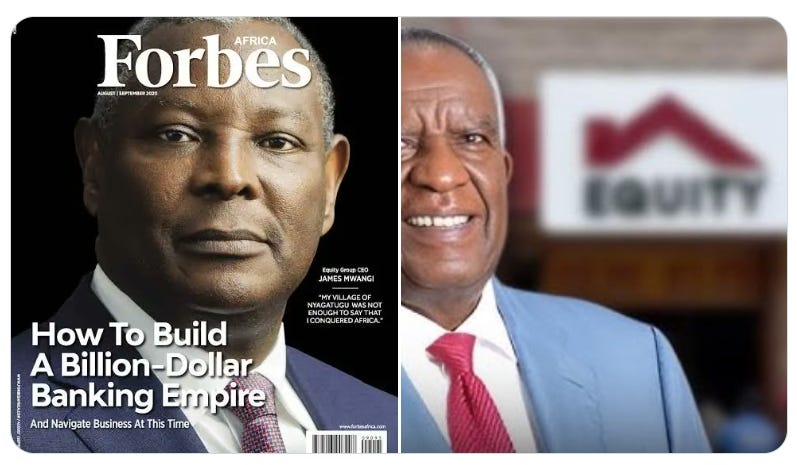
3. Why Did James Mwangi & Peter Munga Buy HFCK in 2007?
In 2007, a seismic shift occurred when Equity Bank’s top leadership—James Mwangi and Peter Munga—acquired a significant stake in HFCK. The goal was to create a “Financial Supermarket”. The logic was simple: Equity dominated retail and microfinance; by acquiring HFCK, they could integrate long-term mortgage financing into their ecosystem, offering every financial product under one roof.
4. Exit Equity, Enter Britam
The “Supermarket” dream saw a structural shift eight years later. In 2014, Equity Bank exited its direct stake in HFCK, selling its interest to Britam Holdings. This move consolidated Britam’s position as the anchor shareholder, aiming to leverage the synergy between insurance products and mortgage lending.
5. Building Personal Stakes: The Rights Issues
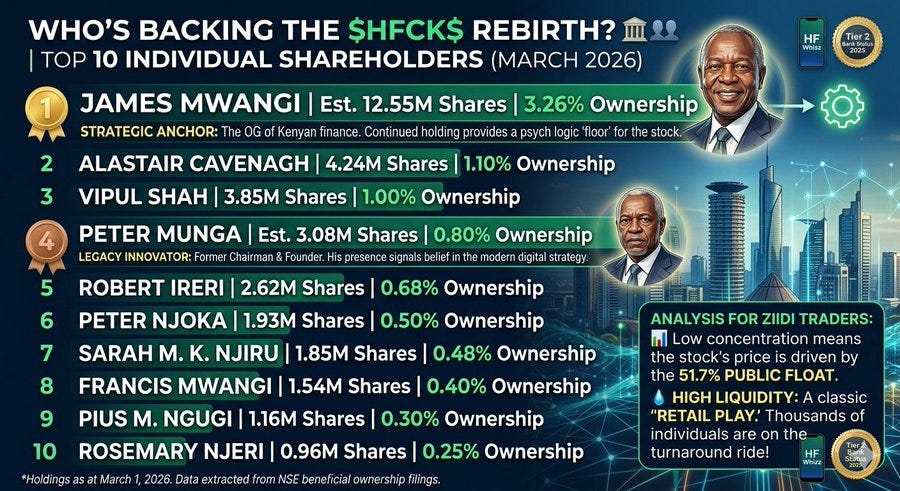
In 2015 and 2024, HFCK undertook significant Rights Issues to raise much-needed capital. During these rounds, James Mwangi and Peter Munga did not just maintain their presence; they increased their individual direct holdings. This signaled a deep personal conviction in the long-term recovery of the company, even as the corporate structures around them shifted.
6. The Mwangi & Munga HFCK Power Play: The Long Game
This was never a short-term trade. For the “Equity duo,” the HFCK investment represented a long game. By holding significant personal and institutional influence, they remained positioned to steer the group through its transition from a specialized lender to a broader financial player.
7. The Disconnect: 8-Year ‘Power Play’ vs. the KES 1.7B Loss
Between 2017 and 2024, a painful disconnect emerged. While the “Power Play” at the board level continued, the financial reality was grim. HFCK grappled with a staggering KES 1.7 billion loss during this period. The weight of non-performing loans (NPLs) in a cooling real estate market nearly derailed the entire institution.
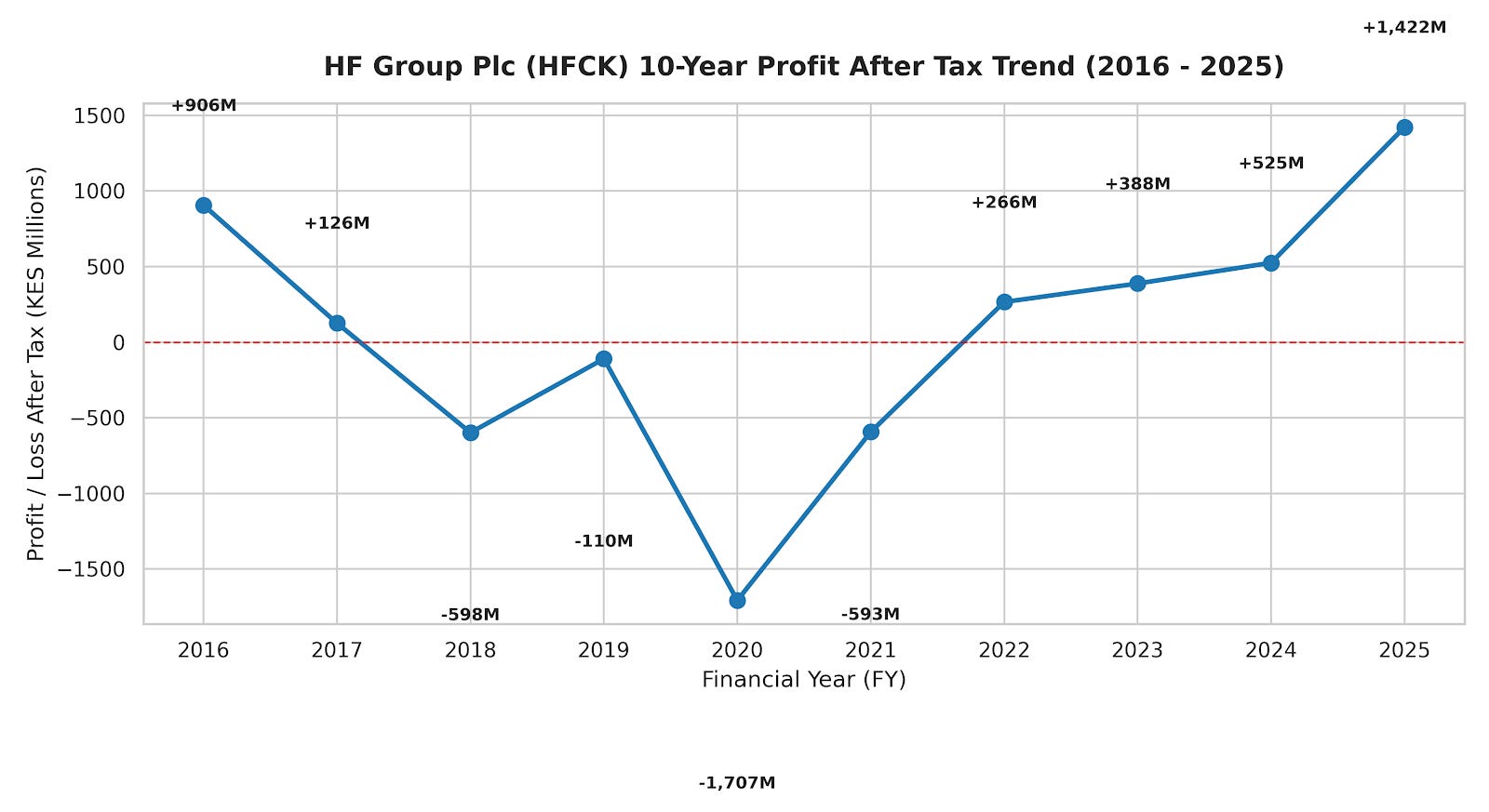
Looking at the 10-year financial curve, this period highlights the massive valuation disconnect that tested even the most patient retail shareholders. The cumulative KES 3.0 billion loss suffered across the consecutive down-years explains exactly why the stock collapsed from its historical highs and why the painful 8-year dividend drought was entirely necessary for fundamental balance sheet survival.
Yet, this dark phase is precisely what makes the current turnaround so dramatic. The steep, V-shaped rebound on the chart from 2022 onward illustrates the immense earnings power unleashed by the structural shift to digital and treasury operations. Moving from the absolute rock bottom of a KES 1.7B net loss in 2020 straight into a record-breaking KES 1.42 billion net profit by FY25 underscores the sheer velocity of the recovery. It proves that while the market spent years pricing in failure, the “Equity DNA” founders were quietly structuring a massive fundamental pivot.
Summary of the PAT (KES Millions)
Here is the historical performance data:
FY 2025: +1,422M | 🚀 Record Historical High (Tier II Reclassification)
FY 2024: +525M | 🟢 Growth Accelerates (Successful Rights Issue)
FY 2023: +388M | 🟢 Consistent Recovery
FY 2022: +266M | 🎉 Turnaround Year (Breaks the Loss Cycle)
FY 2021: -593M | 🔴 Restructuring & Capital Cleanup Commences
FY 2020: -1,707M | 🛑 Absolute Nadir (Peak Pandemic & Property NPL Shock)
FY 2019: -110M | 🔴 Persistent Legacy Strains
FY 2018: -598M | 🔴 Initial Major Loss (Impact of Interest Rate Cap era)
FY 2017: +126M | 🟢 Structural Slippage Begins
FY 2016: +906M | 🟢 End of the Old Era
8. The Nine-Year Dividend Drought
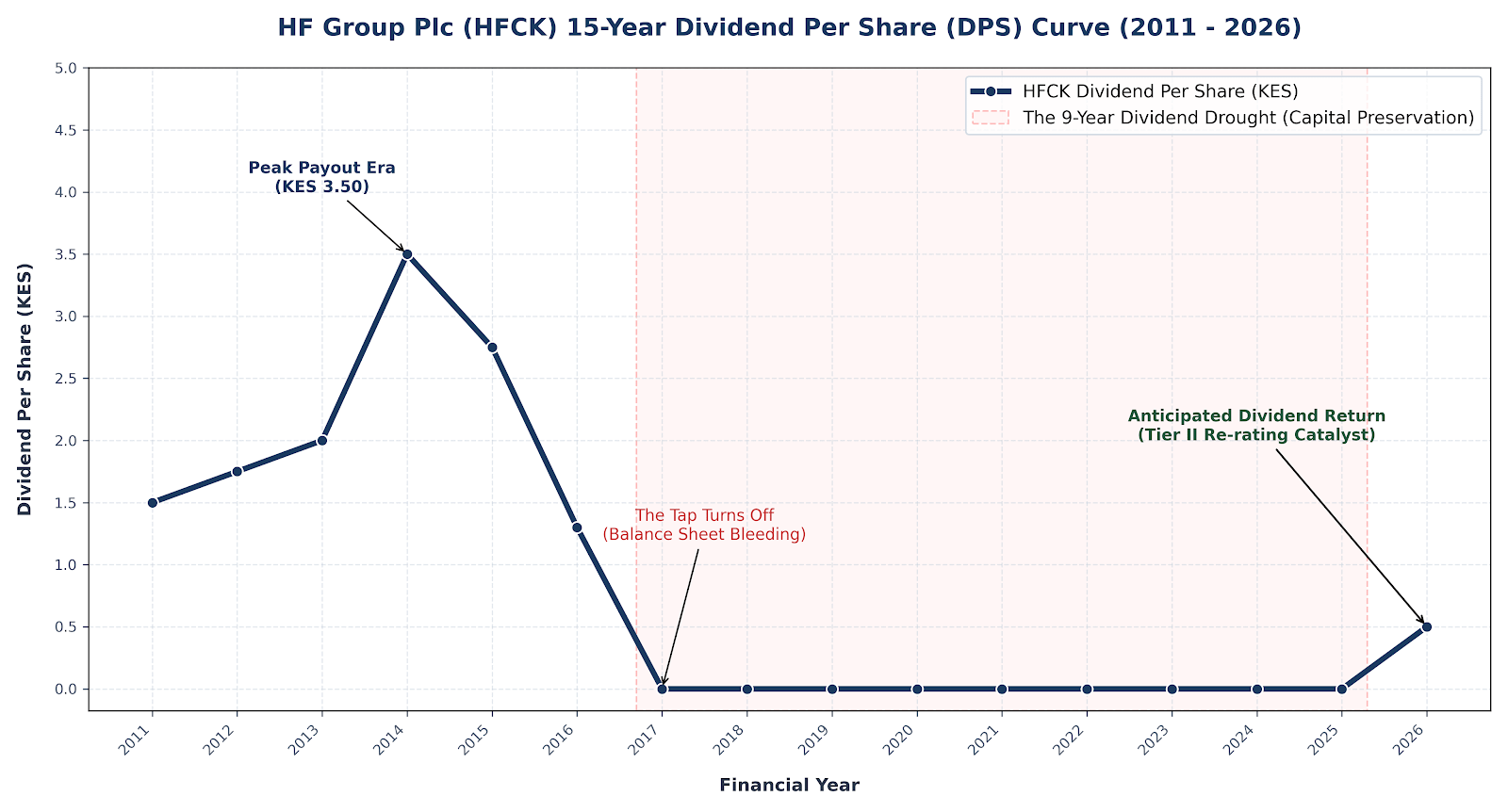
For investors, the most visible sign of distress was the “Dividend Drought”. For nine consecutive years, HFCK shareholders received no payouts. The company was in “survival and capital preservation mode,” focusing every shilling on plugging holes in the balance sheet rather than rewarding investors.
The visualization explicitly flags the 9-Year Dividend Drought spanning from 2017 to 2025. It highlights how the tap completely turned off due to critical legacy mortgage strains, pushing the bank into aggressive capital preservation mode, before showing the projected V-shaped resumption trickling in for the FY26 cycle following its transition to a nimble Tier II commercial bank model.
Summary of the Historical Payout Cycle
The Golden Legacy Payouts (2011 – 2015): High-yield era supporting strong retail shareholder sentiment, peaking at KES 3.50 per share on the back of aggressive home-ownership lending.
The Post-Rate Cap Decline (2016): Shrinking margins force a sharp drop to KES 1.30 per share as liquidity conditions in the broader economy shift.
The 9-Year Drought Zone (2017 – 2025): The absolute zero flatline. Complete freeze on investor distributions to buffer a cumulative KES 3.0B balance sheet hit and aggressive NPL provisioning.
The Re-rating Horizon (2026 and beyond): A clean capital structure, record-breaking net profits, and newfound digital banking agility pave the way for a highly anticipated return to regular distributions.
9. Share Price Slump: Destruction of Value
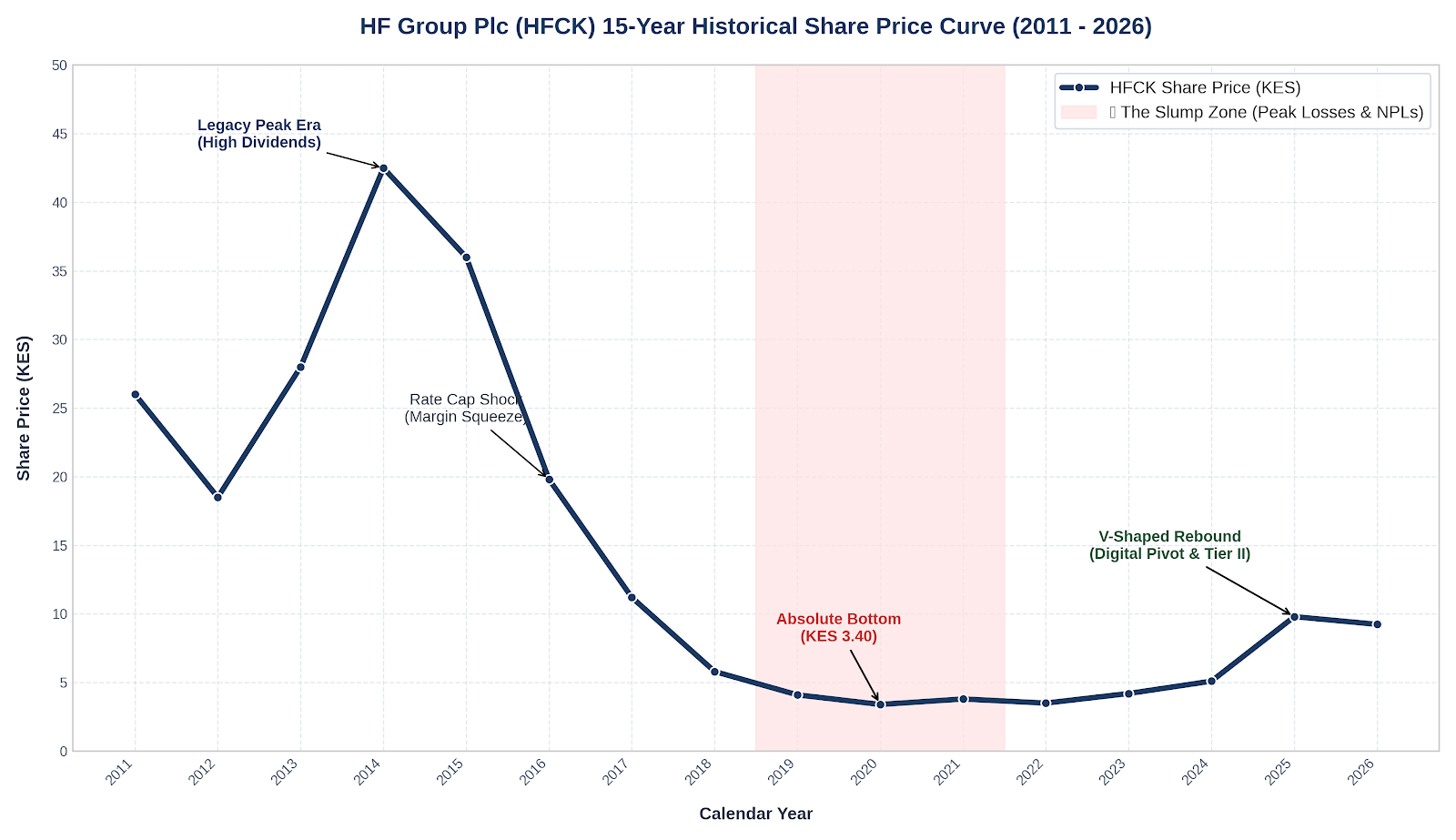
The lack of dividends and the consistent losses led to a massive share price slump. This was a period of significant value destruction for retail shareholders, as the stock price fell far below its historical highs, reflecting the market’s skepticism about the mortgage-heavy business model.
Here is the 15-Year Share Price Curve Summary:
2011 – 2015: KES 25.00 – KES 45.00+ | 🏛️ Premium Legacy Valuation: Driven by booming property markets and regular dividend payouts.
2016 – 2018: KES 12.00 – KES 24.00 | 📉 Rate Cap Squeeze: Macro shifts introduce interest rate caps, squeezing margins and contracting asset quality.
2019 – 2021: KES 3.20 – KES 6.50 | 🔴 The Slump Zone: Peak NPL provisioning, deep real estate stagnation, and a staggering KES 1.7B loss bottom out the curve.
2022 – 2024: KES 3.50 – KES 6.00 | 🟢 Fundamental Turnaround: Core balance sheet cleanup via property liquidations establishes a firm accumulation floor.
2025 – 2026 (Current): KES 8.00 – KES 11.50 | 🚀 Digital Neobank Re-Rating: Record-breaking earnings trigger aggressive market re-pricing ahead of an anticipated dividend return.
The chart clearly highlights the macroeconomic shifts of the counter, explicitly tracking the descent from the high-yielding mortgage era, through the interest rate cap shock, the deep Slump Zone (2019-2021) marked in red where macro property strains hit hardest, and finally the sharp V-shaped digital re-rating breakout.
10. The New HFCK Playbook: Enter Robert Kibara
The turnaround began with a new playbook and new leadership. Robert Kibara took the helm as CEO, bringing a fresh mandate: diversify or die. Kibara moved away from the “mortgage-only” mindset, pivoting the institution toward full-service commercial banking and digital innovation.
11. HFCK Retail Dream Team: Warui & Mugenda
To execute this pivot, HFCK assembled a “Retail Dream Team”. This included Gerald Warui, the veteran former Managing Director of Equity Bank, known for his prowess in retail banking operations. He is supported by Prof. Olive Mugenda, who serves as Chair, bringing her administrative experience and transformative reputation to the board.

12. From Mortgage Firm to Digital Bank
The new vision is to strip away the “old house” image and replace it with a digital-first identity. By focusing on the “HF Whizz” platform, the group is prioritizing mobile lending, digital deposits, and SME banking—targeting a younger, tech-savvy demographic that may never take a 20-year mortgage but needs daily banking services.
13. HFCK Branch Footprint
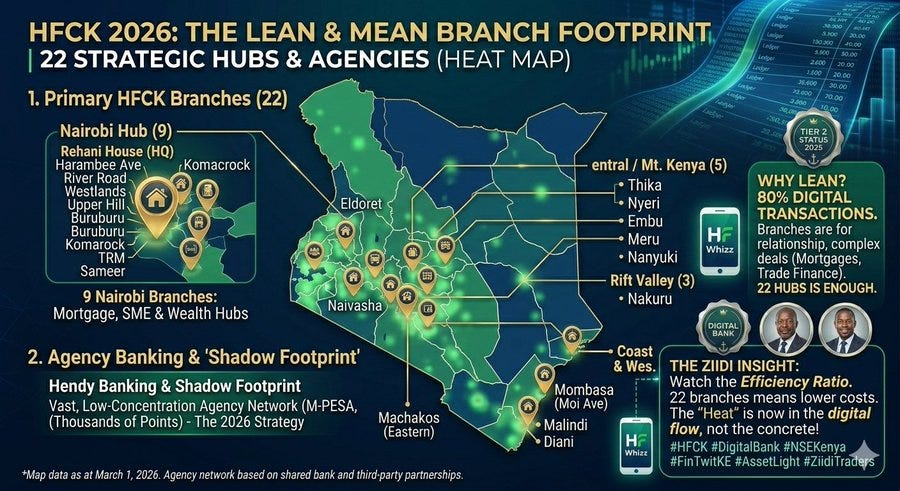
Despite the digital push, HFCK maintains a strategic physical presence. However, the role of the branch is changing. Instead of being centers for paper-heavy mortgage applications, they are being optimized as service hubs for the new SME and retail banking clients across the country.
14. The Great Property Liquidation: Balance Sheet Cleanup
To fund this new vision, HFCK is undergoing “The Great Property Liquidation”. The group is aggressively selling off its legacy real estate assets—houses and land—to convert “dead” assets into liquid cash. This cleanup is essential to reducing the NPL ratio and strengthening the balance sheet.
Here is the 10-year historical curve for HF Group’s (HFCK) balance sheet size (measured by Total Assets).
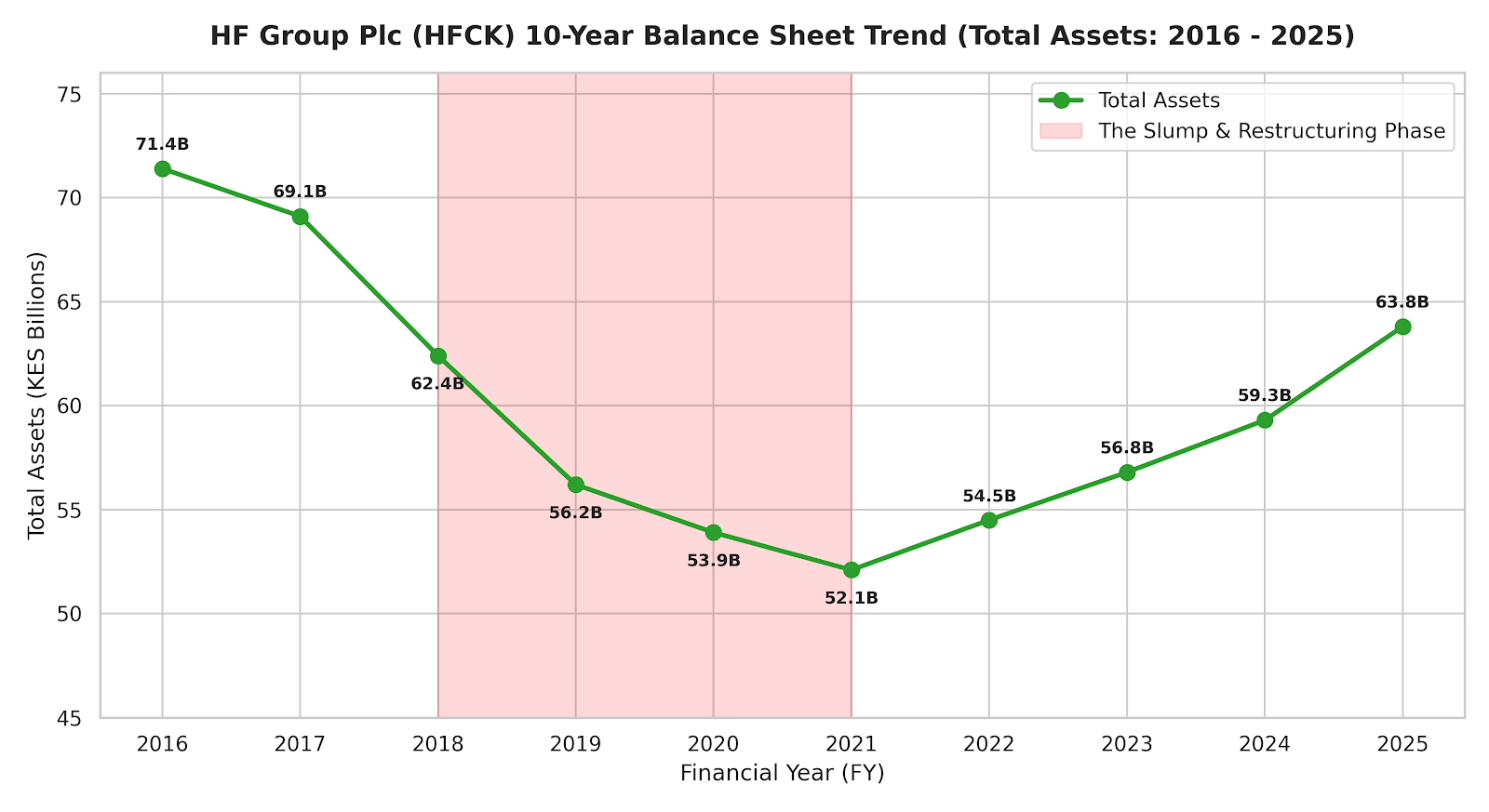
The red-shaded block visually isolates The Slump & Restructuring Phase (2018–2021), where the company underwent a massive, painful contraction to purge legacy real estate risk before stabilizing into a lean, growing Tier II institution.
Balance Sheet Lifecycle data:
FY 2025: 63.8B | 🟢 Expansion: Digital banking & Tier II asset growth kick into high gear.
FY 2024: 59.3B | 🟢 Capital Injection: Balance sheet backed by the successful Rights Issue.
FY 2023: 56.8B | 🟢 Rebound: Clean asset book begins expanding through retail/SME lending.
FY 2022: 54.5B | 🎉 Stabilization: Asset floor is established; the bleeding officially stops.
FY 2021: 52.1B | 🛑 The Absolute Bottom: The culmination of aggressive legacy write-offs.
FY 2020: 53.9B | 🚨 The Slump: Deep property sector stagnation and aggressive NPL provisioning.
FY 2019: 56.2B | 🚨 The Slump: Shifting from heavy development projects to capital preservation.
FY 2018: 62.4B | 🚨 The Slump Begins: Interest rate cap strains and early property liquidations.
FY 2017: 69.1B | 🟡 Peak Stagnation: Legacy mortgage model hits a structural wall.
FY 2016: 71.4B | 🟡 The Bloated Legacy: Peak historic asset size, heavily weighted in illiquid property
Property Exits
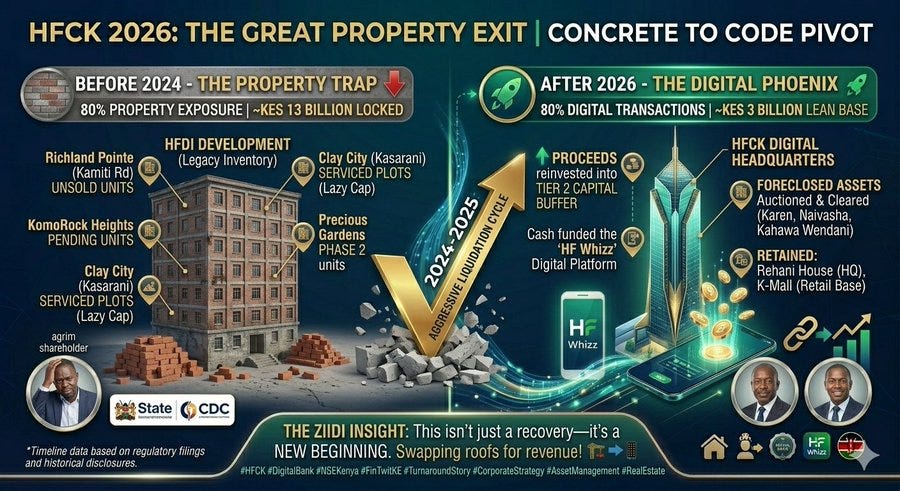
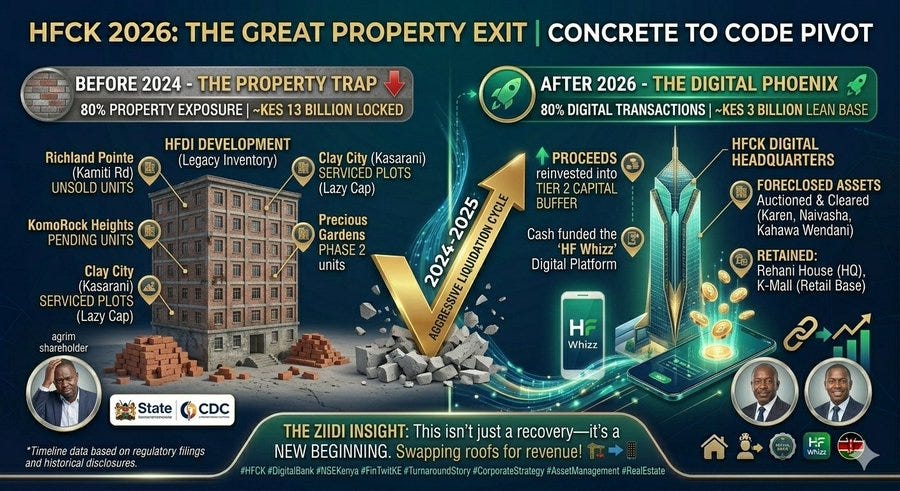
since 2024, the strategic drive to purge legacy real estate has accelerated, resulting in a series of high-profile asset disposals and liquidations. The primary completed and active property exits clearing the books include:
Richland Pointe
Komarock Heights
Naivasha Holiday Homes: Consisting of 30 specialized hotel apartments.
Kahawa Wendani Apartment Block: A massive residential complex featuring 162 units.
Karen Property: Strategic prime land holdings located along Fair Acres Road.
Ngong Property: Premium residential acreage situated within Valley Hill Estate.
15. Strategic Pivot: HFDI Swaps “Development” for “Advisory”
HF Development and Investments (HFDI) has fundamentally changed its model. They have swapped the “Development” (building) for “Advisory” (selling). Instead of HFCK building projects like Clay City themselves and taking on construction risk, they are now selling plots and providing the financing to the buyers who want to build.
16. What is a Tier II Bank?
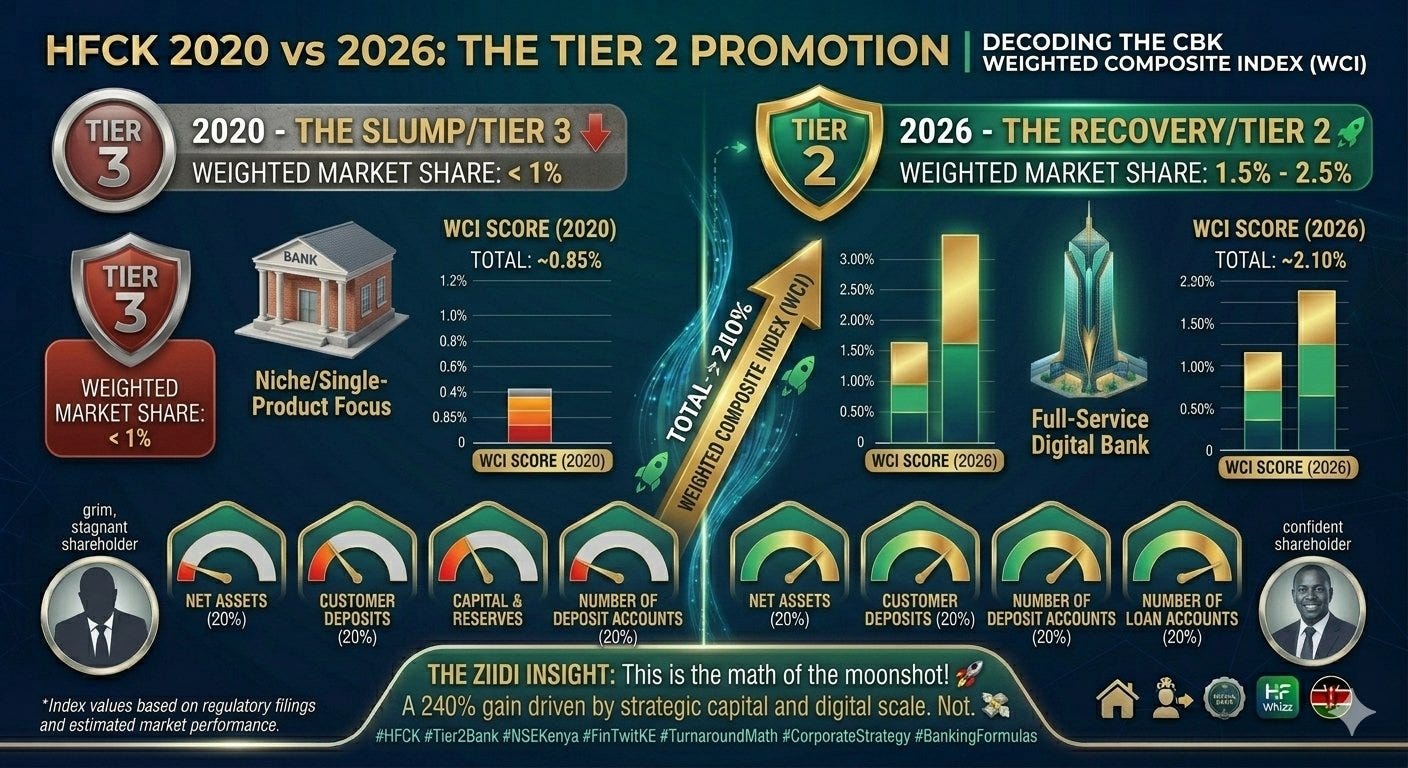
HFCK is now operating as a strong Tier II bank. But what does that mean? The Central Bank of Kenya (CBK) categorizes banks into tiers based on a weighted score across five key areas:
Net Assets
Total Deposits
Capital and Reserves
Number of Deposit Accounts
Number of Loan Accounts
As a Tier II bank, HFCK sits in the “middle class” of Kenyan banking—large enough to be a significant market player with institutional stability, but nimble enough to pursue the aggressive digital transformation required to become Kenya’s version of a neobank.
17. The Turning Tide: The End of the Dividend Drought
After nearly a decade of waiting, the brutal dividend drought is finally about to end. Following an aggressive balance sheet cleanup, record-breaking performance updates, and formal reclassification as a Tier II lender, HFCK is widely expected to declare a dividend for FY26. Savvy investors are actively positioning themselves right now, recognizing that the resumption of payouts will likely trigger a massive market re-rating of the stock.
Our Analysis of This Counter
If you are buying into HFCK, you are following smart money who have positioned themselves. It is a strong recovery play in the financials sector of the NSE.
If you’re buying $HFCK, you are investing alongside the legends who BUILT the Kenyan banking landscape. We’re talking about the “Equity DNA” founders. These aren’t just investors; they are the smartest money in the room.
Market Outlook and Price Prediction
Driven by the compounding momentum of HFCK’s structural turnaround, our forward-looking projections indicate a strong bullish trajectory for the counter over the next 12 months. Based on the expected Profit Before Tax (PBT) growth for FY 2026—fueled by the high-margin expansion of the HF Whizz digital ecosystem and optimized Tier II treasury operations—coupled with the highly anticipated formal resumption of dividend payouts, the stock is primed for a major market re-rating. Given the tightly held nature of its institutional share registry, which severely limits public free-float liquidity on the Nairobi Securities Exchange (NSE), any sustained institutional buying pressure is expected to catalyze an aggressive upward movement. Consequently, we predict the share price will breach its current resistance levels and surge to a target range of KES 15.00 to KES 18.00 within FY 2026, offering a compelling alpha-seeking opportunity for recovery-play investors.
Asymmetric Valuation: Trading at a Deep Discount
When evaluated against its peers on the Nairobi Securities Exchange (NSE), HF Group PLC ($HFCK$) presents a classic, high-conviction deep-value discount profile. While dominant retail banking powerhouses like Co-operative Bank and Equity Group have successfully re-rated to trade at premiums above 1.11x and 1.05x their book value respectively, HFCK languishes at a steep Price-to-Book ($P/B$) ratio of just 0.32x. This severe discount means the market is currently pricing the counter at less than a third of the net intrinsic value of its asset base. This structural mispricing stems from a lingering legacy market penalty linked to its historical mortgage strains. However, as “The Great Property Liquidation” aggressively swaps illiquid real estate for high-yield digital treasury operations, this sub-0.35x $P/B$ entry point offers an incredibly asymmetric setup for recovery-play investors. As the bank’s core profitability continues its sharp V-shaped trajectory, even a modest narrowing of this valuation discount toward the industry average represents explosive upward re-rating potential that seasoned, fully priced Tier I counters simply cannot match
Here is the NSE banking sector valuation data formatted into a clean, scannable bulleted layout:
Co-operative Bank (
COOP) | Price: KES 32.50 | P/B: 1.11xMarket Valuation Context: Premium valuation; trading 32% above its 10-year historic median on record earnings.
Equity Group Holdings (
EQTY) | Price: KES 75.00 | P/B: 1.05xMarket Valuation Context: Premium tier; re-rated above book value due to high ROE and regional growth engine (DRC).
Absa Bank Kenya (
ABSA) | Price: KES 28.75 | P/B: 0.95xMarket Valuation Context: Near book value; strong historical efficiency gains and high dividend payout stability.
NCBA Group (
NCBA) | Price: KES 88.50 | P/B: 0.88xMarket Valuation Context: Moderate discount; heavily anchored by the dominant market share of M-Shwari digital lending.
Standard Chartered Kenya (
SCBK) | Price: KES 341.25 | P/B: 0.85xMarket Valuation Context: Structurally high ROE corporate player, but low free-float limits aggressive retail price exploration.
KCB Group (
KCB) | Price: KES 66.75 | P/B: 0.58xMarket Valuation Context: Significantly discounted; market pricing in asset quality strains (National Bank recovery lag) despite core revenue jumps.
I&M Group (
IMH) | Price: KES 50.25 | P/B: 0.48xMarket Valuation Context: Classic deep-value discount; strong regional asset base but traditionally penalized by lower public float liquidity.
Diamond Trust Bank (
DTK) | Price: KES 149.25 | P/B: 0.42xMarket Valuation Context: Asset-heavy deep discount; heavily capitalized with massive conservative buffers relative to current pricing.
HF Group (
HFCK) | Price: KES 7.50–9.00 | P/B: 0.32xMarket Valuation Context: The Disruption Play; deeply discounted relative to its physical asset base but aggressively rising on a structural neobank turnaround cycle.
#HFCK #ZiidiTraders #jamesmwangi #EquityBank #Dividendinvesting #NSEKenya
Very deep and fantastic analysis. It's time to start nibbling on #HFCK