
The Verdict: A High-Upside Deep Value Play
The numbers behind Home Afrika ($HAFR) point to a classic textbook Deep Value Play based on massive asset undervaluation. While the public market caps the entire company at a mere KES 600 Million, its underlying Net Assets on the balance sheet stand at an incredible KES 3.1 Billion—representing a massive 80% discount. Backed by a brilliant operational pivot to 0% risk “Service Plots,” soaring H1 2025 profits of KES 192 Million, and aggressive insider buying from Hass Consult (4%) and MD Lucy Wanjiku Maina (1.45%), I recommend $HAFR as a highly attractive speculative play for aggressive capital gains.
The Warning: Capitalize with Caution
However, followers must exercise extreme caution: make no mistake, this is still a penny stock. At this price level, the equity is highly vulnerable to low liquidity bottlenecks and undue market movements that can trigger wild, outsized percentage swings completely detached from company performance. Treat this as an asymmetrical bet rather than a core portfolio anchor. Size your positions conservatively, protect your capital, and let the structural turnaround team do the heavy lifting into 2027
Home Afrika: The Rise, Fall & Gritty Resurrection
An exhaustive forensic breakdown of the NSE’s ultimate turnaround story—from insider dumpings to balance sheet structural repair.
2008: Home Afrika starts as a Chama Vision
In 2008, Home Afrika began its journey not as a massive corporate conglomerate, but as a structured, forward-thinking Chama. Led by the visionary triumvirate of Architect Lee Karuri, Engineer Mbugua Kamau, and Dan Awendo, this wasn’t an ordinary investment club looking for quick speculative wins. Their philosophy was radically clear: they wanted to stop buying disjointed suburban plots and start building master-planned cities. The foundational goal was nothing short of institutionalizing real estate in Kenya—transforming informal group-savings culture into a structured, highly commercial asset development engine.
First Project: Morningside Office Park
By 2010, the proof of concept became tangible. The company launched Morningside Office Park along Ngong Road, delivering a stunning 42,000 square feet of Grade A commercial space. Valued at over KES 600 Million, this single landmark project proved that a collaborative investment vehicle could scale fast and compete directly with institutional tier-1 developers. It gave the founders the validation, the execution track record, and the strategic confidence they needed to eye much larger horizons.
Boom! KES 600M project completed by Chama!
With Morningside fully let, generating predictable yields, and printing profit, the “Chama” had officially outgrown its localized roots. It was no longer a private investment club; it had transitioned into a corporate powerhouse ready to tap into public markets for infinite scale. The ambition was infectious, and the trajectory pointed to only one logical destination: the Nairobi Securities Exchange (NSE).
The IPO & Valuation
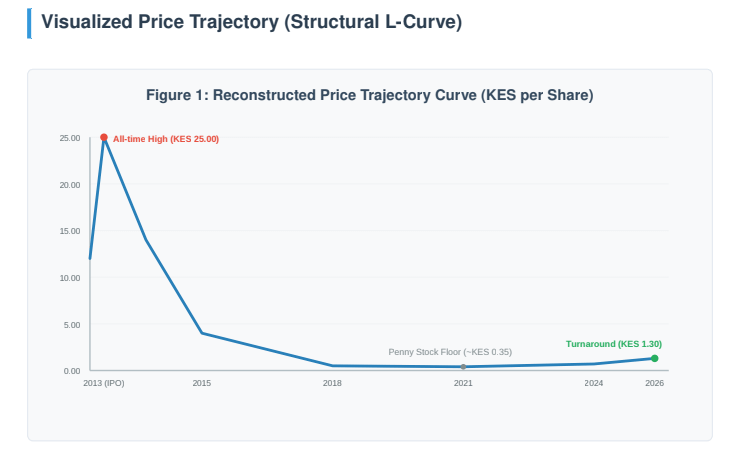
In July 2013, Home Afrika made history by becoming the very first company to list on the NSE Growth Enterprise Market Segment (GEMS). The listing price was set at a modest KES 12.00 per share. What happened next remains legendary in Kenyan market folklore: on Day 1, euphoric demand sent the stock exploding by over 108% to peak at KES 25.00.
Suddenly, the company was sitting on a massive paper market capitalization of KES 10 Billion. But this was the ultimate “Icarus” moment—flying dangerously high on public expectation, completely blind to the fact that it was asset-rich but severely cash-poor.
The NSE Price Collapse
The euphoria didn’t last. From that spectacular hype-peak of KES 12.00 to KES 25.00, the stock suffered a devastating crash down to KES 6.00 in its listing year, paving the way for a decade-long slide into the “Penny Stock” zone. It was a classic tale of a visionary dream meeting a harsh liquidity reality.
But what triggered the immediate collapse from KES 25.00 to KES 6.00? Forensic data reveals a massive founder sell-off. Less than 3 months after listing, top shareholders—who shockingly had zero lock-in periods—dumped 24.8 Million shares, representing a massive 6% stake in the company.
Exit of Founders
The historical charts expose the painful anatomy of the listing. Every single founding member sold off their equity heavily, aggressively diluting their holdings to below the 3% threshold. Because there was no regulatory lock-in mechanism protecting incoming retail investors, the founders were completely free to cash out the exact moment public hype pushed the price to KES 25.00. The result was a historic first-year price correction that now serves as a cautionary textbook case study for the entire NSE GEMS segment.
Migaa: The 775-Acre Dream
The epicenter of both Home Afrika’s grand ambition and its near-fatal undoing was the Migaa Golf Estate in Kiambu. A staggering 775-acre project, Migaa was designed to house 2,500 residential homes, a championship golf course, and an ultra-modern hospital.
However, the sheer scale of the project transformed it into a massive debt trap. The company sank over KES 1.5 Billion into heavy civil infrastructure alone. Capital was locked deep in the Kiambu soil while commercial interest rates climbed relentlessly.

The story of the Migaa Golf Estate in Kiambu County is one of the most prominent case studies in the East African real estate sector. It captures how a brilliant, high-reaching master plan can be severely derailed by funding structures, infrastructure delays, and buyer frustration before undergoing an aggressive structural turnaround.
The Migaa Crisis & Turnaround Timeline
The Grand Vision & Pre-Sales Boom
2010 – 2013
Home Afrika launches Migaa as a premier 774-acre “Live-Work-Play” golf estate. Initial plot pre-sales explode as retail buyers rush in, booking hundreds of parcels. The company collects massive customer deposits but relies entirely on this cash to fund basic operations and land acquisition, rather than locking in institutional development credit.
The Infrastructure Trap
2014 – 2016
The project hits a structural wall. While buyers expect to start constructing homes, Home Afrika struggles to deploy heavy trunk infrastructure (internal tarmac networks, centralized sewerage, reliable water connectivity, and the golf course itself). Because trunk infrastructure in a 774-acre property is incredibly capital-intensive, the company runs out of cash, causing ground development to grind to a halt.
The Buyer Backlash & Default Cycle
2017 – 2019
Frustrated by multi-year delivery delays, plot buyers form welfare associations and aggressively halt further instalment payments. This creates a destructive cash-flow loop: Home Afrika cannot build because buyers stopped paying, and buyers refuse to pay because nothing is being built. Concurrently, commercial banks freeze credit lines to the company due to deteriorating balance sheet metrics.
The Accounting & Legal Crisis
2020 – 2022
Because revenue can only be recognized in real estate once a title deed is processed and the plot handed over, billions of shillings sit trapped on the balance sheet as liabilities (”deferred customer revenue”). Home Afrika records heavy paper losses year after year, and its stock price hits an all-time low on the Nairobi Securities Exchange.
The Restructuring & Revival Hook
2023 – Present
Management initiates a dramatic pivot. By negotiating with contractor groups (such as Seyani Brothers), resolving disputes with the buyer associations, and bringing in joint-venture partners to handle specific sub-estates, infrastructure work restarts. The 18-hole golf course is partially completed, lease titles begin processing at scale, and the company finally unlocks its balance sheet—booking back-to-back net profits in FY24 and FY25 as the estate transitions into a functional, living community.
The 3 Core Pillars of the Migaa Problem
The gridlock that plagued the project can be traced down to three specific economic factors:
The Cash-Flow Mismatch: Real estate developers typically use long-term debt or equity to build roads and utilities, paying it off as plots sell. Home Afrika did the reverse: they used early, short-term plot deposits to buy the massive land asset, leaving very little liquid cash to actually build out the infrastructure promised to those buyers.
The “Deferred Revenue” Trap: Under IFRS rules, a developer cannot claim cash collected from buyers as income until the underlying property is physically delivered. This made the company look fundamentally broke on its income statement for a decade, even though it sat on a massive, multibillion-shilling land asset.
The Multiplier Effect of Scale: Managing a project of 70+ acres is highly predictable; managing a master-planned community of 774 acres requires institutional-grade capital engineering. The sheer scale magnified every logistical delay, engineering error, and contractor dispute.The Slowdown & The Pain
To make matters worse, the real estate market cycle experienced a severe freeze between 2017 and 2022. High interest rates choked buyer financing, and a sluggish economic environment meant luxury homes simply weren’t selling fast enough.
This triggered the dreaded “Deferred Income” problem. Under strict accounting regulations, despite having billions of shillings sitting in buyer deposits, Home Afrika could not legally recognize these inflows as revenue until the properties were physically handed over with titles (IFRS 15). They were operational giants on paper, but liquidity ghosts in practice.
The Debt Squeeze
This accounting bottleneck and infrastructure drag led to a punishing, consecutive 10-year loss streak. To fund the capital-intensive Migaa dream, debt ballooned aggressively from a manageable KES 300 Million at IPO to a staggering KES 1.55 Billion by 2016. Choked by a KES 500 Million private bond alongside heavy commercial bank debt, the original “Chama” spent a decade fighting a raw, gritty battle for basic survival.
The Painful Recovery
But the story doesn’t end in bankruptcy. In 2024, the gritty resurrection became official: Home Afrika broke its decade-long curse, reporting a net profit of KES 133 Million. The momentum accelerated beautifully into H1 2025, with profits surging further to KES 192 Million.
How did they pull off this impossible turnaround? They executed a masterful strategic pivot to “Service Plots.” Instead of shouldering the immense cost, labor, and risk of building every single home themselves, they shifted to providing top-tier infrastructure and clearing titles. This brilliant pivot unlocked instant cash flow while completely eliminating construction risk (0% construction risk). Revenue skyrocketed to KES 781 Million as the backlog of titles for Migaa and Samara was systematically cleared.
Curve Trend Dynamics & Interpretations
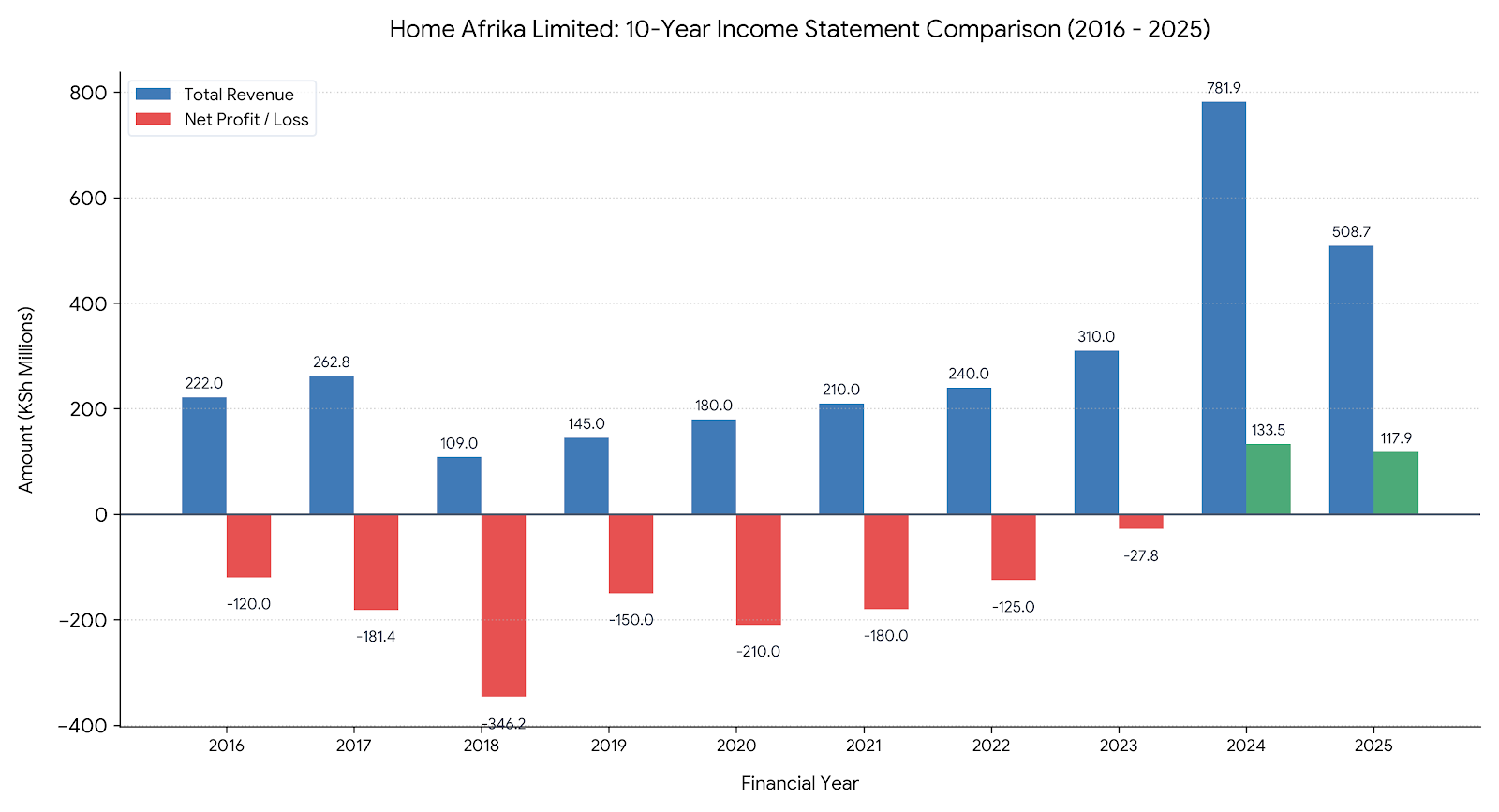
The Revenue Leap (2024 Peak): The top-line curve shows an aggressive spike in 2024 up to KSh 781.9 million. This does not mean sales simply tripled that year; it highlights an intense accounting recognition cycle where cash deposits held on the balance sheet for years were finally released to the Income Statement upon title generation and project completions (such as Migaa PDS lease registrations).
The Top-Line Contraction (2025): In 2025, revenue settled lower by 34.9% to KSh 508.7 million. This decline is primarily due to a high comparison base set in the previous year’s recognition spike, rather than a structural decay in operational demand.
The Bottom-Line Pivot: The Net Profit/Loss curve reveals a visible upward trajectory since its lowest point in 2018 (KSh -346.2 million). By trimming overhead structures by roughly 20%, adjusting finance lines, and expanding recurring income channels (e.g., green fees and hospitality operations at the Migaa Golf Course ecosystem), Home Afrika recorded its second consecutive year of positive earnings in 2025.
Balance Sheet Movement
Key Structural Insights from the Graph:
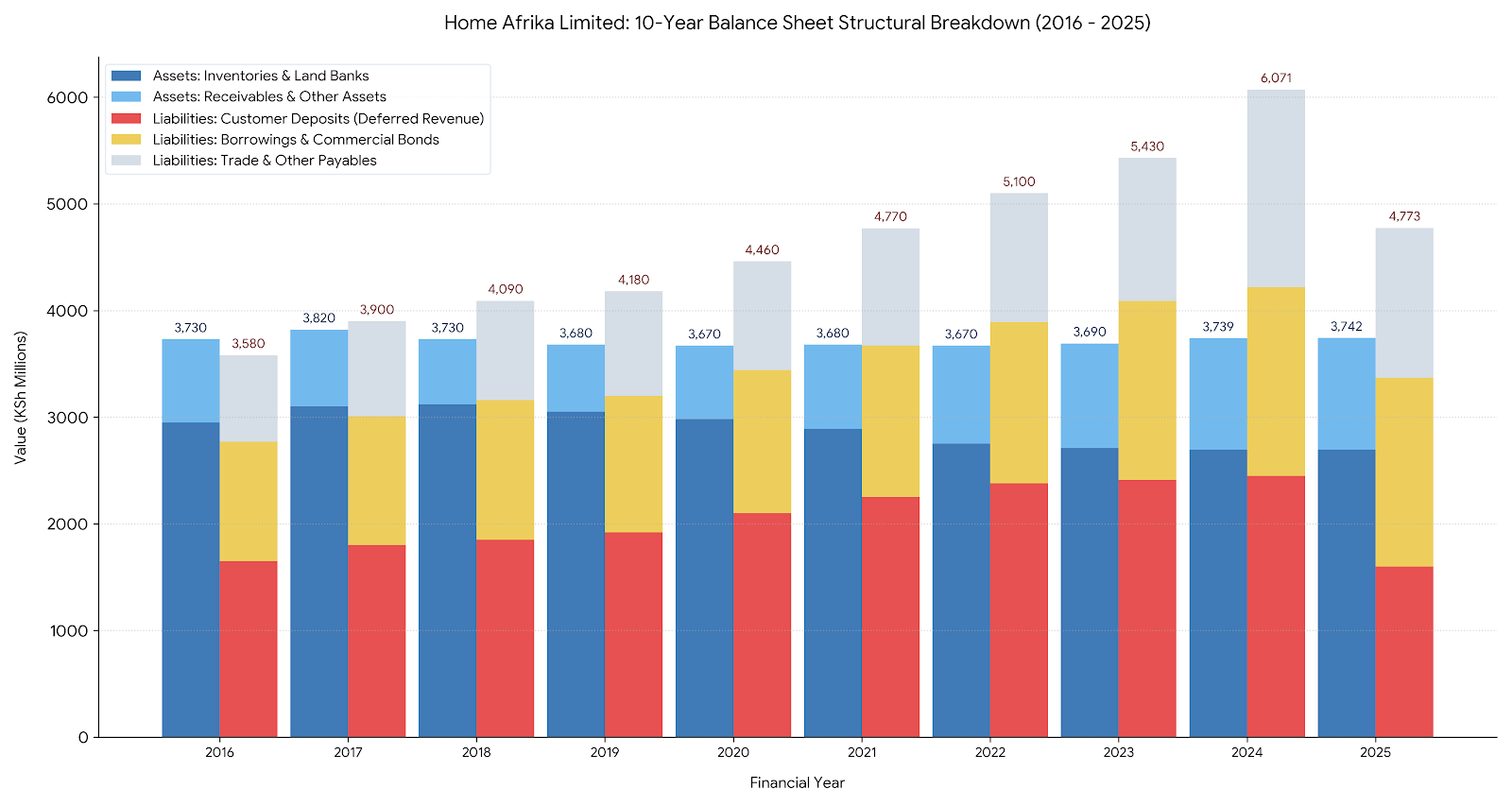
The Asset Core (Left Blue Bars): You will notice the asset base remains remarkably flat across the decade, hover-anchored between KSh 3.6B and KSh 3.8B. This stability reflects the illiquid nature of Home Afrika’s core value—the heavy dark blue block representing Inventories & Land Banks (like the physical layout acreage in Migaa). It acts as a static wealth baseline that slowly transforms into cash only when titles clear and infrastructure milestones are met.
The Negative Equity Gap: By comparing the absolute total headers at the top of each pair, the gap where total liabilities (red/yellow numbers) tower over total assets (blue numbers) visually demonstrates the company’s long-standing negative equity situation.
The 2025 Liability Decompression (Right Stack): Look closely at the final 2025 pairing. Total liabilities dropped sharply from a peak of KSh 6,071 Million down to KSh 4,773 Million. This compression highlights two specific movements:
Revenue Recognition (Red Block Shrinkage): A massive portion of customer plot deposits (deferred liabilities) was officially cleared out of liabilities and moved into the income statement as recognized project revenue.
Trade & Other Payables De-leveraging (Gray Block Shrinkage): General trade payables dropped from KSh 1.50B to KSh 1.26B, reflecting tight cash management and aggressive supplier/contractor account settlements driven by the 2024–2025 turnaround strategy.
The Rigid Debt Line (Yellow Block): The yellow segment tracking institutional bank borrowings and the outstanding KSh 680.95 Million Private Placement Bond has remained stubbornly un-budged. While top-line earnings have returned, actual cash-flow de-leveraging of core structural debt remains the next big hurdle for the management team
The Most Misunderstood Chart on the NSE
For nearly a decade, the $HAFR revenue curve was the most misunderstood chart on the Nairobi Securities Exchange. To the untrained eye, the top-line numbers looked completely stagnant. But real estate accounting operates under strict rules (IFRS 15): you record revenue only when the title is officially handed over. The massive revenue surge of over 100% to KES 781 Million proves that the business wasn’t dead; it was simply waiting for its structural cycle to mature and clear the historical backlog.
When will Home Afrika resume paying dividends?
The golden question for patient retail investors is clear: when will the dividends return? Forward-looking projections indicate a realistic window in late 2026 or 2027. The resumption depends on a clean operational runway: once the remaining KES 100 Million legacy debt is chopped down to exactly 0.00 and the high-margin service plot land-bank revenue keeps flowing, $HAFR’s cash balance will expand dramatically. That is the precise inflection point where the reconstructed “Chama” will finally start sharing the spoils with its public shareholders.
Home Afrika: The Regional Roadmap
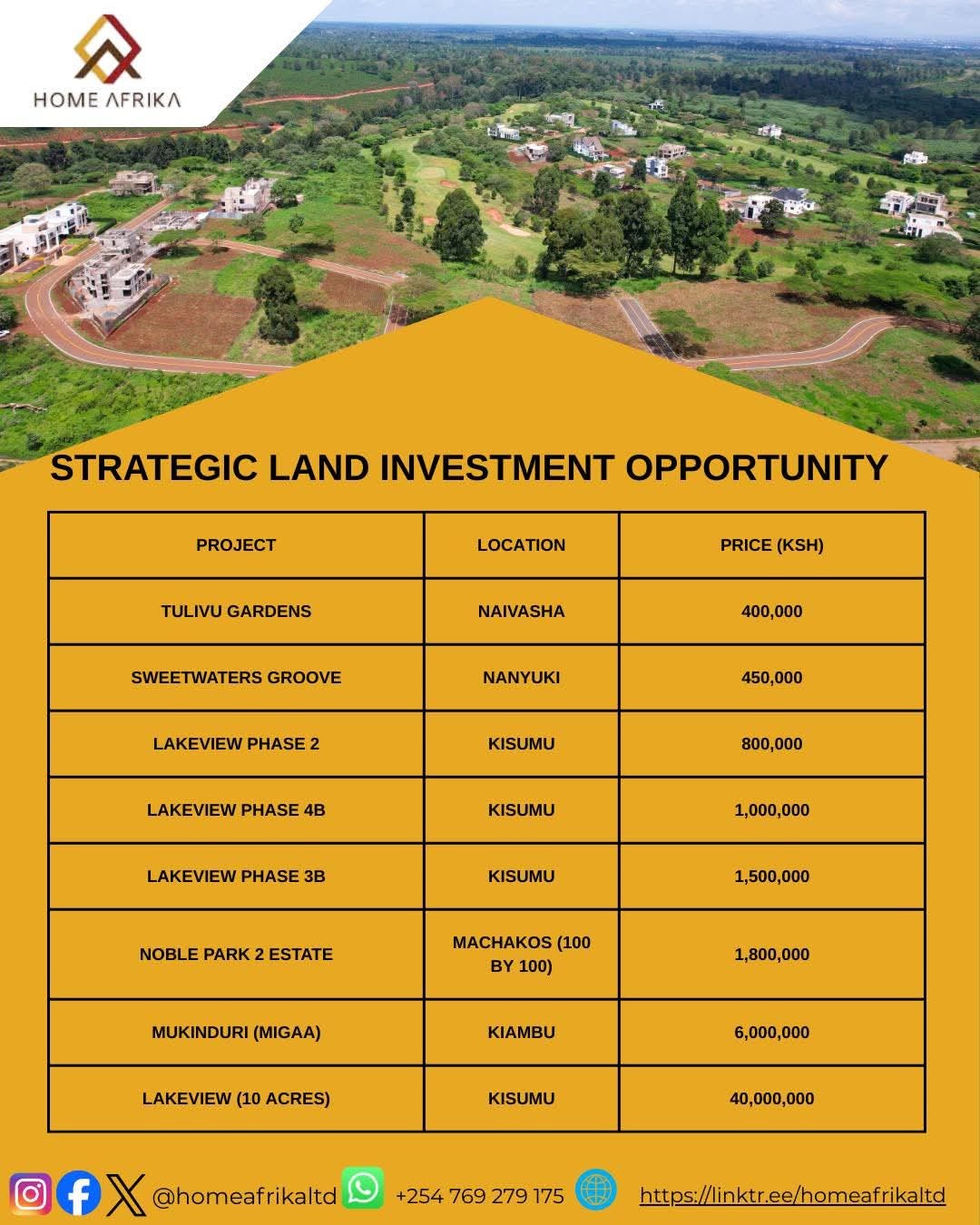
The resurrection isn’t just local—the future of the company is explicitly regional. Home Afrika’s strategic footprint is diversifying geographically to capture massive macroeconomic shifts across Kenya. The upcoming portfolio includes the lakeside luxury of Kisumu’s Lakeview Heights and tapping aggressively into the secondary home boom at Longonot Gate in Naivasha. By intentionally spreading its massive land bank across high-growth corridors, the company is insulating itself against localized economic shocks.
Home Afrika Land Bank Asset Profile
The core value engine of Home Afrika Limited (HAFR) relies heavily on its substantial Land Bank and Inventories, which consistently anchor the asset side of its balance sheet at a valuation holding steady between KES 2.6B and KES 3.1B. Historically an illiquid block of wealth that locked up capital due to delayed infrastructure milestones and title processing, this land bank has transitioned into an active earnings engine through accelerated project delivery and monetization.
The portfolio is primarily composed of the following core properties:
Migaa Golf Estate (Kiambu County): The flagship master-planned asset of the group, spanning 774 acres of premier residential land designed around an 18-hole championship golf course and a sports club ecosystem.
Mitini Scapes (Kiambu County): A high-end residential enclave nestled directly within the greater Migaa master plan, featuring luxury cottages and apartments.
Lukenya Hills (Machakos County): A suburban residential subdivision project positioned within the fast-growing Athi River/Lukenya growth corridor, targeting middle-income buyers.
Llango (Kwale County): A coastal-themed leisure and residential development property intended to tap into the regional resort and vacation home market.
Kikwetu (Athi River): An affordable housing and plot subdivision project aimed at high-density master planning on the outskirts of Nairobi.
Why Naivasha?
Among these regional plays, Naivasha stands out as a crown jewel. Longonot Gate is perfectly positioned to capitalize on the modern “Work-From-Anywhere” remote labor era. As Nairobi continues to suffer from severe urban overcrowding and congestion, $HAFR’s long-term play is to position Naivasha as the ultimate wellness, wellness-commute, and premium retirement destination. Naivasha’s land values are fast transforming into absolute gold.
Has the Chama Remained Intact? & 2026 Shareholding
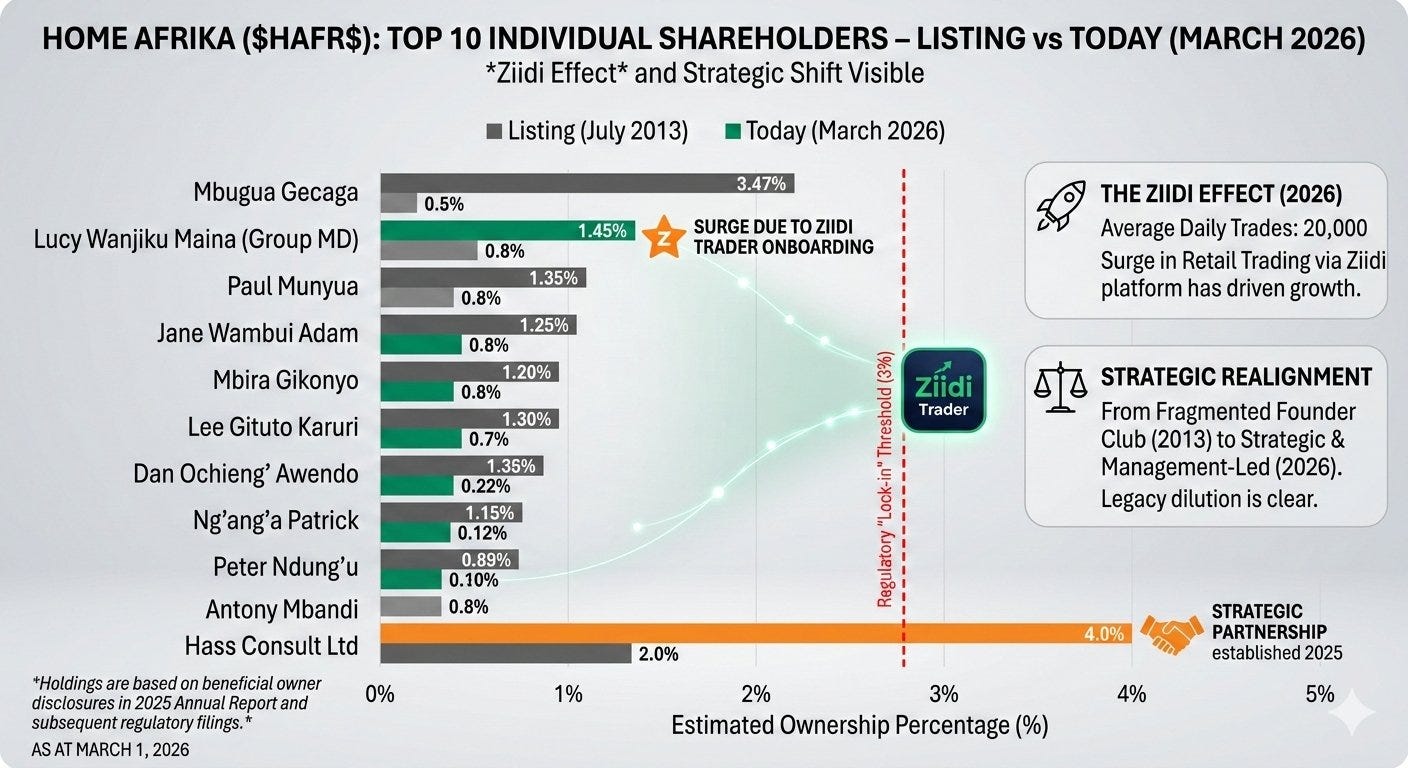
The short answer is no—the original 2013 founder group has mostly diluted and moved out. However, the newly released 2026 shareholder list reveals that a highly sophisticated Turnaround Team is heavily doubling down on the stock, shifting the company from a once fragmented club of 128 early-stage investors into a highly focused corporate strategic powerhouse.
Mbugua Gecaga remains entrenched as the top individual anchor shareholder, signaling rock-solid institutional memory.
Concurrently, the operational driver of the turnaround, Managing Director Lucy Wanjiku Maina, has been quietly and aggressively purchasing confidence directly from the open market, accumulating an aligned personal stake of 1.45%.
The ultimate institutional validation signal? Hass Consult has entered the register aggressively, becoming the single largest individual corporate stakeholder with a commanding 4.00% stake. This massive alignment between top-tier real estate operators and executive management provides the ultimate structural signal that the market’s perception is lagging far behind reality.
The Asset Value vs Share Price Disparity
Today, Home Afrika represents the absolute textbook definition of a “Deep Value Play.” The public equity market caps the entire company at a mere KES 600 Million. Meanwhile, the underlying Net Assets sitting on the balance sheet are valued at an incredible KES 3.1 Billion.
This means the public markets are pricing in a massive, irrational 80% discount on the company, aggressively punishing it for its historical loss-making era while completely turning a blind eye to its newly unlocked liquidity, structural management alignment, and soaring profitability. The gap between a KES 600M market cap and KES 3.1B in net assets represents a profound market disconnect.