

In 2008, a group of ambitious Kenyans decided they were done simply buying and flipping plots. Architect Lee Karuri, Engineer Mbugua Kamau, Dan Awendo and their circle wanted something bigger: to institutionalize real estate, to stop trading land and start building cities. They formed a chama. That chama became Home Afrika.
Seventeen years later the company still carries the scars of that ambition — and the first genuine signs of a resurrection.
The Proof of Concept: Morningside
Home Afrika’s first real test arrived in 2010 with Morningside Office Park on Ngong Road. A 42,000-square-foot Grade A development valued at more than KES 600 million. When it filled up and started generating cash, the message was clear: this was no longer a social investment club. It was a corporate vehicle ready for the public markets.
The Icarus Moment: Listing on the GEMS
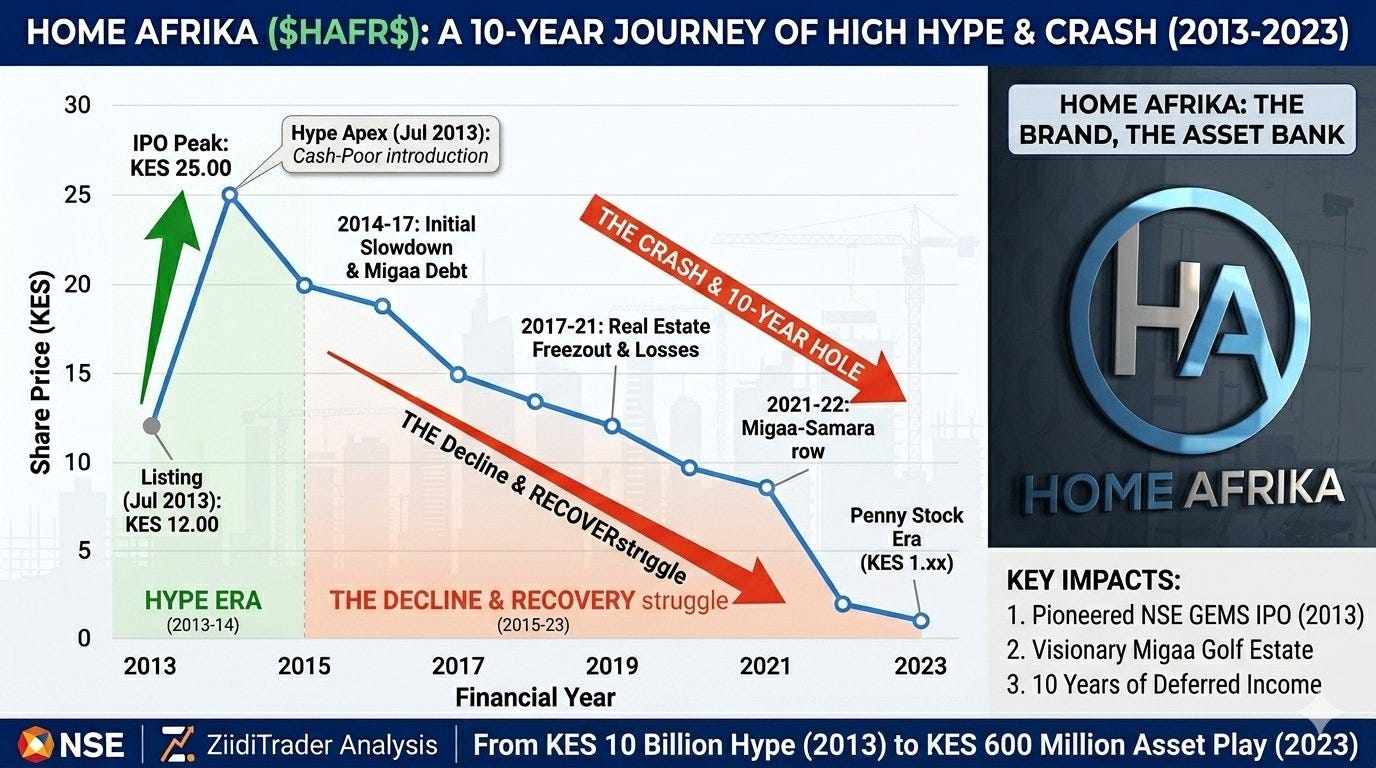
July 2013. Home Afrika became the first company to list on the Nairobi Securities Exchange’s Growth Enterprise Market Segment (GEMS). Offer price: KES 12.00. On day one the share price exploded to KES 25.00. Market capitalisation briefly touched KES 10 billion. It was pure expectation. The company was cash-poor relative to the valuation the market had assigned it. What followed was a classic case of a visionary dream colliding with liquidity reality.
The Decade-Long Slide
From the KES 25 peak the share price began a long, grinding descent into penny-stock territory. The flagship project that was supposed to justify the hype — Migaa Golf Estate in Kiambu — became the central problem.
Migaa was 775 acres designed for 2,500 homes, a golf course and a hospital. The scale was intoxicating. The capital requirements were brutal. Home Afrika poured roughly KES 1.5 billion into infrastructure while interest rates climbed and capital remained locked in the ground.
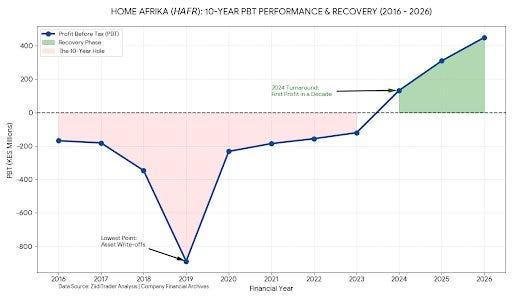
Then came the 2017–2022 real-estate freeze. High interest rates, weak demand and the accounting reality of IFRS 15 (revenue can only be recognised when titles are handed over) created a perfect storm. Billions in customer deposits sat on the books as deferred income. Debt ballooned from around KES 300 million at IPO to KES 1.55 billion by 2016. A KES 500 million private bond and bank facilities kept the company on life support. For ten years Home Afrika reported losses.
The Pivot That Unlocked the Balance Sheet
The turnaround began when management stopped trying to build every house themselves. They shifted to “service plots” — providing infrastructure and clean titles, then letting buyers develop. Construction risk dropped to near zero. Cash started flowing.
In 2024 the company reported a KES 133 million profit. In the first half of 2025 profit rose further to KES 192 million. Revenue jumped more than 100 percent to KES 781 million as titles for Migaa and Samara finally cleared and the long backlog of deferred income began to be recognised.
The most misunderstood chart on the NSE is Home Afrika’s revenue curve. For years it looked stagnant. In reality the company was simply waiting for the moment IFRS 15 allowed the revenue to hit the income statement. That moment arrived in 2024–2025.
The Deep-Value Disconnect
Today the market capitalises Home Afrika at roughly KES 600 million. Net assets stand at approximately KES 3.1 billion — an 80 percent discount. At a share price of about KES 1.50, each share is backed by roughly KES 7.65 of tangible land and assets. The market is effectively ignoring KES 6.15 of value per share.
That gap exists for a reason: a decade of losses and the memory of the 2013 crash. But the numbers have started to move.
Why the Founders Sold — and What It Cost
Why did Home Africa Founders Exit so early?
Following Home Afrika’s listing by introduction on the Nairobi Securities Exchange (NSE) Growth Enterprise Market Segment (GEMS) in July 2013, the Capital Markets Authority (CMA) did not impose a mandatory lock-in period on the founding shareholders.
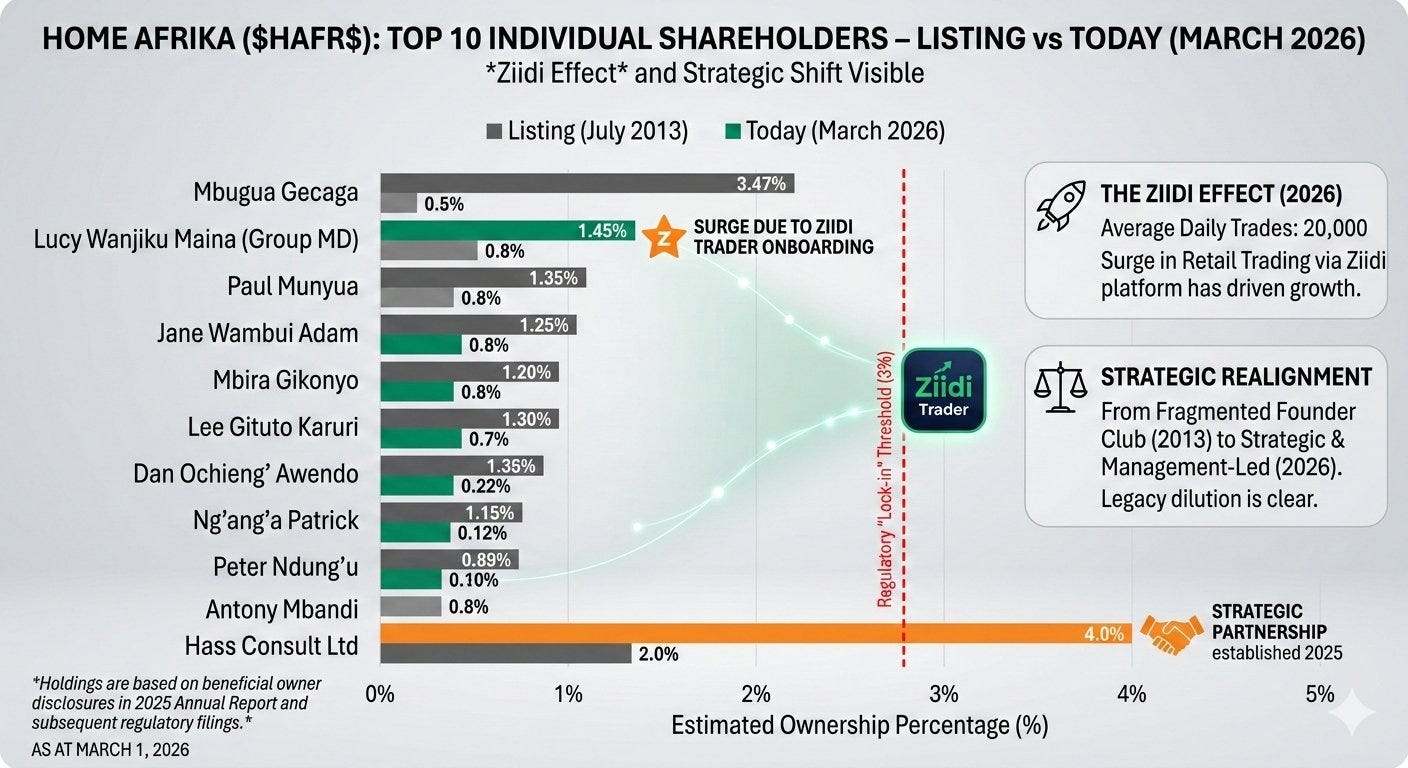
One of the least discussed chapters is the post-IPO founder exit. Data shows that within three months of listing, top shareholders (who had no lock-in period) dumped 24.8 million shares — a 6 percent stake. Every founder reduced their holding below the 3 percent threshold. The result was a historic first-year price correction that still colours how the market views the stock.
List of Major Shareholders & Founders Who Offloaded Stakes
Patrick Ng’ang’a: Sold 5.8 million shares.
Stimela Co-operative: Offloaded 2.4 million shares.
Paul Munyua: Sold 2.0 million shares.
Dale Farm: Sold 2.0 million shares.
Home Afrika Continental: Offloaded 2.0 million shares.
Seyani Brothers & Co.: Sold down their holdings, relinquishing a 2.47% stake.
Hansan Investment: Offloaded 534,900 shares.
The 2026 shareholder register tells a different story. The original founders have largely diluted. Mbugua Gecaga remains a significant individual anchor. Managing Director Lucy Wanjiku Maina has been quietly increasing her stake (currently around 1.45 percent). Hass Consult has emerged as the single largest individual stakeholder at 4 percent. The register has shifted from a fragmented club of 128 investors toward a more concentrated, strategically aligned ownership base.
Key Takeaways from the Exit
Lack of Shareholder Lock-In: Unlike standard Main Investment Market Segment (MIMS) listings, GEMS regulatory rules at the time did not enforce a post-listing lock-in period for anchor promoters, allowing early investors to cash out immediately.
Valuation & Liquidity Disconnect: The rapid dumping of shares flooded the market with supply, causing Home Afrika’s stock price to collapse from its listing peak of KES 12–25 down toward sub-shilling levels over subsequent years.
The Road Ahead
Management’s focus has moved beyond Migaa. The land bank now includes Lakeview Heights in Kisumu, Longonot Gate in Naivasha (positioned for the work-from-anywhere and second-home boom), and planned activity on the Coast and in Western Kenya. The model is evolving further — from pure plot sales toward joint-venture vertical developments that extract more value per acre.
Debt has been reduced. The remaining roughly KES 100 million looks manageable. If the current trajectory holds, the first dividend since the early years could arrive in late 2026 or 2027.
Home Afrika is no longer the high-flying IPO story of 2013, nor the perpetual loss-maker of the late 2010s. It is a land-rich, cash-flow-improving company trading at a deep discount to the assets it already owns. The chama that set out to institutionalise Kenyan real estate nearly went under trying. It is still standing — and for the first time in a long while, the numbers are starting to catch up with the original vision.
Whether the market eventually closes that 80 percent discount is the question that will decide if this resurrection becomes a full recovery or remains a long, grinding value story. The land is there. The titles are clearing. The pivot has worked. The rest is execution — and time.
About Boardlot Africa Research
Boardlot Africa is a premier financial intelligence and corporate governance publication dedicated to unpacking the mechanics of capital, market strategies, and structural shifts across East Africa’s corporate landscape. By bridging the gap between raw economic data and actionable market intelligence, we deliver deep-dive research, independent corporate analysis, and policy insights designed for institutional investors, boardrooms, and sharp market observers.
Get in Touch
Email: boardlot.research@gmail.com
Phone: +254 753 133 901
Substack: Subscribe to Boardlot Africa
X (Twitter): BoardLotSultan
Are you implying we start stacking HAFR
Is the upfront purchase model for real estate sensible.From its peak 60 Trillion around 2022 China has since lost 18 Trillion up to date