
Welcome to Boardlot Africa, where we pull back the curtain to reveal the untold stories, power dynamics, and strategic maneuvers shaping the boardrooms of Corporate Africa—subscribe for free to join the conversation. join 1000 other subscribers
We publish:
Sultans weekly NSE Stock Picks, every Friday at 5pm
Kenya’s Most Consequential Legal, Governance & Labor Disputes
A Series on the 100 Most Influential Kenyan Captains of Industry
The Queens of East Africa Boardrooms
The Silicon Savana Chronicles, every Wednesday at 5.00pm
Sultan’s Farming Diary, every Monday at 5.00pm
In this article:
Act I: The Great Britam Mutiny & War with the Murang’a Oligarchy
Act I (B): The Elite Strike Team—The Brains Behind the Britam Mutiny
Act II: The Street Army and the Illusion of FOMO
Act II (C): The Acquisition & Colonization of Superior Homes: From Kes 1 billion to The Ultimate Betrayal
Act II (D): The Concrete Illusions (2015–2020)
Entry and Premium Proof of Concept (2015): Amara Ridge (Karen).
High-Density Expansion & Satellite Boom (2016): The Alma (Ruaka), Newtown, and The Ridge (Ridgeways).
Consolidation, Delivery, and Scale (2017–2018): Shiv Arora, Superior Homes acquisition and the completion of Amara Ridge.
The Liquidity Wall & Fragmented Delivery (2019–2020): COVID-19 shocks, regulatory gridlock, and the project freeze.
Act II (E): The Ledger of Reality—Project Pipeline vs. Distressed Valuations
Flagship Residential & Mixed-Use Enclaves: Peak Concept Values vs. Official Auction Reserve Valuations (The Ridge, The Alma, Amara Ridge, Situ Village, Taraji Heights).
Mega Master-Planned Cities & Land Banks: RiverRun Estates and Newtown / Mystic Plains.
Commercial Hospitality & Elite Land Holdings: Cytonn Towers Land CySuites.
Act III: The Genius (and Danger) of Regulatory Arbitrage
The Two Faces of Cytonn: The regulated face (CHYF) vs. the unregulated shadow face (CHYS & CPN).
The Asset-Liability Mismatch: Funding long-term concrete developments with short-term demand-driven notes.
Act III (B): The War with the Referee—A Chronology of Dande’s Regulatory Defiance
December 2019 – January 2020: The Trustee Ultimatums and the High Court Injunction.
April – June 2020: The KES 2.5 Billion Statutory Cap Fight.
Mid-2021: The CMA Shadow Banking Public Advisories.
Late 2021 – March 2026: Suing the Regulator for Defamation and the KES 10.5 Million High Court Victory.
March 2026 (Present): The CMA Appeal vs. The Official Receiver Asset Liquidation Tender.
The Scorched-Earth Legal Fortress & “Mali” Law: Vertical Integration of Defense:
The 9-Year Chess Match: Freezing criminal trials across a decade of judicial mane
Silencing the Digital Town Square—Dande vs. Mwango Capital
Act IV: Final Endgame for Cytonn Retail Investors: The harsh reality of distressed asset recovery.
The Gavel as a Woodchipper: The Mathematical Tragedies of Forced Liquidation
Act IV (A): The Final Endgame: Why Cytonn Retail Investors Are Staring Down a 65% Haircut
Act IV (B): What Part of Cytonn is Edwin Dande Still in Control Of? Is he Broke?
Act IV(C): 10 Lessons for Retail Investors from the Cytonn Collapse
The Cytonn Paradox: How Edwin Dande Beat the Oligarchs, Weaponized the Youth, and Broke the Market
Nairobi’s financial history is typically written by gentlemen in mahogany boardrooms who speak in muted tones, respect old money, and never break the unwritten codes of the city’s corporate establishment.

Then came Edwin Harold Dayan Dande.
Armed with a Wharton MBA, a Wall Street pedigree from Lehman Brothers and Bank of America Merrill Lynch, and an absolute disdain for the slow-moving, traditional architecture of Kenyan finance, Dande didn’t just join the market—he set fire to it.
For nearly a decade, he ran an operation that was part high-octane real estate empire, part aggressive legal fortress, and part populist crusade. He pulled off the ultimate corporate mutiny, defeated the country’s most untouchable financial oligarchy, and built a KES 15 billion empire on the backs of an army of young street foot soldiers.
But the very traits that made Dande an invincible market-shaper—his absolute refusal to back down, his mastery of structural loopholes, and his scorched-earth use of the legal system—were the exact same weapons he would ultimately turn on thousands of middle-class Kenyan investors when the music stopped.

Act I: The Great Britam Mutiny & War with the Murang’a Oligarchy
To understand the sheer audacity of Edwin Dande, you have to understand who he chose as his first enemies.
In the early 2010s, Dande was headhunted to lead British American Asset Managers (BAAM), the investment arm of Britam. He brought an aggressive, American-style asset management energy that transformed BAAM into a market leader. But Dande didn’t want to just be a highly paid employee for old money. He wanted the kingdom.
In August 2014, Dande staged what remains the most explosive corporate coup in Kenyan history. Alongside three brilliant young executives—Elizabeth Nkukuu, Patricia Wanjama, and Shiv Arora—he abruptly resigned. They didn’t just walk out; they severed Britam’s multi-billion-shilling real estate development pipeline, convincing its key partner, Acorn Group, to break away with them.
Acorn, owned and led by the sharp real estate strategist Edward Kirathe, was the engine behind the properties. By convincing Kirathe to jump ship to his newly formed Cytonn Investments, Dande effectively tried to transplant Britam’s entire real estate future into his own new baby.
The establishment was furious. Dande and Kirathe had declared asymmetric war on the absolute apex of the Murang’a financial oligarchy:
Peter Munga
Dr. James Mwangi
Dr. Benson Wairegi
This trinity of power unleashed the full weight of corporate and state machinery. Britam slapped Dande’s team and Acorn with five separate commercial lawsuits, claiming they had illicitly funneled KES 3.9 billion out of BAAM accounts to Acorn-affiliated entities just days before exiting. They froze Cytonn’s and Acorn’s bank accounts, intending to strangle the venture in its cradle.

Act I (B): The Elite Strike Team—The Brains Behind the Britam Mutiny
When Edwin Dande took the reins at British American Asset Managers (BAAM), he didn’t just inherit a corporate department; he meticulously engineered a premier financial strike team.
This wasn’t a standard corporate hierarchy where executives worked in insulated silos. Dande cultivated a high-octane, fiercely loyal culture within BAAM. To understand the sheer magnitude of the blow dealt to the Murang’a oligarchy, one must analyze the formidable squad Dande assembled:
1. Elizabeth Nkukuu, CFA – The Engine Room (Senior Portfolio Manager)
If Dande was the aggressive public face and dealmaker, Elizabeth Nkukuu was the analytical brain that kept the machine running.
The BAAM Role: She managed the core investment funds, discretionary portfolios, and unit trusts. Nkukuu possessed a meticulous grasp of equities, fixed income, and cash management solutions. Her CFA credentials lent immense institutional credibility to the operation; her presence assured investors that their capital was governed by strict mathematical discipline.
Post Cytonn: Elizabeth Nkukuu, CFA: From Shadow Banking to Public Trust
In an ironic twist of fate, the woman who once managed Cytonn’s complex investment engine was tapped by the government to serve as the Chief Executive Officer of the Financial Inclusion Fund (The Hustler Fund)

2. Patricia Wanjama – The Structural Shield (Head of Legal & Regulatory Affairs)
Every high-stakes corporate maneuver requires a legal architect who understands compliance boundaries, fiduciary duties, and structural loopholes. Patricia Wanjama was that mind.
The BAAM Role: As the top legal mind for the asset management arm, Wanjama handled corporate governance, board secrets, and joint-venture structures. She was the one who drafted and authorized the multi-billion-shilling real estate partnership agreements between BAAM and Edward Kirathe’s Acorn Group.
Post Cytonn: Patricia Wanjama: The Governance and AI Frontier Guru
She founded and leads Akira Consult, a niche firm specializing in executive board evaluations, sustainability consulting, and corporate governance audits
3. Shiv Arora – The Wall Street Finisher (Lead Investment Analyst)
To maintain a relentless transaction pipeline, Dande needed an execution powerhouse—a tireless financial modeler who could stress-test valuations and run numbers faster than anyone else in Upper Hill. Shiv Arora was that prodigy.
The BAAM Role: Though young at the time, Arora worked directly under Dande, structuring exit strategies, evaluating real estate pipelines, and projecting project cash flows.
Post Cytonn: Shiv Arora: The Real Estate Corporate Titan
He was appointed the Chief Executive Officer of Superior Homes Kenya, one of East Africa’s premier master-planned housing developers (famed for Green Isinya Park and Sultan Palace Beach Retreat).
Arora’s Pivot to CEO: In a brilliant corporate twist, Shiv Arora formally severed his ties with Dande and was headhunted to become the Chief Executive Officer of Superior Homes Kenya. He went from managing Cytonn's spreadsheets to running the very company Cytonn held a minority stake in.
The Lawsuits & Public Warfare: Dande did not take this lightly. He viewed the management of Superior Homes as actively working against Cytonn’s restructuring proposals. Dande launched an aggressive, multi-front legal assault, filing lawsuits against Superior Homes and taking to public media channels to launch scathing attacks on the company’s financial practices and management decisions.
Sticking to Institutional Design: Trapped in a crossfire between his former boss’s legal blitzkrieg and the Official Receiver’s liquidation demands, Arora spent five years successfully steadying and insulating Superior Homes’ day-to-day operations from the Cytonn contagion. He proved that massive master-planned communities could be scaled efficiently under institutional governance, before stepping down in late 2025 to pursue new strategic investment frontiers.

The Corporate Settlement and the Tale of Two Paths Edward Kirathe & Edwin Dande
Most executives would have capitulated under the pressure of criminal threats and frozen assets from the state’s most powerful men. Dande didn’t blink. He played tactical legal chess and forced a massive out-of-court settlement in late 2015.
To unfreeze the operations, Acorn agreed to return approximately KES 5 billion in land assets and cash to Britam. In exchange, Britam completely withdrew all civil claims against Dande’s team and Acorn.
This moment marked the end of the mutiny, but it triggered a fascinating, multi-billion-shilling divergence in how Dande and Kirathe chose to build from the ashes:
Edward Kirathe’s Pivot to Institutional Scale: Kirathe and Acorn Group cut ties with Cytonn’s high-risk financing model and moved on to build a legitimate, institutional juggernaut. Partnering with global heavyweights like the UK’s Helios Investment Partners and the IFC, Kirathe pivoted entirely to specialized student housing. Acorn went on to launch Qwetu and Qejani student hostels, transforming them into a multi-billion-shilling empire.
1. The BRITAM Commercial Warfare (The 2014 Blitzkrieg)
The civil battle was short, sharp, and highly destructive. Dande and his team didn’t just resign; they effectively attempted to sever Britam’s real estate arm and transplant it into their new baby, Cytonn.
August 2014: The Great Escape
Edwin Dande, Elizabeth Nkukuu, Patricia Wanjama, and Shiv Arora abruptly exit British American Asset Managers (BAAM). Simultaneously, Britam’s real estate development partner, Acorn Group (led by Edward Kirathe), terminates its KES 40 billion partnership with Britam to join forces with Dande’s newly formed Cytonn.
October 2014: Britam Strikes Back (Civil Suits 352, 353, 354, 361 & 362 of 2014)
The Kikuyu oligarchy unleashes its full legal weight. Britam files five separate commercial lawsuits in the High Court against Dande, his co-founders, and Acorn Group. The claim? Dande and his team had illicitly funneled KES 3.9 billion out of BAAM accounts to Acorn-affiliated companies just days before their mass resignation. They secure sweeping freeze orders on Cytonn and Acorn’s bank accounts.
October 2015: The Out-of-Court Capitulation (The Commercial “Win”)
Realizing that a prolonged asset freeze would strangle both Cytonn and Acorn in the cradle, a massive out-of-court settlement is brokered. Acorn agrees to return about KES 5 billion in land assets and cash back to Britam. In exchange, Britam withdraws all civil claims against Acorn and Dande’s team. Dande essentially walks away free from civil liability, and Cytonn is officially unchained to begin competing.

2. The Criminal & Constitutional Warfare (2016–2023)
While the commercial case was settled, the Murang’a establishment refused to let Dande walk away completely clean. They turned to the state machinery—the Directorate of Criminal Investigations (DCI) and the Director of Public Prosecutions (DPP)—to crush him criminally.
The State’s Ambush: Late 2016
Despite the 2015 commercial settlement, the DCI acts on a criminal complaint filed by Britam’s Dr. Benson Wairegi based on an internal KPMG forensic audit. The DPP approves formal criminal charges against Dande and his co-founders for the theft of KES 1.17 billion. The state registers Criminal Case No. 1735 of 2016 (Republic vs. Edwin Harold Dayan Dande & 3 Others) in the Chief Magistrate’s Court.
Dande’s Structural Counter-Attack: December 2016
Before the Magistrate can even read the charges, Dande launches a massive counter-offensive in the High Court. He files two Judicial Review suits and a Constitutional Petition. His argument is brilliant: the state is being weaponized by a corporate competitor to fight a commercial war that was already settled in 2015. He secures a conservatory order staying (freezing) the criminal trial.
The High Court Split: September 2018 - February 2019
The High Court delivers a mixed bag. In September 2018, the court dismisses Dande’s Judicial Review applications, ruling that courts shouldn’t preemptively block the DPP’s powers to prosecute.
However, in February 2019, Justice John Mwita hands Dande a massive tactical weapon in the Constitutional Petition. The judge rules that Britam violated Dande’s right to access information and orders Britam to hand over the secret KPMG forensic audit they used to instigate the DCI arrest. Britam refuses and hides the audit, giving Dande the narrative that the state’s evidence is a “fabrication.”
The Court of Appeal Escalation: February 2022
After Dande appeals the unfavorable Judicial Review rulings, the Court of Appeal deals him a massive blow. The three-judge bench rules that Dande and his team must face the Magistrate’s court to plead to the criminal charges of stealing KES 1.17 billion. The freezing orders on the criminal trial are lifted.
The Supreme Court Gambit: June 2023
Refusing to step into a criminal dock, Dande aggressively escalates the fight to the apex court, filing Supreme Court Petition No. 6 of 2022.
On June 16, 2023, the Supreme Court (Coram: Koome, Wanjala, Njoki, Lenaola & Ouko) delivers its landmark judgment. While the ruling expands Kenyan jurisprudence on judicial review, it ultimately dismisses Dande’s appeal with costs. The Supreme Court rules that investigating and prosecuting the Cytonn founders did not constitute an abuse of power by the police or DPP.
Act II: The Street Army and the Illusion of FOMO
With Cytonn unchained but lacking Acorn’s institutional backing, Dande needed capital fast.
He built a distribution machine that felt less like a conservative asset manager and more like a high-octane tech startup. He flooded the streets of Nairobi, Upper Hill, and Westlands with an army: thousands of hungry, ambitious, fresh Kenyan university graduates.
These young foot soldiers flooded coffee shops, offices, and family gatherings, aggressively pitching Cytonn products. The pitch was intoxicating: Why settle for 5% or 7% from conservative banks owned by old men when you can get 18% to 21% returns backed by prime brick-and-mortar real estate in Ruaka, Karen, and Kilimani?
Act II (C): The Colonization of Superior Homes—From the KES 1 Billion Honeymoon to Total Trench Warfare
What began as a KES 1 billion celebratory partnership in a high-end Nairobi hotel ended up as a fierce legal and media slugfest, with former allies weaponizing courtrooms and YouTube broadcasts against each other.
Here is the chronological evolution of the relationship, mapped out for your financial narrative:

The Legacy of Litigation: A Retrospective on Kenya’s Most Consequential Governance & Labor Disputes
Phase 1: The KES 1 Billion Honeymoon (January 2017)
In early 2017, Cytonn was at the absolute zenith of its public fundraising power. Edwin Dande was positioning the firm as the undisputed disrupter of alternative investments in East Africa. However, Cytonn had a glaring structural weakness: while they were elite at raising capital through high-yield notes, they lacked a proven track record of actually delivering massive, master-planned real estate projects on time.
The Target: Enter Superior Homes Kenya, founded by Ian Henderson. They were already legendary in the region for executing Greenpark Estate in Athi River—a highly successful, structured, multi-phase master-planned community. They knew how to build; Cytonn knew how to raise cash.
The Deal: On January 31, 2017, Dande signed a highly publicized agreement to acquire a 25% minority equity stake in Superior Homes for KES 1 billion. The cash was funneled directly from Cytonn’s pool of investor funds (specifically via Cytonn Investment Partners Fifteen LLP).
The Corporate Synergies: Dande publically stated that Superior Homes gave Cytonn instant execution capability in satellite towns, while Henderson noted that Cytonn brought the financial engineering, marketing, and institutional fundraising muscle they desperately needed to scale. Shiv Arora, then Cytonn’s Financial Controller, was one of the key corporate finance minds deeply involved in managing and auditing the mechanics of this investment.
Phase 2: The Cracks and the Mutiny Within (2019–2021)
As Cytonn’s unregulated High Yield Solutions (CHYS) began hitting severe, structural liquidity constraints around 2020, the relationship with Superior Homes soured rapidly. Dande’s aggressive, centralized oversight style clashed with the independent management of Superior Homes.
The Operational Decoupling: Recognizing that the Cytonn brand was becoming highly toxic and drawing heavy regulatory heat from the Capital Markets Authority (CMA), Superior Homes’ management aggressively insulated its operations from the Upper Hill contagion.
The Ultimate Betrayal: In a stunning corporate twist, Shiv Arora completely severed his ties with Edwin Dande. Because Arora had spent years understanding Superior Homes’ financial and operational structures during the partnership, he was headhunted and appointed as the substantive Chief Executive Officer of Superior Homes Kenya.
To Dande, this wasn’t just a resignation; it was a deeply personal corporate mutiny. One of his sharpest, original Britam breakaway lieutenants was now running the very company Cytonn held a massive minority stake in—and using it to block Cytonn’s influence.

Phase 3: Total Warfare and the YouTube Inquisitions (2022–2024)
Once Arora took the wheel at Superior Homes, Dande launched a blistering, multi-front campaign to destabilize the company’s executive team. He stopped acting like a supportive 25% investor and started acting like a hostile corporate raider.
The Public Smear Campaign: Dande took directly to Cytonn’s official media channels and YouTube. In a highly combative, 26-minute public video broadcast titled “Edwin Dande SPEAKS: Superior Homes Kenya | What are they not informing the public?”, Dande launched an extraordinary assault. He accused Superior Homes’ management of corporate governance failures, deliberately hiding financial realities from shareholders, and operating in a non-transparent manner.
The Litigation Blitzkrieg: Using his captive law firm, Mali Advocates, Dande filed a barrage of lawsuits against Superior Homes, attempting to forcefully remove board members, demand emergency forensic audits, and tie up their corporate decision-making in knots.
The Ironclad Shield: Arora and the primary shareholders of Superior Homes stood their ground. They weaponized the courts right back, successfully keeping Cytonn’s chaotic legal maneuvers at arm’s length and ensuring that the day-to-day operations of developments like Greenpark Estate remained entirely unaffected by Cytonn’s implosion.
Phase 4: The Liquidator’s Auction Block (Current Status)
When the High Court officially ordered the liquidation of Cytonn’s shadow funds (CHYS and CPN) to compensate thousands of ruined retail investors, the 25% equity stake in Superior Homes underwent a dramatic legal transformation. It went from being a corporate asset for Dande to a prize piece of evidence for the state.
The Asset Freeze: Under Insolvency Petition No. E063 of 2021, the court-appointed Official Receiver formally traced investor money directly into the acquisition of that equity. In a sweeping consolidated ruling, the Court of Appeal upheld preservation orders over the equity stake in Superior Homes Kenya Limited, locking it down as part of the total assets to be realized.
The Current Disposal War: The Official Receiver has published public tender and auction notices to aggressively sell off Cytonn’s remaining holdings to raise cash. The equity stake in Superior Homes is one of the most liquid, valuable, and attractive institutional assets left in the wreckage, valued at hundreds of millions of shillings.
Dande’s Final Stand: Dande is still desperately fighting the disposal. He has filed fresh, urgent objections against the Official Receiver, claiming the asset tenders are premature and illegal. Meanwhile, Superior Homes continues to scale entirely independent of his control, waiting for the courts to finally auction Dande’s remaining shares to a clean, institutional investor.
Act II (D): The Concrete Illusions—How Cytonn Rapidly Built a KES 73 Billion Real Estate Empire Before the Scaffold Collapsed
Before the high-yield shadow funding engine imploded, Cytonn Real Estate established itself as one of the most aggressive and visually stunning project developers in Nairobi’s suburban landscape. By utilizing forward-selling, aggressive off-plan marketing, and a massive captive pool of retail cash, Edwin Dande rapidly assembled a project pipeline mandated at over KES 73 billion.
Here is the step-by-step chronological timeline of how Cytonn built up its formidable real estate portfolio:

1. The Entry and Premium Proof of Concept (2015)
To prove they were serious developers and not just financial paper traders, Cytonn targeted Nairobi’s most premium, high-trust real estate market: Karen.
September 2015 – Amara Ridge (Karen): Cytonn officially broke ground on its flagship KES 1 billion gated community. Comprising 10 ultra-luxury 5-bedroom villas sitting on half-acre plots opposite the Bomas of Kenya, the development served as its absolute aesthetic standard. The project achieved a blistering 100% off-plan sales rate, proving that Dande’s model could attract high-net-worth buyers.

2. High-Density Expansion and the Satellite Boom (2016)
Flushed with massive investor inflows from the newly launched Cytonn High Yield Solutions (CHYS), the firm aggressively scaled away from boutique luxury toward high-density, mixed-use suburban living.
April 2016 – The Alma (Ruaka): Cytonn broke ground on The Alma, an ambitious, comprehensive lifestyle development featuring 408 modern apartment units, a retail center, and a nursery school in the rapidly growing hub of Ruaka. Using Chinese tech-contractor CATIC, Cytonn pioneered massive, highly publicized site visits (The Sharp Investors Tour) to push rapid off-plan uptake.
May 2016 – Newtown (Machakos): Seeking to match the grand master-planned city narratives of Konza and Tatu City, Cytonn launched Newtown, a massive 1,000-acre mega-city concept intended to blend residential, commercial, and recreational infrastructure in Machakos County.
September 2016 – The Ridge (Ridgeways): Cytonn launched The Ridge, an outstanding KES 6 billion mixed-use development sitting on 10 acres of land along Kiambu Road. Featuring residential apartments, serviced penthouses, and a sprawling retail promenade, the project famously cleared over 20% of its phase-one off-plan inventory on the single day of its public launch.
3. Consolidation, Delivery, and Landmark Scale (2017–2018)
During this period, Cytonn worked to transform its construction sites into finished architectural realities to lock in public credibility and defend against growing whispers regarding its liquidity structure.
January 2017 – Superior Homes Acquisition: To instantly buy institutional execution and construction capability, Cytonn acquired a 25% equity stake in Superior Homes Kenya—the developers of Greenpark Estate—for KES 1 billion.
Mid-2017 – Strategic Pipeline Additions: Ground was broken on Taraji Heights (Ruaka), Situ Village (a KES 5.5 billion luxury villa and cottage development nestled near the Ololua Forest in Karen), and Applewood (Karen).
Late 2018 – Completion of Amara Ridge: Cytonn successfully completed and handed over Amara Ridge to buyers. The successful completion of a KES 1 billion luxury project gave Dande the ultimate marketing shield to counter growing public skepticism.
4. The Liquidity Wall and Fragmented Delivery (2019–2020)
By 2019, the high construction costs of managing multiple mega-projects concurrently began crashing against the structural reality of short-term notes funding long-term brick-and-mortar projects.
Late 2019 – Phase 1 Handover of The Alma: Cytonn managed to complete and officially hand over the first phases of The Alma in Ruaka. The colorful launch ceremony was used to show investors that physical capital appreciation was actively materializing on the ground.
2020 – The Freeze: As COVID-19 hit and the Capital Markets Authority (CMA) locked horns with Cytonn over its unregulated pools, cash dried up. Work slowed down to a crawl or ground to an absolute halt across major structural projects like The Ridge and Situ Village, leaving the portfolio frozen as a multi-billion shilling legal battleground between Special Purpose Vehicles (SPVs) and court-appointed liquidators.
This video takes you directly inside the gates of Cytonn’s completed Karen flagship, showcasing the exact luxury real estate execution they used to build an enviable early portfolio before the broader ecosystem collapsed.
Amara Ridge by Cytonn - 100% Complete Project Tour
Act II (E): The Ledger of Reality—Mapping the Project Pipeline of Cytonn Real Estate
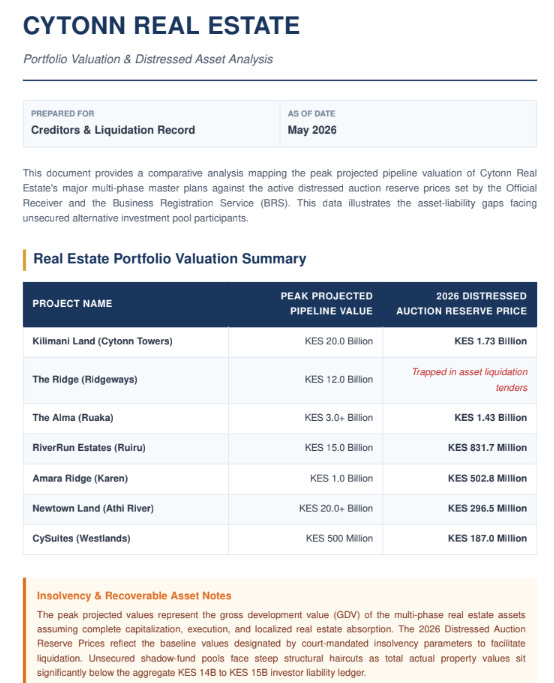
At its peak, Cytonn Real Estate claimed a massive project portfolio under mandate valued between KES 73 billion and KES 82 billion. This was based on projected gross development values (GDV) once all multi-phase master plans were completely built out.
However, following the collapse of the shadow funds and court-ordered liquidations, the Business Registration Service (BRS) and the Official Receiver placed these properties up for distressed public auction. This has exposed the wide gap between Cytonn’s peak marketing “portfolio values” and their actual, current “distressed auction asset valuations.”
The definitive list of Cytonn’s major real estate projects compares their Peak Development/Concept Value against their Official Auction Reserve Valuation:
1. Flagship Residential & Mixed-Use Enclaves
The Ridge (Ridgeways, Kiambu Road)
Concept/Peak Value: KES 12 Billion
Project Scope: A massive, multi-phase 10-acre mixed-use development designed to hold up to 800 residential apartments, serviced penthouses, and a commercial retail promenade.
Current Status: Incomplete shell; caught up in heavy asset liquidation.
The Alma (Ruaka)
Concept/Peak Value: KES 3 Billion+ (Initial phase estimated at KES 1.6 Billion)
Auction Reserve Valuation: KES 1.43 Billion
Project Scope: 408 modern apartment units, a retail center, and a nursery school. This is Cytonn’s most highly completed high-density project.
Amara Ridge (Karen)
Concept/Peak Value: KES 1.0 Billion
Auction Reserve Valuation: KES 502.8 Million
Project Scope: 10 ultra-luxury 5-bedroom villas on half-acre plots with an exclusive clubhouse. 100% completed and handed over.
Situ Village (Ololua, Karen)
Concept/Peak Value: KES 3.05 Billion
Project Scope: A gated master-planned community featuring luxury villas and cottages bordering the Ololua Forest.
Current Status: Stalled/partially completed.
Taraji Heights (Ruaka)
Concept/Peak Value: KES 1.5 Billion
Auction Reserve Valuation: KES 53.8 Million (reflecting distressed/unbuilt land portion parcel valuation)
Project Scope: A 267-unit residential development featuring 2- and 3-bedroom apartments with a private retail facility.
2. Mega Master-Planned Cities & Land Banks
RiverRun Estates (Ruiru)
Concept/Peak Value: KES 15 Billion+
Auction Reserve Valuation: KES 831.7 Million (Split across two auction tranches: KES 535.8M and KES 295.9M)
Project Scope: A 100-acre master-planned community near Tatu City designed for mid-income housing clusters, a water park, and a dam frontage.
Newtown / Mystic Plains (Athi River, Machakos)
Concept/Peak Value: KES 20 Billion+ (Initial modular planning phase captured at KES 12.5 Billion)
Auction Reserve Valuation: KES 296.5 Million (Split between Athi River land at KES 236M and Newtown Mystic Plains at KES 60.5M)
Project Scope: A grand 1,000-acre mega-city concept intended to blend residential, commercial, educational, and institutional zones.
3. Commercial Hospitality & Elite Land Holdings
Kilimani Apartments / Cytonn Towers Land
Concept/Peak Value: KES 20 Billion (Proposed triple-tower mega project)
Auction Reserve Valuation: KES 1.73 Billion
Project Scope: Originally planned as a 150-meter-tall, 35-floor triple-tower structure (holding offices, a hotel, and serviced apartments). The current auction value reflects the high-value prime land acreage in Kilimani.
CySuites (Westlands)
Concept/Peak Value: KES 500 Million
Auction Reserve Valuation: KES 187 Million
Project Scope: A fully functional, luxury serviced-apartment hotel managed under Cytonn’s hospitality arm.
Applewood Miotoni (Karen)
Concept/Peak Value: KES 2.5 Billion
Project Scope: Exclusive gated community comprising premium luxury residential villas tucked within Karen.
Act III: The Genius (and Danger) of Regulatory Arbitrage
How was Dande promising 21% returns when the rest of the market was struggling to hit double digits? The answer lay in a masterclass of regulatory arbitrage—the art of exploiting the massive, gaping holes in Kenya’s financial regulatory framework.
Dande split Cytonn into two distinct faces:
The Regulated Face: Cytonn High Yield Fund (CHYF)
Regulatory Oversight: Strictly approved and monitored by the Capital Markets Authority (CMA).
Yield Structure: Offered modest, standard market-rate returns.
Compliance: Audited heavily with tight, rigid investment restrictions.
The Shadow Face: Cytonn High Yield Solutions (CHYS) & Real Estate Project Notes (CPN)
Regulatory Oversight: Completely unregulated, operating as private-placement Limited Liability Partnerships (LLPs).
Yield Structure: Promised mouth-watering returns ranging from 18% to 21%.
Compliance: Pooled public money into a complex maze of Special Purpose Vehicles (SPVs) where Cytonn maintained 99% control.
To the average retail investor, the line between these two faces was completely invisible. They saw the slick offices, the glossy brochures, the prominent billboard advertisements, and the Wharton-credentialed CEO on television. They assumed the Capital Markets Authority was watching.
But Dande had engineered a structural trap. The unregulated shadow funds were collecting short-term, demand-driven cash from retail savers and plowing them directly into highly illiquid, long-term real estate developments like The Alma in Ruaka.
The Flaw: In finance, you cannot use short-term money that investors expect back in 6 to 12 months to build long-term concrete structures. The moment a few large investors asked for their money back, or a global shock like the 2020 pandemic hit, the liquidity dried up. The music stopped, and there was no lender of last resort for an unregulated fund.
Act III (B): The War with the Referee—A Chronology of Regulatory Defiance
Dande’s entire model relied on keeping his most lucrative funds out of the CMA’s reach. The moment the CMA tried to regulate or flag his private placement LLPs, Dande used the High Court to paralyze them.
The timeline of Dande’s war with the regulator plays out like a corporate thriller:
The Trustee Ultimatums: December 2019
The CMA takes aim at Dande’s regulated entity, Cytonn Asset Managers Limited (CAML). The regulator issues a strict directive threatening to freeze the on-boarding of new clients to the Cytonn Unit Trust Funds if they do not replace their current trustee by December 31.
The High Court Counter-Injunction: January 2020
True to form, Dande bypasses the internal regulatory appeals and heads straight to the High Court on December 30, 2019. By January 2020, he successfully secures sweeping conservatory orders suspending the CMA’s directive. Dande publishes an explosive public statement accusing the CMA of intentionally frustrating capital market innovation.
The KES 2.5 Billion Statutory Cap Fight: April - June 2020
As cracks begin to show in Cytonn’s liquidity, the CMA attempts to de-risk the regulated Cytonn High Yield Fund (CHYF). The regulator orders the fund to reduce its heavy exposure to Cytonn’s own real estate projects to a maximum limit of 10%. Dande hits back with fresh court injunctions, arguing that the CMA is overstepping its statutory mandate and engineering a panic.
The Shadow Banking Exposure: Mid 2021:
With investor complaints reaching a crescendo over locked funds in the Cytonn High Yield Solutions (CHYS) and Project Notes (CPN), the CMA releases public advisories clarifying that these specific products are completely unregulated private placements. The CMA alerts the public that it has no oversight over these KES 15 billion vehicles.
Dande Sues the Referee for Defamation: Late 2021:
Instead of retreating, Dande launches an audacious offensive. He sues the CMA and its Chief Executive, Wycliffe Shamiah, for defamation. Dande argues that the regulator’s public press releases and warnings were malicious, unlawfully damaged Cytonn’s business reputation, and directly triggered the panicked run on their funds.
The Court of Appeal Asset Battle: November 2025
Following the eventual court-mandated liquidation of the shadow funds, the battle moves to the assets. The Court of Appeal delivers a consolidated judgment in Civil Appeal No. E091 of 2024. While the liquidation stands, the court leaves a small window open, allowing Cytonn’s Special Purpose Vehicles (SPVs) to prove to the liquidator that specific real estate assets are distinct from the public funds collected.
Dande’s High Court Victory (The KES 10.5M Blow): March 11, 2026
In a stunning turn of events, Justice L.P. Kassan at the Milimani Law Courts delivers judgment on Dande’s 2021 defamation suit. The High Court finds the CMA and CEO Wycliffe Shamiah personally and institutionally liable for their public remarks against Cytonn, awarding Cytonn KES 10.5 million in damages. Dande highlights this as a validation that the regulator acted with malice.
The Current Appeal and Asset Liquidation Defiance: March 17 - 21, 2026
The CMA and Wycliffe Shamiah file a formal Notice of Appeal to contest the entire KES 10.5 million judgment at the Court of Appeal. Simultaneously, the Official Receiver publishes tender notices to dispose of prime Cytonn assets. Dande issues a defiant public statement to investors, declaring the asset disposal a violation of existing preservation orders and vowing that Mali Advocates will drag the liquidators back to court
The Scorched-Earth Legal Fortress & “Mali” Law
When the liquidity crisis hit and investors realized their matured funds were locked, the complaints turned into an avalanche of lawsuits. The CMA, the Directorate of Criminal Investigations (DCI), and the Director of Public Prosecutions (DPP) finally woke up from their slumber.
But Dande didn’t fold. He turned his entire corporate strategy into total legal warfare.
Realizing that his biggest operational expense was going to be defending himself against thousands of furious savers and a panicked regulator, Dande vertically integrated his defense. He helped orchestrate the setup of a dedicated law firm called Mali Advocates.
Mali existed primarily as a captive, in-house legal shield. Instead of paying top-tier Nairobi law firms tens of millions of shillings to handle the onslaught, Dande used Mali Advocates to tie up the Kenyan judicial system in knots. They filed endless injunctions, continuous constitutional applications, and aggressive countersuits against anyone who threatened the empire.
The 9-Year Chess Match with the State
When the state tried to prosecute him criminally in late 2016 for the original Britam breakout, Dande launched a breathtaking counter-offensive. He sued the state in the High Court, arguing that criminal machinery was being weaponized to settle an old corporate grudge.
He successfully froze his own criminal trial for an astonishing seven years, dragging the case from the Magistrate’s Court to the High Court, through the Court of Appeal, and finally to the Supreme Court. By the time the Supreme Court finally dismissed his appeals in June 2023 and ruled that the state had the right to prosecute him, the old Murang’a oligarchs had already retired, and Cytonn’s funds were already in court-mandated liquidation.
Dande even took the fight directly to the regulator’s chin. In a stunning demonstration of his offensive legal strategy, he sued the CMA and its CEO, Wycliffe Shamiah, for defamation after they issued public warnings advising Kenyans to avoid Cytonn’s unregulated products. In March 2026, the court actually awarded Dande a KES 10.5 million judgment against the regulator—a classic Dande move of attacking the referee and winning on a technicality while his investors remained broke.
Silencing the Digital Town Square—Dande vs. Mwango Capital
How Edwin Dande tried to use the courts to aggressively suppress independent financial commentary and online investor dissent.
Instead of going after traditional mainstream media houses, Dande took the battle to the new frontier of financial reporting in Kenya: FinTech YouTubers and independent research platforms.
The timeline of his short, sharp, and highly publicized legal war against Mwango Capital and data scientist Chris Orwa unfolds as follows:
The YouTuber’s Lament: June 26, 2023
Chris Orwa, a data scientist, writer, and disgruntled Cytonn investor (”Cytonnaire”), uploads an explosive video on his YouTube channel, ‘Orwa’s Digest’. He laments losing KES 1 million of his hard-earned savings accumulated over six years in the Cytonn High Yield Solutions (CHYS) fund, calling the investment a “lost cause” following the court-mandated liquidation orders.
The X Retweet That Triggered Dande: Late June 2023
Mwango Capital, a fast-growing independent Kenyan financial research firm, spots Orwa’s video as relevant market news. They share the video with their massive, audience on X (Twitter), captioning it with a direct quote from Orwa regarding his lost savings.
The Public Ultimatum: June 2023
An incensed Edwin Dande fires back directly under Mwango Capital’s X post. He issues a stark public warning: “The video is defamatory, should come down otherwise we shall take appropriate steps.” Neither Mwango Capital nor Orwa pulls the content down.
The Defamation Lawsuit Filed: July 26, 2023
True to his litigation-first philosophy, Dande moves to the Milimani Courts and formally slaps both Chris Orwa (1st Defendant) and Mwango Capital (2nd Defendant) with a defamation lawsuit. Cytonn’s filings argue that Mwango Capital maliciously weaponized its massive social media following to amplify “unverified and defamatory” claims without exercising due diligence.
The FinX Crowdfunding Campaign: August - September 2023
In a historic moment for Kenya’s digital financial community, Mwango Capital refuses to settle or delete the post. Instead, they turn to the internet to crowdfund their legal defense fees, successfully raising over KES 69,000 from the Kenyan X (”KOT”) community to hire lawyers and fight the corporate giant.
The Dismissal Blow: November 2023
Principal Magistrate B.M. Cheloti delivers a crushing judgment against Cytonn. The court completely throws out the defamation suit, ruling that the online critiques amounted to fair comment on a matter of immense public interest, noting no malice was established.
The Legal Capacity Catch:Post-Judgment Technicality
The magistrate dismisses the case against Mwango Capital with costs, meaning Cytonn has to pay for their legal expenses. Crucially, the court flags a technicality: Cytonn failed to establish if “Mwango Capital” was registered as a limited liability company or just a social media handle, meaning the handle itself lacked the legal capacity to sue or be sued.
Act IV: The Gavel as a Woodchipper: The Mathematical Tragedies of Forced Liquidation
To the uninitiated, the state’s intervention in the collapse of a distressed fund looks like a rescue mission. The headlines read with structural certainty: The Official Receiver steps in, properties are cataloged, tenders are opened, and assets will be realized. It creates a comforting illusion of orderly winding up.
But when you strip away the statutory euphemisms and subject the Official Receiver’s ledger to cold, hard spreadsheet math, a far more sinister reality emerges. The auction block is not a mechanism for investor recovery; it is an economic woodchipper.
The Macro Disconnect: KES 73 Billion to KES 5 Billion
For years, the marketing engines of unregulated shadow investment vehicles pitched a grand vision of multi-billion-shilling master-planned cities, luxury hotel apartments, and high-density residential goldmines. At its peak peak, the gross valuation attached to the underlying real estate asset ecosystem was framed in the neighborhood of KES 73 Billion.
Now look at the reserve pricing benchmarks set by the Official Receiver and the Business Registration Service (BRS) as the April 30th tender window shut:
Asset Portfolio Component: The Peak Vision vs The Receiver’s Reality (Reserve Price)
The Alma (Ruaka)Flagship 408-Unit HuB: KES 1.43 Billion
Kilimani Land Site35-Floor Triple-Tower City Hub: KES 1.73 Billion
RiverRun Estates (Ruiru)100-Acre Master-Planned Suburban Hub: KES 831.7 Million
Newtown Land (Athi River)1,000-Acre Satellite City Footprint: KES 296.5 Million
Amara Ridge (Karen)Elite Gated Enclave Residual Blocks: KES 502.8 Million
CySuites (Westlands)Active Luxury Serviced Hotel: KES 187.0 Million
Taraji Heights & The Ridge: Multi-Unit Expansions & 10-Acre Shells :KES 53.8M / Tender Locked
TOTAL POOL~KES 73 Billion Portfolio KES 5.03 Billion Recovery Baseline
This is a 93% destruction of economic and paper value before a single asset has even been formally hammered down to a buyer. It is the violent reconciliation of illiquid, aggressively projected “going-concern” asset values with the brutal, immediate reality of forced liquidation.
Why the Auction Block Destroys Real Estate Value
Real estate is inherently an asset class defined by time and liquidity premium. When an insolvency process introduces a hard, public deadline—like a court-mandated tender cutoff—it strips the seller of all leverage.
The mechanics of value destruction operate on three distinct levels:
The Distressed Discount Paradox: Institutional capital does not chase distressed assets out of altruism. When the market knows a seller must liquidate to satisfy court orders, smart money deliberately suppresses its bids. The base reserve prices of KES 5 Billion cease to be the floor—they become the maximum ceiling greedy cash buyers are willing to entertain.
The Death of Synergy and Integration: The value of a land bank like RiverRun (Ruiru) or Newtown (Athi River) was fundamentally tied to the “master-planned community” premium. The moment the Receiver chops them up into localized tranches (e.g., selling Newtown in fragmented Athi River and Mystic Plains blocks), that conceptual synergy evaporates. You are no longer selling a future satellite city; you are selling raw dirt at emergency agricultural baselines.
Skeletal Structural Rot: Consider The Ridge on Kiambu Road—10 acres of prime land reduced to decaying, half-finished concrete frameworks, now listed as “Tender Locked”. In real estate, a frozen project is a dying project. As legal battles drag out and structures sit exposed to the elements, the cost of engineering remediation rises exponentially. To a prospective buyer, those concrete shells are no longer an asset; they are a structural liability that requires demolition or heavy capital injection, driving the realisable bid value deep into negative territory.
The Mathematical Impossibility of Retail Recovery
This brings us to the ultimate tragedy of corporate failure: the plight of the retail investor. The court records for the high-yield investment vehicles show a liability profile sitting north of KES 11 Billion to KES 14 Billion owed to over 3,000 everyday creditors.
If the base asset recovery pool engineered by the state is capped at a gross reserve value of just KES 5 Billion, the math on full restitution was dead on arrival. Even if the Receiver miraculously sells every single plot at the exact reserve baseline, the recovery rate stands at a dismal 35% to 45% of the capital pool.
But it gets worse. Under insolvency frameworks, ordinary CHYS/CPN retail investors are un-preferential, unsecured creditors. They sit at the very bottom of the food chain. Before a single shilling trickles down to a school teacher or a retiree who sank their life savings into a high-yielding paper vision, the liquidation pool must first satisfy:
Statutory Receiver administration fees and commissions.
Appointed auctioneer, valuer, and transaction advisory margins.
Preferential tax claims and senior secured banking liens.
By the time the institutional vultures and the structural machinery of the court are paid off, that KES 5 Billion pool will be severely diminished. Retail investors will be left fighting over pennies on the shilling.
The Broader Lesson for Value Investors
The Cytonn ledger provides an unvarnished case study for the wider capital markets. It proves that restructuring—no matter how painful, contentious, or prolonged—is almost always superior to forced liquidation if the goal is wealth preservation. Going-concern values can be nursed back to health; liquidated assets are simply slaughtered.
The regulatory reflex in Kenya is always to call in the liquidator once a shadow fund cracks. But as this ledger screams to anyone paying attention, the auction block is a weapon of absolute destruction. For value investors, the lesson is clear: if you cannot secure the governance and structural integrity of an asset before it breaks, do not expect the state’s legal framework to save anything but the feathers once the goose has been chopped up.
The Final Endgame: Why Cytonn Retail Investors Are Staring Down a 65% Haircut
For the 3,000+ retail investors who sank over KES 11 Billion to KES 14 Billion into Cytonn’s high-yield shadow funds (CHYS/CPN), the endgame under the current forced liquidation framework is a brutal exercise in mathematical gravity.
Stripped of the regulatory and legal jargon, the final chapter for investors breaks down into three harsh realities:
1. A Mathematically Guaranteed Haircut
The most definitive endgame is that investors will not get their full principal back.
The total claims against Cytonn sit north of KES 11 Billion.
Yet, the Official Receiver’s total combined reserve price for the core assets on the auction block caps the gross recovery pool at just around KES 5 Billion.
Even in a flawless scenario where every single property fetches its exact reserve price, the baseline pool can only cover roughly 35% to 45% of what is owed collectively.
2. Scraps at the Bottom of the Priority Ladder
Ordinary retail investors are categorized as unsecured, non-preferential creditors, placing them at the very bottom of the insolvency food chain. Before a single shilling from that KES 5 Billion pool touches an investor’s bank account, the law dictates that the money must first pay off:
Statutory fees, commissions, and steep administrative expenses incurred by the Official Receiver.
Fees for court-appointed liquidators, auctioneers, transaction advisors, and legal teams.
Secured creditors (like mainstream banks holding primary land charges) and preferential statutory debts (like KRA tax claims).
By the time the institutional machinery finishes eating, the remaining pool left for retail investors will be severely diminished, leaving them to fight over pennies on the shilling.
3. Infinite Legal and Institutional Limbo
For assets like The Ridge (Ridgeways), which is officially listed as “Tender Locked,” the endgame is a prolonged freeze. Because these 10 acres of prime Kiambu Road land are trapped in skeletal, half-finished concrete frameworks, they represent a massive structural liability rather than an easy-to-sell plot.
Investors in these specific sub-funds face an indefinite wait as insolvency panels, buyers, and courts bicker over structural remediation costs, all while the physical value of the concrete actively rots away in the elements.
The Bottom Line
The ultimate endgame is a painful lesson in capital market governance. Because the regulatory reflex was to wheel the portfolio onto the auction block rather than forcing a structured operational turnaround, the “going-concern” premium of these master plans was completely destroyed. For the everyday investor, the state-sanctioned liquidation isn’t a rescue mission—it is a formal accounting of their loss.
Act IV (B): What Part of Cytonn is Edwin Dande Still in Control Of? Is he Broke?
Edwin Dande remains the Chief Executive Officer and public face of Cytonn Investment Management PLC (CIMP).
To map out his remaining control, you have to look at the severe structural split between his surviving management business, his small regulated funds, and the massive, collapsed shadow portfolio currently undergoing liquidation.
1. The Regulated Portfolio (Still Under Management)
Dande still retains operational control over Cytonn Asset Managers Limited (CAML), the regulated subsidiary of CIMP. Because these funds were tightly ring-fenced under CMA rules, they survived the wider collapse and are actually experiencing growth from retail investors seeking liquidity.
Cytonn Money Market Fund (CMMF): This is Dande’s remaining active cash cow. The fund’s Assets Under Management (AUM) grew significantly by 72.2% to KES 1.9 billion, up from KES 1.1 billion previously. It remains highly active via its digital channels and USSD structures.
Cytonn High Yield Fund (CHYF): Distinct from the unregulated CHYS, this regulated public fund focused on real estate recorded an AUM growth of 48.8% to hit KES 778 million.
Total Regulated AUM: Approximately KES 2.7 billion.
While these entities are actively managed by Dande’s team, their valuation as a business unit is heavily impaired. The parent company (CIMP) is fundamentally un-investable to outside equity partners, and its brand equity is profoundly impaired due to the shadow fund contagion.
2. The Liquidated Shadow Portfolio (Control Stripped)
This is the massive chunk of the empire that Dande no longer controls. Following High Court liquidation orders, these entities were forcefully handed over to the Official Receiver (OR).
Cytonn High Yield Solutions (CHYS) & Real Estate Project Notes (CPN): These private-placement vehicles are dead. Their combined peak AUM/liabilities represent over KES 15 billion in un-repaid investor capital.
The Valuation Reality: On paper, the assets were supposed to back multi-billion-shilling real estate developments. Because they are being sold under distressed conditions, their realizable market valuation is a mere fraction of the original KES 15 billion liability.
3. The Special Purpose Vehicles (The Legal Battleground)
This is Dande’s primary tactical trench. While the Official Receiver controls the liquidated funds (CHYS/CPN), Dande is using the parent management company (CIMP) to fight a multi-front legal war over the underlying Special Purpose Vehicles (SPVs)—such as Cytonn Integrated Project LLP, Taraji LLP, The Ridge LLP, and Applewood LLP.
These SPVs hold the actual land and physical brick-and-mortar real estate assets (like The Alma, Taraji Heights, and The Ridge).
The Valuation at Stake: The underlying real estate assets trapped across these SPVs are valued at several billion shillings on a completed-project basis, though many projects have completely halted.
Dande’s Strategy: Armed with recent Court of Appeal judgments, Dande is actively filing petitions to prove to the Official Receiver that the assets in these specific SPVs are legally distinct from the cash pools collected from the public. By exploiting these complex entity structures, he is trying to block the Official Receiver from seizing and selling off the real estate properties at forced-auction values.
Is He Broke?
It depends entirely on how you define “broke”—corporate insolvency vs. personal wealth.
1. Corporately “Broke” (The Cytonn Core)
If you look at the flagship investment business, it is completely bankrupt. The core asset-management machinery that once aimed to challenge Britam and Centum is dead. Capital raising for private real estate has ground to zero, and the company faces an insurmountable KES 15 billion hole it can never fill out of standard operations.
2. Personally “Broke”? Highly Unlikely
While Cytonn is drowning in debt and undergoing asset liquidation, Edwin Dande himself remains highly insulated.
The Corporate Veil: In corporate law, a company is a separate legal entity from its founders. Unless the state or liquidators successfully prove personal criminal fraud in a way that pierces the corporate veil, Dande’s personal estate cannot be attached to pay back Cytonn’s corporate creditors.
The Fees and Architecture: For years during Cytonn’s peak growth era, substantial management fees, corporate salaries, and structured director expenses were paid directly out of the massive investor inflows into the parent management company—which Dande and his inner circle controlled up to 99%.
A Continuous High-Court War Chest: Dande continues to deploy top-tier legal representation in Nairobi. He is concurrently battling the Official Receiver, appealing asset tenders, defending insolvency petitions, and even secured a KES 10.5 million High Court damage award against the CMA for defamation. A truly “broke” individual cannot finance or sustain a multi-front, multi-year litigation campaign of this scale in the Kenyan courts.
Dande has effectively decoupled his personal financial survival from the sinking, multi-billion-shilling wreckage of the shadow funds.
Act IV c: 10 Lessons for Retail Investors from the Cytonn Collapse
The final chapters of the Cytonn liquidation serve as an expensive, unvarnished masterclass in wealth preservation. For any retail investor trying to navigate the Nairobi capital markets, here are the 10 brutal lessons you must internalize to survive.
1. The 65% Haircut is Simple Math: When a fund faces a mountain of liabilities north of KES 14B but the state’s total asset auction reserve is tightly capped near KES 5B, a devastating 65% loss on your principal is mathematically guaranteed. The numbers don’t lie.
2. The Government is Not Your Protector: Never assume state agencies or statutory receivers will swoop in to rescue your money. In a collapse, bureaucratic institutions and the courts act to protect their administrative mandates, legal fees, and transaction costs first.
3. The Liquidation Food Chain is Brutal: As an ordinary retail investor, you are an unsecured, non-preferential creditor at the very bottom of the ladder. Statutory fees, receiver commissions, tax claims, and bank lines eat first. You get left fighting over the crumbs.
4. Liquidation is a Value Woodchipper: A forced auction under a hard court deadline destroys value by design. When buyers know a seller must liquidate, they sit back and suppress their bids. The auction floor quickly becomes the maximum ceiling.
5. Fragmenting Assets Kills the Premium: Real estate relies on synergy. The moment the Receiver chops master-planned spaces like RiverRun or Newtown into isolated, piecemeal land tranches to force a quick sale, the development premium completely evaporates.
6. Restructuring Wins Over Liquidation: When a fund faces distress, a negotiated settlement or operational turnaround is almost always superior to a forced liquidation. Going-concern values can eventually be nursed back to health; liquidated assets are just slaughtered.
7. Beware of Frozen Limbo: As seen with The Ridge on Kiambu Road, a “Tender Locked” status means assets get trapped in institutional mud. Unfinished concrete skeletal frameworks quickly turn into structural liabilities, rotting away value while lawyers argue.
8. Auditors Will Not Save You: An audit report is a look backward, not a look forward. External auditors verify if the financial statements look compliant with standard accounting rules—they do not validate the business model or protect you from an economic asset-liability mismatch. A perfectly compliant audit can still front a mathematical impossibility.
9. Lawyers Aren’t Automatically Money-Aware: A massive portion of the investors who lost life savings in these unregulated pools were highly educated lawyers. Being legally literate does not make you financially sophisticated or aware of systemic market risks.
10. Differentiate Between Legal and Investment Advice: A legal professional can verify if a contract is validly executed, but they cannot tell you if the underlying business model is fundamentally flawed. Know which expert to seek out for which problem.
11. Bonus Lesson: Insist on Regulation: Always invest in regulated vehicles. Do not take a fund manager’s word for it—go directly to the Capital Markets Authority (CMA) website to verify their license status and confirm the product is approved. If it’s not on the CMA portal, you are exposing your capital to existential risk.
The Ultimate Thesis: The Legacy of a System-Breaker
Edwin Dande cannot be dismissed as a simple corporate villain. He was a hyper-intelligent, system-breaking force who reshaped the landscape of Kenyan capital markets forever.
He exposed the soft underbelly of Kenya’s regulatory framework. He proved that the Capital Markets Authority was flat-footed, reactive, and completely unequipped to handle modern financial engineering and shadow banking. He showed that with a brilliant legal team, an executive can stall the state machinery for a decade while exploiting the legal gray areas of “private placements.”
But the ultimate tragedy of the Cytonn paradox is highlighted by the success of his former partner, Edward Kirathe. Acorn proved that you could take the assets from the Britam fallout, build a transparent, multi-billion-shilling empire like Qwetu, and win the market through proper institutional design.
Dande, instead, chose the shadow labyrinth. The exact same traits that allowed him to defeat the country’s most powerful old-money oligarchs—his relentless refusal to back down, his aggressive structural maneuvering, and his weaponization of the courts—were the exact same weapons he turned on his own middle-class retail investors when his empire collapsed.
He beat the oligarchs, but in the end, it was the ordinary Kenyan investor who paid the KES 15 billion price for his ambition.
A case of shifting risk onto other people, hidden behind legal loopholes. Retail investors carry the losses, while the corporate veil, well intended in principle, becomes the loophole Dande exploits to keep his own assets untouched.
Very well researched, very well written, lots of nuggets