
Titus Kiondo Muya’s legacy as a foundational architect in Kenya’s capital markets is defined by a cautious, marathoner’s discipline that stands in stark contrast to the aggressive, sprinter’s velocity of peers like James Mwangi. True to his middle name, Kiondo—the Kikuyu term for a woven basket—he built his institution as a place to collect, preserve, and accumulate value, proving that gradual, careful building is a powerful path to achieving enduring institutional greatness
Table of Contents
I. The Shared Starting Line (1984)
The Genesis: From Exclusion to Opportunity
The Founders’ Philosophies: The Marathoner vs. The Sprinter
The Architect of the Foundation: Titus Muya’s Formative Years
II. The Sprinter’s Gambit (2004–2010)
The Sprint: Equity Bank’s Meteoric Rise
The “Burn-Rate” vs. “Build-Rate” Model
III. The Marathoner’s Discipline (2007–2026)
The Steady Path: Family Bank’s Community Focus
Strategic Consolidation and Organic Growth
IV. The Ten-Year Odyssey: The Marathoner’s Final Mile
The Governance Transition: A Timeline of Leadership
The Evolution of the CEO Office and Chairmanship
The Strategic “Final Mile” toward Transparency
V. The Intersection: The Listing of June 2026
The “Listing by Introduction” Strategy
Private Placements: Shoring up Capital Before the Bourse
Institutional Maturity: A Tier Two Powerhouse
Financial Performance Analysis (2021–2025)
VI. Shareholder Structure and Diversified Interests
Top 10 Shareholders as of December 2025
The Muya Portfolio: Diversification into Real Estate, Insurance, and Agriculture
The “Conglomerate” Strategy
VII. The Succession: Bridging the Legacy
Institutionalizing Leadership: Professional Management and Board Governance
Generational Continuity: The Role of Mark Keriri Muya
I. The Shared Starting Line (1984)
The Genesis:
The year 1984 marked a quiet revolution in Kenyan finance. Against a landscape where formal banking was a closed door, reserved for the corporate elite and the colonial-legacy institutions, two distinct vessels were launched to ferry the ordinary Kenyan into the financial mainstream: Family Finance Building Society and Equity Building Society. Both were born from the same gnawing market necessity—the exclusion of the mwananchi—yet they emerged with fundamentally different internal compasses.
The Founders’ Philosophies:
Titus Muya, a career banker who had faced the glass ceiling of non-graduate advancement in his own life, approached his founding of Family Finance Building Society as a deliberate, methodical commitment to community stability. His philosophy was anchored in the concept of the “family”—a steady, durable anchor meant to grow alongside its customers. Muya viewed the institution as an organic entity; for him, the mission was to provide a safe, reliable harbor for those who had been deemed “unbankable” by traditional lenders. His approach was defined by patience, humility, and the belief that an institution should serve its people like an extended home, growing at a pace that ensured longevity and trust.
In contrast, James Mwangi’s approach at the nascent Equity Building Society was forged in the heat of a desperate turnaround. While Muya built his “family” as a steady community project, Mwangi—coming in as an auditor and later a director—viewed Equity as a high-stakes engine for systemic disruption. Where Muya sought to provide a reliable service, Mwangi sought to challenge the entire architecture of banking. He treated the institution as a vehicle for aggressive social engineering, turning Equity into a performance-driven machine that pursued market dominance with the speed of a sprinter.
For Muya, the race was always about the endurance of the community he served; for Mwangi, it was about the velocity required to break a broken system. While both aimed to empower the marginalized, Muya chose the path of the marathoner, trusting that the strength of the foundation would eventually guarantee his arrival at the peak.
Family Bank Listing by Introduction
This video provides an overview of the logistical details surrounding Family Bank’s June 2026 listing by introduction, capturing the culmination of their decades-long strategic preparation as the “marathoner” of the industry.
The Architect of the Foundation: Titus Muya’s Formative Years
Before the name “Family Bank” became synonymous with community banking in Kenya, Titus Kiondo Muya was a man defined by the rigorous discipline of the public sector. His journey to becoming a titan of industry did not begin in a boardroom, but in the trenches of the civil service, where he honed the methodical attention to detail that would later become the hallmark of his “marathon” approach to business.
From Civil Service to Banking
Muya’s early career as a civil servant exposed him to the complexities of the Kenyan economic landscape, particularly the frustration of witnessing the systematic exclusion of hardworking, ordinary citizens from the formal banking sector. During his time in public service, he encountered a banking industry that operated as a closed shop, governed by colonial-era criteria that treated the average mwananchi as “unbankable.” This experience served as the catalyst for his professional pivot; he realized that if the existing system would not serve the people, he would have to build an institution that would.
Education and Character
Muya’s background is rooted in a generation of leaders who viewed education as a tool for empowerment rather than just a credential. His career progression—from a civil servant to a trailblazing banker—was characterized by the relentless pursuit of self-advancement. He famously navigated a professional environment where “graduate” status was often a prerequisite for advancement, yet he broke through those glass ceilings through sheer grit, technical acumen, and an unwavering commitment to learning the mechanics of finance from the ground up.
His education and early experiences were not merely academic; they were pragmatic. He learned the value of a shilling, the necessity of building trust in a community, and the importance of long-term planning—lessons he carried forward into the creation of Family Finance Building Society in 1984. By the time he transitioned into full-time entrepreneurship, he had already developed the “marathoner’s mindset”: a deep-seated belief that sustained success is the result of methodical preparation, resilience in the face of bureaucratic hurdles, and an unshakeable focus on a singular, noble mission—empowering the excluded.
This foundational experience is what separates Muya from the “sprinters” of the market. While others may have viewed the sector as a place to achieve rapid, aggressive disruption, Muya’s background in public service taught him that a bank is more than a profit machine—it is a societal anchor that must be built to withstand the test of time.

II. The Sprinter’s Gambit (2004–2010)
The Sprint: If banking in Kenya was once a gilded cage, James Mwangi arrived with the key—and a wrecking ball. From 2004 onward, Equity Bank executed a meteoric rise that defied the cautious conventions of the time. Mwangi didn’t just want to grow; he wanted to democratize access with the speed of a lightning strike. By 2006, the bank’s historic IPO on the Nairobi Stock Exchange signaled the start of a land-grab era. Equity didn’t merely open branches; it deployed “village satellite” units and mobile banking, turning every retail outlet into a point of sale. It was a race for scale that saw Equity transition from a building society to a regional titan in under a decade, rewriting the geography of Kenyan finance in the process.
The “Burn-Rate” vs. “Build-Rate”: Equity’s strategy was a masterclass in aggressive market capture. Mwangi operated on a model where rapid expansion took precedence over traditional margins. By lowering barriers to entry—often allowing accounts to be opened with zero balance—the bank accepted a higher “burn-rate” on initial customer acquisition to secure a massive, loyal user base. This created a self-sustaining flywheel: as the network grew, the cost of servicing each customer plummeted, and the sheer volume of transactions generated an ecosystem that competitors couldn’t touch. While critics questioned the viability of such explosive growth, Mwangi leveraged the resulting market dominance to cement Equity as the undisputed “people’s bank.”
III. The Marathoner’s Discipline (2007–2026)
The Steady Path: While the industry watched the sprint, Titus Muya was busy laying the foundation for an oak. When Family Finance officially transitioned into a fully-fledged commercial bank in May 2007, Muya’s vision was not to conquer the market overnight, but to embed his institution deep into the community fabric. He maintained a family-centric corporate culture, prioritizing the quality of relationships over the quantity of accounts. For Muya, the “marathon” meant resisting the temptation of hyper-growth that could dilute the bank’s values. He invested in a culture of “winning together”—a philosophy that viewed the customer not as a transaction to be optimized, but as a stakeholder in a long-term partnership.
Strategic Consolidation: Family Bank’s journey to the Nairobi Securities Exchange this June is the hallmark of a marathoner who refused to be hurried. Instead of opting for the rapid, sometimes chaotic, dilution of an early-stage IPO, Muya and his successors prioritized shoring up the balance sheet through disciplined, organic growth and targeted private placements—such as the oversubscribed 4.42 billion shilling raise in 2021 and the 8 billion raised in 2025. By the time Family Bank approached its 2026 listing by introduction, it did so from a position of fortified strength: a Tier Two powerhouse with over 230 billion shillings in assets and a maturity that only four decades of steady building can provide. The bank didn’t just survive the race; it ensured that when it finally reached the bourse, it arrived as a matured institution, ready to stand on its own terms.
IV. The Ten-Year Odyssey: The Marathoner’s Final Mile
The listing by introduction of Family Bank on the Nairobi Securities Exchange (NSE) on June 23, 2026, is not merely a corporate milestone; it is the culmination of a decade-long “quiet preparation.” While the market often clamors for the immediate gratification of an IPO, Titus Muya’s legacy demanded a different approach: professionalization before public exposure.
The Governance Transition: A Timeline of Leadership
The “ten years of trying” refers to the deliberate process of shifting the institution from a family-led venture into a board-governed corporate entity. This transition required the founder to progressively step back, creating space for independent oversight.
The Evolution of the CEO Office:
1984–2006: Titus Muya. The founder-CEO era, where Muya acted as the vision’s primary architect, transitioning the bank from a building society to a commercial bank in 2007.
2006–2011: Peter Kinyanjui / Various Interim Leadership. Post-Muya’s exit as CEO, the bank underwent a period of professionalization to meet the demands of a regulated commercial banking environment.
2011–2016: Peter Munyiri. Brought in to scale the bank’s operational footprint and drive institutional efficiency.
2016–2018: David Thuku. Navigated the bank through a period of market volatility and internal restructuring.
2019–2023: Rebecca Mbithi. An insider-turned-CEO who oversaw the bank’s digital transformation and robust balance sheet fortification.
2024–Present: Nancy Njau. Currently steering the bank into its public era, focusing on the 2025–2029 strategic growth plan.
The Evolution of the Chairman’s Seat:
1984–2006: Titus Muya. Simultaneously served as founder and chairman during the building society era.
2006–2012: Titus Muya. Transitioned to Non-Executive Chairman, maintaining influence while separating executive and board roles.
2012–2023: Dr. Wilfred D. Kiboro. The era of institutionalization. Kiboro’s tenure was characterized by the appointment of independent directors and the formalization of governance frameworks necessary for a public entity.
2023–Present: Lazarus Muema. Leading the final stretch of the marathon, overseeing the successful KSh 8 billion private placement in 2025 and the final regulatory approvals for the 2026 listing.

The Strategic “Final Mile”
The decade of preparation involved more than just changing titles. It was about cleaning the balance sheet and demonstrating transparency to the Capital Markets Authority (CMA). By opting for a “listing by introduction”—where no new capital is raised—the bank signaled that it wasn’t desperate for cash but was ready for the scrutiny of the public market. The appointment of independent directors over the last five years effectively diluted the “family-first” perception, replacing it with a “governance-first” reality that finally unlocked the doors of the NSE.
Family Bank to list on NSE by way of introduction
This video provides the official announcement and logistical details of Family Bank’s June 2026 listing by introduction, marking the formal end of the bank’s ten-year journey toward public market maturity.
V. The Intersection: The Listing of June 2026
The “Listing by Introduction”: June 23, 2026, marks the definitive “marathoner’s finish line.” By debuting on the Nairobi Securities Exchange (NSE) via a “listing by introduction,” Family Bank has eschewed the common path of a traditional IPO. While a traditional IPO acts as the “sprinter’s method”—a frantic dash to raise massive capital from the public to fuel growth—Family Bank’s approach is one of quiet, deliberate maturity. It signals to the market that the bank is not seeking to be “rescued” by public cash, but is instead inviting the public to participate in an institution that has already arrived. It is a transition from a closed family circle to a public titan, entering the bourse from a position of fortified, tested strength.
Private Placements: Shoring up Capital Before the Bourse: Before the final bell of this listing, Family Bank underwent years of disciplined capital restructuring. This involved a series of strategic maneuvers designed to bring the bank’s capital ratios in line with the highest tiers of global banking. Central to this were successive rights issues over the past decade, which were essential for growth but fundamentally altered the bank’s DNA; most notably, these rounds necessitated the gradual dilution of the Muya family’s original ownership stake, transforming a founder-led enterprise into a multi-stakeholder institution.
In the final year leading to the listing, the bank accelerated this fortification through targeted private placements. Rather than casting a wide net for retail capital, Family Bank strategically engaged institutional partners capable of adding long-term value. A landmark example was the successful 2025 private placement, which raised 8 billion shillings. This round saw significant participation from high-caliber institutional players, including the Standard Investment Bank (SIB) and the Mansa-X Special Fund. By bringing in such sophisticated partners, Family Bank did more than just balance the books; it stress-tested its governance and market credibility, ensuring that by the time it rang the opening bell on the NSE, it was not merely “ready”—it was structurally and operationally undeniable.
Institutional Maturity: Family Bank enters the bourse as a true Tier Two powerhouse, boasting a massive asset base of KSh 230.3 billion. This is not the valuation of an experimental startup, but the result of forty-two years of institutional evolution. With the capital structure bolstered by the 2025 placements and a governance framework now overseen by an independent board, Family Bank’s arrival on the exchange is the ultimate proof of its marathon strategy: while others sprinted for the early headlines, Family Bank spent its energy building the endurance necessary to thrive in the public eye.
As Family Bank prepares for its landmark listing by introduction on the Nairobi Securities Exchange (NSE) on June 23, 2026, its ownership structure reflects a transition from a family-controlled entity to a more diverse, institutionalized shareholding base. As of December 2025, the bank’s top ten shareholders collectively controlled approximately 59.1% of its issued shares. The shareholder register is characterized by a mix of long-term institutional investors and estates associated with the founding family.
Attracting Institutional Capital
Family Bank has meticulously built its reputation by attracting a diverse array of international and local institutional partners, establishing a track record of fiscal discipline that prepared it for the public markets.
KTDA Holdings Ltd.: As the anchor shareholder, KTDA represents the bank’s foundational connection to Kenya’s agricultural engine.
European Investment Bank (EIB): Family Bank entered into a finance agreement with the EIB for 50 million Euros to support SMEs and MidCaps.
British International Investment (BII): The bank secured a 20 million USD facility agreement dated May 28, 2025, to finance trade-related transactions.
Blue Orchard: A 10 million USD loan agreement dated July 24, 2025, was established to support MSME financing.
ResponsAbility SICAV (Lux): The bank has multiple engagements with ResponsAbility, including a 3.5 million USD loan commencing July 27, 2022, a 4.5 million USD loan for lending activities, and a 2 million USD loan commencing July 27, 2022.
Global Access Fund IV LP: A 10 million USD loan agreement was signed on August 9, 2023, specifically to finance water and sanitation infrastructure.
Eco Business Fund, SICAV-SIF: On December 22, 2023, the bank secured a 5 million USD facility to finance its microfinance portfolio.
Incofin Climate-Smart Microfinance Fund, SICAV: A 2.5 million USD facility agreement dated June 26, 2024, focuses on renewable energy and climate-smart projects.
Major Shareholders (as of December 2025)
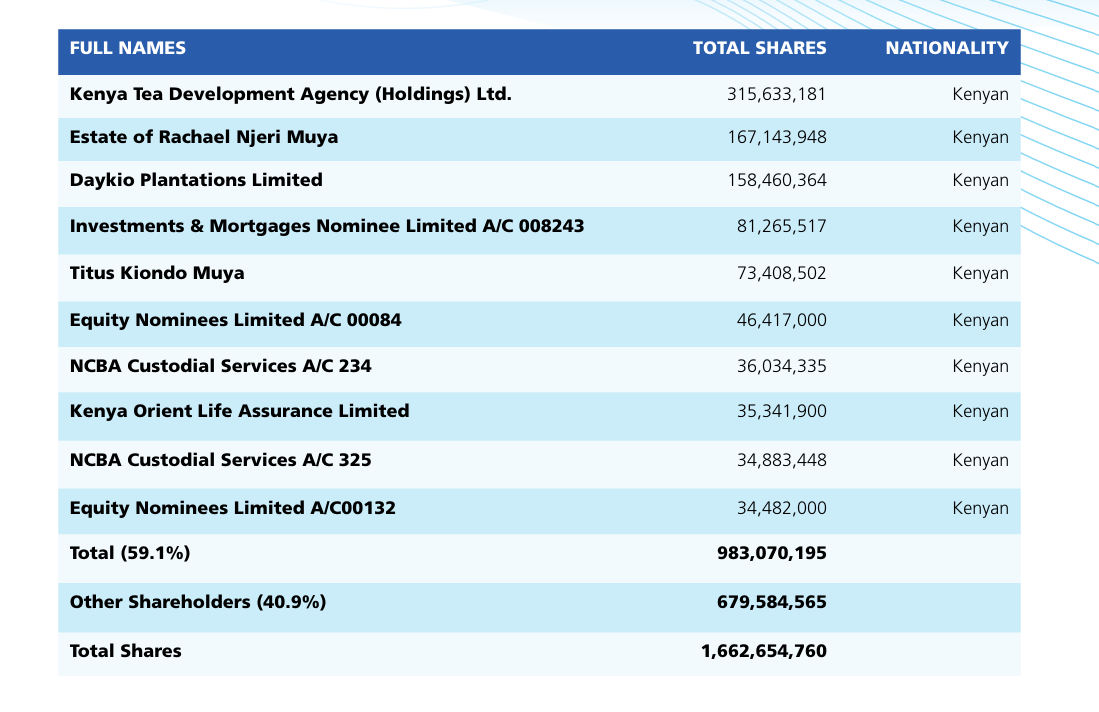
Kenya Tea Development Agency (Holdings) Ltd. 315,633,181
Estate of Rachael Njeri Muya 167,143,948
Daykio Plantations Limited 158,460,364
Investments & Mortgages Nominee Limited A/C 008243 81,265,517
Titus Kiondo Muya 73,408,502
Equity Nominees Limited A/C 000844 6,417,000
NCBA Custodial Services A/C 234 36,034,335
Kenya Orient Life Assurance Limited35,341,900
NCBA Custodial Services A/C 32534,883,448
Equity Nominees Limited A/C0013234,482,000
Note: The remaining 40.9% of the shareholding is distributed among a broader base of smaller retail and private investors.
Key Insights on the Shareholding Structure
Institutional Dominance: The presence of the Kenya Tea Development Agency (KTDA) as the single largest shareholder underscores the bank’s deep roots in Kenya’s agricultural economy.
Founder’s Legacy: The inclusion of the Estate of Rachael Njeri Muya and Daykio Plantations Limited (a firm closely associated with the Muya family) highlights the transition of the founder’s original stake, which has been gradually diluted over the years through successive rights issues and strategic private placements.
Consolidation Strategy: The top ten shareholders controlling nearly 60% of the bank indicates a stable, long-term investor base that has supported the bank through its decade-long journey toward the public market.
Governance Shift: The dilution of the founding family’s stake has been a deliberate part of the bank’s “marathon” strategy, ensuring that the institution could successfully integrate independent directors and meet the rigorous corporate governance standards required for an NSE listing.
This ownership profile represents a “fortified” structure—one where institutional anchors and long-term family stakeholders have balanced interests, providing the stability needed for the bank’s entry into the public bourse.
Financial Performance Analysis (2021–2025)
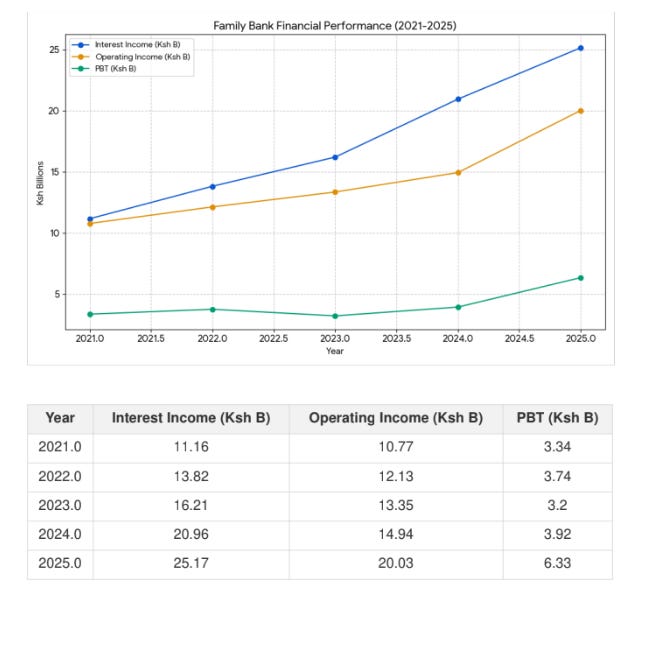
The historical financial data of Family Bank from 2021 to 2025 reveals a consistent upward trajectory across all major performance metrics.
Interest Income: The bank experienced steady growth in interest income, rising from Ksh 11.16 billion in 2021 to Ksh 25.17 billion by 2025, reflecting a strong expansion in its lending portfolio.
Operating Income: Total operating income showed significant momentum, climbing from Ksh 10.77 billion in 2021 to reach Ksh 20.03 billion in 2025, highlighting the bank’s increased ability to generate core revenue.
Profit Before Tax (PBT): While the bank maintained a stable profit floor between 2021 and 2024, it achieved a notable breakout in 2025, with PBT surging to Ksh 6.33 billion from Ksh 3.92 billion in the previous year.
Balance Sheet Analysis (2021–2025)
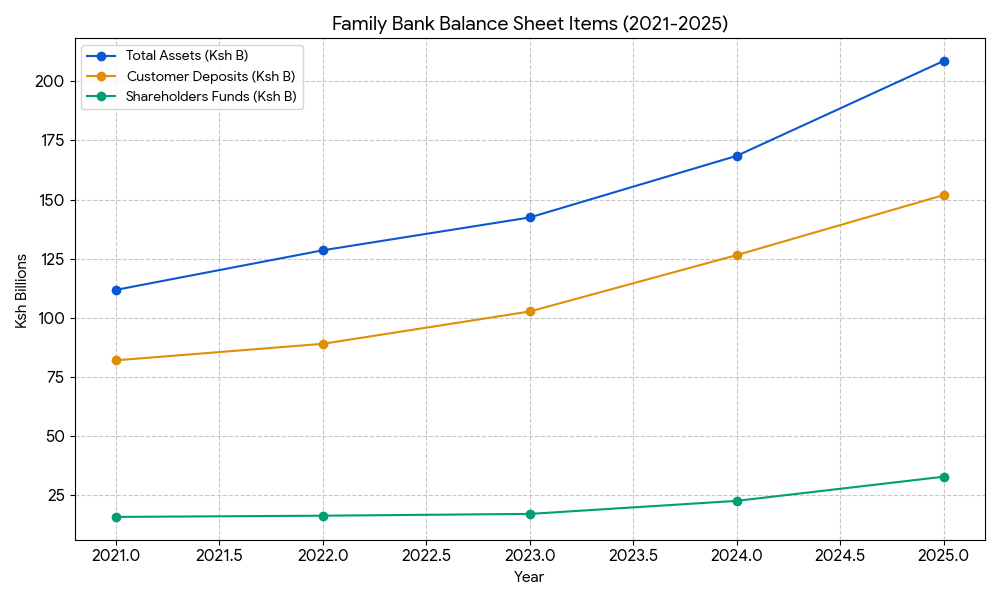
The historical financial position of Family Bank from 2021 to 2025, as detailed in Screenshot 2026-06-19 153918.png, demonstrates robust growth in asset accumulation and liability management, underscoring the bank’s successful “marathon” strategy.
Total Assets: The bank’s asset base experienced consistent, substantial growth, increasing from Ksh 111.74 billion in 2021 to Ksh 208.69 billion by 2025, effectively doubling in size over the five-year period.
Loans and Advances to Customers: Reflecting core banking growth, customer loans expanded from Ksh 66.90 billion in 2021 to Ksh 105.90 billion in 2025, indicating a sustained commitment to lending and economic empowerment.
Customer Deposits: Liabilities mirrored the growth in assets, with customer deposits rising from Ksh 81.91 billion in 2021 to Ksh 151.88 billion in 2025, which reflects deep-seated customer trust and the bank’s success in mobilizing savings.
Total Shareholders’ Funds: The bank successfully bolstered its capital position, with total shareholders’ funds growing from Ksh 15.59 billion in 2021 to Ksh 32.62 billion in 2025, a result of disciplined retained earnings and strategic capital restructuring.
The Muya Portfolio: Diversification into Value
Titus Muya’s influence extends far beyond the banking sector, forming a diversified conglomerate that reflects his strategy of long-term asset building and capital preservation. His investment philosophy centers on securing control in high-value, tangible sectors that benefit from Kenya’s economic growth.
Daykio Plantations Limited: While often recognized as a major shareholder in Family Bank, Daykio is a formidable real estate player in its own right. The firm has carved a niche by developing high-value residential projects—most notably in areas like Kajiado and along the Eastern Bypass—turning raw land into prime residential estates. It represents Muya’s transition from agricultural holding to urban infrastructure development.
Kenya Orient Life Assurance: Muya’s foray into the insurance sector via Kenya Orient Life Assurance aligns with his banking strategy of capturing the “financial ecosystem.” By controlling a life insurance arm, he creates a hedge for his banking interests, allowing for the cross-selling of financial products and providing a stable pool of capital that can be reinvested into his wider corporate network.
Tea Farming Interests: Linked heavily through the Kenya Tea Development Agency (KTDA) shareholding, Muya’s interests in tea farming represent his commitment to the backbone of the Kenyan export economy. These holdings serve as a stable source of liquidity and a strategic link to the rural economy that has been central to Family Bank’s customer base for over four decades.
The “Conglomerate” Strategy
Muya’s approach is the antithesis of the “sprint” model. By anchoring his wealth in real estate (Daykio), financial protection (Kenya Orient), and export commodities (Tea), he has built a protective circle around his interests.
This structure ensures that his empire is not solely reliant on the volatile banking sector. Instead, he has constructed a self-reinforcing loop: the agricultural sector produces the wealth, the bank manages the capital, the insurance arm protects the family legacy, and the real estate division provides the permanent, appreciating asset base that grounds the entire structure. Just like his “marathon” approach to Family Bank, his portfolio is designed to outlast short-term market cycles.
VI. The Succession: Bridging the Legacy
The transition of Family Bank from a founder-led institution to a publicly traded powerhouse is defined by a meticulous, decade-long separation of family ownership and operational management. While Titus Kiondo Muya and his associates retain a combined 35.67% shareholding—encompassing interests held by various family members and estates—the day-to-day leadership has been entirely professionalized.
A critical element of this succession strategy is the presence of Mr. Mark Keriri on the Board of Directors as a Non-Executive Director, serving directly alongside the founder, Mr. Titus K. Muya. His position on the board signals his role as his father’s successor within the bank’s governance structure, ensuring the family’s foundational vision remains represented while the institution embraces independent oversight.
This evolution is further supported by the current composition of the bank’s senior management team, which is led by Managing Director and Chief Executive Officer Ms. Nancy Njau. The management structure is composed of specialized executives, including:
Ms. Belinda Maghanga: Chief Operations Officer
Mr. Elijah Kariuki: Chief Transformation Officer
Mr. Paul Nagaragari: Chief Finance Officer
Ms. Phyllis Kimani: Chief Retail Banking Officer
Mr. John Wachiuri: Chief Risk Officer
Mr. Carlpeter Ngunuh: Chief Officer, Special Projects
Ms. Veronica Muthara: Chief Credit Officer
Mr. Bildard Fwamba: Chief Internal Auditor
Mr. Eric K. Murai: Company Secretary and Chief Legal Officer
By separating these operational roles from the family’s equity interests, the bank has effectively institutionalized its leadership, maintaining family representation at the board level while tasking an independent management cadre with driving the bank’s strategic future.