
Welcome to Boardlot Africa, where we pull back the curtain to reveal the untold stories, power dynamics, and strategic maneuvers shaping the boardrooms of Corporate Africa—subscribe for free to join the conversation. join 1000 other subscribers
We publish Kenya’s Most Consequential Legal, Governance & Labor Disputes and A Series on the 100 Most Influential Kenyan Captains of Industry
While the appointment of Abdi Mohamed as CEO of I&M Bank Kenya is a strategic win, it has inadvertently highlighted the bank’s most pressing governance vulnerability: an opaque organizational structure that prioritizes private family control over clear, professional accountability.

I. The Hook: A New CEO in a Fog of Reporting Lines
The News: I&M Group has officially tapped Abdi Mohamed—a veteran of the Kenyan banking sector and former CEO of Absa Bank Kenya—to take the helm as the new Chief Executive Officer of I&M Bank Kenya. The appointment, announced on June 29, 2026, marks a major coup for the lender as it seeks to fortify its competitive edge. However, the transition remains “subject to regulatory approval by the Central Bank of Kenya,” leaving the bank in a brief but critical period of administrative limbo.
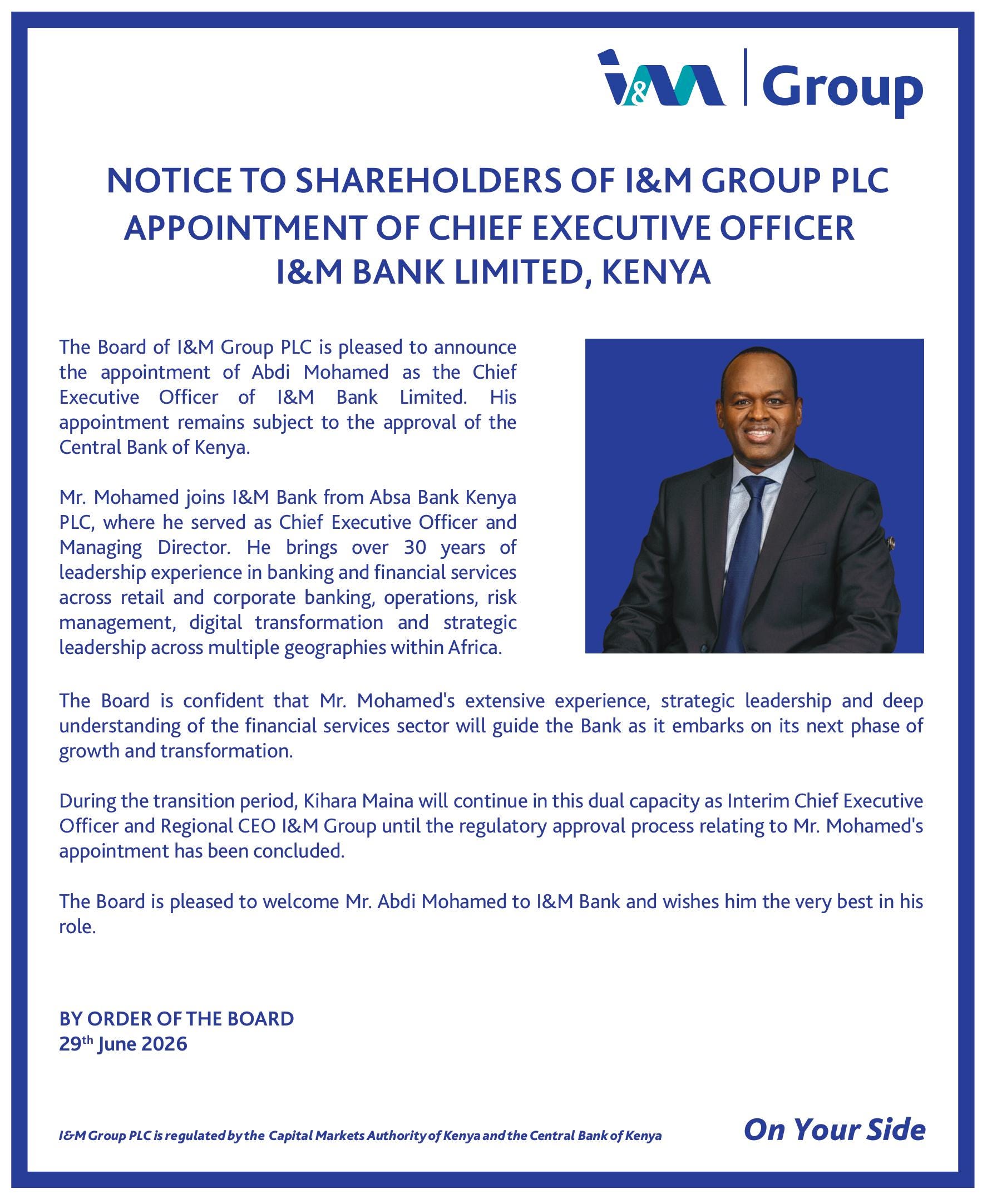
The Observation: While securing a leader of Mohamed’s caliber is a significant strategic win, his arrival lands squarely in the middle of a curiously opaque organizational structure. For months, Kihara Maina has been navigating a high-pressure dual-hat role, balancing his responsibilities as the Regional CEO of I&M Group with the interim leadership of the Kenyan subsidiary.
This overlapping authority has left stakeholders and employees alike grappling with a fundamental question: where does the regional mandate end and the local execution begin? By keeping the top-level reporting lines blurred—specifically the lack of clarity regarding whether the Kenya CEO will report directly to Group Executive Director Sarit Raja-Shah or to the Regional CEO—the bank risks creating a “two-boss” dilemma. For a regional conglomerate in the middle of aggressive expansion and significant capital raises, this lack of structural precision isn’t just an internal management quirk; it is a potential friction point that could delay decision-making and stifle the very momentum this new hire is meant to accelerate.
I&M Bank leadership transition news update
This video is relevant as it provides the official reporting on Abdi Mohamed’s appointment and confirms the ongoing interim dual-role status of Kihara Maina

II. The Structural “Gray Zone”
The Reporting Dilemma: The Matrix of Ambiguity At the heart of I&M’s current malaise is a classic “matrix” structure that appears designed more to manage internal power dynamics than to drive operational efficiency. With Abdi Mohamed’s entry, the reporting line remains shrouded in corporate doublespeak. Does the Kenya CEO report directly to the Regional CEO, Kihara Maina, providing a clean vertical chain of command? Or is he tethered to the Group Executive Director, Sarit Raja-Shah, effectively bypassing regional leadership?
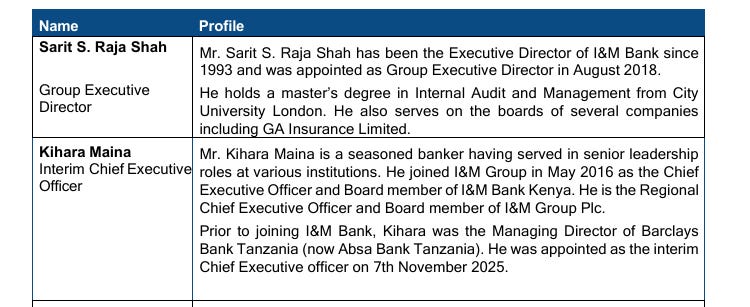
The confusion is codified in the very documents the bank uses to court institutional capital. In the official Information Memorandum for the bank’s recent Medium-Term Note (MTN), Kihara Maina is still explicitly identified as the Interim Chief Executive of the Kenyan subsidiary. This suggests that even as the group solicits billions from the market, it has yet to formalize the transition of power. This ambiguity is no accident; it is a calculated friction designed to balance the Shah family’s desire for direct, hands-on control over their crown jewel against the bank’s need to present a professional, modern face to the public. By maintaining this fluid, “interim” reporting environment, the group retains the ability to bypass its own professional leadership whenever the family decides to intervene in the substantive, private decisions that dictate the bank’s direction.
I&M Bank Medium-Term Note Programme Launch Recap
This video is relevant because it highlights the official launch of the KES 20 billion Medium-Term Note Programme, which is the specific document where the “interim” leadership status of the bank’s key executives is formally codified for institutional investors.
The Subsidiary Question: Silos or Synergies? The opacity extends beyond the banking unit. The reporting architecture for I&M Capital and I&M Burbidge Capital remains a black box for most market observers. Are these entities truly integrated into the regional growth strategy, or are they functioning as independent fiefdoms reporting directly to the group’s inner circle? Without a transparent organizational chart, it is impossible for shareholders to discern whether these subsidiaries are operating as cohesive components of a regional powerhouse or as disconnected assets. This lack of visibility suggests a structure that prioritizes keeping “the family” in the loop over empowering regional executives to actually lead.

Why It Matters: Accountability in the Vacuum The cost of this “dual-loyalty” structure is high. When the lines of authority are blurred, decision-making grinds to a halt—every major strategic pivot becomes a negotiation between the “family” interest and the “professional” executive. This confusion creates a dangerous accountability vacuum.
For a group actively raising capital through Medium-Term Notes, such structural messiness is a red flag. Institutional investors are not just buying into the balance sheet; they are buying into the governance of the firm. By attempting to have it both ways—employing a highly regarded, market-facing Kenyan CEO to capture customers and satisfy regulators, while maintaining the Shah family’s grip on the actual decision-making levers—I&M is running the risk of stalling its own regional engine. In the fast-paced world of East African finance, a bank that is busy navigating its own internal hierarchy is a bank that is missing the market.

III. The High Stakes: The “Invisible” Hand vs. The Public Face
The Optics Trap The current I&M governance model relies on a deliberate separation between the bank’s public persona and its private engine room. In every forum—from the floor of the Nairobi Securities Exchange to high-level regulatory briefings—Kihara Maina is the face of the group. He is the one articulating the “iMara 2.0” vision, handling the investor calls, and providing the professional polish required of a Tier-1 financial institution. He is the public embodiment of the bank’s aspirations to modernize and scale.
The Reality of Private Power Yet, beneath this public-facing layer of professional management, the actual decision-making hierarchy tells a different story. In the quiet corridors of power, the strategic levers are still held firmly by the Shah family. This dichotomy creates a disjointed reality: the public and the regulators are presented with a “professionalized” management structure led by individuals like Kihara and now Abdi Mohamed, while the substantive, long-term strategic choices—on investments, structural shifts, and the allocation of capital—are ultimately directed by the family.
Why This Matters for Investors This disconnect is far more than a matter of corporate culture; it is a critical concern for those providing capital, particularly in light of the recent KES 20 billion Medium-Term Note (MTN). Institutional investors—who are increasingly focused on Environmental, Social, and Governance (ESG) standards—seek transparency in decision-making. When they see a regional CEO who carries the title but perhaps lacks the ultimate veto power, it introduces “key-man” risk and structural uncertainty.
The market expects that the person holding the CEO title has the executive authority to execute the mandate they were hired for. If investors get the sense that they are essentially underwriting a family-led operation masquerading as a modern corporate conglomerate, the cost of capital will eventually reflect that risk. A bank that performs well on the surface but is constrained by opaque, private family dictates is a bank with a glass ceiling on its potential. To maintain the confidence of the debt and equity markets, I&M needs to reconcile the face they show the public with the reality of how they run their business.

About Boardlot Africa Research
Boardlot Africa is a premier financial intelligence and corporate governance publication dedicated to unpacking the mechanics of capital, market strategies, and structural shifts across East Africa’s corporate landscape. By bridging the gap between raw economic data and actionable market intelligence, we deliver deep-dive research, independent corporate analysis, and policy insights designed for institutional investors, boardrooms, and sharp market observers.
Get in Touch
Email: boardlot.research@gmail.com
Phone: +254 753 133 901
Substack: Subscribe to Boardlot Africa
X (Twitter): BoardLotSultan