
Is the Lobito Corridor the New Frontier for Equity Bank and James Mwangi?
From the Indian Ocean to the Atlantic Slipways: Why Upper Hill is Betting on Southern Africa’s Mineral Superhighway
In every investor briefing lately, James Mwangi has stopped talking merely about non-performing loans, cost-to-income ratios, and digital transaction volumes. Instead, he speaks with the sweeping cadence of a 19th-century railway baron. As Equity Group Holdings casts its gaze past its traditional East African stomping grounds—having hit a ceiling in its regional growth ambitions—the chief strategist is turning his attention south.
The magnet pulling East Africa’s largest bank by customer base toward the Atlantic isn’t just commercial retail; it’s a multi-billion-dollar geopolitical bet known as the Lobito Corridor. But the real question facing the market is simple: Can a Kenyan banking titan successfully trade its Swahili-Anglophone comfort zone for the Portuguese legal codes and copper-soaked trade routes of Southern Africa?
1. The Geographical Anatomy: What is the Lobito Corridor?
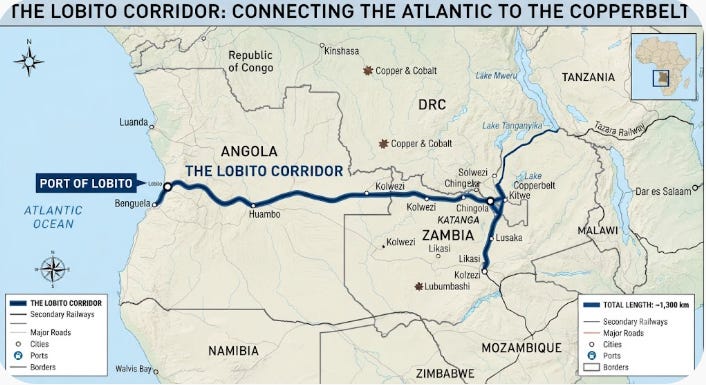
To understand why James Mwangi is so captivated, you have to look at a map. The Lobito Corridor is roughly a 1,300-kilometer trade and transport spine designed to fundamentally rewrite African logistics.
The Atlantic Anchor: The route begins at the deep-water port of Lobito in Angola on Africa’s western coast.
The Mineral Heartland: It cuts inland through the mineral-rich Katanga region of the Democratic Republic of Congo (DRC).
The Copperbelt Finish: It plunges deep into the Zambian Copperbelt.
This isn’t just a regional railway project; it is a vital geopolitical umbilical cord. Backed heavily by Western powers like the United States and the European Union, the corridor is engineered to speed critical minerals—cobalt, copper, and rare earth elements—straight out of Central Africa to Western markets via the Atlantic, bypassing traditional eastern choke points like Mombasa or congested southern routes. Where logistics go, capital follows. And where capital flows, James Mwangi intends to plant a flag.
2. The Business Logic: Following the Trade, Not Just the Flag
Traditional cross-border banking expansion in Africa has long been plagued by institutional narcissism: banks open subsidiaries in new countries simply to wave a flag and chase sovereign debt. Mwangi’s playbook at Equity has always been different: follow the trade routes, not just the country borders.
The Lobito Corridor represents the ultimate expression of corridor economics. By connecting the Atlantic to the Copperbelt, it creates an integrated multi-national economic zone spanning three jurisdictions.
Capturing the Value Chain: From multinational mining conglomerates and logistics operators down to the informal cross-border traders who handle a massive chunk of regional commerce, every node along this 1,300km stretch requires working capital, trade finance, foreign exchange, and remittance channels.
The Scale Requirement: Having already crossed the KSh 2 trillion balance sheet threshold, with regional subsidiaries contributing aggressively to group profitability, Equity requires macro-scale frontiers to keep its compound growth engine humming. Local market saturation in Kenya means future growth must come from regional integration.
3. The DRC Bridgehead: Why Equity is Already Halfway There
Skeptics who argue that Angola and Zambia are unfamiliar territory for a Kenyan bank forget one crucial detail: Equity is already a dominant player in the DRC.
Through its strategic acquisitions (culminating in the massive integration of Equity Bank Congo and BCDC), Equity has built a formidable bridgehead in the heart of Central Africa. With over 3,000 staff stationed in the DRC—making it the bank’s second-largest operational hub outside Kenya—Equity already understands the chaotic, high-reward, high-risk reality of Central African commerce.
Kenya: 7,013 staff
Democratic Republic of Congo: 3,057 staff
Uganda: 1,424 staff
Rwanda: 939 staff
Tanzania: 501 staff
South Sudan: 149 staff
The DRC segment of the Lobito Corridor sits squarely inside Equity BCDC’s primary sphere of influence. Using the DRC as a secure operational staging ground, pushing further south down the railway line into Zambia and ultimately into Angola is no longer a blind leap—it is a logical, contiguous progression.
4. Expanding the Horizon: The Mozambique and Angola Strategy
What was once whispered in financial corridors has now been formally unveiled: Equity Group has tabled substantive entry plans for Mozambique and Angola.
Speaking during financial briefings and executive forums, James Mwangi confirmed that the bank’s southward pivot targets acquisitions in Angola, Zambia, and Mozambique in rapid succession.
The Corridor Logic: As Mwangi noted, “You can’t do Mozambique without Zambia”—recognizing that while Angola serves as the Atlantic outlet for the Lobito Corridor, Mozambique acts as the crucial eastern gateway for trade vectors flowing toward Asian and global markets.
Diplomatic Backing: High-level state diplomacy has actively greased the wheels for this expansion. Mwangi credited presidential statecraft—specifically high-level introductions facilitated by Kenya’s leadership to Mozambique’s President Daniel Chapo—for securing direct access and executive trust in Maputo.
The Acquisition Blueprint: Rather than suffering the slow death of greenfield licensing, Equity is zeroing in on majority-stake acquisitions of established local banks in Luanda and Maputo to secure an immediate operational foothold.
5. The Geopolitical Crucible: Washington, Beijing, and the Battle for the Rails
You cannot analyze the Lobito Corridor without acknowledging the grand-strategy chess match playing out across its tracks. For U.S. President Joe Biden, Sub-Saharan Africa was largely a diplomatic afterthought during his tenure—except for one monumental exception. In a historic journey that marked his only visit to Sub-Saharan Africa of his entire administration, Biden traveled directly to Angola to champion and fund the Lobito Corridor infrastructure.
The American Playbook: Washington’s multi-billion-dollar backing of the Lobito project through the Partnership for Global Infrastructure and Investment (PGII) is not driven by philanthropy. It is a direct, calculated counterweight to China’s Belt and Road Initiative (BRI). For decades, Beijing poured billions into modernizing the Benguela railway, deep-water ports, and mining vectors across Central Africa, securing a chokehold over roughly 80% of the DRC’s copper and cobalt mines.
The New Cold War on Rails: While China built its dominance through state-backed extraction and integrated processing footprints, the U.S. and its G7 allies are weaponizing the Lobito route to carve out secure, Western-aligned supply chains for the energy transition.
The Private Sector Rush: Biden’s presidential endorsement unlocked a flood of institutional and corporate backing—bringing in American miners, tech firms, and financiers. But this intense great-power competition creates a lucrative vacuum. While Washington and Beijing fight over geopolitical supremacy and mineral extraction rights, commercial capital and localized trade financing remain wide open. This is precisely where agile, indigenous African financial institutions like Equity Bank plan to swoop in, banking the suppliers, logistics firms, and localized trade networks feeding off the multi-billion-dollar infrastructure boom.
6. The “Plug-and-Play” Model: Exporting the Kenyan Playbook
Can a digital-first, agency-banking model forged in Nairobi survive the transition to Southern Africa? Equity’s historical strategy relies on a tried-and-tested template:
Fintech as the Trojan Horse: Leveraging proprietary digital platforms and agile infrastructure rather than sinking exorbitant capital into expensive, brick-and-mortar branch networks across sparsely populated mining towns.
The Agency Banking Export: Replicating the model that brought financial inclusion to unbanked populations in Kenya and Uganda, targeting the unbanked supplier ecosystems that orbit major mining operations along the corridor.
The Acquisition over Greenfield Strategy: Mwangi has consistently shown a preference for buying established balance sheets or merging with local entities rather than suffering the slow, painful death of greenfield licensing in unfamiliar regulatory terrains.
7. The Reality Check: Risks, Hurdles, and the Language Barrier
Before we crown James Mwangi the Emperor of the Atlantic-Indian Ocean arc, a heavy dose of reality is required. The Lobito Corridor and Southern African expansion introduces monumental structural risks:
The Lusophone-Francophone-Anglophone Trilemma: Equity’s institutional DNA is deeply rooted in Anglophone and Swahili-speaking East Africa. Entering the DRC introduced the complexities of French corporate administration. Moving deeper into Angola and Mozambique introduces a completely different beast—Portuguese legal codes, distinct corporate cultures, and profound language barriers. Can a Nairobi boardroom effectively manage Luanda and Maputo balance sheets without getting lost in translation?
Sovereign Risk and Macro Volatility: Angola and Mozambique present macroeconomic environments heavily tethered to commodity price cycles, foreign exchange liquidity bottlenecks, and strict central bank controls—vastly different risk profiles than East Africa.
Execution Fatigue: Managing operations across a targeted footprint scaling toward 15 countries by 2030 requires superhuman executive bandwidth. If management gets bogged down trying to decode Portuguese-speaking regulatory red tape, it risks losing focus on its core cash cows in Nairobi and Kinshasa.
8. The Boardlot Verdict
The whisperings in Upper Hill have hardened into concrete ambition. Equity’s race into Angola and Mozambique is vintage James Mwangi: audacious, macro-driven, and timed to catch the opening wave of a multi-decade infrastructure supercycle backed by superpowers.
If it succeeds, Equity Group ceases to be merely an East African champion and officially transforms into a transcontinental financial powerhouse bridging two oceans. If it falters, it will serve as a textbook case of imperial overextension.
Either way, one thing is certain: James Mwangi is done playing small in regional ponds. As Washington and Beijing battle for the soul of the mineral corridor, the race for the Atlantic and Indian oceans has officially begun.
Sources & References:
The American Presidency Project / White House Fact Sheets (December 2024): “President Biden’s Trip to Angola” (Documenting the historic first presidential visit to Sub-Saharan Africa focused on the Lobito Corridor).
U.S. Department of State Briefings (December 2024): “President Biden’s Historic Trip to Angola” (Overview of the $3+ billion G7 infrastructure backing and multimodal regional integration).
Punch Nigeria (April 30, 2026): “Equity Group eyes Angola, Zambia, Mozambique acquisitions” (Reporting on James Mwangi’s strategic announcements targeting the Lobito Corridor, Mozambique, and Angola).
AllAfrica / Nairobi Conference Reports (March 30, 2026): “Equity Group Plans Mozambique’s Entry, James Mwangi” (Covering high-level diplomatic introductions and planned executive engagements regarding Mozambique entry).
The Kenya Times (May 19, 2026): “Equity Bank Eyes Angola, Zambia, And Mozambique Markets” (Details on the Q1 financial results briefing outlining the 2030 15-country expansion roadmap).
The geopolitical battle over Africa’s resources is detailed further in this US Vs China: Battle for Africa’s Minerals and the Lobito Corridor analysis.
About Boardlot Africa Research
Boardlot Africa is a premier financial intelligence and corporate governance publication dedicated to unpacking the mechanics of capital, market strategies, and structural shifts across East Africa’s corporate landscape. By bridging the gap between raw economic data and actionable market intelligence, we deliver deep-dive research, independent corporate analysis, and policy insights designed for institutional investors, boardrooms, and sharp market observers.
Get in Touch
Email: boardlot.research@gmail.com
Phone: +254 753 133 901
Substack: Subscribe to Boardlot Africa
X (Twitter): BoardLotSultan
Linkedn:): BoardLot Sultan