
📊 The Core Takeaway: Navigating Kenya’s Yield Shift
The key takeaway for your portfolio right now is velocity and structural matching. As the Central Bank of Kenya eases interest rates and the standard Money Market Fund (MMF) market average stabilizes around 9.1%, holding mid-to-long-term capital in a basic transactional MMF means accepting a self-imposed penalty on your returns. High-velocity independent managers and unconstrained multi-asset Special Funds are aggressively outperforming traditional channels by actively trading global currency derivatives, commodities, and private credit—with top tiers capturing net annualized yields between 13% (in USD) and upwards of 20% (in KES). Moving forward, the “smart money” play is clear: retain a tight, liquid cash cushion in a reliable MMF for immediate emergencies, but aggressively graduate your 12-36 month capital into Fixed Income or structured Special Funds to lock in premium yields and insulate your wealth from inflation and local currency swings. Stop Leaving Money on the Table: MMFs vs. Fixed Income vs. Special Funds Explained
If you have your hard-earned money sitting in a traditional bank savings account earning 3% to 5% interest, inflation is quietly eroding your purchasing power. Over the last few years, thousands of Kenyans have discovered Collective Investment Schemes (CIS)—commonly called unit trusts—to fight back.
But as the Kenyan financial market matures, simply parking all your cash in a standard Money Market Fund (MMF) might mean you are leaving significant returns on the table. The Capital Markets Authority (CMA) regulates several types of funds designed for entirely different financial goals. Let’s break down the three most important options available to you today.
1. The Yield Ceiling: Why Your MMF Alone Won’t Beat Inflation Anymore
For most Kenyans, a Money Market Fund (MMF) is the gateway to investing. It pools money from thousands of investors and places it into very safe, short-term assets like Treasury Bills (T-Bills) and bank fixed deposits.
The Big Benefit: Liquidity. Your money is safe, and you can usually access it within 24 to 48 hours via your phone. It is the perfect home for your emergency fund or next term’s school fees.
The Catch: Because MMFs invest in short-term instruments, their yields fluctuate constantly based on market changes. With the Central Bank of Kenya (CBK) easing interest rates, average MMF yields have stabilized. Keeping money in an MMF that you don’t plan on touching for the next two or three years means you are paying a “liquidity premium”—accepting a lower return for access to cash you don’t actually need right now.
2. The 2-to-5 Year Play: How Fixed Income Funds Beat the DhowCSD Hustle
If you have a financial goal that is 12 to 36 months away—such as buying land, building a perimeter fence, or funding a major business injection—you need to graduate from an MMF to a Fixed Income Fund.
Unlike MMFs, Fixed Income Funds invest in longer-term government bonds and stable corporate debt.
Why not just buy bonds directly via DhowCSD? Buying bonds directly through the Central Bank’s DhowCSD platform is fantastic, but it requires significant capital to diversify across multiple bonds, and your cash is locked in unless you navigate the secondary market to sell.
The Fund Advantage: A Fixed Income Fund does the heavy lifting for you. It pools your money to buy a diversified basket of high-yielding, medium-term bonds. This allows you to lock in higher, more stable coupon returns than a standard MMF can offer, while still giving you a reasonable exit window if you need your capital back early.
3. Breaking the Local Bias: How Special Funds Give You Access to Global and Alternative Assets
This is the newest frontier for retail investors in Kenya. A Special Fund is a distinct regulatory category under the CMA.
Standard MMFs and Fixed Income Funds are strictly restricted by law regarding where they can put your money. Special Funds break these traditional boundaries to hunt for higher returns. They can invest in:
Offshore & Global Assets: Giving you easy exposure to global indices, commodities, precious metals, or foreign currencies (like USD-denominated funds).
Alternative Investments: Such as private credit, structured private debt, and derivatives.
If you want a portion of your portfolio actively managed to chase aggressive growth, hedge against local currency depreciation, or access unique institutional private debt markets, Special Funds are where you look.
4. Comparing the Giants: Bank-Managed vs. Insurance vs. Independent Unit Trusts
Once you know which fund type fits your goal, you have to choose who manages it. In Kenya, providers generally fall into three distinct categories, each with its own operational DNA:
Bank-Managed Unit Trusts: Offer seamless integration directly with your existing retail banking apps, making transfers instant. They come with rock-solid institutional backing but often feature lower yields because banks tend to be highly conservative.
Insurance-Led Unit Trusts: Have decades of deep experience managing massive, long-term pools of capital. Their drawback is that withdrawal processes can sometimes feel a bit slower or more paper-heavy compared to newer, fintech-first platforms.
Independent Asset Managers & Wealth-Techs: Highly agile, deeply innovative with their digital onboarding platforms, and aggressively hunt for competitive yields. They lack the massive physical branch footprint of a bank, relying almost entirely on apps, USSD shortcodes, or centralized relationship channels.
To help you see how these providers stack up in the real market, here is the official leaderboard of the Top 20 Unit Trust Schemes in Kenya ranked by Assets Under Management (AUM) according to the official Q4 Capital Markets Authority (CMA) report:
Top 20 Unit Trust Schemes in Kenya (As of December 31, 2025)
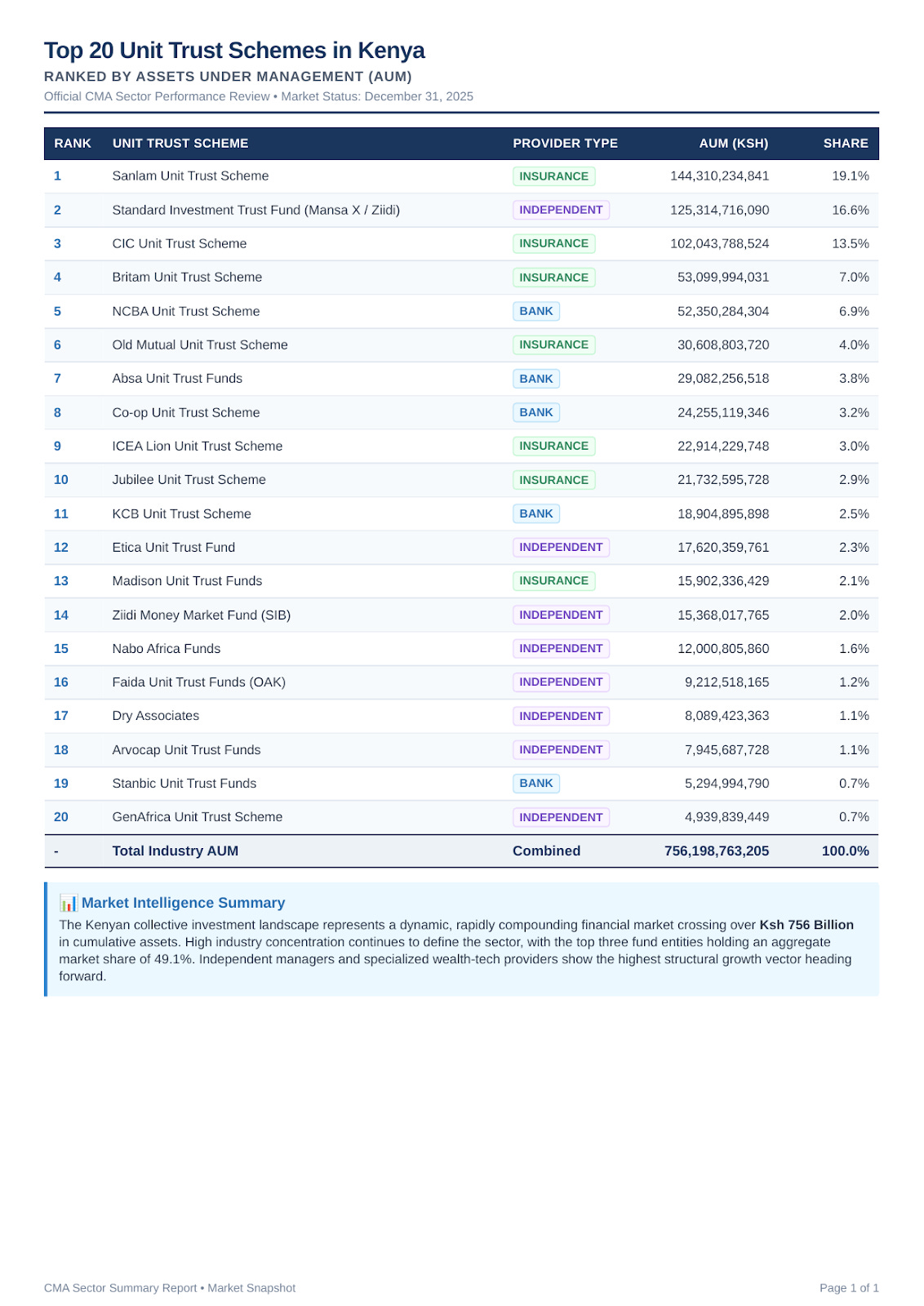
📊 Key Takeaway from the Data: The Kenyan unit trust industry has experienced explosive growth, crossing over Ksh 756 Billion in total assets. However, the market is highly concentrated: the top three players (Sanlam, SIB, and CIC) control nearly half (49.1%) of all the investment capital in the country.
Sanlam Unit Trust Scheme
♦ Who they are: Regulated under Sanlam Investments East Africa, a major subsidiary of the South African financial services giant Sanlam Group.
♦ Age & Origin: Sanlam has had an active presence in Kenya for over two decades, following its strategic acquisition of Pan Africa Insurance in the early 2000s and later reshaping its asset management arm.
♦ Historical Yield Context: Historically averages consistent gross returns between 11% and 13.5% depending on the specific economic cycle and shifting government treasury bill yields.
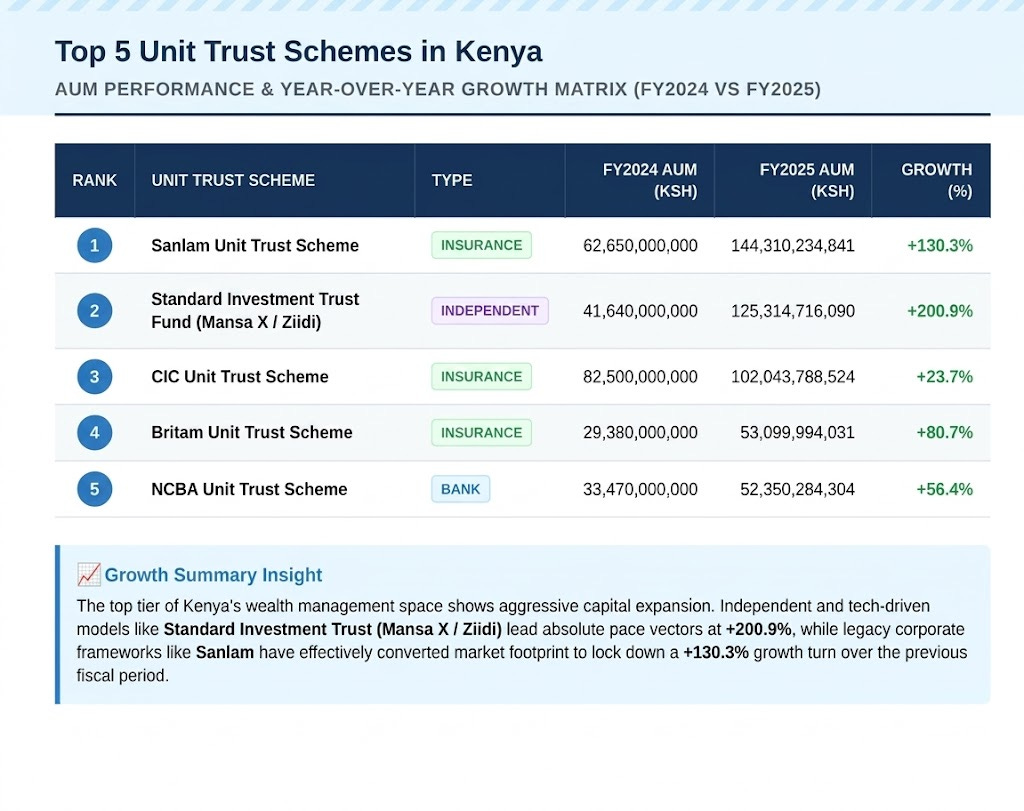
♦ Why it is growing rapidly: Sanlam surged to the top of the leaderboard with +130.3% growth by capturing massive institutional, pension-fund, and corporate capital allocations, utilizing its enormous pan-African balance sheet to negotiate top-tier yields on large-volume commercial bank deposits.
Standard Investment Trust Fund (Mansa X )
♦ Who they are: The flagships of Standard Investment Bank (SIB), a leading Kenyan indigenous investment house founded in 1995.
♦ Age & Origin: SIB has been around for over 30 years, but its ultra-popular Mansa X Special Fund was launched globally in 2019 to cater to retail and institutional tech-savvy investors.
♦ Historical Yield Context: Consistently tracks as a top-performing alternative asset engine, hitting average annual net returns of 16% to 20.7% due to its unconstrained multi-asset framework.
♦ Why it is growing rapidly: Achieved an explosive +200.9% growth trajectory because it acts as an excellent hedge against inflation and local currency depreciation. Mansa X utilizes a unique long/short model that trades global equities, precious metals (like gold), and global currencies.
CIC Unit Trust Scheme
♦ Who they are: The investment branch of the CIC Insurance Group, which is heavily anchored by Kenya’s massive cooperative movement (Co-op Bank and various Saccos).
♦ Age & Origin: Formally set up its Asset Management operations in 2011, quickly climbing to prominence over the next decade.
♦ Historical Yield Context: Maintained reliable yields fluctuating between 11% and 14% historically, positioning it as a highly stable corporate haven.
♦ Why it is growing rapidly: Although its year-over-year expansion rate moderated to +23.7% due to intense market competition, it crossed the massive landmark of Ksh 100 Billion. Its underlying strength is unmatched retail customer loyalty, driven by automatic, structural pipelines of cash coming straight from Kenyan Saccos and co-operative societies.
Britam Unit Trust Scheme
♦ Who they are: Managed under Britam Asset Managers, a highly decorated subsidiary of the publicly-listed financial services conglomerate Britam Holdings Plc.
♦ Age & Origin: Formed in 2004, Britam Asset Managers has been a core player in the Nairobi Securities Exchange (NSE) and regional property markets for over 20 years.
♦ Historical Yield Context: Its Money Market and Balanced funds traditionally register reliable annual net yields floating around 10% to 12.5%.
♦ Why it is growing rapidly: Spiked significantly by +80.7% by aggressively modernizing its digital onboarding tools. By eliminating paperwork and allowing retail investors to open an account instantly via mobile apps and USSD codes, Britam successfully tapped into the burgeoning middle-class demographic saving for short-term goals.
NCBA Unit Trust Scheme
♦ Who they are: The fund management arm of NCBA Investment Bank, backed directly by tier-1 commercial banking heavyweight NCBA Group.
♦ Age & Origin: While it evolved through the landmark corporate merger between NIC Bank and CBA Bank, its collective investment legacy dates back more than 15 years.
♦ Historical Yield Context: Typically clocks steady, highly secure yields between 10.5% and 13% per annum.
♦ Why it is growing rapidly: Clocked a healthy +56.4% asset expansion due to cross-selling synergy. NCBA effortlessly routes wealth management solutions to its existing high-net-worth corporate banking clients and premium retail depositors, making it an incredibly convenient path for clients wanting to move money seamlessly out of traditional current accounts into high-yielding trust funds.
5. Yield Leaderboard: Comparing the Top 20 MMFs in Q1 FY2026
While Assets Under Management (AUM) show you where the volume is, the Effective Annual Rate (EAR) yield shows you how hard your money is actually working.
As interest rates cool down across the banking sector, fund managers are adjusting. The Serrari MMF Market Average Index currently hovers around 9.10%, but a select tier of agile asset managers continues to outperform the index by targeting highly optimized short-term corporate paper and government debt.
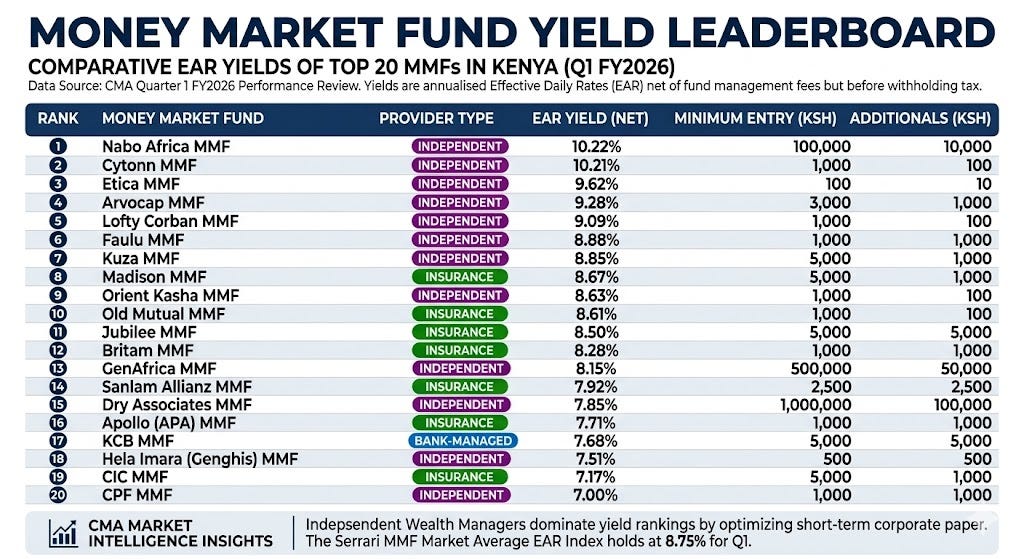
Here is how Kenya’s top 20 regulated shilling-denominated Money Market Funds rank by yield heading out of Q1 FY2026:
Top 20 Kenyan Money Market Funds Ranked by Yield (Q1 FY2026)
💡 Crucial Yield Takeaways for Investors
The Alpha Shift: Independent asset managers (Nabo, Cytonn, and Etica) dominate the top tier of the yield charts. Because they lack the heavy, expensive real estate overhead of Tier-1 retail banks, they are structurally positioned to return a larger cut of their earnings directly to you.
The Net Return Rule: When a provider advertises a “12% yield”, look at the fine print. The Gross Yield is what the fund earns before it takes its cut. The Net Yield is what hits your account daily after their annual management fees (typically ranging from 1.5% to 2.5%) are sliced off.
The Tax Factor: Remember that all your MMF earnings are subject to a 15% withholding tax by the Kenya Revenue Authority (KRA). This is deducted automatically at the point of distribution, meaning you never have to worry about filing it yourself.
6. Deep Dive Into Special Funds: The “Smart Money” Frontier
If you look closely at the charts, the fastest-growing investment vehicle in Kenya is no longer the traditional MMF. It is the Special Fund (often categorized by the CMA as a Special Collective Investment Scheme). Driven by platforms like Standard Investment Bank’s Mansa X, Faida’s OAK Fund, and tech-centric platforms like Ndovu’s Kibaba Fund, the assets under management in Special Funds crossed an astounding Ksh 162 Billion.
But what exactly happens to your cash when you step into this tier? Let’s strip away the marketing terms and do a forensic deep dive into how these funds actually operate.
A. The Permissible Asset Classes: Where Does the Money Go?
Standard MMFs and Fixed Income Funds are tightly bound by the CMA to local government paper and commercial bank deposits. They are geographically and structurally locked.
Special Funds, by design, are built with an unconstrained, multi-asset strategy mandate. This means the CMA allows the Fund Manager to actively deploy capital into non-traditional, high-yield securities both locally and internationally. Your money is split across a global canvas:
Global Derivatives, Futures & Options: This is their primary engine. Special funds use a “long/short” model. Unlike regular funds that only make money when the market goes up, special funds can bet against overvalued assets (shorting) or use options to generate massive, market-neutral yields even during a global recession.
Precious Metals & Commodities: Direct, institutional exposure to real-time global spot prices of Gold, Silver, Crude Oil, and Natural Gas.
Global Currencies (FX Trading): Active trading across major global currency crosses (USD, EUR, GBP, JPY). This 24-hour liquidity exposure is a fundamental reason their yields outpace local instruments.
International Equities & Exchange Traded Funds (ETFs): Direct pipelines into the world’s largest stock exchanges—the New York Stock Exchange (NYSE), London Stock Exchange (LSE), and Frankfurt Stock Exchange (FRA)—allowing investment in global tech leaders or broad index trackers.
Local Alternative Assets: High-conviction corporate private debt, NSE derivatives, and Real Estate Investment Trusts (REITs).
B. The Entry Thresholds: Breaking the “Sophisticated Investor” Barrier
Historically, these high-performance asset allocations were legally reserved exclusively for institutional players or multi-millionaire “Sophisticated Investors.” However, the retail wave has structurally broken this barrier down.
While some ultra-niche independent special funds still demand a minimum entry of Ksh 1,000,000 or USD equivalent, the current market standard for mainstream Special Funds has dropped significantly:
Minimum Initial Investment: Typically starts at Ksh 250,000 (or $2,500 for the USD-denominated fund options).
Minimum Top-Up Threshold: Usually set at a minimum of Ksh 100,000 (or $1,000) per transaction.
This entry requirement keeps the fund stable, ensuring it is powered by serious, goal-oriented medium-term capital rather than highly volatile, daily transactional cash.
C. The Structural Safeguards: The 6-Month Lock-In and Fee Models
Because a Special Fund actively positions capital in complex international global markets and futures contracts, it cannot afford to face sudden, erratic daily cash panics from retail investors. To protect the collective pool, they deploy distinct structural clauses:
The 6-Month Lock-In Period: This is a non-negotiable industry standard for Special Funds (such as Mansa X and Ndovu’s Kibaba). When you deposit your initial capital, it is structurally locked for exactly 6 months. During this window, you cannot execute a withdrawal. This gives the asset manager a predictable runway to execute their trading strategy without being forced to liquidate open global positions prematurely.
Post-Lock-In Liquidity: Once your initial 6 months lapse, your funds become fully liquid. You can opt to roll them over or execute a redemption, which typically processes smoothly within 2 to 3 working days directly to your bank account.
The Fee Architecture (The Hurdle Rate): Special funds operate on an institutional fee model designed to align the fund manager’s incentives with your profit. They typically charge:
A Base Management/Financial Service Fee: Typically around 5% per annum, pro-rated daily over 365 days.
A Performance Charge (Success Fee): Usually a 10% charge applied only on the surplus returns earned above a specific Hurdle Rate (typically 25% p.a. for KES funds and 15% p.a. for USD funds). If the manager doesn’t beat the hurdle, they don’t get the bonus.
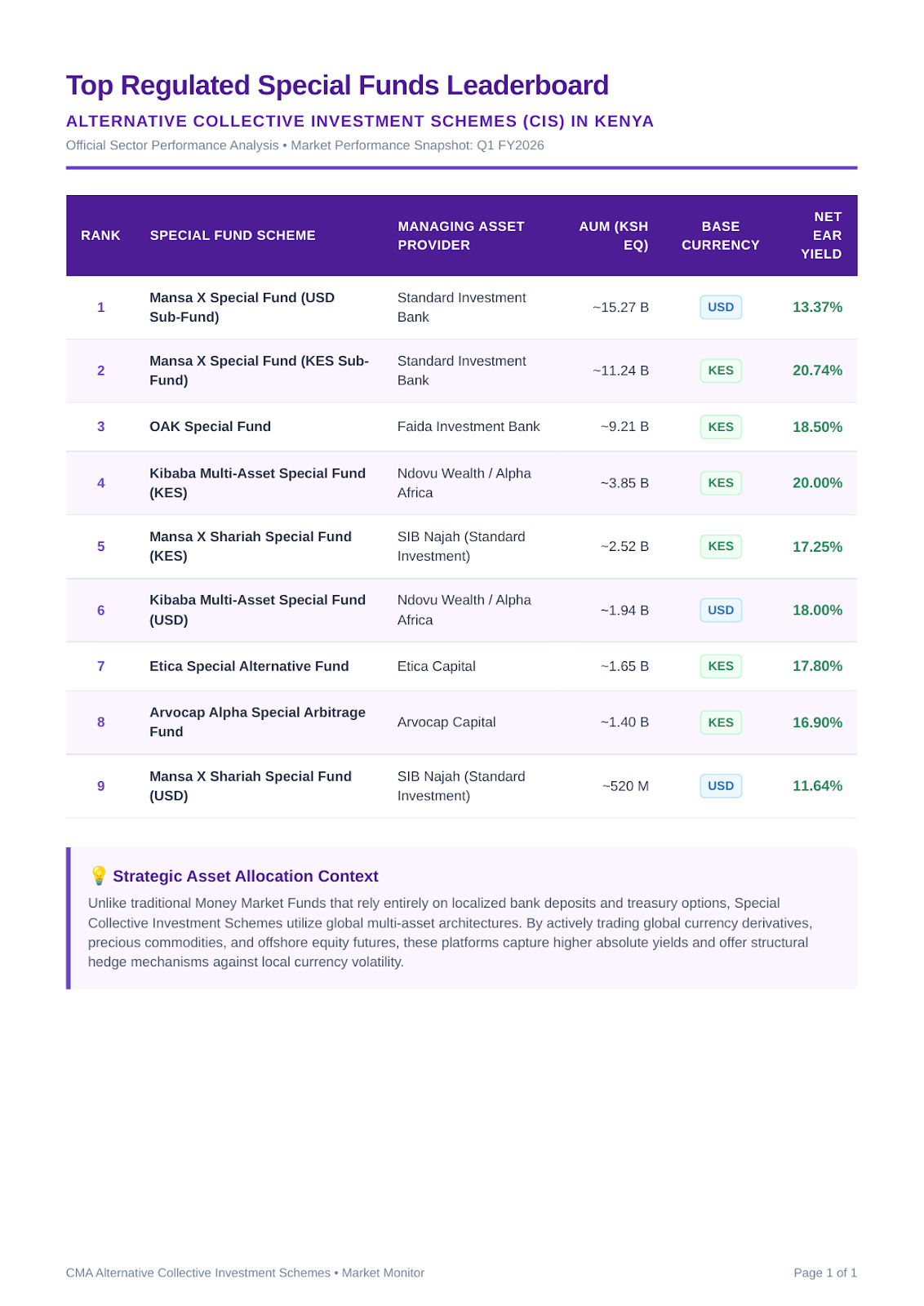
📌 Note on Performance Yields: In accordance with CMA disclosure guidelines, Special Fund returns are displayed as Annualized Net Returns distributed to unit holders. Because these funds utilize active long/short derivative trading, currency futures, and offshore commodities, their returns are distributed net of base management fees and performance success charges, but prior to local withholding taxes.
📊 Strategic Market Takeaways
The SIB Dominance: Standard Investment Bank’s unified Mansa X umbrella platform continues to act as the primary structural giant in this alternative market tier, commanding the bulk of multi-asset capital allocations across its conventional and Shariah-compliant variations.
The Currency Play: Hard-currency (USD) denominated special variants are growing rapidly. Savvy local investors utilize these specialized vehicles to store value in US Dollars while bypassing flat, low-yielding traditional onshore dollar bank deposits.
Hurdle-Driven Alignment: Unlike traditional Money Market Funds that deliver passive underlying interest, Special Fund returns rely heavily on active tactical trading overlays. This framework protects your downside risk via active hedging while sharing out-performance alpha once the manager clears their designated internal return benchmarks.
The Summary Verdict on Special Funds
Special Funds are fundamentally not “set-and-forget” savings accounts; they are high-octane growth engines. If you are looking for immediate access to your cash for an emergency next weekend, stay in an MMF. But if you have capital that you can confidently lock away for 6 to 12 months, and you want an aggressive, legally regulated shield against inflation and local currency depreciation, shifting a percentage of your portfolio into a Special Fund is exactly how the “smart money” in Nairobi is investing today.
7. Checking Your Risks: Key Factors to Consider While Choosing Your Provider
Higher yield numbers look attractive on a marketing flyer, but never chase returns blindly. Before clicking “Deposit,” run every provider through this checklist:
A. Regulatory Compliance (The Non-Negotiable)
Never invest a single shilling in a fund that is not fully licensed and regulated by the Capital Markets Authority (CMA). The CMA ensures that your provider appoints an independent Trustee (usually a commercial bank) to custody your cash and a separate Custodian to hold the actual securities. This structure legally prevents the fund manager from simply running away with your principal.
B. Assets Under Management (AUM)
As shown in the table above, size matters. A larger fund size usually means the manager has massive bargaining power with commercial banks and the government to negotiate higher interest rates on fixed deposits and bonds. It also means they can easily handle large, sudden withdrawals from other investors without hurting your daily returns.
C. The Asset Allocation Breakdown
Every quarter, fund managers are required by law to publish a factsheet showing where they put your money. Look at the balance sheet: Are they heavily exposed to commercial banks that are currently struggling? Are they overly exposed to corporate paper from companies facing liquidity issues? A healthy fund should have a clean, transparent allocation heavily backed by Government of Kenya securities and stable, Tier-1 financial institutions.
D. Expense Ratios and Fees
Yields are usually quoted net of management fees, but you should still check the Total Expense Ratio (TER). High management fees will quietly eat into your compounding wealth over time. Always ask what the fund manager charges as an annual fee.
The Verdict: Where Should You Park Your Cash Today?
Use MMFs as your transactional holding pen and emergency fund. It is your cash cushion.
Use Fixed Income Funds for money you know you won’t need for the next 12 to 36 months, allowing you to capture higher structural yields.
Use Special Funds to diversify out of traditional local assets, protect against currency swings, and access private market opportunities.
Diversification doesn’t just mean owning different stocks; it means matching the right pool of money to the right investment horizon.
Over to You 🫵
Building wealth in Kenya today isn’t just about saving every shilling you can; it’s about making sure every single shilling is working in the right lane. If your money is still sitting idle in a basic savings account, it’s time to make a move.
Let’s talk in the replies: Where is your cash parked right now? Are you sticking to a reliable MMF, locking in yields with a Fixed Income Fund, or testing the waters with a Special Fund? Let me know which fund type (and provider) you’re currently using and why!