
"Kenya's leading position in 2025 is driven by 2 specific factors: first, its ability to attract significantly more debt funding than any other market... and second, the concentration of 4 of the 9 megadeals recorded in Africa in 2025... marking the first time Kenya has led Africa in megadeal concentration." — Partech Africa Tech Venture Capital Report
The 10th Partech Africa Report (2025): Full Continental Analysis
The African tech ecosystem recorded a major structural turning point in 2025. Moving decisively past the speculative “growth at all costs” era, the continent has entered a phase of execution-first normalization.
According to the comprehensive findings published in the 10th Partech Africa Tech Venture Capital Report, total combined funding rebounded to $4.1 billion, representing a 25% year-on-year (YoY) increase. While this reverses the consecutive contractions of the 2023–2024 funding winter, the underlying financial engineering has completely changed. Debt financing hit an all-time high of $1.64 billion (+63% YoY), now accounting for 41% of all capital deployed on the continent. Equity stabilized at $2.41 billion (+8% YoY), with investors choosing to write larger check sizes for highly vetted, operationally sound entities rather than aggressively scaling transaction volumes.
While geographic concentration remains high—with the “Big Four” hubs (Kenya, South Africa, Egypt, and Nigeria) capturing 72% of total capital—the internal dynamics of the ecosystem have fundamentally reorganized around two defining shifts: Kenya’s absolute capital dominance and the systemic compression of fintech’s market share.
Shift 1: Kenya’s Capital Dominance ($1.04 Billion)
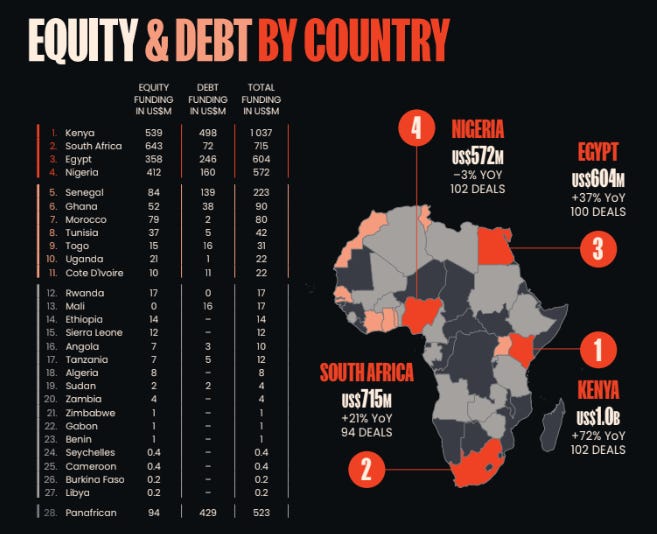
Kenya claimed the #1 spot on the continent for total capital raised, pulling in a record $1.04 billion (+72% YoY). This marks the first time a single East African market has breached the billion-dollar threshold since the 2022 market peak. However, a forensic analysis reveals that Kenya’s dominance is highly concentrated and structurally unique compared to its peers:
The Continental Debt Magnet: Kenya single-handedly anchored the African debt boom by absorbing $498 million in non-dilutive credit. Kenya’s debt volume was more than double that of the next largest debt market on the continent (Egypt).
Megadeal Concentration: Kenya became the epicenter for late-stage consolidation, capturing 4 out of the 9 total continental megadeals (rounds exceeding $100 million) recorded across all of Africa. These 4 massive transactions accounted for $610 million, or roughly 60% of Kenya’s entire funding inflow.
The Late-Stage Equity Rebound: Equity investment in Kenya grew by 144% YoY to reach $539 million across 72 deals. Two major transactions alone contributed $260 million of this total.
The Narrowing Pipeline Risk: Despite the staggering headline figure, the underlying base of the Kenyan ecosystem experienced severe tightening. The number of Kenyan ventures successfully raising rounds of at least $100,000 fell by 23% YoY to just 75 companies—the sharpest early-stage contraction among the Big Four hubs.
Shift 2: The Systematic Decline of Fintech’s Dominance
For nearly a decade, fintech enjoyed a near-monopoly on African venture capital, frequently capturing upwards of half of all equity flows. In 2025, fintech’s iron grip formally loosened. While it technically remains the largest single equity vertical with $769 million raised, its total share of equity funding dropped significantly to 25%.
The contraction is driven by both global macro adjustments and a deliberate rebalancing by on-the-ground fund managers:
Premium Compression: Investors are no longer giving pure-play digital payment or lending platforms the sky-high multiples seen in the bubble era.
The Divergence in Kenya: Fintech’s decline is most stark in the Kenyan market. Historically driven by financial inclusion metrics, Kenya’s fintech sector captured a mere 15% share of the country’s equity capital.
The Pivot to Non-Fintech Infrastructure: For the first time since the 2021–2022 cycle, multiple non-fintech verticals simultaneously broke the $200 million annual equity funding threshold:
Cleantech: Exploded to $550 million (+186% YoY), capitalizing on asset-backed models like climate-smart infrastructure and e-mobility.
Healthtech: Emerged as a major breakout vertical, securing $215 million (+232% YoY) in late-stage equity backing.
Enterprise Software: Rose steadily to $238 million (+55% YoY) as local B2B corporate digitization matured.
3. Geographic Realignments: How the Rest of the “Big Four” Fared
While Kenya relied heavily on debt and outsized megadeals to fuel its position, its peers followed entirely different paths to scale:
🇿🇦 South Africa: The Equity Standard ($643 Million Equity)
South Africa quietly established itself as the continent’s healthiest, most diversified equity market. It claimed the absolute #1 spot for equity volume ($643 million, +41% YoY) and equity deal count (85 rounds, +27% YoY). Strikingly, South Africa achieved this without relying on outsized capital distortions: megadeals accounted for only 15% of its total equity.
🇪🇬 Egypt: Growth-Stage Pipeline Resilience ($604 Million Total)
Egypt maintained an exceptionally dense mid-market transaction pipeline, clocking 100 deals with a balanced financing mix of $358 million in equity and $246 million in debt. Rising ticket sizes keep its mid-to-late growth pipeline highly consistent.
🇳🇬 Nigeria: The Seed Pipeline in Correction ($572 Million Total)
Nigeria was the only major hub to witness an absolute funding decline (-3% YoY). However, it recorded the second-highest deal volume on the continent (102 deals) and retains its position as Africa’s foundational early-stage market, leading aggregate seed-stage activity by a wide margin.
4. The Structural Bottle-Neck: The Seed Gap Challenge
Across all geographies and sectors, the report highlights an acute operational bottleneck. While Series A (+21% in average round size) and Series B (+12%) bounced back due to a institutional “flight to quality,” Seed+ funding eroded for the third consecutive year, dropping by 4% YoY.
The exit of cross-border “tourist investors”—fund managers without local operational footprints—has left early-stage company formation severely undercapitalized. Startups graduating from Series A to Series B now face an average transition window of 12 quarters (3 full years) compared to just 7 quarters in 2020, with a tight 6% conversion rate.
Report Source & Links
Primary Source: 2025 Africa Tech Venture Capital Report by Partech Partners
Official Press Release: Partech Partners Newsroom
About Boardlot Africa Research
Boardlot Africa is a premier financial intelligence and corporate governance publication dedicated to unpacking the mechanics of capital, market strategies, and structural shifts across East Africa’s corporate landscape. By bridging the gap between raw economic data and actionable market intelligence, we deliver deep-dive research, independent corporate analysis, and policy insights designed for institutional investors, boardrooms, and sharp market observers.
Get in Touch
Email: boardlot.research@gmail.com
Phone: +254 753 133 901
Substack: Subscribe to Boardlot Africa
X (Twitter): BoardLotSulta