
From Maturity Cliff to Sustainable Debt: Why Kenya Must Issue Long-Term Bonds to Spread Its Domestic Debt Burden
By BoardLotSultan – Finance Historian
KSh 11.8 Trillion Debt Stock: Time to Address Maturity Risks
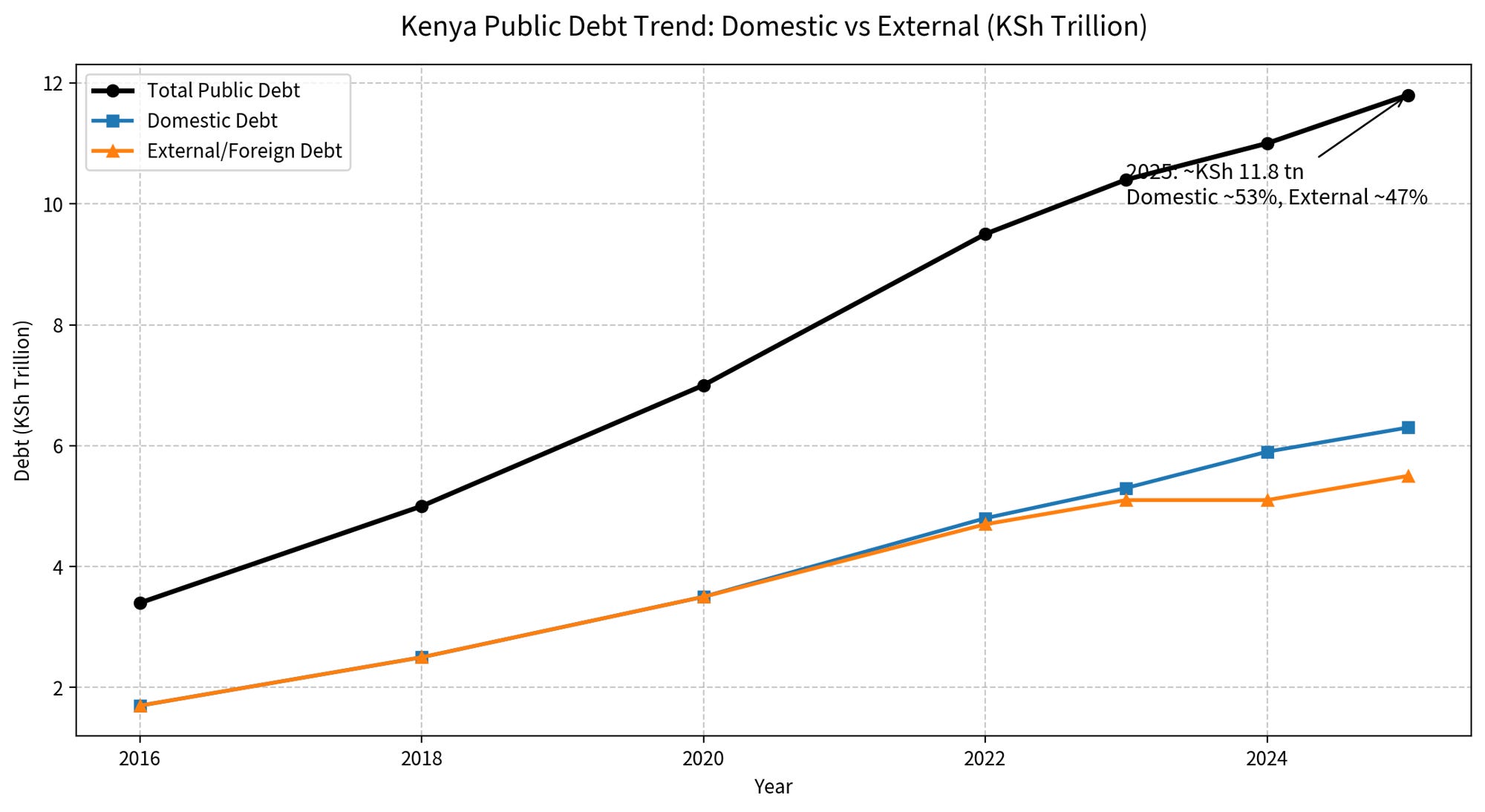
Kenya’s public debt has surged to approximately KSh 11.8 trillion as of June 2025, equivalent to around 67.8% of GDP. Of this total, domestic debt accounts for roughly 53% (over KSh 6.3 trillion), while external (foreign) debt makes up the remaining 47%. What was once a more balanced portfolio has tilted heavily toward local borrowing in recent years, reflecting both a deliberate strategy to reduce forex risk and the reality of constrained external market access.
While this shift has helped stabilise currency exposure, it has come with a hidden cost: a heavily front-loaded domestic debt profile that now poses significant refinancing risks. Before addressing how to fix this, it is essential to examine the maturity structure within the domestic component, where the bulk of the pressure lies.
Source: National Treasury MTDS
Domestic Debt Concentration: Over Half Maturing in Less Than 5 Years
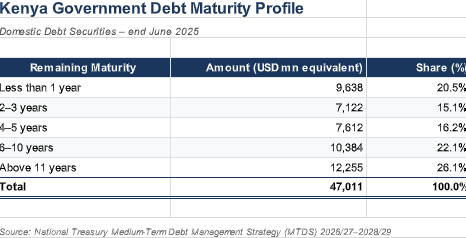
Kenya’s domestic debt market is sitting on a ticking refinancing challenge. As of end-June 2025, over half (51.8%) of domestic debt securities mature in less than 5 years. This heavy concentration at the front end of the curve creates a major vulnerability for the national budget, exposes the government to repeated rollover risk, and threatens to crowd out private sector credit in the years ahead.
A single, well-targeted long-term infrastructure bond — such as a KSh 100 billion, 11% coupon, 10-year issuance — offers a practical way to begin spreading these maturities, mop up abundant domestic liquidity, and put the country’s debt profile on a more sustainable path.

The Maturity Concentration Problem:
According to the National Treasury’s Medium-Term Debt Management Strategy (MTDS) 2026/27–2028/29, the breakdown of domestic debt securities as at end-June 2025 is as follows:
Source: National Treasury MTDS
More than 51.8% of the domestic debt portfolio will need refinancing or rollover within the next five years. This is not just a statistical detail — it is a structural risk. Bunched maturities create “walls” that force the government back to the market repeatedly under potentially unfavourable conditions. If investor appetite weakens, interest rates spike, or liquidity tightens, the cost of refinancing rises sharply. This also increases interest rate risk for the budget and limits space for development spending. The government’s own MTDS acknowledges this challenge and sets clear goals: reduce reliance on short-term Treasury bills, lengthen the average time to maturity (currently around 6.4 years for domestic debt), and shift toward more medium- and long-term fixed-rate instruments. The current profile shows we are not yet making fast enough progress on that front.
Abundant Liquidity Waiting to Be Unlocked
At the same time, Kenya’s financial system is flush with capital looking for productive outlets. The Capital Markets Authority’s Q1 2026 Collective Investment Schemes report shows total assets under management reached KSh 851.7 billion — up 13% in a single quarter. A large share remains parked in cash, fixed deposits, and short-term government securities, reflecting a preference for safety over duration.
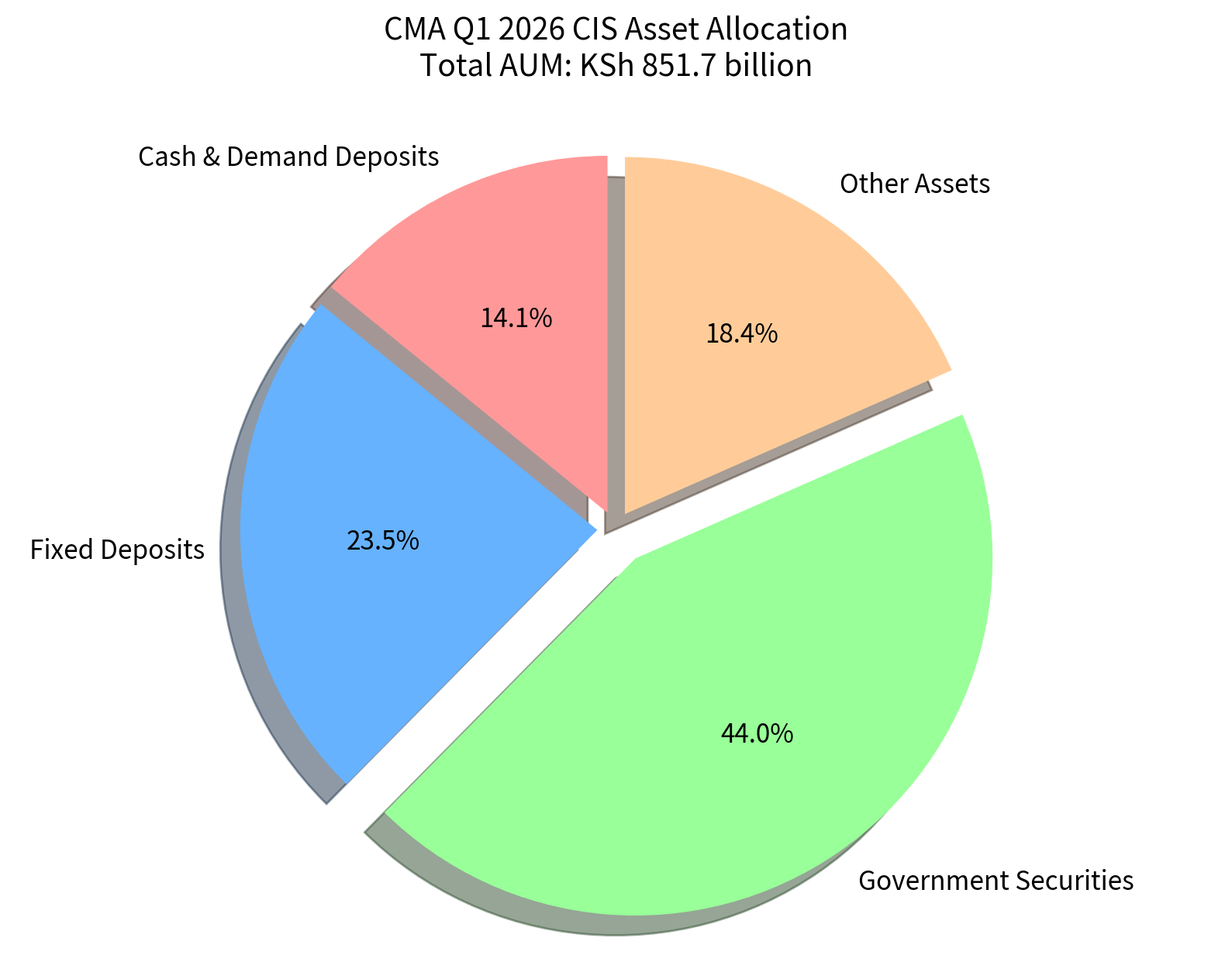
Cash & Demand Deposits: 14.1% (KSh 120.2 bn)
Fixed Deposits: 23.5% (KSh 200.2 bn)
Government Securities: 44.0% (KSh 374.6 bn)
Other Assets: 18.4% (KSh 156.7 bn)
Total AUM: KSh 851.7 billion
Pension funds, banks, and retail investors through unit trusts hold significant additional liquidity. These investors have repeatedly shown strong appetite for well-structured infrastructure bonds in the past. The opportunity is clear: redirect part of this liquidity into longer-tenor instruments that match the long-life nature of infrastructure assets.

The Proposal: A KSh 100 Billion, 11% 10-Year Infrastructure Bond
To begin smoothing the maturity profile, I recommend the National Treasury issue a KSh 100 billion infrastructure bond with these parameters:
Tenor: 10 years
Coupon: 11% fixed (semi-annual payments)
Use of Proceeds: Ring-fenced for high-impact infrastructure projects (roads, energy, water, digital infrastructure, etc.)
Investor Incentives: Tax-exempt interest (following the precedent of successful past infrastructure bonds)
Structure: Bullet or amortizing, with provisions for reopenings to build liquidity on the curve
Why 11%?
In the current environment (CBR at 8.75%, short-term T-bills around 8.8–9.0%, and 10-year government yields near 12.1–12.3%), 11% strikes an attractive balance. It offers investors a meaningful premium for the longer duration while remaining affordable for the government compared to rolling shorter-term debt in a potentially volatile rate environment. A 10-year tenor directly helps address the <5-year concentration by pushing a meaningful portion of obligations further out the curve. Annual interest on a KSh 100 billion bullet issuance would be approximately KSh 11 billion — predictable and manageable, in exchange for significantly lower refinancing risk.
Why This Is Urgent and Achievable
Risk Reduction: Spreading maturities reduces bunching and the danger of having to refinance large amounts in a single window.
Liquidity Absorption: Converts idle or short-term capital into long-term productive funding.
Market Precedent: Previous infrastructure bonds have been oversubscribed. With current liquidity levels, demand should be strong.
Policy Alignment: This move directly supports the MTDS objectives of lengthening the debt profile and deepening the domestic bond market.
Economic Multiplier: Funds infrastructure that supports growth under the Bottom-Up Economic Transformation Agenda while keeping capital domestic and avoiding forex risk.
Recommendations for Implementation:
The National Treasury and Central Bank should move quickly to:
Announce the bond with clear project linkages and transparent governance.
Offer tax incentives to maximise retail and institutional uptake.
Combine with investor education and digital access channels.
Use proceeds reporting and impact measurement to build long-term credibility.
Continue broader efforts to reduce Treasury bill reliance and extend the overall yield curve.
Kenya does not suffer from a lack of domestic capital. It suffers from a mismatch between the short-term nature of much of its debt and the long-term nature of its development needs. By issuing long-term bonds such as the proposed KSh 100 billion 10-year infrastructure bond, the government can spread its maturity profile, reduce refinancing vulnerabilities, and turn abundant liquidity into lasting infrastructure. The data is clear. The strategy is already in official documents. The time to act is now.

Past Success: Strong Investor Appetite for Infrastructure Bonds:
Kenya has a proven track record of successful infrastructure bond issuances that demonstrate robust local demand. The Talanta (Linzi) Infrastructure Asset-Backed Bond, for example, was oversubscribed by over 100%, raising the full target of approximately KSh 44.8 billion. Priced with an internal rate of return (IRR) of around 15.04%, the 15-year instrument was backed by future revenues from betting and gaming taxes and proved highly attractive to investors.
Earlier infrastructure bonds have similarly been met with strong uptake, often trading at a premium in the secondary market. These precedents show that when offered at competitive, tax-advantaged rates and tied to tangible infrastructure outcomes, Kenyan investors — from pension funds and CIS to retail participants — are eager to commit capital for longer tenors. A new 10-year bond at 11% would likely build on this momentum in the current lower-rate environment, while helping address the pressing maturity concentration in the broader domestic debt portfolio.
About Boardlot Africa Research
Boardlot Africa is a premier financial intelligence and corporate governance publication dedicated to unpacking the mechanics of capital, market strategies, and structural shifts across East Africa’s corporate landscape. By bridging the gap between raw economic data and actionable market intelligence, we deliver deep-dive research, independent corporate analysis, and policy insights designed for institutional investors, boardrooms, and sharp market observers.
Get in Touch
Email: boardlot.research@gmail.com
Phone: +254 753 133 901
Substack: Subscribe to Boardlot Africa
X (Twitter): @BoardlotSultan