
Why leading Africa in raw production fails to put a branded packet of milk on Nairobi retail shelves.
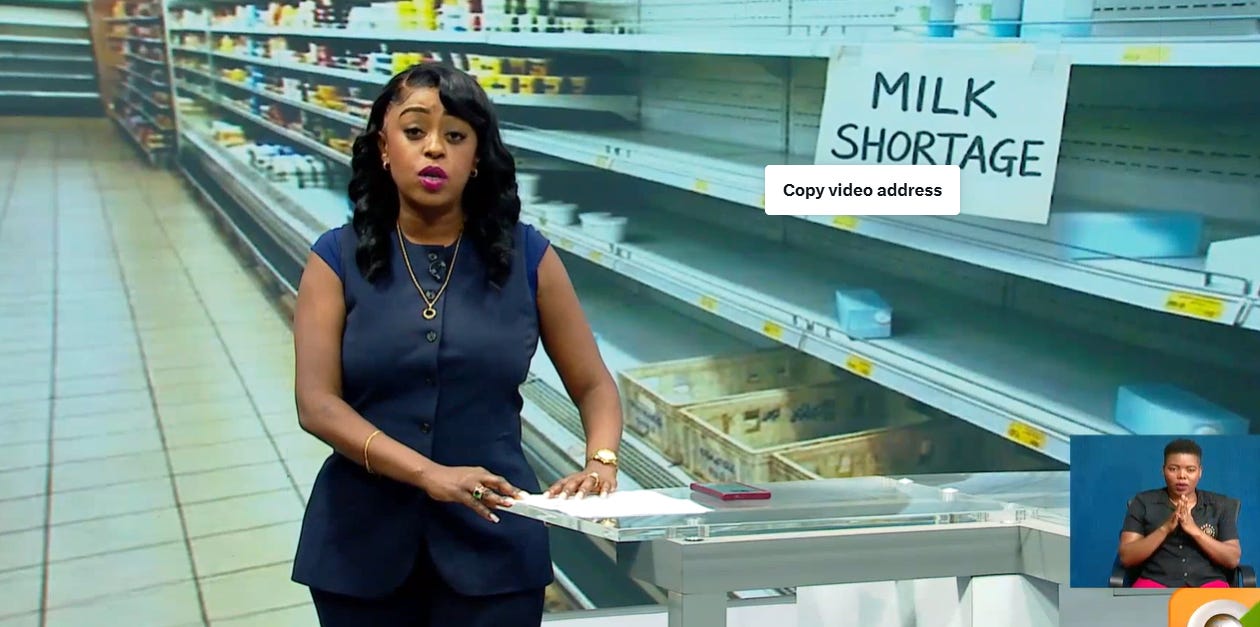
Kenya is being told two stories at once. One is that the country has overtaken Egypt as Africa’s largest milk producer, with output around 5.4–5.5 million tonnes a year. The other is visible in Nairobi supermarkets this September: missing brands, rationed packets and prices up by about 30 per cent. Both can be true. The shortage is not proof that the production numbers are invented. It is proof that most Kenyan milk never reaches a licensed plant, a packet or an export container. Understanding that gap is more useful than arguing over a single headline figure.
What the production numbers actually say
The Kenya National Bureau of Statistics has put 2025 fresh milk output at about 5.5 million tonnes, a third straight annual record. Livestock officials have used similar figures — 5.4 billion litres in some briefings, 5.5 billion in others. Kenya and Egypt have traded the African lead for years. In 2026 the State Department for Livestock said Kenya was ahead. That claim is plausible on official data. It does not mean households can buy packaged milk on demand. Most of that 5.5 million tonnes is never formally counted as “intake”. Formal processors crossed one billion litres of intake in 2025. That is a real achievement. It is still only a fraction of national output. The rest moves through hawkers, milk bars, farm-gate sales and brokers.
Why 80% Bypasses the Factory Gate
This divide is driven by rural financial reality. Formal processors frequently operate on prolonged payment cycles, leaving farmers waiting weeks for settlement. Local hawkers and village brokers pay cash on delivery, providing smallholders with immediate daily liquidity to purchase commercial feed and cover household expenses. Furthermore, a substantial volume of farm-gate milk functions as local currency—consumed at home or bartered directly to pay for farm labor and trade for regional produce. Until formal processors resolve delayed payout structures, cash-strapped smallholders will naturally favor the immediacy of local channels over industrial supply chains.
Why the shops are empty if the country is “awash with milk”
Agriculture Cabinet Secretary Mutahi Kagwe has named two immediate causes of the 2026 squeeze. First, dry conditions have cut pasture and yields. Farmers who were getting seven to nine litres a cow have reported four or five. Commercial feed prices have also risen sharply. Second, brokers are paying more than many cooperatives. Milk that would have gone to Brookside, New KCC or other plants is being sold raw in the countryside. The result is a split market: villages still have bottles; city shelves do not.
Kenya Dairy Board figures showed formal deliveries falling from 84.4 million litres in June 2026 to 81.3 million in July, and lower again in August. That is a modest percentage drop in the formal pipe. Because the formal pipe is thin, a small diversion shows up as a national “shortage”. This is the central fact of Kenyan dairy: a shortage of processed, branded milk is not the same as a shortage of milk.
The Kenya Dairy Board (KDB) recorded a 3.7% drop in formal milk deliveries between June and July 2026.
The underlying volume figures behind that percentage show:
June 2026: 84.4 million litres
July 2026: 81.3 million litres (a net loss of 3.1 million litres)
KDB noted that preliminary figures for August 2026 indicated a further decline due to seasonal cold and dry weather conditions, alongside the diversion of raw milk to informal brokers.
The 40 per cent feed problem
Economist David Ndii has argued that closing a “40 per cent livestock nutritional deficit” could double milk and meat output. The ministry’s own arithmetic is harsher and more precise. Kenya needs about 55 million tonnes of livestock feed a year. It supplies only about 40 per cent of that — roughly 22 million tonnes — leaving a deficit of about 33 million tonnes, or around 60 per cent. Close to half of what is produced is then lost after harvest.
That is why yields per cow stay low, why drought empties the formal market so quickly, and why “double production by feeding animals properly” is a serious policy target rather than a slogan. The government has said as much: it wants milk output lifted towards 10 billion litres, and it is spending on coolers, sexed semen and feed strategy. Ambition is not the same as delivery.
Why exports remain small
If Kenya is Africa’s top producer, why is dairy not already a major export? Recorded dairy exports were about USD 8 million in 2023 and USD 5.5 million in 2025. Government scorecards have spoken of nearly doubling exports to KSh 9.4 billion, and one 2026 report put the figure as high as KSh 14.2 billion. Those official shilling numbers and the customs/ITC dollar figures do not match. Treat the large shilling totals as political or broadly defined industry claims until they appear in consistent trade statistics.
Even on the optimistic reading, dairy exports are tiny next to tea or horticulture. Kenya still imports more dairy than it sells — USD 57 million of imports in 2025 against USD 5.5 million of exports on the trade-data series. Uganda has been the main source of powder and other products. Kenya sells some processed milk, powder, yoghurt and cheese to neighbours: Uganda, Tanzania, South Sudan and the DRC. It is not yet a serious Gulf or European dairy supplier.
Processing plants run at only about 45% capacity utilization, driving up unit costs. Furthermore, 85% of what is processed remains liquid pasteurized or UHT milk, leaving Kenya short on high-value, shelf-stable exports like powder, butter, and cheese. As a result, Kenya remains a net dairy importer, recording just USD 5.5 million in exports against USD 57 million in imports in 2025.
The barriers that keep milk at home
Exporting milk is harder than producing it. Informality. Export buyers want pasteurised or further-processed product with traceability. Eighty to eighty-five per cent of Kenyan milk never enters that system. Product mix. Installed processing capacity is about 5.2 million litres a day, but utilisation is only around 45 per cent. Of what is processed, about 85 per cent is liquid pasteurised or UHT milk. Cheese, butter, ghee and powder — the products that travel — remain scarce. The Kenya Dairy Board has said Kenya cannot even meet domestic demand for those high-value lines.
Safety and animal health. Importers require Codex limits on bacteria, drug residues and aflatoxin, plus freedom from notifiable diseases such as foot-and-mouth. Kenya’s national dairy lab is now ISO 17025 certified. Farm hygiene and disease control are not uniformly at that standard.
Cost and seasonality. Underused plants raise unit costs. Feed deficits keep farm costs high. Flush seasons and droughts make year-round export contracts difficult.
Standards friction. EAC and AfCFTA tariffs may be low, but testing and certification still differ by country. EU and Gulf rules add residue, process and Halal requirements that only a few processors can meet.
Until those constraints ease, “livestock products will be Kenya’s largest export industry by 2030” remains a forecast, not a fact. Meat and leather have a better near-term export case than fresh milk. Dairy’s first job is still feeding Kenyans through a formal, reliable chain.
How to read the argument without taking sides
Ndii’s post was directionally right on three points: Kenya is in the African production lead; feed is the binding constraint; livestock could earn far more if nutrition and processing improved. It overstated the neatness of the “40 per cent deficit” (the operational deficit is closer to 60 per cent of feed need) and treated a 2030 export ranking as destiny rather than a target.
The current shortage does not refute the production statistics. It illustrates them. A country can lead Africa in litres produced and still fail to put a branded packet on a Nairobi shelf if most litres never pass through a cooler, a contract or a plant. The policy test is therefore simple. Not “are we number one in Africa?” but “what share of milk is cooled, tested, paid for on time and turned into products that last?” Coolers, feed hubs, disease control and processor payments to farmers matter more than the league table.
Fixing the Pipeline
Celebrating raw production totals while urban consumers queue for milk reveals a fundamental misfocus. The policy priority should not be claiming the top spot in African production rankings. The focus must be building out the formal pipeline: expanding cold-chain infrastructure, reducing feed costs, ensuring prompt processor payouts, and establishing fair smallholder contracts. Until the formal share of milk expands, Kenya will continue to report record harvests and face retail shortages in the same month.
Sources
KNBS / industry reporting on 5.5 million tonnes in 2025
Livestock PS Jonathan Mueke on Kenya overtaking Egypt
Ministry figures: 55 million tonnes feed need, 40 per cent supplied, 33 million tonne gap
Invest Kenya / ITC-style series: dairy exports USD 8m (2023) to USD 5.5m (2025)
KDB / ministry: processing capacity 5.2 million litres/day, ~45 per cent utilisation; ~85 per cent of processed volume is liquid milk
CS Mutahi Kagwe, mid-September 2026: drought plus brokers diverting milk from processors; formal intake down June–August 2026
About Boardlot Africa Research
Boardlot Africa is a premier financial intelligence and corporate governance publication dedicated to unpacking the mechanics of capital, market strategies, and structural shifts across East Africa’s corporate landscape. By bridging the gap between raw economic data and actionable market intelligence, we deliver deep-dive research, independent corporate analysis, and policy insights designed for institutional investors, boardrooms, and sharp market observers.
Get in Touch
Email: boardlot.research@gmail.com
Phone: +254 753 133 901
Substack: Subscribe to Boardlot Africa
X (Twitter): BoardLotSultan