
Welcome to Boardlot Africa, where we pull back the curtain to reveal the untold stories, power dynamics, and strategic maneuvers shaping the boardrooms of Corporate Africa—subscribe for free to join the conversation. Join 1000 other subscribers.
We publish:
Kenya’s Most Consequential Legal, Governance & Labor Disputes
A Series on the 100 Most Influential Kenyan Captains of Industry
The Queens of East Africa Boardrooms
Founding & Vision
In 2018, KOKO Networks was founded by Nick Moon and a small team with a bold mission: solve one of Africa’s most pressing environmental and health challenges — dirty cooking fuels. The core idea was elegant on paper. Instead of households continuing to rely on charcoal and firewood (which drive deforestation and cause dangerous indoor air pollution), KOKO would deploy a network of smart, pay-as-you-go ethanol dispensers. Users would pay via mobile money for clean-burning ethanol fuel dispensed in controlled amounts, making it safer, more convenient, and more affordable over time. The model was designed as a climate-tech triple win:
Social impact: Reduce respiratory diseases caused by indoor smoke, especially among women and children.
Environmental impact: Cut deforestation and black carbon emissions.
Financial innovation: Monetize the carbon emission reductions through the sale of carbon credits, using that revenue to subsidize fuel costs for low-income users.
KOKO Networks positioned itself at the intersection of climate finance, clean energy distribution, and last-mile technology. It wasn’t just another fuel company — it was building what many called “the Uber of clean cooking” in East Africa. Backed by high-profile climate investors and development finance institutions, the company quickly attracted significant capital. The vision was ambitious: scale across Kenya, expand into Rwanda, and eventually become a pan-African solution that proved clean energy could be both impactful and commercially viable in informal markets. For a few years, it looked like KOKO was well on its way to becoming one of East Africa’s brightest climate-tech success stories.

Brief Bio: Nick Moon (Pre-KOKO Networks)
Nick Moon is a British entrepreneur and development practitioner with decades of experience in East Africa.
Background & Early Career:
He has lived and worked in Kenya since the 1980s.
Co-founder of KickStart International (originally ApproTEC) — one of the most successful social enterprises in Africa.
KickStart developed and commercialized low-cost irrigation pumps (MoneyMaker pumps) that helped hundreds of thousands of smallholder farmers escape poverty by moving from subsistence to commercial farming.
Under his leadership, KickStart became a pioneer in market-based solutions to poverty, selling simple technologies to poor farmers rather than giving them away.
Philosophy:
Moon is a strong believer in market-driven development — creating sustainable businesses that serve low-income customers profitably, instead of relying on endless aid or subsidies. He has long advocated for technology and entrepreneurship as tools for large-scale poverty alleviation.
Transition to KOKO:
His experience with KickStart (building last-mile distribution networks for affordable technologies in informal markets) directly informed the KOKO Networks model — smart pay-as-you-go dispensers for clean cooking fuel, targeting the same bottom-of-the-pyramid customers.
In short, before founding KOKO in 2018, Nick Moon was a veteran social entrepreneur known for proving that commercially viable, technology-enabled solutions could work at scale for poor African households.

The Rise (2019–2023): From Startup to Climate-Tech Darling
KOKO Networks moved fast and raised big. Between 2019 and 2024, the company secured close to $200 million in equity, debt, and guarantees from a mix of impact investors, development finance institutions, and climate-focused funds. This included large guarantees from the World Bank’s Multilateral Investment Guarantee Agency (MIGA) to de-risk the business.
The model appeared to be working:
Smart ethanol dispensers were installed across Nairobi’s informal settlements and later expanded to other counties and Rwanda.
Customers paid via mobile money (M-Pesa) for metered clean fuel — removing the need to buy large quantities of charcoal or kerosene.
KOKO aggressively pursued carbon credit certification. Every litre of ethanol used instead of charcoal generated verifiable carbon credits that could be sold on international markets.
At its peak, KOKO claimed hundreds of thousands of active users and was celebrated in global climate conferences as a shining example of for-profit climate action in Africa.The narrative was compelling: a tech-enabled solution that was reducing emissions, improving health outcomes, and creating a commercially sustainable business in one of the hardest markets — low-income urban households. Investors loved the combination of measurable climate impact + technology + recurring revenue. For a while, KOKO looked like it had cracked the code. But beneath the surface, the business was becoming dangerously dependent on one thing: the timely monetization of carbon credits.
The Rise (2019–2024): Capital Inflow and Rapid Scaling
KOKO Networks experienced one of the fastest capital build-ups in East African climate-tech history.
Key Fundraising Timeline:
2019–2020 (Early Stage): Secured initial seed and Series A funding from impact-focused investors. Early backers included organizations interested in clean cooking and carbon markets.
2021–2022: Raised significant growth capital as the company expanded its dispenser network in Kenya. Total funding crossed the $50M mark during this period.
2023–2024: The company hit its peak fundraising momentum. KOKO raised close to $200 million in a combination of equity, debt facilities, and risk guarantees. Major partners included:
Development finance institutions
Global climate funds
The World Bank’s Multilateral Investment Guarantee Agency (MIGA), which provided a $179.6 million political risk guarantee — one of the largest of its kind for an African startup at the time.
By late 2024, KOKO had built an extensive physical infrastructure: thousands of smart ethanol dispensing points, a sophisticated supply chain for bio-ethanol, and a large customer base across urban informal settlements in Kenya and Rwanda. The company was generating revenue from fuel sales while banking on large future cash flows from the sale of carbon credits generated by displacing dirty fuels. At its height, KOKO was widely praised in international development and climate circles as a model for how technology, private capital, and carbon markets could deliver impact at scale.
Part 3: The Distribution Network and Market Capture (2020–2024)
KOKO Networks didn’t just sell fuel — they built an entirely new last-mile distribution infrastructure from the ground up.
How They Captured the Market:
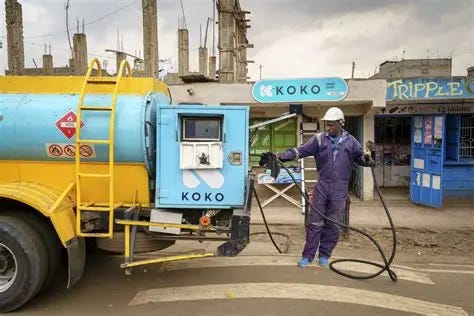
The Smart Dispenser Model — KOKO installed proprietary “KOKO Points” — intelligent ethanol dispensing machines placed in high-density informal settlements. These dispensers worked like modern fuel pumps but were designed for small, daily purchases via mobile money (M-Pesa). Customers bought fuel in 1-litre increments instead of hauling heavy charcoal sacks.
Target Market — Focused primarily on urban slum households in Nairobi and other Kenyan cities, later expanding to Rwanda. These were families that traditionally relied on charcoal and kerosene — markets estimated at tens of millions of users across East Africa.
Expansion Timeline:
2020–2021: Pilot phase in Nairobi. Rapidly scaled from a few hundred to several thousand dispensing points.
2022: Aggressive rollout across multiple counties in Kenya. At peak, KOKO claimed thousands of active dispensers serving hundreds of thousands of households.
2023–early 2024: Entered Rwanda and deepened penetration in Kenya. The company reported reaching a significant portion of the urban clean cooking transition market.
KOKO’s approach was asset-heavy by design. They owned and operated the physical network, managed the ethanol supply chain (sourcing, storage, and logistics), and controlled the customer relationship end-to-end. This gave them strong data on usage patterns but also created very high fixed costs and working capital requirements. For a while, the model appeared successful. Many households switched to cleaner ethanol, usage data looked promising, and KOKO became one of the most visible clean cooking companies on the continent. However, this massive physical footprint would later become one of the biggest vulnerabilities when the revenue model started to break.

KOKO Networks Unit Economics Analysis
KOKO Networks’ business model was a classic asset-heavy, subsidy-driven climate-tech play that ultimately failed because its unit economics were structurally dependent on carbon credit revenue rather than customer payments.
**KOKO Networks Unit Economics Breakdown**

| Metric                          | Estimate / Detail                          | Implication                          |
|---------------------------------|--------------------------------------------|--------------------------------------|
| Households Served (Peak)        | 1.0 – 1.5 million                          | Strong adoption                      |
| Dispensers (KOKO Points)        | ~3,000                                     | Asset-heavy network                  |
| Total Capital Raised/Invested   | ~$200M equity/debt + $179.6M guarantee (~$300M+ total) | Massive upfront capital             |
| Stove Subsidy                   | Up to 85% (sold < $20)                     | Deep hardware discounting            |
| Fuel Pricing                    | Highly subsidized (~half market price)     | Negative contribution margin         |
| Carbon Credits Issued           | ~2.45 million tons (by end 2023)           | Primary subsidy engine               |
| Revenue Model                   | Fuel sales (low margin) + Carbon credits   | Not profitable without credits       |
| Unit Economics (Core)           | **Negative without carbon revenue**        | Fatal flaw                           |
| Break-even Dependency           | Heavily reliant on timely carbon credit sales | Regulatory & market risk            |
Business Model Overview
KOKO built and operated a network of smart bioethanol dispensers (“KOKO Points”) in informal settlements. Customers bought clean ethanol fuel in small quantities via mobile money. The company sold both hardware (stoves) and fuel at highly subsidized prices to drive adoption and compete with charcoal/kerosene.
Two main revenue streams:
Direct fuel sales (recurring but low-margin)
Carbon credits generated from displacing dirty fuels (the main profit/subsidy engine)
Key Operational Metrics (at peak)
Households served1M – 1.5 million -Multiple reports (peak 1.3M)
KOKO Points (dispensers)~3,000 -Consistent across source)
Total capital invested~$300 million (Infrastructure + working capital)
Carbon credits issued2.45 million tons (by Dec 2023) - World Bank MIGA report
Stove subsidy: Up to 85% Reports indicate heavy subsidization
Unit Economics Breakdown
A. Revenue per Household
Fuel sales: Sold at a price significantly below cost (roughly competitive with or below charcoal on a per-meal basis).
Carbon credit allocation: This was the critical component. Revenue from carbon credits was used to subsidize both the stove and ongoing fuel costs.
B. Cost Structure (Per Household / Per Dispenser)
High fixed costs: Owning and operating ~3,000 smart dispensers + supply chain (ethanol sourcing, logistics, micro-tankers) created substantial capital and operating expenditure.
Hardware subsidy: Stoves sold for less than $20 (far below actual cost).
Fuel subsidy: Ethanol sold at a discount to make it attractive.
Customer acquisition & retention: Heavy discounting was required to win customers from charcoal.
C. Gross Margin Reality Without carbon credits, unit economics were deeply negative.
Customer payments alone did not cover the cost of goods sold + operating expenses.
Multiple analysts noted: “KOKO was not structurally profitable from customers alone. Carbon revenue was not an add-on — it was the business.”
The model only worked if carbon credit revenue could reliably cover the large subsidy gap.
Why the Unit Economics Failed
Heavy Asset Base: High fixed costs spread across customers, High
Deep Subsidies: Negative contribution margin on fuel + hardware, Very High
Carbon Credit Dependency: Revenue timing and amount were uncertain, Critical
Regulatory Blockage: Kenya denied Letter of Authorization for high-value credits, Fatal
Verification & Additionality Issue: Risk of over-crediting and lower issuance, High
Market Price Volatility: Carbon credit prices fluctuated and trended down, Medium
5. Summary Assessment
Customer Value Proposition: Strong Convenient, cleaner, pay-as-you-go
Direct Unit Economics (Fuel + Hardware): Very Weak Negative without subsidies
Carbon Credit Leverage: Extremely High, Made or broke the entire model
Scalability Risk: Very High, Asset-heavy model amplified losses
Overall Viability: Poor, Structurally dependent on external factors
Bottom Line:
KOKO’s unit economics were fundamentally misaligned with a sustainable business. The company achieved impressive scale and real customer adoption, but the economics only closed because of an external subsidy (carbon credits) that proved unreliable due to regulatory, verification, and market risks.
This is a textbook example of impact vs. unit economics — strong social/environmental outcomes do not automatically create viable unit economics, especially in low-income markets with high infrastructure costs.

Part 5: Understanding the Carbon Markets – The Mechanism That Failed KOKO
To understand why KOKO Networks collapsed, one must first understand how carbon markets actually work. How Carbon Markets Function: Carbon markets operate on the principle of “cap and trade” or voluntary offsetting. Companies, governments, or individuals that emit carbon can buy “credits” to offset their emissions. Each credit represents one tonne of CO₂ (or equivalent) that has been avoided or removed from the atmosphere elsewhere.
There are two main types relevant to KOKO:
Compliance Markets — Regulated systems (e.g., EU ETS) where emitters are legally required to surrender credits.
Voluntary Carbon Markets (VCM) — Where corporations buy credits voluntarily for ESG reporting, net-zero claims, or reputational purposes.
The Project Developer Cycle (KOKO’s Model):
A company like KOKO implements a project (clean cooking with ethanol).
They measure the baseline emissions (what would have happened if people continued using charcoal).
They calculate the difference (emission reductions) using approved methodologies.
Projects are registered with standards bodies (e.g., Verra, Gold Standard).
Independent auditors verify the reductions.
Credits are issued and can then be sold on the open market.
The Revenue Flow: KOKO’s business plan assumed that for every litre of ethanol sold, they would generate a certain number of carbon credits. These credits would be sold at $5–15+ per tonne, providing a critical subsidy stream to keep the customer price low and cover the high costs of building and maintaining the dispenser network.
Why This Became a Trap for KOKO:
Carbon credit issuance is slow, bureaucratic, and subject to frequent methodology changes.
Prices in the voluntary market are highly volatile and have dropped significantly in recent years due to oversupply and quality concerns.
Buyers increasingly demand high-quality, “additional” credits — making verification stricter.
KOKO’s model required large, predictable credit revenue to service debt and fund operations. When issuance slowed or prices fell, the subsidy layer disappeared.
In essence, KOKO bet the entire company on the smooth functioning of a complex, policy-driven, and often unpredictable global market — while carrying the full burden of heavy infrastructure costs in one of the toughest operating environments in the world.

Carbon Credit Verification Methods – The Critical (and Fragile) Process
Carbon credit verification is the most important — and often the weakest — link in the entire system. It determines whether a project like KOKO actually gets paid.
The Standard Verification Process:
Project Design & Registration
The developer (e.g., KOKO) designs the project using approved methodologies from standards like Verra (VCS), Gold Standard, or CDM. They submit a detailed Project Design Document (PDD) showing baseline emissions, project emissions, and expected reductions.Additionality Test
Proves the project would not have happened without carbon finance. (“Would households have switched to ethanol anyway?”)Monitoring
The project must continuously collect data — litres of ethanol sold, number of active users, fuel displacement rates, etc.Verification & Validation
An independent third-party auditor (Validation/Verification Body — VVB) is hired to audit the project. They check:Is the data accurate?
Are monitoring methods followed?
Are calculations correct?
Is the project truly additional?
Issuance of Credits
After successful verification, credits are issued and can be sold on the market.
Common Challenges in Verification (Why KOKO Struggled):
Long Delays: The full cycle from monitoring to credit issuance can take 12–24 months.
High Costs: Hiring reputable auditors is expensive.
Strict Additionality Requirements: Auditors increasingly reject projects if they believe the activity would have happened anyway due to market forces or government policy.
Methodology Changes: Standards bodies frequently update rules, making older projects suddenly ineligible or requiring expensive re-verification.
Data Quality: In informal settlements, accurately tracking thousands of low-income households’ fuel usage is extremely difficult.
For KOKO Networks, this verification bottleneck became existential. The company had built a massive physical network and was burning cash daily, but the carbon revenue — the lifeblood of the model — kept getting delayed or reduced due to verification issues and market price drops.
In the end, the business model was not just dependent on customers buying fuel, but on distant auditors, international standards bodies, and volatile carbon buyers approving and paying for emission reductions that existed mostly on paper.

Part 6: The Collapse
By mid-2025, the cracks had become impossible to ignore. Despite raising close to $200 million and building one of the most ambitious clean cooking networks in Africa, KOKO Networks ran out of runway. The company suddenly and unannounced shut down operations. What triggered the collapse?
Carbon Credit Revenue Dried Up: Verification delays and lower market prices meant the expected subsidy cash flow never materialized at the required scale.
High Burn Rate: Maintaining thousands of smart dispensers, a complex ethanol supply chain, logistics, and customer support in low-margin informal markets was extremely expensive.
Debt Pressure: Significant debt facilities (including those backed by guarantees) started coming due while revenue remained insufficient.
Regulatory & Market Risk Materialized: The sovereign approvals and carbon market liquidity that the entire model depended on failed to deliver in time.
The shutdown was swift and quiet. Customers who had adopted the system were left without reliable fuel supply. Suppliers and partners who had invested in the ecosystem were left unpaid. The extensive physical infrastructure — once hailed as a revolutionary distribution network — became stranded assets. KOKO’s fall was particularly shocking because it was not caused by poor execution or lack of customer adoption. The technology worked. Households were using the service. The failure was structural: the business model was built on the assumption that global carbon markets and regulatory systems would behave predictably — an assumption that proved fatal.

Part 6: The Collapse
By mid-2025, the dream had collapsed.
Despite raising nearly $200 million in equity, debt, and guarantees (including a massive $179.6 million political risk guarantee from the World Bank’s MIGA), KOKO Networks suddenly and unannounced shut down operations.
The Scale of the Failure:
Over $300 million had reportedly been invested into building the physical infrastructure, supply chain, and customer network (including significant working capital and subsidies).
The company had spent more than $100 million subsidising fuel costs to keep the price affordable for low-income households.
Hundreds of thousands of households that had switched to the KOKO system were left without reliable clean fuel supply.
Suppliers, distributors, and local partners were left with unpaid invoices running into tens of millions of dollars.
The shutdown was swift. Operations were halted with little public warning. The extensive network of smart dispensers — once the pride of the company — became idle or were dismantled. What was supposed to be East Africa’s flagship climate-tech success story ended up as one of its most expensive failures. KOKO’s fall was not due to lack of customer adoption or poor technology. The core problem was structural: a capital-intensive, asset-heavy business model that was critically dependent on slow, unpredictable, and ultimately insufficient carbon credit revenues.

Part 7: Key Lessons & Takeaways
The KOKO Networks saga offers some of the clearest lessons in the entire Burn Rate Chronicles series.
1. Carbon Markets Are Not a Reliable Subsidy Engine
Building a business that depends heavily on carbon credit revenue is extremely risky. Verification is slow, prices are volatile, and buyer standards keep rising. Never bet your core unit economics on a market you do not control.
2. Asset-Heavy Models in Low-Income Markets Are Brutal
KOKO’s decision to own and operate a massive physical dispenser network gave them control but created crushing fixed costs and working capital needs. In markets with thin margins and irregular cash flows, this structure can quickly become unsustainable.
3. Sovereign & Regulatory Risk Is Real
When your entire business model relies on government approvals, policy stability, or international climate mechanisms, you are exposed to forces far beyond your operational control. “Policy risk” is not abstract — it can kill companies.
4. Impact ≠ Sustainable Unit Economics
Strong social and environmental impact does not automatically translate into a viable business. KOKO had genuine impact on the ground, yet the financial model failed.
5. The Danger of “Too Big to Fail” Thinking
Large guarantees and high-profile backing can create a false sense of security. Money raised is not the same as sustainable revenue. Capital is a tool, not a strategy.
Final Thought
KOKO Networks was not a story of bad execution or fraud. It was a story of smart people building something ambitious with the wrong assumptions about how risk, revenue, and regulation actually work in Africa.
For the next generation of founders and investors in Silicon Savannah:
Build models that can survive even if the carbon markets, subsidies, or policy support disappear. Because sometimes — they do.
About Boardlot Africa Research
Boardlot Africa is a premier financial intelligence and corporate governance publication dedicated to unpacking the mechanics of capital, market strategies, and structural shifts across East Africa’s corporate landscape. By bridging the gap between raw economic data and actionable market intelligence, we deliver deep-dive research, independent corporate analysis, and policy insights designed for institutional investors, boardrooms, and sharp market observers.
Get in Touch
Email: boardlot.research@gmail.com
Phone: +254 753 133 901
Substack: Subscribe to Boardlot Africa
X (Twitter): BoardLotSultan
I heard there was some political harassment too