
Our recommendation
If your goal is financial agility and wealth compounding, it is time to exit the speculative buroti maguta tour bus and shift your capital into liquid, yield-bearing alternatives like NSE equities, tax-free Infrastructure Bonds, and compounding Money Market Funds. Raw land is a highly specialized, intensely illiquidity-prone utility asset meant for development, generational preservation, or targeted agriculture—it is structurally unsuited for short-term or medium-term speculation. Freezing your capital for years in an unproductive plot forces you to absorb massive opportunity costs, hidden maintenance fees, and an agonizingly slow exit timeline when you need liquidity the most.
Snapshot: Current Market Yields
To give you an idea of how the active income engines compare, here are the prevailing annual yields across the local landscape:
Government Infrastructure Bonds (IFBs): 13% to 18% p.a.
Kenyan Money Market Funds (MMFs): 8.5% to 12% p.a.
NSE Blue-Chip Equities (Dividend Yield): 5.5% to 11% p.a.
Developed Rental Real Estate (Kikimani/Kilimani): 6% to 8% p.a.
Speculative Idle Land: 2% p.a.
The “Buroti Maguta” Illusion: What My 10-Year Corner Baridi Plot Sale Taught Me About Capital Allocation
Every weekend in Kenya, an elaborate, highly calculated financial ritual plays out.
If you have lived in Nairobi long enough, you know the drill. It starts with an upbeat radio advertisement during your morning commute, morphs into a series of colorful billboards along major highways and culminates on a Saturday morning with a crowd of optimistic investors piling into a branded corporate matatu.
I know it because I lived it.
Back in 2017, I was inside one of those matatus, heading down Magadi Road toward Corner Baridi in Kajiado County. The energy inside the vehicle was infectious. As we snaked past Ongata Rongai, the land buying company’s sales agents kept the cabin buzzing with excitement. Every few kilometers, they pointed out the window to show us “progress.”
They gave us the ultimate insider pitch, listing the prominent Kenyan big shots who had allegedly already acquired massive tracts of land in the area. We were told former Kenya Airways CEO Titus Naikuni, former Infrastructure PS Michael Kamau, local MPs, and influential governors were all quietly accumulating acreage right where we were going.
The social proof was overwhelming. Massive billboards lined the road all the way from Rongai, screaming promises of rapid appreciation. To top it off, Maina Kageni was on Classic FM every single morning hyping the exact same project, delivering a convincing gospel of wealth that made you feel like an absolute fool if you didn’t buy in.
It was a masterclass in behavioral marketing. It was professional, it was prestigious, and it was entirely convincing. Like thousands of other Kenyans, I signed the paperwork, paid the deposit, and proudly waited for my title deed to secure my financial future.
Recently, I finally exited that exact investment, shaking hands on a sale price of KES 1.5 million. On paper, it sounds like a classic real estate win—I owned property, I sold it for millions, and I booked a 50% net return on my initial purchase price.
But when the cash finally hit my account, I sat down with a spreadsheet. When you strip away the emotional high of holding physical dirt and look at the brutal reality of inflation, opportunity cost, and capital stagnation, the great Kenyan plot myth completely shatters.
Part 1: The Anatomy of the Hype Trap
The reason so many of us fall for the buroti maguta maguta (the fat plot) illusion is because the marketing machinery is designed to exploit our cultural bias. Our parents built wealth through land, so we assume the exact same playbook applies today.
But there is a massive difference between strategic land acquisition and speculative hype-buying. What Maina Kageni won’t tell you on the radio, and what those glossy billboards conveniently omit, are the structural risks built into these remote subdivisions:
The Infrastructure Pricing Trap: When land companies sell you a 50x100 plot, future unbuilt infrastructure—the promised tarmac, the rumored bypass, the upcoming university campus—is already priced into your entry fee. You are effectively paying 2030 prices for 2017 dust.
The Illusion of Celebrity Alignment: Just because a prominent politician or a corporate titan owns 100 acres in Kajiado doesn’t mean your quarter-acre plot will appreciate at the same rate. Big shots buy land defensively to store generational wealth or for massive agricultural/commercial scale. A speculative retail investor buying a tiny fractional piece relies entirely on the “Greater Fool” theory—hoping someone else will come along later to buy an unproductive asset for double the price.
The Fatal Flaw: Multi-Year Illiquidity: This was my ultimate wake-up call. It took me a staggering two years to sell my Corner Baridi plot. When you need urgent liquidity—whether to fund a high-yielding business pilot, pay school fees, or cover a medical emergency—you cannot liquidate a shamba in an afternoon. You are completely locked down, at the mercy of a slow market, spending months dodging lowballers and processing bureaucratic paperwork.
Part 2: The Ultimate Showdown: Corner Baridi vs. The Capital Markets
To understand the true cost of that high-energy matatu ride down Magadi Road, I ran a simple retroactive calculation. What if, instead of being swayed by the billboards and the radio hype in 2017, I had dumped that exact same capital footprint into alternative market assets?
The data exposes the sheer weight of the opportunity cost:
1. The Single Stock Alternative: Equity Group (EQTY)
Had I bypassed the shamba and purchased Equity Bank shares on the Nairobi Securities Exchange (NSE), the financial outcome would have been starkly different.
My Shamba: Reached a value of KES 1.5 million (a flat +50% net return after nearly a decade, with zero interim cash flow).
The Equity Bank Shares: My capital appreciation alone would have pushed the shares value to KES 2.5 million. When you add the cumulative cash dividends pocketed over those years (KES 883,000), the total portfolio value sits at KES 3.4 million—a staggering +236% total return.
2. The Broad Market Benchmarks: NASI, IFBs, and MMFs
Even if we look beyond a single outperforming stock to account for market fluctuations, raw land still loses the battle of capital allocation:
The NSE Index (NASI Total Return): Critics often claim that picking individual stocks introduces hindsight bias. But even if I had simply tracked the broader market index over that decade, the index return (factoring in compounded distributions) would have yielded roughly +110%, easily doubling the performance of the idle plot.
Infrastructure Bonds (IFBs): Central Bank Infrastructure Bonds have consistently offered tax-free coupons ranging between 12% and 18%. An IFB allocation would have compounded to roughly a +270% total return over a decade, depositing predictable cash into my bank account every six months like clockwork—without a single boundary dispute.
Money Market Funds (MMFs): A conservative compounding MMF account averaging 10% annually would have generated a +160% total return, preserving capital while offering instant 24-hour liquidity to fund fast-moving business ventures.
Part 3: The Hard Math of Capital Allocation (10-Year Total Returns)
When you visualize these asset classes side-by-side, the financial reality becomes undeniable:
Infrastructure Bonds (IFBs): +270%
NSE Equities (Equity Bank): +236%
Money Market Funds (MMFs): +160%
NSE Index (NASI Total): +110%
Idle Land (Corner Baridi): +50%
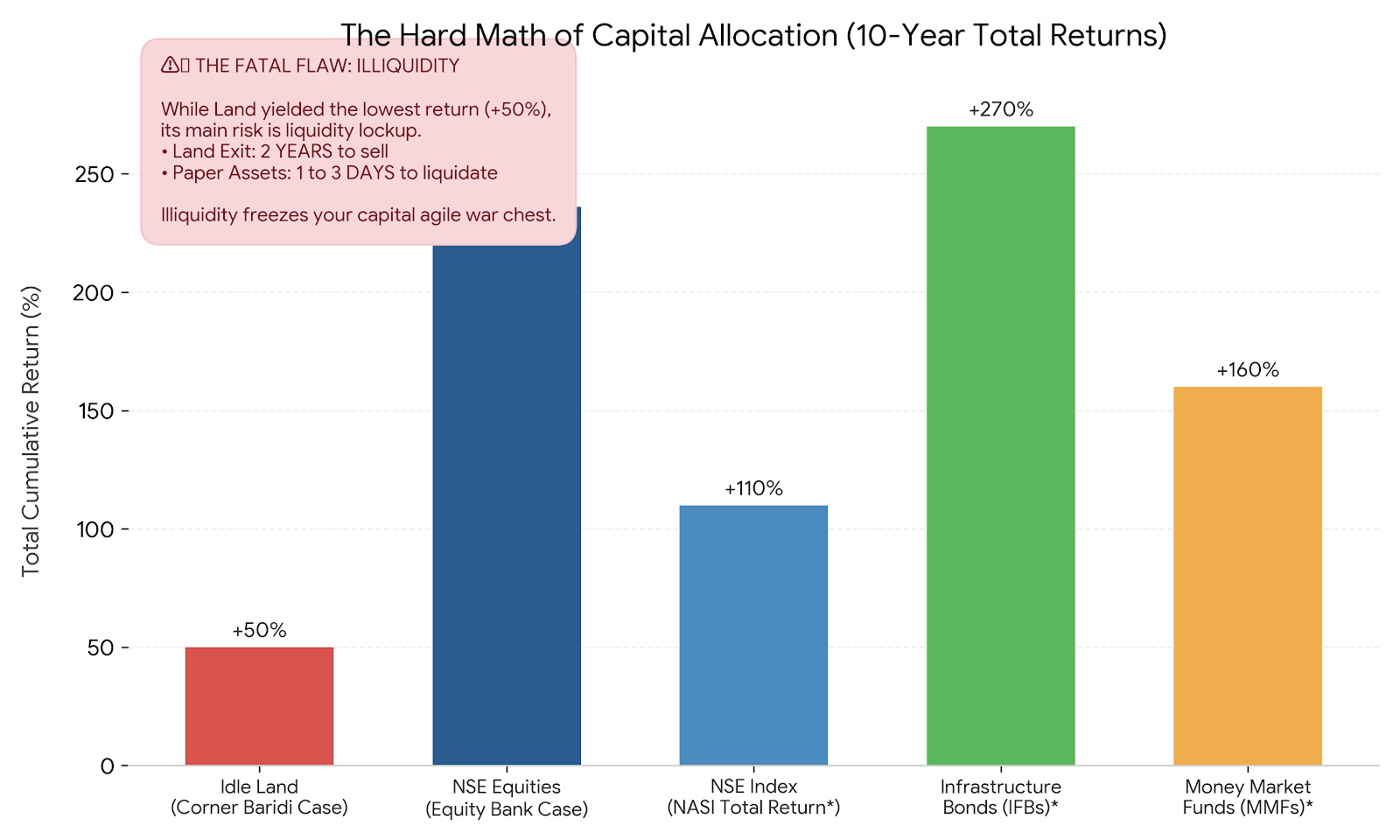
⚠️ THE CRITICAL RISK FACTOR: While Land yielded the absolute lowest total return (+50%), its fatal flaw is its extreme illiquidity. It took 2 full years to sell, freezing capital entirely. By contrast, every other asset class listed above can be liquidated and settled into cash within 1 to 3 business days.
Part 4: The Generational Paradigm Shift: Agility over “Dead Soil”
Our parents accumulated land because the financial markets of the 1980s and 90s were opaque and inaccessible. For them, a physical title deed locked in a metallic box under the bed was the only reliable form of security. It was a defensive strategy born of its time.
But the modern Kenyan entrepreneur operates in a hyper-connected, digital economy. We face fast-moving opportunities and volatile cash flow needs.
True financial strength today is no longer measured by how many idle acres you lock behind a rusted barbed-wire fence in a remote outpost. It is measured by your monthly passive yield and your capital agility. The modern investor values the ability to look at a digital dashboard, analyze compounding yields, and know that their wealth is actively working for them in liquid vehicles.
Real estate isn’t the enemy—but non-yielding, speculative land banking is a wealth trap. If you want real estate exposure, look at developed, cash-flowing rental units in high-density nodes like Kilimani or Kikimani that provide immediate monthly rental yield alongside property appreciation. Don’t freeze your capital in an empty field waiting for a savior.
Final Thoughts: Unlocking Capital from the Dirt
Selling my Corner Baridi shamba wasn’t just a financial transaction; it was a psychological liberation. It freed me from the cultural illusion that owning physical dirt automatically equates to building smart wealth.
If you are currently paying off a plot or looking at glossy land-buying brochures because of a convincing radio ad or a billboard campaign, take a step back. Open up an Excel sheet. Run the actual math on your holding costs, factor in inflation, and seriously weigh a 2-year liquidation delay against the compounding power of the modern capital markets.
It’s time to stop buying into the hype, get off the speculative tour bus, and put your money where it can actively breathe, compound, and serve you.
Did you get caught up in the Magadi Road or Juja land rushes? How long did it take you to exit a speculative plot? Let’s map out the realities of the Kenyan market in the comments below.
Thanks for sharing. You have driven your point home, very well