
Family Bank’s journey from a humble Kiambu building society to a publicly traded powerhouse on the Nairobi Securities Exchange is a complex saga of entrepreneurial grit, governance friction, and the pivotal institutional intervention that finally unlocked its market potential.
The Family Bank Journey
I. Visionary Founder: Building an Empire on Retail Roots
II. The CEO Carousel: A Search for Professionalism
III. The Capital Drought: Shunned While Equity Soared
IV. The Turning Point: How Mansa-X Saved the Listing
V. The Final Handover: The Price of Retiring a Founder
VI. The Boardlot Verdict: Founder Tax and Market Maturity
I. The Visionary Founder: Building an Empire on Retail Roots
In 1984, in the bustling heart of Kiambu, Titus “TK” Muya began with a singular, ambitious premise: to build a financial institution that catered to the ordinary Kenyan. What started as the Family Finance Building Society was, for over two decades, the pure embodiment of the “hands-on” founder. Muya did not merely manage the institution; he was the institution. He famously wore every hat required to keep the lights on—serving simultaneously as the founder, CEO, chairman, chief lender, and even the accountant. His hands-on oversight ensured the building society grew steadily through the 1990s and early 2000s, turning it into a cornerstone of local commerce.
The institution’s defining moment arrived in 2007 when it shed its building society status to receive a commercial banking license, rebranding as Family Bank. The vision was clear: to democratize banking for the small-scale trader and the aspiring middle class, challenging the cold, exclusionary nature of the traditional Tier-1 banks.
However, the very traits that fueled Family Bank’s early ascent—Muya’s absolute control, his instinctive lending, and his hyper-centralized decision-making—began to transform. As the bank scaled into a complex commercial entity, the founder’s struggle to step away from the wheel evolved into the organization’s most significant structural bottleneck. While Muya had expertly built the engine of a retail powerhouse, he found himself unable to relinquish the controls. This reluctance to delegate, while initially a source of resilience, would eventually create a friction point that hampered professionalization, stifled independent governance, and kept the bank trapped in a private, founder-centric silo long after its peers had embraced the efficiency and transparency of the public markets.
II. The CEO Carousel: A Search for Professionalism
As Family Bank transitioned into the competitive commercial banking landscape, it encountered a paradox: it needed the prestige and expertise of professional management to scale, yet the institutional culture remained tethered to Muya’s “tight grip.” For the founder, hiring an MD or CEO was a necessity, but empowering them to lead independently proved to be a psychological and structural hurdle.

Timeline of CEO/Managing Director Changes at Family Bank (Post-Muya Era)
Titus Kiondo Muya served as founder, Chairman, and CEO from the bank’s inception in 1984 until June 2006 (22+ years). He stepped down as CEO to comply with regulations when the institution converted from a building society to a full commercial bank. He remained non-executive chairman until December 2012.
Post-2006 CEO Succession (Frequent Turnover Highlighted)
Peter Kinyanjui — Managing Director (approx. 2005/2006 – ~2011)
Served roughly 5–6 years. He was in place during the commercial banking transition period. Left around 2011.Peter Munyiri — Managing Director & CEO (June 2011 – June 2016)
Served exactly 5 years. Appointed from a senior role at KCB. His contract was not renewed; he exited amid challenges including an NYS-related scandal involving staff.Dr. David Thuku — Managing Director & CEO (May/April 2016 – September/November 2018)
Served approx. 2.5 years. Promoted internally from Director of Retail Banking. Resigned to pursue personal interests. Shortest recent tenure.Rebecca Mbithi — Managing Director & CEO (October 2019 – December 2023)
Served approx. 4–5 years (announced 2019, effective after approval). Previously Company Secretary/Legal Director. Credited with turnaround efforts; left to pursue other opportunities (later joined Ecobank Kenya).Nancy Njau — Managing Director & CEO (January 2, 2024 – present)
Serving ongoing (insider promotion from Chief Commercial Officer/strategic roles). First full year completed by listing time in 2026.
Key Observations on Tenure Patterns
Average post-Muya CEO tenure: ~4–5 years, with several under 3 years.
Pattern of short/rotating leadership: From 2006 to 2024, the bank had at least 5 different CEOs/MDs. This aligns with the narrative of founder influence, family control, and challenges in allowing fully independent professional management.
Internal promotions common in later years (Thuku, Mbithi, Njau), but frequent changes created instability.
Contrast: Wilfred Kiboro provided longer stability as Board Chairman (2012–2024, ~12 years), but even he faced limits on fully professionalizing the institution.
This timeline illustrates the “CEO carousel” dynamic described in the article — frequent leadership transitions that likely contributed to slower professionalization, investor caution, and delayed capital raises/listing compared to peers like Equity Bank.
Brief on Peter Munyiri’s Tenure at Family Bank (2011–2016)
Peter Munyiri Maina served as Managing Director and Chief Executive Officer of Family Bank from July 2011 to July 2016 on a five-year fixed-term contract.
Key Highlights of His Tenure:
Background: A seasoned banker, Munyiri previously held senior roles at KCB (as Deputy CEO), Co-operative Bank, Standard Chartered, and Barclays. He joined Family Bank to professionalize operations and drive growth under the founder-led institution.
Performance Achievements:
Oversaw significant expansion: Assets grew from ~Sh20 billion to over Sh82 billion (roughly quadrupled).
Net profit increased more than five-fold, from Sh391 million (2010) to over Sh3 billion (pre-tax by 2015).
Branch network expanded from ~54 to 87.
Strong focus on SME and retail lending, deposits, and diversification (e.g., launch of Family Bank Insurance Agency).
Challenges: The NYS Heist
His tenure coincided with Family Bank’s implication in the 2015 National Youth Service (NYS) scandal, leading to the sacking of nine employees. This was cited as a low point.
He announced his departure in early 2016, choosing not to renew his contract upon expiry in June/July 2016.
Tensions with the Chairman/Founder:
Public reports do not detail open clashes, but industry commentary and the context of founder Titus Muya’s continued influence (as Chairman during much of Munyiri’s tenure) suggest underlying governance tensions typical in founder-led banks transitioning to professional management. Munyiri’s exit aligned with efforts to bring in fresh leadership (succeeded by David Thuku). A prolonged post-exit legal battle over his gratuity/exit package (resolved in 2025 with a Court of Appeal award of ~Sh30.6 million) further indicates friction in the separation terms.
Overall: Munyiri is credited with transforming Family Bank into a stronger mid-tier player during a key growth phase, though his tenure ended amid scandal fallout and the natural end of his contract. His time marked an important step in shifting from pure founder control toward more professionalized management.
While Family Bank was trapped in a "CEO carousel"—burning through leadership with an average turnover of every 3.5 years—Equity Bank flourished under James Mwangi’s multi-decade tenure, demonstrating that true scale requires not just a visionary at the top, but the sustained stability to build a deep, empowered pool of capable professional management beneath them.

The Kiboro Era: A Struggle for Autonomy
In 2012, in a bid to signal a new dawn, Muya appointed Dr. Wilfred Kiboro—a titan of the Kenyan corporate world and former CEO of the Nation Media Group—as board chairman. The appointment was widely seen as the bank’s most serious attempt to embrace international governance standards. During his roughly 12-year tenure, Kiboro achieved undeniable success, navigating the bank through the 2016 sector liquidity crisis, the COVID-19 pandemic, and an ambitious expansion that saw the branch network grow to over 90 locations.
Yet, even with a leader of Kiboro’s stature, the “founder effect” persisted. Insiders recount that while Kiboro succeeded in modernizing systems and expanding the footprint, his efforts to fully professionalize were frequently tested. Muya’s continued presence on the board, his family’s substantial shareholding, and a network of legacy relationships meant that even a chairman with Kiboro’s influence could not always override the founder’s preferences on critical operational matters. For over a decade, Family Bank remained in a state of suspended animation: too large to be run as a family shop, but too constrained to act as a truly independent public institution.

III. The Capital Drought: Shunned While Equity Soared
The governance overhang at Family Bank had tangible, often painful, financial consequences. By the early 2020s, the divergence between Family Bank and its peers was undeniable. While Equity Bank—which listed on the NSE in 2006—had aggressively embraced professional management under James Mwangi, successfully accessing capital markets to fuel an explosive growth in assets, branches, and regional influence, Family Bank remained largely anchored to its past.
A Market That Looked Elsewhere
Equity Bank became the darling of the Nairobi Securities Exchange, attracting deep-pocketed institutional investors who valued its transparent governance and predictable growth trajectory. In contrast, Family Bank found itself increasingly isolated. The market was not blind to the lender’s potential; it was simply wary of the structural risk. Sophisticated investors—pension funds, international development finance institutions, and major asset managers—remained on the sidelines, deterred by what they viewed as a “Founder Risk” overhang. Governance concerns, coupled with the opacity surrounding related-party exposures, turned the bank into an institution that was fundamentally sound on paper but institutionally “untouchable” in practice.
The Cost of Skepticism
This institutional cold shoulder was laid bare during the bank’s capital-raising efforts. A 2023 rights issue, intended to be a significant injection of fresh equity, became a sobering diagnostic of the bank’s market standing. Despite the clear need for capital, the exercise raised a mere Sh252 million—a fraction of its target. The failure was not a reflection of the bank’s retail profitability, but rather a sharp rebuke from a market that refused to commit large sums while the institution’s ownership remained concentrated and its management autonomy questioned.
Earlier attempts at private placements were met with similar investor hesitation. Where Equity Bank could tap the market with ease to finance its next phase of expansion, Family Bank was forced to rely on slower, organic capital generation. The result was a paradox: the bank was growing, yet it was losing the race for market relevance. It lacked the “war chest” required to compete aggressively on lending, digital transformation, and regional expansion. For years, the bank operated in a state of institutional limbo—held back not by a lack of customers, but by a lack of investor confidence.

IV. The Turning Point: How Mansa-X Saved the Listing
By early 2026, the mood surrounding Family Bank’s planned entry into the Nairobi Securities Exchange (NSE) was one of tempered exhaustion. Previous rights issues and private placements had struggled to find takers at KSh14.50 per share, as the market remained locked in a standoff between the bank’s potential and investor skepticism toward its governance. The listing was at a standstill, the valuation viewed with caution, and the “Founder Risk” overhang appeared insurmountable.
The Intervention
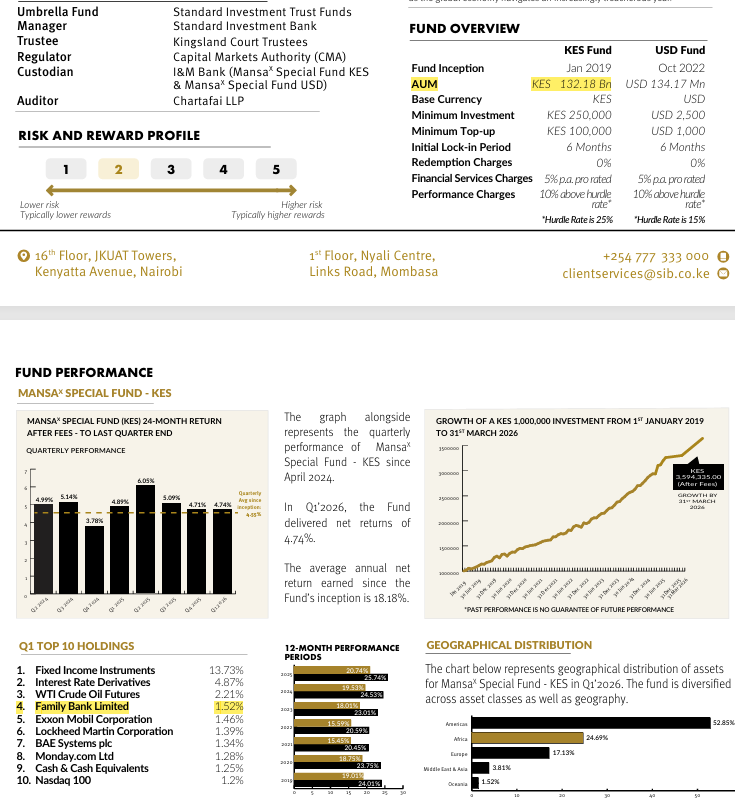
Enter Standard Investment Bank’s Mansa-X Special Fund. In a move that would prove to be the linchpin of the entire transition, the prominent collective investment scheme stepped into the void. According to its Q1 2026 fact sheet, the fund disclosed a significant 4.89% stake in Family Bank, amounting to 81.3 million shares. What was most telling was the internal valuation: Mansa-X carried these shares at an implied value of approximately KSh24.70 per share—a massive premium over the previously shunned KSh14.50 offer.
The Validation Effect
Mansa-X’s involvement was far more than a simple capital injection; it was a powerful signal of institutional conviction. By committing capital at a price well above the historical “discounted” expectations, Mansa-X effectively anchored a new narrative of value. It provided the “seal of approval” that smaller, hesitant investors had been waiting for. When the bank finally listed by introduction on June 23, 2026, at KSh18 per share, the market was primed. The stock opened strongly, surged to an intraday high of KSh50, and settled at KSh26—handily validating the Mansa-X thesis.
The fund’s involvement acted as a bridge, closing the credibility gap that had stunted the bank’s growth for years. It provided the necessary liquidity signals to shift the stock from a “distressed asset” narrative to that of a “blue-chip candidate.”
The Lesson: Why Local Capital Matters
The saga of Family Bank’s debut offers a profound lesson for Kenya’s financial ecosystem: the necessity of robust, local institutional capital. In a market where global funds are often risk-averse and local retail investors are prone to volatility, specialized local vehicles like Mansa-X serve as critical stabilizers. They possess the internal analytical capacity to look past governance “noise,” conduct deep-dive valuations, and provide the counter-cyclical capital needed to jumpstart stalled institutional transformations. Without this decisive, locally-driven conviction, Family Bank might have remained a private, founder-constrained entity for years longer. Instead, the Mansa-X play proved that a well-timed, high-conviction local intervention can do more than just provide liquidity—it can fundamentally rewrite the governance trajectory of a national institution.
V. The Final Handover: The Price of Retiring a Founder
As the bank accelerated toward its June 2026 listing, a final, structural hurdle remained: the founder himself. Titus Kiondo Muya’s decades-long influence had become inextricably linked with the bank’s identity, and a clean break was required to satisfy the institutional transparency demanded by the public market. The transition that followed was not merely an administrative shift; it was a high-stakes financial negotiation.

The Price of Letting Go:
The path to the NSE was cleared by what essentially amounted to a strategic “exit price.” Disclosures revealed that Muya received a staggering Sh231.3 million in goodwill (ex-gratia) payments across 2024 and 2025. The breakdown—Sh165.86 million in 2024 and Sh128.6 million in 2025—was meticulously tied to his long-standing roles, including his time as Chief Investment Officer and Chairman. While framed by the bank as recognition for “long service,” the timing and scale of these payments suggest a more pragmatic reality: this was the cost of transitioning a founder out of the cockpit. It was the financial lubrication required to finalize a handover that had been stalled for nearly two decades.
While the bank describes the payments as a gesture of goodwill for long service, the scale of the amounts — revealed publicly only around the time of the listing — raises questions about the terms on which the founder was prepared to release control. Even after these payments and his reduced executive role, Muya and his associates continue to hold a dominant stake. Following the listing, they collectively own 35.67% of the bank, well above the regulatory 25% threshold (though granted a temporary concession). The combination of a substantial cash exit package and continued significant ownership illustrates the complex — and often expensive — process of professionalizing a founder-led financial institution.

The Shadow of Ownership
The payout successfully facilitated Muya’s departure from day-to-day operations, but it did not extinguish his influence. The bank successfully opened to the public, yet a significant structural tether remains. Following the listing, Muya and his associates retain a 35.67% stake in the institution—well above the Central Bank’s standard 25% regulatory threshold. While the regulator granted a temporary concession to allow for a phased transition, this high concentration of ownership remains a lingering “Founder’s Shadow.”
This complex, expensive transition underscores the reality of professionalizing a founder-led institution: the cost is often paid in both cash and time. Family Bank has moved from a private, family-steered building society to a publicly listed entity, but the journey toward full independence is still underway. The bank has escaped the founder’s direct grip, but as it continues to work toward ownership compliance and further governance maturation, it remains a case study in just how difficult it is to decouple a pioneer’s vision from the rigorous demands of the modern, public capital markets.
VI. The Boardlot Verdict
Family Bank’s successful debut on the Nairobi Securities Exchange is a triumph of persistence, but it serves as a sobering reminder of the “Founder Tax” that private institutions pay when they delay professionalization. For nearly two decades, the bank’s potential was eclipsed by the very hands that built it. While Titus Muya’s entrepreneurial spirit was the catalyst for the bank’s birth, his refusal to yield the controls created a structural bottleneck that cost the institution years of competitive growth, hindered capital accumulation, and left it playing catch-up to peers like Equity Bank.
The Road Ahead
The bank is now public, but the real work has only just begun. The institution has exited the private sanctuary of the founder’s “direct sign-off” and entered the unforgiving, transparent discipline of the public markets. It now faces the relentless scrutiny of institutional investors, quarterly performance pressures, and the demand for governance that goes beyond the legacy of its founding family.
Mansa-X provided the vital platform and the institutional credibility required to save the listing, effectively acting as the bridge to a new era. However, that platform was merely the start. Family Bank must now prove that its recent successes—the government deposit mobilization, the expanding loan book, and the improved profitability—are the result of a robust, independent corporate engine rather than the residual momentum of its retail roots.
The path to full maturity will require the bank to navigate the ongoing reduction of the founding family’s stake below the 25% threshold, the professionalization of its remaining leadership, and the cultivation of a governance culture that rewards transparency over patronage. Family Bank has successfully arrived at the NSE, but its survival and prosperity as a blue-chip lender now depend on its ability to prove that it can thrive in a world where the founder’s voice is finally silent, replaced by the collective mandate of the public market
The Two Paths to Market Maturity: A Tale of Two Banks
Ultimately, the divergent trajectories of Family Bank and Equity Bank serve as the definitive case study in the cost of governance delays. While Equity Bank embraced the discipline of the public market in 2006—leveraging professional management to catalyze its meteoric rise into a regional powerhouse—Family Bank chose the path of the “founder’s fortress,” sacrificing two decades of potential scaling for the sake of centralized control. Where Equity transformed itself into a dynamic public institution by shedding the weight of its origins early, Family Bank was forced to learn that lesson the hard way: by stalling until forced by the natural limits of succession. The two banks began as comparable challengers to the elite, but their contrasting roads to the NSE illustrate that in modern finance, the speed at which an institution moves from a founder’s vision to a shareholder’s asset is the ultimate determinant of its long-term market legacy.
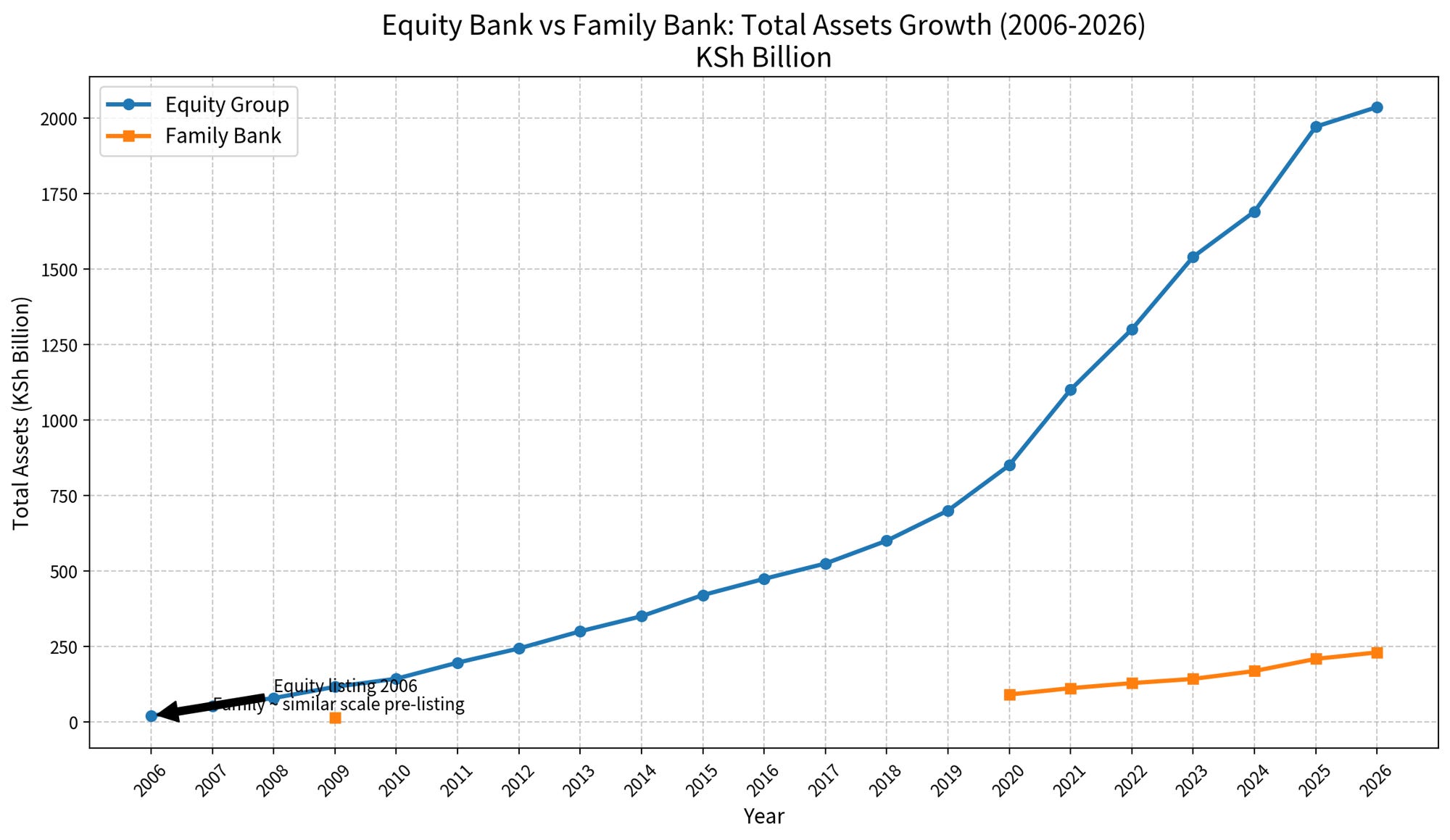
In 2006, Equity Bank and Family Bank operated at roughly similar scale. Equity’s total assets stood at approximately KSh 20 billion shortly after its listing, while Family Bank’s assets were in the KSh 13–20 billion range. Two decades later, the divergence is stark. By mid-2026, Equity Group has grown to KSh 2.04 trillion in total assets — roughly nine times larger than Family Bank’s KSh 230 billion. The key difference? Equity embraced public listing and professional governance early, allowing it to tap capital markets, expand regionally, and scale aggressively. Family Bank, by contrast, remained largely under founder control for far longer. The result is a textbook illustration of how delayed listing and concentrated ownership can dramatically constrain long-term growth, even for an otherwise solid institution.
