
1. The Visionary Builder
Charles Field-Marsham stands as a definitive figure among the “institutional pioneers” who navigated the transformative landscape of Kenya’s economy during the liberalization era of the early 1990s.
Global Pedigree: From Wall Street to Nairobi Field-Marsham brought to Kenya a background forged in the high-stakes environment of global investment banking. Before his arrival in East Africa, he spent his formative professional years at Credit Suisse First Boston (CSFB) in New York, one of the most prestigious financial institutions of the era. During his tenure at CSFB, he was immersed in the rigorous disciplines of international capital markets, corporate finance, and the mechanics of large-scale asset management. This elite training provided him with the analytical framework and strategic foresight necessary to identify the latent potential in emerging economies.
Architecting the Marketplace Upon arriving in Kenya, he did not merely observe the emerging capital markets; he took an active hand in architecting their future. His pivotal move came in 1995 with the founding of Kestrel Capital (East Africa) Limited. At a time when the Nairobi Securities Exchange (NSE) was nascent and largely informal, Kestrel Capital functioned as a critical market-maker.
By leveraging the sophisticated standards he learned on Wall Street, he introduced disciplined brokerage services, high-level corporate advisory, and equity research that adhered to global institutional benchmarks. In doing so, Field-Marsham provided the essential “plumbing” required for the NSE to transition from a localized trading floor into a credible, transparent, and efficient hub capable of attracting deep pools of institutional and foreign capital.
Family and Industrial Legacy: The Biwott Connection
Charles Field-Marsham’s integration into the Kenyan landscape is also marked by his marriage to Rita Field-Marsham, the daughter of the late, influential Kenyan politician Nicholas Biwott. This union placed him within one of Kenya’s most prominent business and political families.
Clarifying Business Entanglements While his personal connection to the Biwott family is well-established, his professional involvement was more limited than speculative reports have suggested.
Field-Marsham held board positions at several companies associated with Nicholas Biwott, including the Yaya Centre, Lima Ltd, and KenolKobil.
While past investigations, such as the Kroll Report, alleged that Field-Marsham acted as a manager or “front” for Biwott’s personal assets, these claims have been consistently disputed by legal representatives and independent research.
Independent inquiries have found no evidence to suggest that there was cross-shareholding or that Field-Marsham managed Biwott’s private wealth or business interests on his behalf.
This distinction is crucial to understanding Field-Marsham’s professional trajectory, as it separates his individual accomplishments in investment banking and industrial development from the broader, and often politically charged, business ecosystem associated with the Biwott estate.

2. The Financial Catalyst: Kestrel Capital
Professionalizing the Brokerage Industry
Field-Marsham’s greatest contribution to the Kenyan financial sector was the elevation of the brokerage industry from a simple transaction-based model to a sophisticated investment advisory service. Under his stewardship, Kestrel Capital became the vital bridge between global institutional investors and the Kenyan private sector. By introducing the same rigorous analytical standards common in major global financial hubs, Kestrel transformed the market experience on the Nairobi Securities Exchange (NSE). The firm played a pivotal role in the Government of Kenya’s major privatization exercises and facilitated significant capital-raising initiatives for cornerstone blue-chip entities, including KCB Group and Diamond Trust Bank. His approach helped establish the “sell-side” research culture in Kenya, ensuring that investors had access to the data, valuation models, and market intelligence necessary to make informed, long-term capital allocations.
Strategic Divergence: The Pivot That Wasn’t
While Kestrel cemented its reputation as the gold standard for equity brokerage and foreign institutional flow, the mid-2020s revealed a distinct strategic divergence in the competitive landscape. As other market leaders—most notably Standard Investment Bank (SIB)—aggressively pivoted toward the specialty funds sector, diversifying into asset management, alternative investments, and specialized financial products, Kestrel remained anchored to its core brokerage and advisory model. This decision to prioritize its trading legacy meant that while Kestrel maintained its prestige and dominance in institutional equity trading, it lagged behind competitors in capturing the burgeoning market for specialized, managed fund products. This strategic “lag” highlighted an industry divide: firms like SIB moved to capture the full value chain of wealth management, whereas Kestrel remained the undisputed titan of the traditional trading floor.
The 2025 Succession: A Landmark Management Buyout
After three decades of building Kestrel Capital into a powerhouse, Field-Marsham executed a final, strategic move to ensure the firm’s longevity. In October 2025, he facilitated a landmark management buyout (MBO), transferring ownership of the firm to a consortium of eight investors operating under Theo Capital Holdings Ltd.
The transition is anchored by two central figures: Eric Ruenji, who serves as the Chairman of Theo Capital Holdings, and Francis Mwangi, who continues in his role as CEO of Kestrel Capital. Each holds a 25% stake in Theo Capital, with the remaining six investors holding stakes ranging from 3.5% to 19%. By handing the reins to the professionals who had grown within the institution, Field-Marsham ensured that Kestrel would remain a homegrown anchor for the capital markets. This successful transition—the first of its kind in Kenyan history—is widely regarded as a gold-standard case study in succession planning, positioning the firm as a robust, locally-owned institution ready to lead the next chapter of Kenya’s digital and regional market expansion.
Theo Capital Holdings assumes ownership of Kestrel Capital
This video documents the landmark 2025 management buyout of Kestrel Capital by Theo Capital Holdings, illustrating the firm’s transition to executive ownership.
The New Era: Ziidi Trader and the Democratization of Capital
Following the successful management buyout of Kestrel Capital, the firm’s new leadership—spearheaded by the team at Theo Capital Holdings—demonstrated an immediate commitment to market modernization. Nowhere was this impact more visible than in the launch of the Ziidi Trader platform, a strategic initiative developed in partnership with Safaricom. Designed to lower the barriers to entry for everyday Kenyans, Ziidi Trader acted as a powerful engine for financial inclusion, quickly proving that technology could bridge the gap between traditional brokerage services and the retail investor.
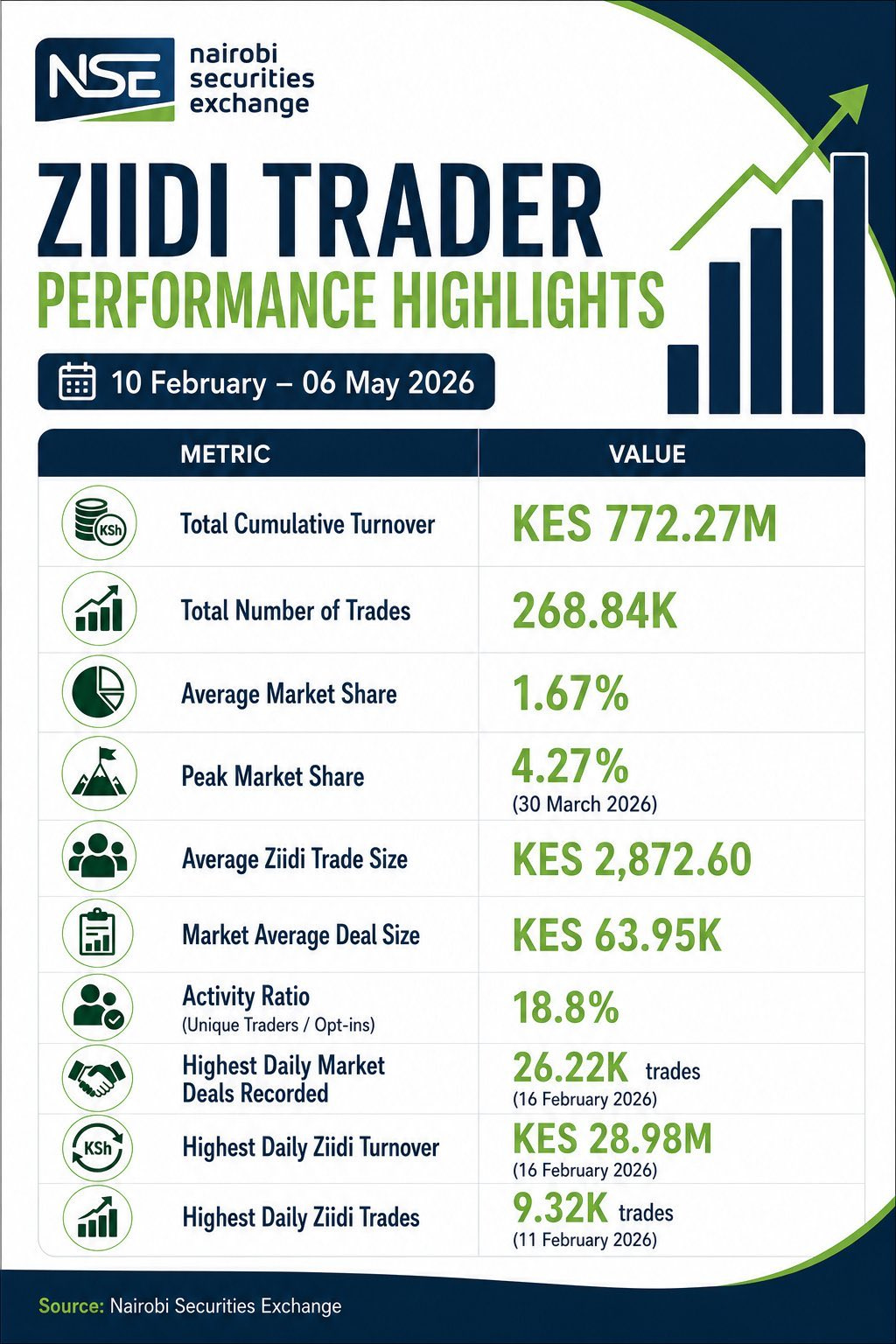
A Market-Shifting Performance The impact of this new management strategy was swift and measurable. In a short period, Ziidi Trader emerged as a significant force, consistently capturing 2% to 4% of daily trading value—a substantial achievement for a retail-focused product in a market historically dominated by large institutional players. The performance highlights from the period of February 10 to May 6, 2026, underscore the platform’s rapid adoption and its success in bringing a new demographic of participants into the capital markets:
Broad Market Engagement: Over the three-month window, the platform facilitated a Total Cumulative Turnover of KES 772.27 million, driven by a massive volume of 268.84K individual trades.
Retail-Centric Dynamics: The platform’s efficacy in capturing small-ticket trades is evident in its Average Ziidi Trade Size of KES 2,872.60. By enabling such small entry points, Ziidi Trader has effectively democratized access to the NSE, allowing retail investors to participate in the market at a scale previously ignored by traditional institutional brokers.
Peak Performance & Activity: The platform showed significant resilience and growth potential, hitting a Peak Market Share of 4.27% on March 30, 2026. Additionally, the platform’s high-engagement nature was reflected in its 18.8% Activity Ratio (the proportion of opt-ins who actively traded), signaling that Ziidi Trader is not just an app, but an active portal for financial participation.
Redefining the Value Chain This pivot toward technology-enabled retail trading represents the “digital dividend” of the new ownership at Kestrel. By successfully integrating with mobile infrastructure, the new leadership has not only addressed the industry’s previous lag in specialized product development but has also created a scalable template for growth. With its Highest Daily Ziidi Turnover reaching KES 28.98 million (recorded on February 16, 2026), Ziidi Trader serves as a powerful testament to the fact that when financial expertise is coupled with accessible technology, the market depth of the Nairobi Securities Exchange can be expanded to include the millions of Kenyans who were previously on the periphery of the financial system.
[Performance data provided by the Nairobi Securities Exchange for the period 10 February – 06 May 2026]
3. The Industrialist: Beyond the Markets
Revitalizing State Assets: Kenya Fluorspar Field-Marsham’s impact on the Kenyan economy was arguably most profound in the industrial sector, where he demonstrated a unique ability to turn distressed assets into engines of national wealth. In 1997, he took the bold step of acquiring the ailing, state-owned fluorspar mine in the Kerio Valley. Under his leadership, the Kenya Fluorspar Company was transformed into one of the country’s top foreign exchange earners, proving that private sector discipline could successfully revitalize paralyzed state enterprises.
Panafrican Equipment Group: Powering Infrastructure Parallel to his mining success, Field-Marsham founded the Panafrican Equipment Group in 1996. Recognizing that East Africa’s economic ascent would be constrained by a lack of heavy-duty machinery, he built the company to serve as the critical supply chain partner for the region’s largest infrastructure and mining projects. By securing partnerships with global original equipment manufacturers (OEMs), Panafrican Equipment became the backbone of heavy machinery distribution in East Africa. The company provided the essential physical “muscle”—from earthmovers to power generation sets—that supported the expansion of roads, energy installations, and agricultural processing plants, further anchoring his reputation as an industrialist who invested in the structural foundations of the Kenyan economy
4. Philanthropy and Education: The KENSAP Legacy
Human Capital Investment Field-Marsham’s influence extends far beyond balance sheets, reaching into the critical “human capital” market. In 2004, he became the principal benefactor and chairman of the Kenya Scholar Access Program (KENSAP). Recognizing that high-achieving, disadvantaged Kenyan students often lacked the bridge to global opportunities, he created a pipeline that has helped over 300 scholars secure placements at world-class institutions, including Harvard, Yale, and MIT. This initiative serves as a profound investment in the future leaders of the very markets he helped establish, ensuring that Kenya’s economic growth is fueled by a new generation of globally educated talent.
The Charles and Rita Field-Marsham Foundation This commitment to long-term societal value is formalized through The Charles and Rita Field-Marsham Foundation. The foundation focuses on high-impact interventions in education, healthcare, and economic development, seeking to address systemic barriers to prosperity. By prioritizing initiatives that foster self-sustainability and innovation, the foundation reflects Field-Marsham’s broader philosophy: that true development is not achieved through temporary aid, but by creating robust systems that empower individuals to realize their full potential.
5. Conclusion: A Blueprint for Emerging Markets
Lessons in Patient Capital Charles Field-Marsham’s career is characterized by a “Warren Buffett-esque” philosophy: patient, persistent, and research-driven. His trajectory offers a masterclass in emerging market investing, demonstrating that the most successful ventures are those built on the structural foundations of a country.
The Lasting Impact on the Kenyan Financial Landscape As he steps back from his primary financial ventures, Field-Marsham leaves behind a market that is significantly more robust, transparent, and globally connected than the one he found in 1993.
The KenolKobil Controversy: A Regulatory Litmus Test
The takeover of KenolKobil by the French firm Rubis Energies in 2018 stands as a defining, albeit turbulent, episode in the history of the Nairobi Securities Exchange (NSE), placing Kestrel Capital under intense regulatory scrutiny.
The Anatomy of the Insider Trading Investigation The investigation, spearheaded by the Capital Markets Authority (CMA), centered on irregular trading patterns detected prior to the official announcement of the Rubis takeover in October 2018. The CMA identified that material, non-public information concerning the deal—specifically the transfer of a 24.99% stake from Wells Petroleum to Rubis—had been leaked to select market participants. These individuals leveraged this sensitive intelligence to accumulate approximately 59 million shares of KenolKobil, anticipating a significant price appreciation upon the deal’s public disclosure.
Kestrel Capital’s Role and Leadership Fallout As the transaction advisor for KenolKobil, Kestrel Capital occupied a position of extreme confidentiality, making the subsequent investigation highly sensitive.
The Former CEO’s Breach: The CMA investigation concluded that the then-CEO, Andre DeSimone, had disclosed material, non-public information regarding the impending takeover to specific stockbroking agents, namely Aly Khan Satchu and Kunal Bid. As a result, DeSimone was fined KES 2.5 million and barred from holding any senior office in a listed company or brokerage for a period of one year.
The Chairman’s Exoneration: Despite the firm’s central role in the transaction, the CMA Board conducted a exhaustive review of the evidence and fully cleared the Chairman, Charles Field-Marsham, of any liability or involvement in insider dealing.
The No-Contest Settlement: Kestrel Capital ultimately entered into a “No Contest Settlement Agreement” with the regulator. To resolve the matter, the firm voluntarily disgorged KES 9.86 million in commissions generated from the trades associated with the irregular activities, opting to settle without formally admitting or denying liability.
Industry-Wide Regulatory Consequences The CMA’s Ad Hoc Committee used this case to send a stern message regarding market integrity.
Sanctions for Participants: Aly Khan Satchu was ordered to disgorge KES 4.69 million in commissions and was banned from holding any key position in a listed company or brokerage for three years.
Legal Precedent: Kunal Bid was required to disgorge KES 23.41 million in gains. Although he later appealed the decision, the Capital Markets Tribunal upheld the findings of insider trading against him in 2024, though it granted a partial refund of the disgorged amount after concluding that his status as a “secondary insider” warranted a less punitive measure than that applied to primary insiders.
This episode remains a pivotal moment for the Kenyan capital markets, illustrating the CMA’s heightened resolve to penalize the exploitation of information asymmetry and uphold the principles of market fairness.
Kestrel Capital KenolKobil scandal CMA investigation details
This video provides contemporary reporting on the initial CMA investigation into the suspicious trading of KenolKobil shares ahead of the Rubis takeover.