
THE GULLIBLE TITAN
Paul Wanderi Ndung’u and the Architecture of Betrayal
“In the brutal arena of Kenyan high finance, a contract is only as binding as the person holding the gavel.”
Introduction: The Billionaire Who Believed in Promises
In the brutal arena of Kenyan high finance, Paul Wanderi Ndung’u is a study in a singular, fatal contradiction: he is a man who understood the mechanics of the market but remained pathologically blind to the malice of its players. Throughout his career—from the boardroom trenches of CMC Motors to the high-stakes vacuum of the SportPesa heist—Ndung’u has been the ultimate “Kingmaker” who consistently played by the rules of a game that had long ago been replaced by raw, predatory opportunism. His trajectory is a sequence of staggering corporate betrayals that begs a haunting question: Was he a victim of a uniquely ruthless system, or was he a gullible architect who believed that his personal loyalty to power brokers would protect his wealth? Time and again, Ndung’u invested his billions into ventures as if they were governed by law, only to realize, when the locks were changed and the assets spirited offshore, that in the Kenyan economic model, a contract is only as binding as the person holding the gavel
Table of Contents: The Gullible Titan
Introduction: The Billionaire Who Believed in Promises
The fatal contradiction of a man who understood markets but was blind to the malice of their players.
Part I: The Quiet Kingmaker
From the accounting desks of Uchumi to the boardrooms of the NSE: How a clinical investor built the Mobicom empire.
Part I (B): The Mobicom Pivot: A Billion-Shilling Gamble
The high-stakes defection from Safaricom to Telkom that revealed the fragility of “distribution as power.”
Part II: Paul Wanderi Ndung’u and the CMC Coup
Activism, insurgency, and the dismantling of the “Old Guard”: A masterclass in boardroom warfare.
Part II A: The Kingmaker’s Debt: From the ICC to Jubilee
The Gigiri Sanctum and the price of political patronage: Financing the Uhuru project.
Part III: The Great Betrayal: The SportPesa Shell Game
From founding stakeholder to marginalized spectator: The anatomy of the Milestone maneuver.
Part III A: The Shadow of the Presidency
Weaponized regulation and the “heist”: How a commercial dispute became a political scandal.
Part IV: The Judicial Gauntlet: A Costly Lesson in Fragility
The London defeat and the finality of the gavel: When legal process meets existential corporate survival.
Part IV (B): The Auction Block: When the “Kingmaker” Becomes the Collateral
The humiliation of the public notice: How a titan’s bedrock assets were liquidated by the hammer.
Part V: The Legacy of the Grounded Titan
The final descent: Why influence borrowed from the state is the most dangerous currency of all.
Part I: The Quiet Kingmaker
Long before the boardroom wars of SportPesa turned his life into a series of high-stakes court filings and auction notices, Paul Wanderi Ndung’u was a master of the “long game.” Unlike the flamboyant disruptors who eventually crowded him out of his own empire, Ndung’u built his initial fortune in the shadows of Kenya’s burgeoning telecommunications revolution.
His ascent was not a product of political theater, but of a keen, almost clinical eye for market cycles. After cutting his teeth as an accounting clerk at Uchumi Supermarkets and later as a chief accountant and investment officer at Pioneer Assurance, Ndung’u learned the precise art of stock picking. He didn’t just invest; he watched. He waited for the volatile swings of the Nairobi Securities Exchange (NSE) to present opportunities—moving with aggressive, leveraged precision into stocks like Kenya Power and Kenya Airways, turning hundreds of thousands of shillings into billions.
But his true masterstroke came in 2001. Recognizing that mobile telephony was the next great frontier in a country still struggling with basic infrastructure, he co-founded Mobicom. As a premier dealer for Safaricom, Mobicom became the vital artery of Kenya’s digital transition. With 42 outlets countrywide, Ndung’u didn’t just sell phones and scratch cards; he built the distribution network that brought mobile connectivity to the masses.
For a decade, Mobicom rode the wave of Safaricom’s explosive subscriber growth, providing Ndung’u with a massive, recurring cash cow. This was the “Kingmaker” phase: he was the silent financier, the shrewd operator who understood the mechanics of the Kenyan market better than most. He used the liquidity from Mobicom to seed a sprawling portfolio—from Crown Paints and Housing Finance to ambitious agricultural ventures like Simba Fresh.
By the time he turned his sights toward the nascent world of sports betting, Paul Wanderi Ndung’u was already a titan. He was a man who believed that the power of capital—the ability to hold a significant stake, demand accountability, and trust in the letter of the law—was the ultimate currency. He did not yet realize that in the world of Kenyan gaming, where the rules could be rewritten overnight, being a “Kingmaker” was not the same as being the “Architect.”
Part I (B): The Mobicom Pivot: A Billion-Shilling Gamble
If the later years of Paul Wanderi Ndung’u’s career were defined by legal battles and boardroom “heists,” the beginning was defined by the intoxicating weight of being a market-maker. By 2010, Ndung’u’s company, Mobicom, was the undisputed king of Safaricom’s retail ecosystem. With 42 flagship shops across the country, Mobicom was the primary artery through which Safaricom’s airtime and SIM cards flowed, handling a staggering 10% of the telco’s entire business—translating to roughly Sh450 million in monthly turnover and Sh5.5 billion annually.
The Billion-Shilling Defection
In a move that stunned the Nairobi Securities Exchange, Ndung’u and his managing director, Joel Kibe, orchestrated a total severance of their relationship with Safaricom to join forces with the then-sleeping giant, Telkom Kenya (Orange). This was not a rash decision; it was a deal three months in the making, negotiated not just in Nairobi, but at the highest levels with France Telecom.
The scale of this pivot was immense. Mobicom was walking away from Sh5.5 billion in annual revenue, gambling that they could leverage Telkom’s “idle capacity” to generate up to Sh20 billion in revenues. As the only Telkom dealer with a national presence among 56 regional competitors, Mobicom positioned itself to become the exclusive “Superdealer,” effectively placing itself in charge of the entire Telkom distribution network.
The Strategic Mirage
Ndung’u’s vision was grand: spend Sh30 million to rebrand all 42 shops in Orange colors and pivot from simple airtime sales to a high-end tech portfolio, including modems, WiMax radios, CDMA gadgets, and fixed-line services. The core of their thesis was that Mobicom could unlock the value of Telkom’s massive infrastructure—specifically the TEAMS and EASSy undersea cables, the terrestrial fiber network, and the government-owned NOFBI.
For Ndung’u, this was the ultimate validation of his power; he believed he was a titan who could dictate the market’s direction. But it also laid the foundation for his greatest vulnerability. He had taken a massive, guaranteed revenue stream and traded it for the promise of future capacity.
The Cost of Overconfidence
This pivot reveals the first major “gullibility” flaw in Ndung’u’s career: he mistook the potential of an asset for the reality of the market. He believed that because he controlled the physical “footprint,” he could force the consumer to follow him to a brand that lacked Safaricom’s digital momentum.
When the industry rapidly shifted toward M-Pesa dominance and digital-first purchases, Mobicom’s massive retail empire—the very asset he had gambled his billions on—began to collapse. The Sh20 billion revenue projection proved to be a mirage, and the “Superdealer” status became a burden as the market moved online, bypassing his brick-and-mortar shops entirely. He had walked away from the winning horse for a “better deal,” failing to see that in the high-stakes game of corporate raiding, he was being used as the spearhead for a market war he was destined to lose. Once he had delivered his distribution network to the other side, his utility—and his leverage—evaporated.: Paul Wanderi Ndung’u and the CMC Coup
In the annals of the Nairobi Securities Exchange, few corporate tremors have been as seismic as the fall of CMC Holdings. While history often fixates on the established “Old Guard”—led by the venerable Jeremiah Kiereini—the true architect of the tectonic shift was Paul Wanderi Ndung’u.
For years, CMC was a closed shop, a bastion of corporate insularity presided over by Kiereini and long-serving MD Martin Forster. To the casual observer, it was a steady blue-chip automaker. To Ndung’u, a burgeoning investor with a keen eye for undervalued assets and a low tolerance for opaque governance, it was a target.
The Anatomy of the Insurgency
Ndung’u did not act in isolation; he functioned as a shrewd coalition-builder. He recognized that the company’s structural integrity was being eroded from within. The catalyst for the battle was a realization that the firm’s profitability was being siphoned off through questionable logistics contracts—most notably those involving Peter Muthoka’s Andy Forwarders—and the existence of hidden, offshore accounts that bypassed regulatory oversight.
Ndung’u’s strategy was twofold:
Consolidation of Voting Power: He quietly built a formidable shareholding block, aligning himself with other disgruntled directors like Joel Kibe.
Regulatory Pressure: By leveraging the Capital Markets Authority (CMA) as a cudgel, Ndung’u transformed a private boardroom spat into a public inquiry. He understood that by exposing the “Old Guard’s” failure in fiduciary duty, he could dismantle their long-standing legitimacy.
The Decisive Strike
When the move to oust the establishment began, it was a masterclass in boardroom warfare. Ndung’u was the engine behind the call for an Extraordinary General Meeting (EGM). He, alongside his allies, presented a dossier of grievances that rendered Kiereini’s position untenable. The accusation was not merely about bad business; it was about the fundamental betrayal of the minority shareholder.
By successfully framing the conflict as a struggle against “corporate capture,” Ndung’u managed to turn the tide of investor sentiment. The eventual exit of Kiereini and the subsequent regulatory fallout proved that Ndung’u was not just playing for dividends—he was playing for control.
The Legacy of the Conflict
For Ndung’u, the CMC battle served as a defining moment in his investment career. It solidified his reputation as an activist investor—someone who would not hesitate to dismantle a board to protect his equity. The aftermath, involving years of legal wrangling, bank freezes, and the eventual disintegration of the CMC entity, became a cautionary tale for Kenyan corporate giants: no empire is too entrenched to be toppled when a challenger understands the levers of shareholder activism.
Part II A: The Kingmaker’s Debt: From the ICC to Jubilee
Paul Wanderi Ndung’u’s fall from grace is particularly bitter because he was not merely an observer of the political order; he was one of its chief architects. To understand the depth of his eventual “betrayal” at SportPesa, one must look back to the years 2010–2013, when he sat at the very heart of the Uhuru Kenyatta political project.
The Gigiri Sanctum
In his own correspondence, Ndung’u has famously described himself as the President’s “friend” during the most perilous era of Kenyatta’s political life. Following the 2007 post-election violence and the subsequent ICC indictment, Kenyatta found himself in a state of professional and political isolation. It was during this period—specifically between 2010 and 2013—that Ndung’u’s private office in Gigiri became a sanctuary for the future President.
By his account, Ndung’u was not just a financier; he was a core strategist. He served as:
The Fundraiser: Host, convenor, and treasurer of the Jubilee fundraising committees for the 2013 and 2017 elections.
The Institutional Anchor: A founder of the Friends of Jubilee Foundation and a Director of the Mount Kenya Foundation—the exclusive clubs that essentially bankrolled the machinery of the Kenyatta presidency.
Financing the ICC Defense
While the formal narrative of the 2013 election focused on the “tyranny of numbers,” the infrastructure of that campaign was built in the shadow of The Hague. Ndung’u’s contribution went beyond the campaign trail; he was part of the intimate circle that navigated the legal and diplomatic costs associated with the ICC cases. He was, in every sense, a man who had invested his capital and his reputation into the “Uhuru Project,” believing that he was buying a future where his business interests would be protected by the very state he helped create.
The Fatal Miscalculation
This history is what makes the SportPesa heist so psychologically bruising for Ndung’u. He had operated under a fundamental, unwritten rule of Kenyan politics: you finance the king, and the king secures the kingdom.
He believed that his role as a “Kingmaker”—the man who opened his office in Gigiri, who managed the purse strings of Jubilee, and who stood by the President during his greatest legal peril—granted him a permanent exemption from the “regulatory wrath” of the state. He didn’t just consider himself a business partner to the President’s family; he considered himself a stakeholder in the Kenyatta presidency itself.
The Great Reversal
When the 2019 crackdown hit SportPesa, Ndung’u initially expected the “Gigiri-era” friendship to intervene. He expected his past loyalty to be the shield that saved his 17% stake. Instead, he discovered that in the Kenyan economic model, political alliances have an expiration date.
The transition from “Friend of the President” to “Target of the State” happened with terrifying speed. The same institutions he helped strengthen—the KRA, the Interior Ministry, and the security apparatus—were turned against his company. For Ndung’u, the realization that he was being “disenfranchised” by the very people he had bankrolled was not just a business loss; it was a profound, personal existential crisis. He had spent years building a kingdom, only to realize that he had inadvertently built the gallows for his own business empire.
Part III: The Great Betrayal: The SportPesa Shell Game
The SportPesa Genesis: A High-Stakes Introduction
The rapid ascent of SportPesa was not solely a product of market demand; it was engineered through a series of high-level introductions that tethered the betting venture to Kenya’s established corporate elite. A pivotal moment in this early trajectory was orchestrated by the late former Nairobi Mayor, Dick Wathika, who served as a critical bridge between the startup’s Bulgarian founders and the local capital market.
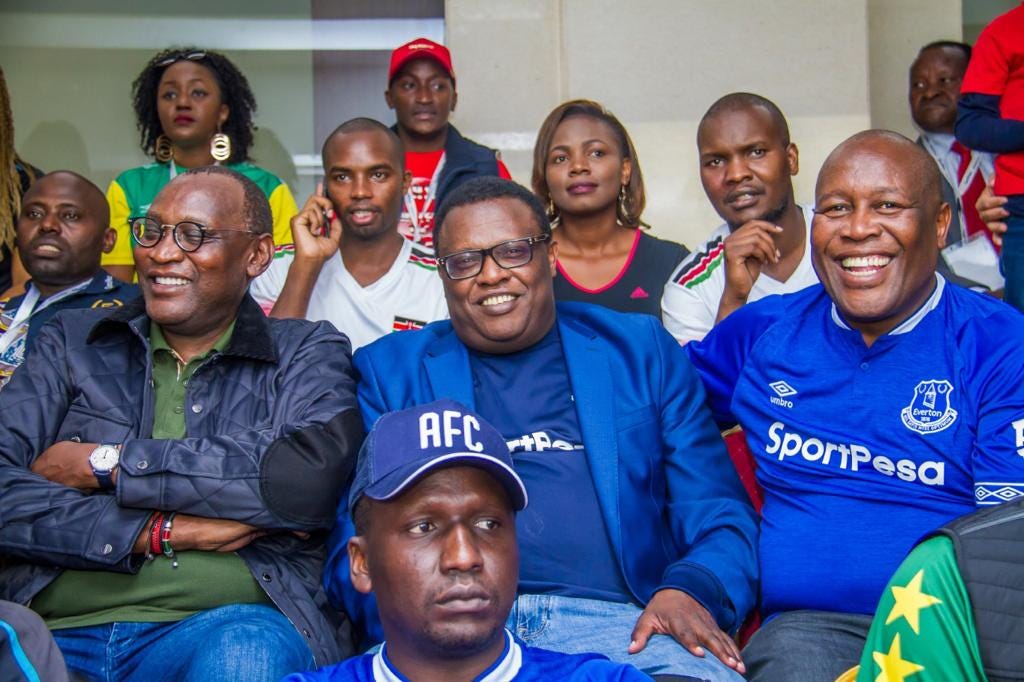
Recognizing the need for deep-pocketed, influential local support to navigate Kenya’s complex regulatory environment, Wathika introduced the founders to tycoon Paul Wanderi Ndung’u. The meeting proved transformative for the company’s capitalization. Impressed by the firm’s potential, Ndung’u stepped in as a cornerstone investor, committing approximately Ksh100 million to acquire a 21 percent stake in Pevans East Africa, the holding company that would soon become a dominant force in the African betting landscape. This investment not only provided the necessary liquidity for SportPesa to scale its operations but also signaled the entry of one of the country’s most formidable business minds into the venture—a partnership that would, years later, dissolve into one of the most bitter corporate feuds in Kenyan history.
If the CMC Motors battle was a traditional boardroom scrap, the SportPesa conflict was a masterclass in corporate “shell games.” Paul Wanderi Ndung’u entered the betting industry as a founding shareholder of Pevans East Africa, the entity that made the name “SportPesa” a household word. He saw himself as a pillar of the business—a man who had helped build a colossus. But as the regulatory noose tightened in 2019, he discovered that while he held the equity, he did not hold the keys.

The Anatomy of the “Milestone” Maneuver
The tipping point arrived when the Kenyan government, citing massive tax arrears and regulatory concerns, suspended the Pevans license. As the company went dark, Ndung’u expected his fellow directors to be in the trenches with him, fighting the Kenya Revenue Authority (KRA) and navigating the regulatory freeze.
Instead, he watched from the sidelines as a new entity—Milestone Games Limited—miraculously emerged to “revive” the SportPesa brand. For Ndung’u, the announcement was a shock; he learned of the company’s resurrection through social media at 9:00 PM on a Friday, exactly like a common gambler.
The Architecture of Exclusion
The maneuver that stunned Ndung’u was both ingenious and ruthless:
The Trademark Transfer: While Pevans East Africa (the Kenyan entity where Ndung’u held a 17% stake) was left to bleed from tax claims, the “SportPesa” brand itself was managed by SportPesa Global Holdings (SPGHL), an offshore entity. Through a series of restructurings, the brand was licensed to the new operator, Milestone.
The Shareholder Dilution: Ndung’u alleged that while the new entity was being built, the original local shareholders were systematically excluded from rights issues and share allotments. He watched his influence drop from a substantial 17% stake in Pevans to a marginalized 0.8% in the new global structure.
The Offshore Pipeline: Ndung’u’s formal protests highlighted a grim reality: his partners had allegedly facilitated the transfer of over $250 million (Sh27 billion) to offshore accounts in the Isle of Man, Dubai, and the Canary Islands—funds that he argued belonged to the Pevans ecosystem he helped build.
The Displaced Founder’s Reality
This was the ultimate betrayal. Ndung’u had been a “Kingmaker” for Safaricom and a “Titan” at CMC, but at SportPesa, he was reduced to a spectator. He found that in the world of high-stakes betting, equity is only as valuable as the person who controls the operating license.
While he focused on traditional shareholder protections, his partners—led by CEO Ronald Karauri—had moved the “operating engine” of the business into a new vehicle where Ndung’u had no seat at the table. He was not just fighting a boardroom rival; he was fighting a ghost. The company he helped capitalize had effectively vacated his presence, leaving him with a minority stake in a hollowed-out corporate shell, while the real profits continued to flow through a separate, rebranded operation.

Part III A: The Shadow of the Presidency
The betrayal of Paul Wanderi Ndung’u was not merely a boardroom maneuver; in his view, it was a state-orchestrated liquidation. As the legal battles intensified, Ndung’u’s filings began to move beyond simple shareholder grievances, leveling explosive accusations that the restructuring of SportPesa was, in essence, a “hostile takeover” facilitated by the highest office in the land.
The Allegation: The Presidency as a Partner
In the narrative of Ndung’u’s legal filings and public complaints, the displacement of original shareholders was not a private dispute between directors. He posited that the 2019 regulatory clampdown—which saw SportPesa’s licenses withdrawn and foreign directors deported—was a deliberate, state-engineered environment designed to drive the company into insolvency.
According to Ndung’u, this “regulatory siege” served a singular purpose: to force Pevans East Africa (PEAL) to its knees so that a new, politically compliant vehicle—Milestone Gaming—could emerge with its shareholding restructured to benefit the inner circle of the Kenyatta administration. He pointed to the emergence of presidential relatives and associates within the new corporate architecture as the “smoking gun.”
The “Heist” Narrative
Ndung’u’s accusations painted a picture of a systematic “heist” involving:
Regulatory Weaponization: The use of the Kenya Revenue Authority (KRA) to freeze accounts and the Betting Control and Licensing Board (BCLB) to suspend licenses, not as a matter of law, but as a lever to force the “old guard” out.
The Kenyatta Connection: Ndung’u drew direct lines between the administration’s interest in the betting sector and the subsequent shift in ownership. He alleged that the transition of assets—Paybill numbers, shortcodes, and brand rights—from PEAL to Milestone was done with the tacit (and sometimes active) approval of government agencies, effectively turning state regulators into accomplices in a private expropriation.
The Silence of the Giants: He frequently cited the “studious silence” of Safaricom as proof of collusion. He argued that a blue-chip entity like Safaricom would never have transferred the lucrative Paybill assets—which held billions in customer deposits—to a new, unproven entity like Milestone without “high-level” political mandates.
The Political Pivot of the Conflict
For Ndung’u, the “betrayal” was compounded by the fact that he was once a prominent fundraiser for the Jubilee party and a key figure in the Mt. Kenya Foundation. He felt he had been “burned” by the very power structure he helped elect.
This transformation of a commercial dispute into an attack on the Presidency is what elevated the SportPesa saga from a standard shareholder brawl to a national political scandal. It frames the “Great Betrayal” not as a disagreement between partners, but as a classic Kenyan power struggle where the state—having realized the immense cash-flow potential of the betting industry—decided that the “business” was simply too important to be left in the hands of the original founders.

Part IV: The Judicial Gauntlet: A Costly Lesson in Fragility
If the SportPesa “shell game” was the betrayal, the years that followed were the punishment. For Paul Wanderi Ndung’u, the path to justice was not through a boardroom coup—as he had attempted at CMC—but through the labyrinthine corridors of the High Court in Nairobi and, eventually, the High Court of Justice in London.
The London Defeat: The Finality of the Gavel
The climax of Ndung’u’s battle arrived on November 18, 2025, when the UK High Court delivered a 190-page judgment that effectively dismantled his case. For years, Ndung’u had staked his reputation and a fortune in legal fees on the argument that his partners had engaged in a fraudulent conspiracy to dilute his stake from 17% to a mere 0.8%. He alleged forgery, oppressive conduct, and a systematic “heist” of the SportPesa brand.
The court, however, saw it differently. Justice Edwin Johnson ruled that the restructuring—the emergency capital raisings, the trademark transfers to the UK-based SPGHL, and the eventual licensing to Milestone—was not a conspiracy, but a commercial necessity. The judge found no evidence of fraud or forgery. Crucially, the court accepted the company’s defense: SportPesa was facing an existential threat from tax arrears and regulatory lockdowns, and the share dilution was a lawful, justified move to prevent total insolvency.
The Cost of “Process”
The London ruling was more than just a loss for Ndung’u; it was a brutal masterclass in the dangers of ignoring governance detail. The court noted that while the company’s actions were ultimately lawful, they had exposed the “governance weaknesses” that had plagued Pevans. However, because Ndung’u could not prove that these procedural slips actually caused his loss—or that he had the financial willingness to step up and provide the emergency capital himself—his case collapsed.
In Nairobi, the story was equally grueling. Ndung’u’s repeated attempts to freeze Milestone’s operations, to set aside consent orders, and to claim a seat at the table were met with consistent pushback. By early 2026, the Court of Appeal had dismissed his bid to challenge key settlement agreements, branding his motions as having “no merit.”
The Billionaire’s Bankruptcy of Strategy
For a man who had built his wealth by betting on the “process” of the Nairobi Securities Exchange, this was the ultimate irony. Ndung’u had operated under the assumption that if he followed the formal rules of shareholder engagement, the system would eventually protect him. He spent years and billions of shillings in legal fees only to be told that:
Survival trumps Equity: When a company is in a genuine “financial emergency,” the board’s duty shifts from protecting the status quo of shareholders to saving the business—even if that means wiping out early investors.
Equity without control is a fiction: In the high-stakes world of Kenyan betting, holding a 17% stake does not grant you a “seat at the table” if you don’t control the operating license or the brand management.
By mid-2026, the man who was once the “Kingmaker” of the mobile money age found himself on the losing side of a corporate war he could not litigate away. His journey serves as the ultimate caution for the “100 Men Who Shaped Our Markets”: in Kenya’s high-growth, high-regulatory environment, wealth is not a static asset. It is a dynamic state of play. When you stop playing, or when you play by the old rules, you aren’t just beaten—you are erased.
Part V: The Legacy of the Grounded Titan
If the Chaka-Nyeri helicopter incident was the zenith of Paul Wanderi Ndung’u’s influence—a moment where he physically rose above the constraints of the state—his current reality is the ultimate descent. The story of Paul Wanderi Ndung’u is not merely a tale of a business empire lost; it is a profound, cautionary parable for the Kenyan elite. It proves that in our political economy, wealth is not a fortress; it is a tether to the current regime.
The Mirage of Independence
For years, Ndung’u operated under the illusion that his capital was his own—that the Mobicom millions and his blue-chip NSE portfolio were independent pillars of power. He believed that by financing the right people, he was building an “insurance policy.” But as the SportPesa heist demonstrated, in a system where political power acts as the ultimate arbiter of property rights, money without political access is not capital; it is a liability.
When the political tide turned and his “Gigiri-era” influence evaporated, he discovered that the state does not honor the debts of the past. The helicopter that once rescued him from the wreckage in Nyeri could not fly him out of the regulatory siege of 2019. The institutions he helped build—the KRA, the judiciary, the licensing boards—became the very tools used to dismantle his stake.
The Lesson of the Grounded Titan
The legacy of Paul Wanderi Ndung’u is defined by a singular, stinging reality: he was the ultimate architect of a system that eventually cannibalized him.
The Governance Trap: Ndung’u spent his career perfecting the art of “clean” corporate warfare—shareholder activism, forensic audits, and legal injunctions. But he was fighting in a system that had evolved past boardrooms into the realm of “state-capture” capitalism. He brought a legal brief to a political knife fight.
The Myth of the Self-Made Titan: His downfall exposes the fragility of the “independent” Kenyan billionaire. He proved that no matter how much you diversify, how many shares you hold, or how much you build, if you do not control the political climate—or if you have fallen out of favor with those who do—your assets can be transferred, diluted, or legislated out of existence overnight.
Conclusion: A Hollow Throne
Today, the legacy of Paul Wanderi Ndung’u serves as a cold wake-up call to the financiers and analysts of the Nairobi Securities Exchange. He stands as a reminder that the “Kingmaker” is, ultimately, just a subject of the King. His story has stripped away the myth of the invincible investor, revealing that in Kenya, influence is not earned through dividends or share counts—it is borrowed from the state.
When the state calls in that debt, or decides that your presence is no longer required, no amount of money or legal argument can keep you aloft. The helicopter has long since stopped coming for him. Paul Wanderi Ndung’u remains our most visible lesson in the dangers of forgetting that in our markets, the law is merely a suggestion, and power is the only currency that never devalues.
Part IV (B): The Auction Block: When the “Kingmaker” Becomes the Collateral
If the legal battles in London and Nairobi were the intellectual phase of Paul Wanderi Ndung’u’s decline, the events of early 2023 provided the physical proof that his era of invincibility had ended. The “Gullible Titan,” who had once been airlifted from disaster by helicopter, was now being grounded by the very mechanism he had mastered: the auctioneer’s hammer.
The Humiliation of the Public Notice
In February 2023, the illusion of Ndung’u’s financial untouchability was shattered by a series of public advertisements in the national dailies. Garam Investments Auctioneers, acting on behalf of lenders, announced the sale of his most prized assets: a prime 2.8-acre residential property in the elite Gigiri estate—the very neighborhood that once served as the “Gigiri Sanctum” for the political elite—and a sprawling 600-acre commercial farm in Laikipia.
These were not just assets; they were symbols of his stature. The Gigiri property, registered under his firm Simba Fresh Produce Limited, was the heart of his personal estate, and the Laikipia farm was a cornerstone of his agricultural ambitions. To see them listed in the “Wanted/Auction” sections of newspapers was a signal to the entire business community: the man who once moved in the clouds was now struggling to stay grounded.
The Irony of the “Simba” Fall
There is a cruel irony in the fact that these properties were lost while he was still embroiled in the fight for his SportPesa stake. Even as he was claiming he had injected KSh 5 billion into the betting giant and accusing his partners of a “heist,” he was simultaneously losing his own bedrock assets to satisfy creditors.
This period exposed the true cost of his “Gullible” strategy:
Liquidity Trap: By pouring his capital into the high-risk, high-regulatory environment of the betting industry and exhausting his remaining reserves on multi-jurisdictional legal battles, Ndung’u had hollowed out his own treasury.
The Loss of the “Moat”: At the height of his influence, his property portfolio acted as a physical representation of his success. When those properties—his home, his land—entered the auction block, it stripped him of the one thing that commands respect in Kenyan business: unencumbered capital.
The New Reality
The auction of his Gigiri and Laikipia holdings signaled the end of the “Kingmaker” aura. In the eyes of the market, Ndung’u had shifted from being a powerful shareholder to being a “distressed asset.” The public nature of these auctions served as a final, humiliating public service announcement: the man who once sat at the right hand of the President was now being cleared out by creditors.
When he looked out his window in Gigiri during those final months, he was no longer looking at an empire; he was looking at an impending deadline. He had spent his life playing a high-stakes game of political patronage and corporate strategy, only to find that when the political favor evaporated, the creditors—unlike the political friends—did not offer extensions. They simply brought the hammer down.
Proximity to power deluded him.
Gideon Muriuki of CO-OP bank might face the same predicaments.
Excellent read! Very well researched.