

Welcome to Boardlot Africa, where we pull back the curtain to reveal the untold stories, power dynamics, and strategic maneuvers shaping the boardrooms of Corporate Africa—subscribe for free to join the conversation. join 1000 other subscribers
We publish Kenya’s Most Consequential Legal, Governance & Labor Disputes and A Series on the 100 Most Influential Kenyan Captains of Industry
As East Africa’s rail networks rapidly modernize, a high-stakes, zero-sum contest for control of regional trade corridors is unfolding—pitting national ambitions, massive debt, and economic leverage against the vision of a seamless logistics powerhouse.
Table of Contents
I. The Zero-Sum Race: The strategic battle for the 200M+ consumer hinterland.
II. Echoes from the Past: Historical legacies of steel, empire, and failed infrastructure.
III. The Contenders: Strategic profiles of Kenya, Tanzania, and Ethiopia.
IV. The Battlefield: Key metrics: speed, cost, and port efficiency.
V. Weapons of the War: Financing, diplomacy, and the tools of dominance.
VI. The Human Ledger: Social costs, displacement, and economic transformation.
VII. The New Scramble: External powers, global influence, and future outlook.
Rails of Rivalry: The Ruthless Battle for East Africa’s Trade Corridors
In the red dust of Narok County on July 1, 2026, Kenya’s President William Ruto and officials broke ground on one of the region’s most ambitious infrastructure projects: the Naivasha–Kisumu–Malaba Standard Gauge Railway. At an estimated Ksh 700 billion, this extension aims to link Kenya’s existing SGR network all the way to the Ugandan border, piercing through nine counties and positioning Mombasa as the undisputed gateway to East Africa’s interior.

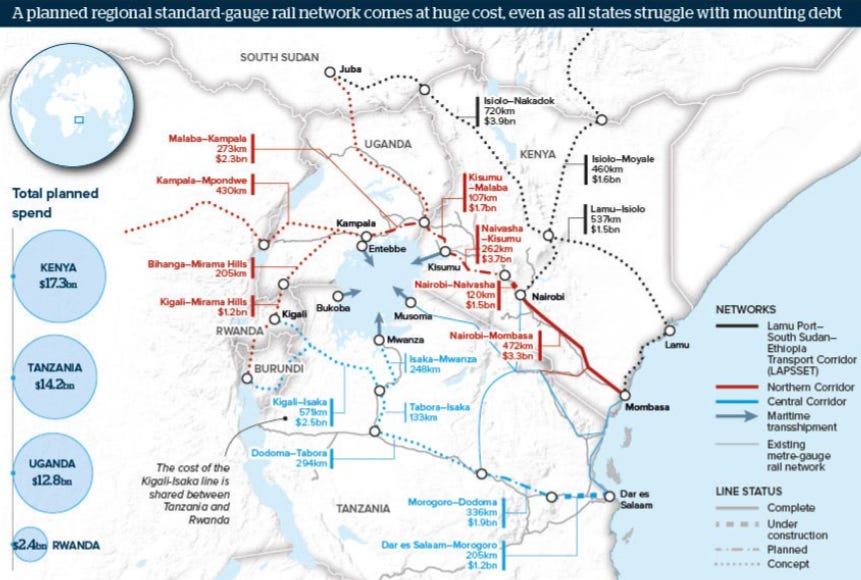
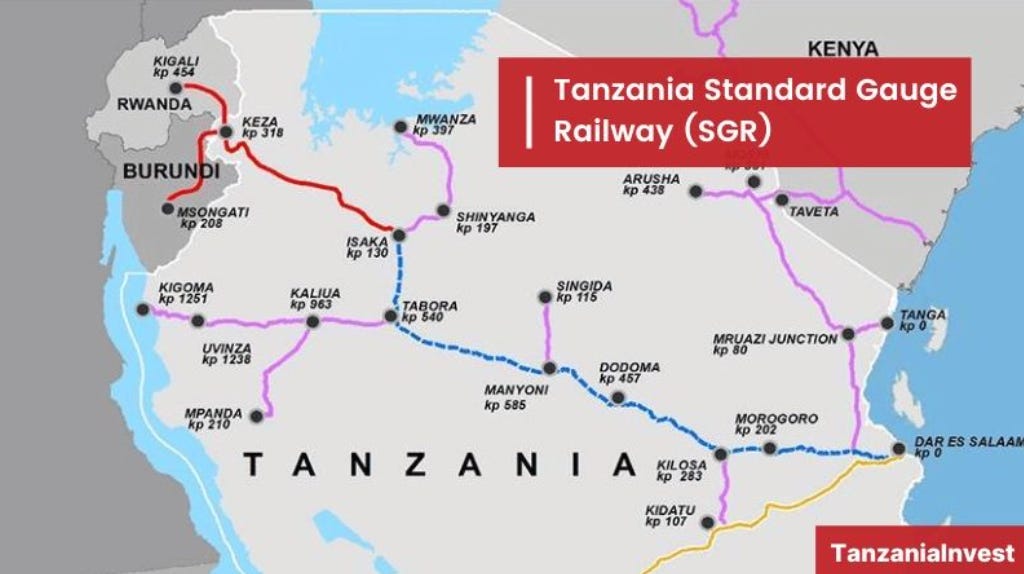
Just across the border, another story unfolds. Tanzania’s Standard Gauge Railway is no longer a plan on paper. Trains already race between Dar es Salaam and Dodoma at modern speeds, with sections pushing toward Tabora, Isaka, and Mwanza. New financing deals—over $2 billion recently syndicated—and steady progress on extensions toward Rwanda, Burundi, and the DRC signal a confident push to make Dar es Salaam the faster, cheaper choice for landlocked cargo.
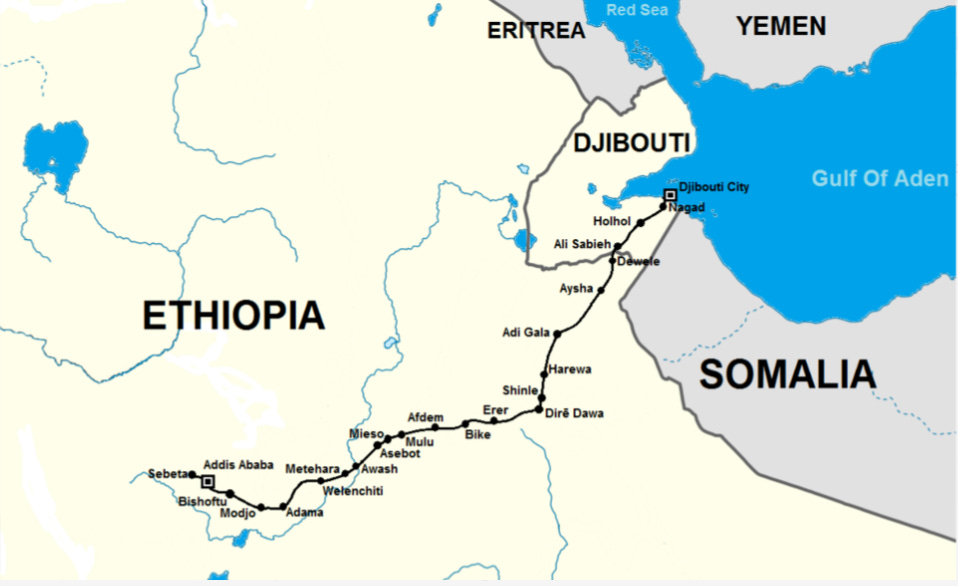
Farther north, Ethiopia relies on its operational Addis Ababa–Djibouti railway, a Chinese-built lifeline carrying the vast majority of the country’s trade. But Addis is hedging its bets. Plans for connections via Kenya’s LAPSSET corridor—to Lamu port and beyond—hint at a broader strategy to reduce single-port dependence and open new southern routes.
This is not mere infrastructure development. This is a high-stakes, zero-sum contest for control of trade routes that could determine which nation becomes East Africa’s undisputed logistics powerhouse for generations. The battlefield spans the Northern Corridor (Kenya’s Mombasa-led network) and the Central Corridor (Tanzania’s Dar es Salaam system), with Ethiopia as both a massive prize market and an ambitious player seeking alternatives. The contestants are fighting over cargo from Uganda, Rwanda, Burundi, eastern DRC, and South Sudan—a hinterland of more than 200 million people and growing economies hungry for reliable, affordable access to the Indian Ocean. For landlocked nations, the choice is existential. Every extra day a container sits in port or on a potholed road means higher costs passed to consumers and lost competitiveness for exporters.
Every tonne shifted from one corridor to another means lost revenue for ports, railways, truckers, and governments. Billions of dollars in transit fees, port dues, logistics jobs, and industrial spillovers hang in the balance.This rivalry echoes older scrambles—colonial railways carved for extraction, the 1970s TAZARA line built with Chinese help to bypass white-minority regimes—but it plays out with modern weapons: standard-gauge steel, electrified lines, syndicated loans from diverse financiers, diplomatic lobbying, and ruthless efficiency campaigns. Kenya leverages its established Mombasa volume and strategic LAPSSET ambitions.
Tanzania bets on shorter distances to key markets, rapid SGR rollout, and diversified contractors (Chinese and Turkish). Ethiopia maneuvers for options beyond Djibouti, eyeing Lamu as a potential game-changer.Yet the race carries risks: mounting debt, duplicated capacity, community displacements, environmental strain, and the perennial temptation of political patronage over pragmatic integration. The East African Community talks of seamless rail networks, but national ambitions often speak louder.In the coming chapters, we will follow the steel, the money, the politics, and the people caught in this contest. Because in East Africa today, the future is not being written in boardrooms or capitals alone. It is being laid, mile by mile, in railway ballast and bold political will.Who will win the race to the sea—and what will victory cost the region? The tracks are moving. The competition is just beginning.

Part 2: Echoes from the Past – The Long Shadow of Steel and Ambition:
The red soil of East Africa has long known the bite of railway spikes. Long before the sleek Chinese-built Standard Gauge Railways of today, iron rails cut through savanna and highlands in service of empire. The British Uganda Railway, completed in 1901, was a feat of colonial engineering—and brutality—that linked Mombasa to Lake Victoria. It ferried cotton, coffee, and ivory outward while importing administrators and soldiers inward. Thousands of Indian laborers died building it, and the line became the backbone of British East Africa’s economy.
In German East Africa (now Tanzania), parallel efforts created meter-gauge networks that fed Dar es Salaam. After independence, these lines aged into relics. Maintenance faltered, speeds slowed to a crawl, and trucks took over the roads. By the late 20th century, the old railways symbolized decline: unreliable, loss-making, and increasingly irrelevant in a continent opening to global trade.
One exception stood out. In the 1970s, newly independent Tanzania and Zambia turned to China for the TAZARA railway, a 1,860-kilometer lifeline built to bypass white-ruled Rhodesia and South Africa. Completed in 1976 with massive Chinese support, it was a geopolitical statement as much as infrastructure: South-South solidarity in action. Yet even TAZARA eventually suffered from underinvestment, mismanagement, and competition from roads.
Fast-forward to the 21st century. China returned, this time with commercial muscle under the Belt and Road Initiative. Kenya’s Mombasa–Nairobi SGR (the Madaraka Express), inaugurated in 2017, marked the dawn of the new era. Financed largely by Chinese loans and built by Chinese firms, it slashed travel time from Mombasa to Nairobi dramatically and promised to revitalize the Northern Corridor. Ethiopia followed with the Addis Ababa–Djibouti line, operational from 2018, finally giving the landlocked giant a modern rail lifeline to the sea. Tanzania, not to be outdone, launched its own ambitious SGR program aimed squarely at the Central Corridor.
What began as regional integration dreams under the East African Railway Master Plan quickly morphed into something sharper: national competition. Kenya poured resources into extending its network westward toward Uganda, eyeing dominance over the traditional Northern Corridor. Tanzania accelerated construction from Dar es Salaam inland and westward, courting the same landlocked customers with promises of shorter distances and newer infrastructure. Ethiopia, heavily dependent on Djibouti, began exploring diversification—most notably through the long-gestating LAPSSET corridor that could one day link Lamu port directly to its southern regions.
This is where the ruthlessness enters the story. Infrastructure has never been neutral. Colonial rails extracted wealth for distant capitals. Post-independence lines often served political patronage more than efficiency. Today’s SGR projects blend genuine development ambition with hard-edged calculations of revenue, influence, and prestige. Leaders stake their legacies on them. Billions in loans hang in the balance. Neighboring countries are lobbied aggressively: “Route your cargo through us—we’re faster, cheaper, more reliable.”
Yet the past also whispers warnings. Debt from the first wave of SGR projects has strained budgets. Land acquisition sparked local resistance. Environmental costs—disrupted wildlife corridors, displaced farmers—remain real. And the old meter-gauge ghosts still haunt the region: underused tracks that once promised transformation but delivered mixed results.
The new railways are faster, heavier, and electrified. But the fundamental contest remains the same one that has shaped East Africa for over a century: who controls the routes to the sea, and who reaps the rewards of that control? As Kenya breaks new ground in Narok and Tanzania pushes steel deeper into the interior, history is not just background. It is the terrain on which today’s battle is being fought.

Part 3: The Contenders – Profiles of Ruthless Ambition
Three nations, three strategies, one prize: mastery of the routes that carry East Africa’s lifeblood. The competition is not polite cooperation under the East African Community banner. It is a calculated, sometimes cutthroat contest for cargo volumes, transit revenues, and long-term economic centrality.
Kenya: The Established Powerhouse with Western Reach
Kenya entered the modern railway era first and fastest. The Mombasa–Nairobi SGR, operational since 2017, remains the flagship. Mombasa port has historically handled the lion’s share of regional cargo, serving Uganda, Rwanda, and beyond via the Northern Corridor. Kenya’s bet is continuity plus expansion. The Naivasha–Kisumu–Malaba extension now under construction aims to bring standard-gauge steel right to Uganda’s doorstep, slashing transit times and costs for the landlocked north.
Beyond that lies the ambitious LAPSSET corridor. Lamu port’s first berth is operational, roads are advancing, and rail plans envision a new northern artery linking to South Sudan and Ethiopia. Kenya is diversifying its financing—reducing reliance on fresh Chinese loans through securitization and domestic revenue tools—while still leveraging established port infrastructure and diplomatic relationships.
Kenya’s ruthless edge is incumbency. It can point to proven volumes and an existing ecosystem of truckers, clearing agents, and logistics firms. But challenges bite hard: past debt concerns on the first SGR phases, slower progress on western extensions until the recent restart, and security issues slowing LAPSSET in northern Kenya. The strategy is clear: use scale and momentum to lock in traditional customers while opening new northern frontiers.

Tanzania: The Agile Challenger Building Speed
Tanzania is playing the role of disruptor with impressive momentum. Its SGR is no longer aspirational. Passenger services run reliably between Dar es Salaam and Dodoma, with freight capacity scaling up. Sections to Tabora and Isaka–Mwanza are advancing rapidly, backed by a mix of Chinese and Turkish contractors and fresh international financing packages.
The Central Corridor’s geographic advantage is real: shorter distances to Kigali, Bujumbura, and parts of eastern DRC. Tanzania is courting these markets aggressively—offering competitive transit deals, improving port efficiency at Dar es Salaam, and extending lines toward multiple neighbors simultaneously. Recent MoUs, such as with Uganda, signal a push even into traditional Northern Corridor territory.
Tanzania’s ruthlessness shows in execution. It diversified contractors to maintain pace, secured syndicated loans to avoid over-reliance on one partner, and markets its SGR as the modern, reliable alternative. Critics point to heavy overall investment and the need to prove sustained freight uptake, but the trajectory is upward. Dar es Salaam is positioning itself as the efficient, forward-looking gateway.
Ethiopia: The Landlocked Giant Seeking Options
Ethiopia plays a dual role: massive potential customer and ambitious regional actor. The Addis Ababa–Djibouti railway transformed its logistics, moving goods reliably to the sea and supporting the country’s export ambitions in manufacturing and agriculture. Yet heavy dependence on a single port creates vulnerability—hence the diversification drive.
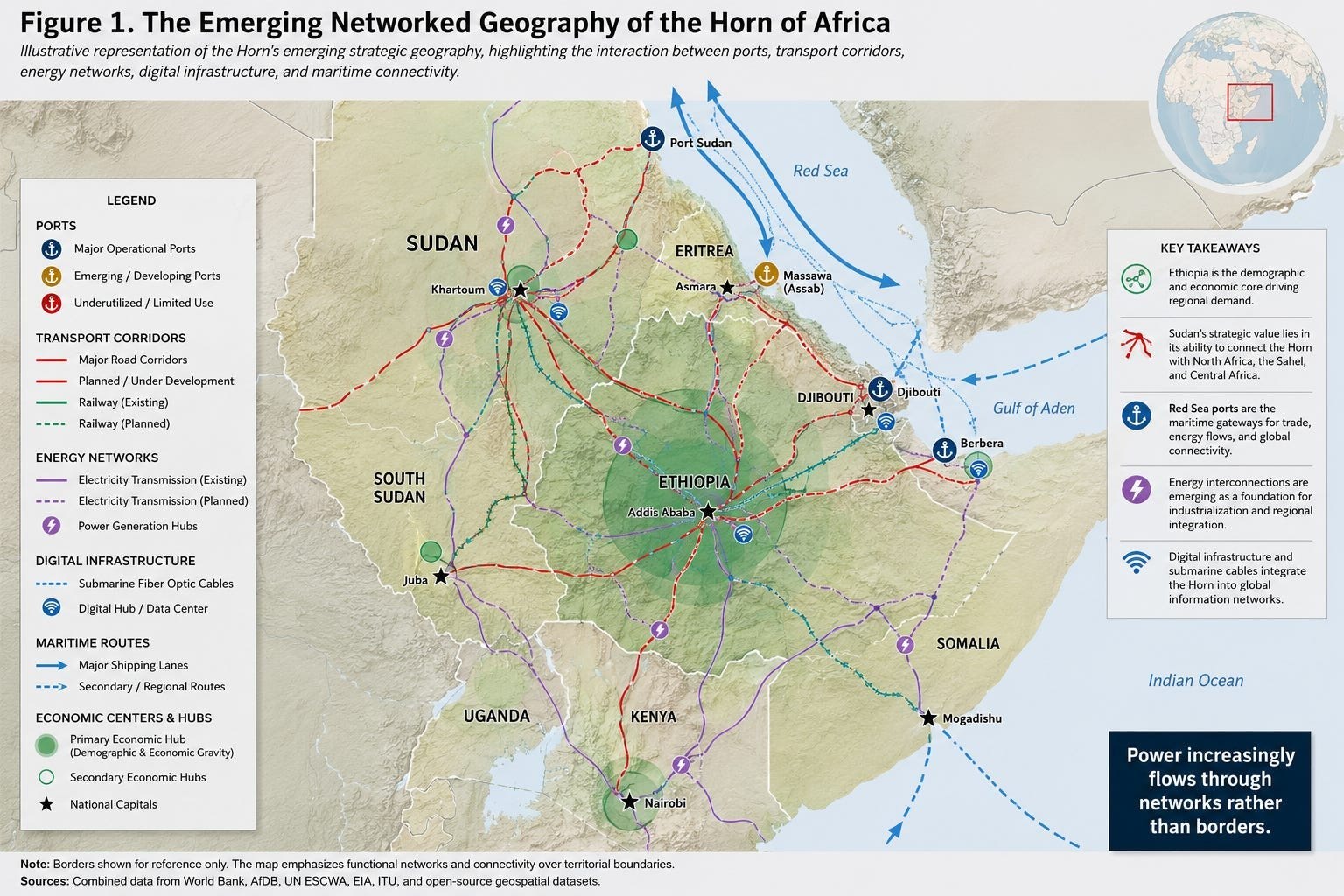
LAPSSET represents Ethiopia’s southern bet: potential rail and road links via Moyale to Lamu, offering an alternative Indian Ocean outlet and unlocking southern regions. Internal rail expansions (Modjo–Hawassa and others) strengthen the national network while feeding into broader corridor plans. Ethiopia leverages its economic size and political weight to negotiate better terms across routes.Its ruthless pragmatism lies in multi-alignment: maintaining the Djibouti lifeline while actively exploring Kenya (LAPSSET), potential Somaliland options, and deeper EAC ties. Ethiopia does not merely choose corridors; it forces them to compete for its cargo.The contest among these three is intensifying. Kenya defends its northern dominance and expands west and north. Tanzania accelerates construction and diplomatic outreach to peel away market share. Ethiopia keeps options open, using its scale as leverage. In the next section, we examine the battlefield itself: the landlocked prize nations and the metrics—time, cost, reliability—by which this war will be won or lost.
Part 4: The Battlefield – The Prize and the Metrics of Victory
At the heart of this railway war lies a vast, landlocked prize. Uganda, Rwanda, Burundi, eastern Democratic Republic of Congo, South Sudan—and to a degree, Ethiopia’s own diversification needs—form a hinterland of over 200 million people with rapidly expanding economies. These nations generate massive import needs (fuel, machinery, consumer goods) and export potential (minerals, coffee, tea, agricultural produce). Every container moved, every tonne of freight routed, represents revenue for ports, railways, governments, and logistics chains.
The competition is brutal because the margins are thin and the stakes enormous. Landlocked countries do not choose corridors out of loyalty. They choose on cold calculations of total landed cost, transit time, reliability, security, and customs efficiency. A few days’ difference or a percentage point in cost can shift millions in annual cargo.
Key Battle Metrics
Distance and Speed: Tanzania often claims shorter road/rail distances to Kigali and Bujumbura. Kenya counters with established Mombasa–Kampala routes and the promise of seamless new SGR extensions. Rail dramatically outperforms trucks: modern SGR can move freight at 100+ km/h with far higher capacity and lower unit costs once running at scale.
Port Efficiency and Dwell Times: Mombasa has historically led in volume but faces congestion challenges. Dar es Salaam has pushed reforms and benefits from newer infrastructure. Delays at either port—sometimes weeks for offloading or clearing—can erase any rail advantage.
Total Logistics Cost: Regional transport costs remain high (often cited around $1.8 per km per container versus a global ideal near $1). Rail promises sharp reductions, but only if last-mile trucking, border crossings, and bribes are tamed. One-stop border posts and digital customs systems become competitive weapons.
Reliability and Security: Consistent schedules win long-term contracts. Road insecurity on some corridors or political instability can tip decisions. Rail’s predictability is a major selling point.
Transit Fees and Incentives: Governments offer deals—lower tariffs, dedicated trains, or guaranteed volumes—to lure cargo. Diplomatic visits and government-to-government agreements (such as recent fuel import shifts) are part of the arsenal.
The Landlocked Players as Kingmakers
Uganda sits at the crossroads and has long leaned Northern Corridor, but is open to Tanzanian overtures via new rail links. Rwanda has balanced both, famously pragmatic about costs. Burundi and eastern DRC, with shorter paths to Dar, are prime targets for Tanzania’s westward push. South Sudan looks north to Kenya and LAPSSET.
The ruthlessness appears in how aggressively the coastal states court these governments. Delegations fly in with presentations comparing transit times down to the hour. Ports tweak tariffs. Railway operators court major shippers and mining companies. Behind closed doors, broader geopolitical favors and infrastructure bundling come into play.
Yet the battlefield has traps. Overcapacity looms—if both Kenya and Tanzania build parallel high-capacity lines, freight may split thinly, undermining debt repayment for both. Environmental and social costs mount as new lines cut through farmland and wildlife corridors. Local communities demand benefits or resist displacement.For now, the race is live. Kenya’s new western extension aims to cement Northern dominance. Tanzania’s advancing network and financing momentum position it as the rising challenger. Ethiopia’s choices will ripple across the map. The next decisive battles will be measured not just in steel laid, but in cargo manifests signed and containers rerouted.In the sections ahead, we turn to the human and geopolitical layers: the people living along these new lines, the external powers fueling the contest, and the possible futures this rivalry could forge for East Africa.
Part 5: Weapons of the War – Financing, Diplomacy, and the Tools of Dominance
This is no gentleman’s contest fought solely on engineering merit. The railway rivalry deploys an arsenal of modern weapons: capital, diplomacy, incentives, and narrative control. Victory belongs to the corridor that combines steel with shrewd execution.
Financing as Firepower
Early phases relied heavily on Chinese loans and contractors. Kenya’s first SGR bore that hallmark; so did Ethiopia’s Djibouti line and Tanzania’s initial sections. But strategies have evolved. Kenya has shifted toward securitizing railway levies and renegotiated terms to restart extensions without fresh large-scale Chinese borrowing. Tanzania has blended sources—Chinese firms for some segments, Turkish contractors (such as Yapı Merkezi) for others—and recently locked in over $2 billion in syndicated financing with export credit support. Ethiopia similarly balances partners while expanding its national network. The ruthless calculus is clear: diversify funders to maintain momentum and negotiating leverage, while avoiding debt traps that could hand effective control to creditors.
Contractors and Technology
Chinese state firms remain central, bringing speed and scale. Yet introducing Turkish and other players allows cost competition and technology transfer bargaining. Electrified SGR lines promise lower operating costs and higher speeds than older systems. The winner will be the one whose trains run closest to advertised capacity with fewest breakdowns.
Diplomacy and Cargo Capture
Coastal states court landlocked capitals relentlessly. Delegations highlight comparative advantages—shorter routes, faster clearance, dedicated freight windows. Government-to-government fuel deals, mining company contracts, and joint infrastructure pacts serve as battle standards. Rwanda’s recent large fuel import shift toward Mombasa despite Dar’s distance shows how port efficiency and reliability can override pure geography. Tanzania counters with MoUs and targeted extensions toward Burundi and Uganda. Ethiopia leverages its size, keeping multiple corridors competing for its growing trade volumes.
Incentives and Soft Power
Lower transit tariffs, one-stop border facilities, digital tracking, and security guarantees become competitive edges. Marketing campaigns position one port as modern and efficient, the other as established and high-volume. Behind the scenes, broader ties—trade preferences, political support, or bundled investments—sweeten deals.
The Double-Edged Sword
These weapons carry risks. Aggressive borrowing fuels debt sustainability debates. Rapid construction can sideline environmental and community consultations, breeding local resentment. Overpromising on timelines or capacity risks credibility. And the ultimate danger is duplication: parallel world-class corridors splitting thin freight volumes, leaving both heavily indebted with underutilized assets.
The war’s weapons are therefore not just tracks and trains, but the ability to deliver reliable, cost-effective service at scale while managing political and financial fallout. Kenya wields incumbency and northern reach. Tanzania deploys speed of execution and geographic advantages. Ethiopia plays the long game of optionality.
As construction accelerates and cargo begins shifting in measurable ways, the human dimension comes into focus. In the next section, we meet the people living—and sometimes suffering—along these new steel arteries, and the broader geopolitical players shaping the contest from afar. The rails are transforming landscapes and lives. The question is whether the transformation ultimately benefits the many or entrenches new winners and losers.

Part 6: The Human Ledger – Stories from the Tracks, Gains, and Hidden Costs
Behind the grand strategies and ribbon-cuttings are millions of lives being reshaped, one rail tie at a time. The human and economic ledger of this railway rivalry is complex: undeniable transformation mixed with real pain, opportunity with displacement.
Winners on the Ground
For logistics workers and traders, the shift from trucks to rail is revolutionary. A container that once crawled for days on potholed roads now moves reliably at speed. Farmers in western Kenya or central Tanzania can reach export markets faster and cheaper, potentially raising incomes. Port cities buzz with activity—Mombasa’s established ecosystem and Dar es Salaam’s scaling operations support thousands of jobs in handling, clearing, and services. Along new lines, towns near stations anticipate boom times: hotels, warehouses, small industries.
Landlocked consumers benefit when costs fall. Cheaper transport of fuel, fertilizer, and medicine ripples into lower prices and greater competitiveness for exporters of coffee, minerals, or horticulture. Governments eye increased tax revenue and reduced road maintenance burdens as heavy freight shifts to rail.
The Human Cost
Construction exacts a price. In Narok and other counties, families face land acquisition for the new Kenyan extension. Compensation processes can be slow or contested; some lose farmland that sustained generations. Wildlife corridors in the Serengeti–Maasai Mara ecosystem and Rift Valley face pressure, threatening tourism-dependent communities. In Tanzania’s expanding western sections, similar stories unfold—villages relocated, grazing lands bisected, sacred sites affected.Truck drivers and small haulage businesses, the backbone of the old system, risk obsolescence on main corridors. Many may pivot to last-mile feeder routes, but the transition is painful. Informal border economies built around trucking could shrink. Safety concerns persist: construction accidents, and the long-term risk that underutilized parallel lines lead to maintenance shortfalls or white-elephant projects.
Economic Multipliers and Risks
Successful corridors could catalyze industrial parks, special economic zones, and skills development around rail technology and logistics. Kenya and Tanzania both talk of broader Vision 2030-style goals tied to these projects. Yet the debt burden is the shadow. Large loans, even restructured, require reliable revenue. If cargo volumes disappoint due to splitting between competing lines, governments may face tough choices on subsidies or tariffs that ultimately hit citizens.
Local content requirements—jobs and contracts for nationals—vary in delivery. Technology transfer from Chinese and Turkish partners offers long-term skills gains, but early phases often rely heavily on foreign expertise.
The human ledger is not zero-sum. A more efficient corridor benefits shippers region-wide, but the aggressive national push creates localized losers and risks overcapacity. Communities along the winning routes may thrive; those on slower or bypassed paths could stagnate. Leaders must balance ruthless pursuit of national advantage with equitable sharing of gains—otherwise, resentment festers and undermines the very connectivity they seek.
As these human stories play out on the ground, a parallel drama unfolds in capitals and boardrooms far beyond East Africa. External powers are not neutral observers; they supply the capital, contractors, and sometimes the geopolitical wind that fills the sails of these competing corridors. The next section examines the new scramble—China’s enduring role, Turkey’s rising presence, and other actors shaping the rails of rivalry.
Part 7: External Powers – The New Scramble for Influence
No great infrastructure contest in Africa unfolds in isolation. Behind Kenya’s steel, Tanzania’s momentum, and Ethiopia’s diversification sits a web of global actors supplying money, machines, expertise—and advancing their own strategic interests.
China: The Enduring Architect
Beijing remains the dominant player. Its firms built the foundational SGR lines across the region, financed largely through concessional and commercial loans. The model delivered rapid results: Kenya’s Madaraka Express, Ethiopia’s Djibouti lifeline, and core sections of Tanzania’s network. China gains ports of call for its Belt and Road vision, markets for its rail technology and rolling stock, and diplomatic goodwill. Yet both Kenya and Tanzania have shown a desire to diversify away from exclusive dependence, renegotiating terms and blending financiers. The ruthless edge for China is scale and speed; for African states, it is learning to extract better conditions over time.
Turkey: The Agile New Entrant
Turkish companies, notably Yapı Merkezi, have taken significant roles in Tanzania’s SGR phases, supported by Turkish export credit. This diversification gives Tanzania negotiating leverage and introduces competition into what was once a near-monopoly space. Turkey gains construction revenue, international prestige for its engineering firms, and stronger ties in a strategically vital region. Its involvement underscores how the railway race has opened doors for middle powers.
Other Actors and Interests
Gulf states eye logistics and port synergies. Western donors and development banks appear more selectively, often favoring governance reforms or environmental standards. Private capital, through syndicated loans, is playing a larger role—evidence that projects are maturing beyond pure state-to-state deals. India and others explore niche opportunities in rail components or operations.
Geopolitical Undercurrents
These railways are more than commercial. They shape influence over critical supply chains (minerals from the Copper Belt and Great Lakes), security corridors, and regional alignments. Control of efficient trade routes translates into soft power: who sets standards, who benefits from transit fees, who becomes the indispensable partner for landlocked states. External backers understand this. Financing one corridor over another can tilt the balance of regional power.
The African states are not passive. They play suitors against each other—leveraging Chinese scale against Turkish agility or Western standards—to secure better terms. This multi-alignment is itself a form of agency in a new scramble that echoes colonial-era rivalries but with African governments firmly in the driver’s seat.
The external dimension adds volatility. Global interest rate shifts, commodity cycles, or great-power tensions can alter financing availability overnight. Yet it also accelerates progress: competition among external providers can deliver faster, cheaper, or greener infrastructure.
As the steel advances and external players maneuver, the region stands at a crossroads. The final section examines possible futures—dominance by one corridor, uneasy coexistence, or deeper integration—and what this ruthless railway race ultimately means for East Africa’s destiny. The tracks are being laid. The question is whether they will bind the region together or become new lines of division in the contest for its future wealth.
Debt Trap Dynamics – The Hidden Ledger of the Railway Race
The gleaming new tracks and high-speed trains mask a parallel financial reality: East Africa’s railway resurgence is built on massive borrowing. The “debt trap” debate—whether these projects empower nations or ensnare them in cycles of dependency—looms over every groundbreaking ceremony.
Scale and Structure of the Debt
Kenya’s original Mombasa–Nairobi SGR carried a roughly $3.8 billion price tag, financed predominantly by China Exim Bank loans. The new Naivasha–Kisumu–Malaba extension (Ksh 700 billion / ~$5.4 billion) reflects a shift: greater use of domestic revenue tools, securitization of the Railway Development Levy, and renegotiated terms to reduce fresh external borrowing. Tanzania’s SGR program exceeds $10 billion overall, funded through a mix of Chinese facilities, Turkish export credits, and recent $2+ billion syndicated commercial packages with European export credit agency backing. Ethiopia’s Addis–Djibouti line followed a similar Chinese-financed model.These are not uniform “traps.” Loan terms vary—some concessional with long grace periods, others closer to commercial rates. Repayment is typically tied to project revenues (freight and passenger tariffs) plus government guarantees, creating direct pressure on fiscal space if usage falls short of projections.
Risk Factors in Play
Revenue Realism: Projections assume rapid cargo shifts from road to rail and strong regional growth. If competing corridors split volumes, or if last-mile and border inefficiencies persist, income may disappoint. Kenya faced criticism over early SGR utilization and debt servicing; Tanzania must prove its expanding network generates sufficient freight tonnes.
Currency and Fiscal Pressure: Loans are often in foreign currency (USD or RMB) while revenues are partly in local currency, exposing governments to exchange rate volatility. Broader public debt levels in the region leave limited buffers for shocks.
Contingent Liabilities: Government guarantees on public-private elements or underperforming state-owned operators can suddenly hit budgets.
Opportunity Cost: Capital locked into rail reduces fiscal room for health, education, or climate resilience—especially if projects take longer than planned to reach profitability.
Mitigation and Agency
East African governments are adapting. Kenya’s pivot to blended and domestic financing for western extensions shows learning from early phases. Tanzania’s diversification of contractors and financiers spreads risk. Ethiopia uses its economic scale to negotiate across multiple partners. Regional bodies and newer lenders (commercial syndicates, development banks) introduce more scrutiny on feasibility studies and governance.
Critics of the “debt trap” narrative argue it understates African agency and the genuine infrastructure gap these projects address. Rail can deliver structural economic gains—lower logistics costs (a major drag on competitiveness), industrial clustering, and job creation—that outweigh debt service if well executed. Supporters of the trap framing point to cases where port or rail assets faced pressure during repayment difficulties elsewhere, and to the strategic leverage long-term debt can confer on creditors.
Current 2026 Outlook
As of mid-2026, no major East African SGR project has collapsed into overt asset seizure, but servicing pressures are real. Kenya has restructured elements successfully. Tanzania’s recent financing deals suggest market confidence in its trajectory. The ultimate test will be operational performance: Can these lines consistently move enough freight at competitive prices to service debts while delivering lower end-to-end costs for shippers?The debt dynamics reveal the ruthlessness beneath the ambition. Leaders bet today’s borrowing on tomorrow’s growth, often prioritizing national prestige and short-term political wins. Success could validate the strategy and break the high-cost logistics trap that has held the region back. Failure risks fiscal strain, reduced policy sovereignty, and disillusioned publics. In this railway race, the financial rails may prove as decisive as the physical ones.
Part 8: The Kingmaker – Museveni and Uganda’s Pivotal Role in the Rail Wars:
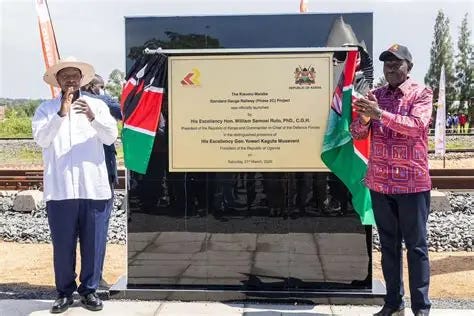
No analysis of East Africa’s railway rivalry is complete without Yoweri Museveni, Uganda’s long-serving president and one of the region’s most influential political figures. Uganda sits at the geographic and economic heart of the contest. As the largest and most central landlocked player, its cargo volumes make it the single biggest prize—and Museveni’s strategic pragmatism turns Kampala into a decisive swing factor.
Uganda imports vast quantities of fuel, machinery, and consumer goods while exporting coffee, minerals, and agricultural produce. Historically, the bulk of this trade has flowed through Mombasa via the Northern Corridor. Yet Dar es Salaam offers shorter routes for some western Ugandan cargo, and Tanzania’s advancing SGR extensions—including recent MoUs for cross-border links—present a credible alternative. Every percentage point of Ugandan cargo that shifts corridors directly impacts port revenues, railway viability, and national prestige in Nairobi and Dodoma.
Museveni wields this leverage with characteristic acumen. His decades in power and role as a regional power broker give him outsized respect within the East African Community. He has publicly engaged both Kenya and Tanzania, praising infrastructure while extracting concessions. Uganda has kept options open: maintaining strong ties with Kenya (shared security interests, historical Northern Corridor dependence) while signaling openness to Tanzanian rail connectivity. This hedging forces both coastal states to compete harder—offering better terms, faster customs, and dedicated infrastructure commitments.
The ruthlessness of Museveni’s positioning is subtle but effective. He links rail access to broader negotiations—energy projects, security cooperation, or political alignment within the EAC. Uganda’s central location also makes it a bridge to Rwanda, Burundi, and eastern DRC. Decisions made in Kampala ripple across the Great Lakes, amplifying Museveni’s influence far beyond Uganda’s borders. Landlocked neighbors watch closely how Kampala tilts, often following pragmatic cost and reliability signals.
For Kenya, Museveni’s favor helps secure the Northern Corridor’s dominance and justifies heavy investment in the Malaba extension. For Tanzania, winning more Ugandan traffic would validate its SGR gamble and erode Kenya’s historical edge. Museveni, ever the survivor, avoids outright commitment to one side. He benefits from the competition: better service, lower costs, and infrastructure tailored to Ugandan needs.This dynamic underscores a deeper truth in the railway wars. While Kenya, Tanzania, and Ethiopia build the steel, middle powers like Uganda—through figures like Museveni—shape the flows of cargo that ultimately determine which lines succeed or struggle under their debt loads. Museveni does not lay the tracks, but he helps decide which ones carry the freight that pays for them. In the ruthless logic of trade corridors, the kingmaker may ultimately hold as much power as the builders.
About Boardlot Africa Research
Boardlot Africa is a premier financial intelligence and corporate governance publication dedicated to unpacking the mechanics of capital, market strategies, and structural shifts across East Africa’s corporate landscape. By bridging the gap between raw economic data and actionable market intelligence, we deliver deep-dive research, independent corporate analysis, and policy insights designed for institutional investors, boardrooms, and sharp market observers.
Get in Touch
Email: boardlot.research@gmail.com
Phone: +254 753 133 901
Substack: Subscribe to Boardlot Africa
X (Twitter): BoardLotSultan