

Table of Contents
1.0 Introduction: The Double-Edged Enforcer
1.1 The Twin Battlegrounds
1.2 The 2004 Baseline
1.3 The Core Thesis
2.0 The Great Immobilization: Cleaning the Market Plumbing
2.1 Smashing the Paper Cartel
2.2 The Dematerialization Mandate
2.3 The Title Deed of Capital
3.0 Compressing the Settlement Cycle and Mitigating Risk
3.1 Shifting from T+5 to T+3
3.2 Eliminating Counterparty Vulnerability
3.3 Institutionalizing the Automated Pipeline
4.0 The Golf Course Battleground: Mambo v. Limuru Country Club
4.1 Confronting the Elite Status Quo
4.2 The Retaliation and Rejection
4.3 Constitutional Precedent (Petition 160 of 2013)
5.0 Boardroom Sovereignty: Navigating 15 Years at the Apex
5.1 Balancing Competing Financial Heavies
5.2 Enforcing Rights in the Executive Suite
5.3 The Longevity Paradox
6.0 Data Feature: The Cartels and Their Incentives
7.0 Infographic: The Paper Cleanout (2004–2014)
8.0 Conclusion: The Legacy of the Ledger and the Law
1.0 Introduction: The Double-Edged Enforcer
1.1 The Twin Battlegrounds
The corporate history of East African capital markets is frequently written through the lens of executive boardroom maneuvers and high-stakes asset allocations. Yet, the true maturity of a financial ecosystem is decided far from the spotlight, down in the mechanical trenches where the rules of engagement are enforced. Few careers embody this relentless pursuit of structural integrity like that of Rose Mambo.
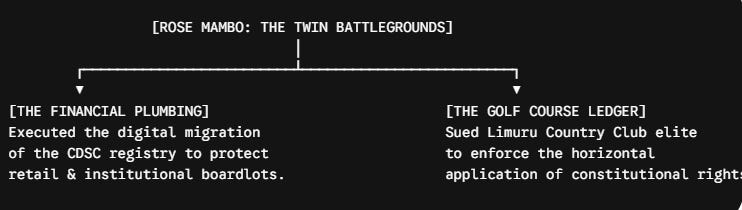
Her legacy was forged not on a single front, but across two simultaneous, high-stakes battlegrounds that appeared worlds apart but were driven by the exact same systemic rot.
On one front, she took on the clinical, monumental task of restructuring the back-office plumbing of the Nairobi Securities Exchange (NSE), dragging a reluctant market into the digital age. On the other, she stepped onto the pristine greens of the Limuru Country Club to spearhead a landmark constitutional lawsuit that dismantled decades of entrenched, elite gender discrimination.
1.2 The 2004 Baseline
When Mambo assumed leadership as the Chief Executive Officer of the Central Depository and Settlement Corporation (CDSC) in 2004, she inherited a clearinghouse that was structurally fragile and vulnerable to systemic exploitation. Although the electronic depository was in its infancy, the wider exchange remained a volatile, paper-heavy environment heavily dependent on physical share certificates. These paper trails were an operational nightmare—frequently lost, easily forged, and systematically manipulated by rogue stockbrokers to execute unauthorized liquidations of client portfolios.
The back-office infrastructure was highly susceptible to intermediary capture. Settling a trade was a slow, manual marathon that left retail savers exposed to catastrophic counterparty risk during the days it took for a transaction to clear. The market plumbing Mambo took over was not a secure highway for long-term capital compounding; it was a fragmented network where a handful of powerful market intermediaries could exploit infrastructural blind spots at the expense of public trust.
1.3 The Core Thesis
To view Rose Mambo merely as a quiet corporate bureaucrat who managed an electronic registry is to completely misunderstand the defining undercurrent of her career. Her true legacy is anchored on a singular, unyielding thesis:
Market depth, societal progress, and institutional trust cannot exist within a rigged system. Rules are meaningless unless they apply horizontally, uniformly, and without exception—whether protecting a retail investor’s digital boardlot or defending a woman’s right to vote on a sports committee.
Mambo operated on the fundamental conviction that institutional plumbing and constitutional rights are driven by the exact same mechanic: fairness. If a legacy broker could ignore property rights by clandestinely selling a client’s shares, or if a private country club board could arbitrarily scrap a member’s voting rights based on gender, the underlying foundation of trust collapsed entirely.
By refusing to tolerate rigged systems, she established a fierce precedent. She proved that the guardrails of accountability must cut through the insular agreements of elite circles, ensuring that the smallest participant is granted the exact same structural protection as the most powerful operator in the room.
2.0 The Great Immobilization: Cleaning the Market Plumbing
2.1 Smashing the Paper Cartel
Before Rose Mambo’s strategic intervention, the back-office architecture of the Nairobi Securities Exchange was structurally compromised by its absolute reliance on physical paper share certificates. These paper documents were the operational lifeblood of the old exchange, but they simultaneously served as the primary tools for a deeply entrenched paper cartel. Unscrupulous, under-capitalized stockbrokers routinely exploited the vulnerabilities of this manual system.
By weaponizing the operational mandate of the Central Depository and Settlement Corporation (CDSC), she forced the market to acknowledge that paper certificates were no longer a symbol of wealth, but a vector for systemic fraud. This infrastructural cleanup met fierce resistance from traditional brokers who benefited from the opacity of manual clearing, but Mambo’s objective remained unyielding: smash the paper cartel by removing the paper itself.
2.2 The Dematerialization Mandate
The transition from paper to pixels was not a simple software update; it was a high-stakes, legally fraught migration of millions of historical paper holdings into a centralized digital registry. Mambo engineered this shift through a two-step structural process: immobilization (collecting and locking physical certificates in centralized vaults) followed by absolute dematerialization (the legal erasure of paper certificates in favor of pure electronic ledger records).

Managing this logistical marathon required navigating a minefield of missing corporate records, historical registry discrepancies, and deep public skepticism. Mambo forced listed companies, commercial banks, share registrars, and custodial entities onto a strict, non-negotiable compliance timeline. Under her direct supervision, the CDSC built ring-fenced electronic accounts that insulated client assets from broker balance sheets.
2.3 The Title Deed of Capital
The ultimate achievement of Mambo’s electronic registry architecture was the democratization of asset security on the exchange. By converting vulnerable, easily manipulated paper slips into unassailable, digitally encrypted ledger entries, the CDSC effectively created the modern title deed of capital. This digital account statement became the definitive, legally untouchable proof of corporate asset ownership in East Africa.
The Mechanical Transformation of the Nairobi Securities Exchange under Rose Mambo
1. Registry & Capital Scaling
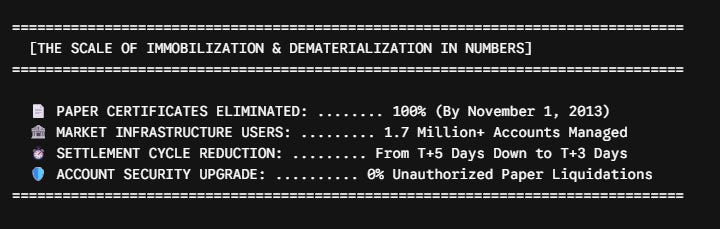
1.7 Million Accounts: The massive surge in electronic Central Depository System (CDS) accounts managed by the CDSC following the landmark Safaricom IPO stress test—skyrocketing from a baseline of 800,000.
97 Billion Shares: The total volume of equity securities successfully locked down and digitized into the electronic registry, representing 95% of the total issued wealth on the exchange.
100% Equity Dematerialization: Reached on November 1, 2013, when physical share certificates were stripped of their status as legal evidence of ownership across all listed firms.
Fixed-Income Dematerialization: Concluded in October 2014, successfully digitizing and transitioning all corporate bonds onto a completely paperless electronic architecture.
2. Operational Efficiency & Risk Reduction
40% Settlement Compression: Shifting trade execution timelines from an archaic, manual T+5 cycle down to the global standard T+3 delivery-versus-payment protocol.
11 Public Companies: Systematically coordinated alongside the National Treasury to completely flush historical government-held certificates into electronic records.
Zero-Paper Vector: Elimination of physical certificates completely erased the paper cartel’s primary tools for committing registry fraud, certificate forgery, and broker-level client asset theft.
3. Intermediary Compliance & Oversight
~20 Licensed Intermediaries: The strict network of Central Depository Agents (CDAs)—consisting of licensed stockbrokers, investment banks, and institutional custodians—forced onto real-time, automated clearing networks.
15-Year Institutional Tenure: Serving from 2004 to 2019, providing the uninterrupted executive continuity required to transition the clearinghouse from a manual startup to a globally compliant registry utility.
3.0 Compressing the Settlement Cycle and Mitigating Risk
3.1 Shifting from T+5 to T+3
In the early days of the market, transactions crawled through a T+7 or T+5 cycle—meaning an investor had to wait up to five to seven business days after the transaction date for shares to hit their account or for cash to reach their bank.
Rose Mambo shifted the CDSC’s by compressing the trade settlement timeline down to T+3 cycle. This was not a superficial policy shift; it required a complete digital synchronization of the exchange’s automated trading book with the CDSC’s clearing and settlement system.

3.2 Eliminating Counterparty Vulnerability
The danger of a long, drawn-out settlement cycle isn’t just the inconvenience of waiting; it is the massive accumulation of counterparty risk. In a T+5 system, a massive volume of trades hangs in limbo at any given moment. If a stockbrokerage suffered a sudden liquidity crisis or ran into insolvency mid-week, all the pending transactions executed through that broker risked collapsing into a legal black hole.
Furthermore, she anchored this system with rigid Delivery-versus-Payment (DVP) protocols, ensuring that the electronic transfer of securities occurred only if the corresponding cash payment was simultaneously confirmed.
3.3 Institutionalizing the Automated Pipeline
Mambo’s newly modernized CDSC faced its definitive trial during Kenya’s high-growth privatization era, most notably overseeing the historic Safaricom IPO which flooded the market with hundreds of thousands of new retail accounts.
Beyond managing mega-listings, she expanded this automated pipeline to permanently reform how corporate actions were handled across the street. By bypassing these manual, corruptible paper trails, Mambo ensured that the rewards of capital compounding flowed directly, transparently, and immediately to the rightful owners of the boardlots
The Immobilization Cartels and Their Incentives
1. The Paper Registry Cartel (Rogue Stockbrokers & Intermediaries)
Who they were: A tight network of legacy stockbrokers, investment banks, and rogue back-office compliance officers who controlled the manual trading flow.
Their incentives against her:
Maintaining Opacity: A manual, paper-heavy system made it easy to forge signatures, duplicate registries, and disguise operational cash shortfalls.
Unauthorized Liquidations: They used physical certificates to clandestinely sell off retail investors’ shares to fund their own proprietary trading or prop up failing broker balances.
Resisting Oversight: Electronic dematerialization forced an automated, real-time audit trail that instantly exposed client asset theft and put an end to their unmonitored pool of shadow liquidity.
2. The Float Exploitation Cartel (The “T+5” Float Hoarders)
Who they were: Under-capitalized brokers and certain clearing intermediaries who fiercely protected the archaic, slow-moving settlement cycles.
Their incentives against her:
Hoarding the Float: Under the old T+5 or T+7 cycles, capital was trapped in limbo for up to a week.
Risk Disguise: Compressing the timeline to a strict T+3 Delivery-versus-Payment (DVP) system meant they could no longer hide their lack of liquidity or use today’s buyer to settle yesterday’s seller. It forced them to maintain actual capital reserves, which threatened their low-cost, high-leverage business models.
3. The Corporate Dividend & Check Cartel
Who they were: Corrupt elements within the postal system, manual share registrars, and unscrupulous banking intermediaries.
Their incentives against her:
Intercepting Wealth: These cartels routinely intercepted, forged, and illegally cashed checks belonging to unsuspecting or dead retail shareholders.
The Unclaimed Dividend Pool: Mambo’s automated mobile and direct-bank pipeline completely cut off this illicit stream of income.
4. The Old Boys’ Club Boardroom Cartel
Who they were: The elite, patriarchal corporate establishment holding dominant seats across commercial banks, institutional funds, and exclusive private networks (like the Limuru Country Club board).
Their incentives against her:
Preserving Exclusive Control: They relied on informal, backroom “handshake agreements” to run public utilities and private clubs alike.
Fighting Horizontal Accountability: They believed that wealth, prestige, and private status exempted them from uniform rules.
1. The Paper Registry Cartel (Rogue Stockbrokers & Intermediaries)
Who they were: A tight network of legacy stockbrokers, investment banks, and rogue back-office compliance officers who controlled the manual trading flow.
Their incentives against her:
Maintaining Opacity: A manual, paper-heavy system made it easy to forge signatures, duplicate registries, and disguise operational cash shortfalls.
Unauthorized Liquidations: They used physical certificates to clandestinely sell off retail investors’ shares to fund their own proprietary trading or prop up failing broker balances.
Resisting Oversight: Electronic dematerialization forced an automated, real-time audit trail that instantly exposed client asset theft and put an end to their unmonitored pool of shadow liquidity.
4.0 The Golf Course Battleground: Mambo v. Limuru Country Club
4.1 Confronting the Elite Status Quo
In 2012, while Rose Mambo was clinically managing the electronic registry of Kenya’s capital markets, she found herself at the center of a regressive boardroom clash on the pristine greens of the Limuru Country Club. The club’s male-dominated board of directors introduced a controversial, discriminatory new internal by-law. This rule explicitly barred female golf players from participating, voting, or contesting for positions in the club’s internal golf committee elections.
4.2 The Retaliation and Rejection
Mambo, alongside two of her fellow female members (Caroline Ngugi and Martha Vincent), fiercely and vocally opposed the club’s discriminatory edict. In an attempt to silence the dissent and protect their insular hierarchy, the board of directors arbitrarily suspended and subsequently expelled Mambo and her co-petitioners from the club, completely stripping them of their hard-earned membership rights and benefits.
4.3 Constitutional Precedent (Petition 160 of 2013)
The legal battle culminated on March 12, 2014, in a historic judgment delivered by Justice Mumbi Ngugi in Constitutional Petition 160 of 2013. The club’s directors had mounted a classic elitist defense: they argued that because the Limuru Country Club was a private members’ club, it possessed absolute autonomy over its own internal affairs. They claimed that the constitutional protections of the Bill of Rights applied strictly to state actions (vertical application) and could not be used to interfere with the private bylaws of an independent social club.

Justice Mumbi Ngugi completely shattered this defense, ruling emphatically in favor of Rose Mambo and her colleagues. The judgment established a monumental legal milestone in Kenyan jurisprudence: the horizontal application of the Bill of Rights. Justice Ngugi declared the club’s discriminatory rules null and void, ordered the immediate and full reinstatement of Rose Mambo to the club, and ordered the directors to personally bear the legal costs of the suit as a penalty for their overreach.
5.0 Boardroom Sovereignty: Navigating 15 Years at the Apex
5.1 Balancing Competing Financial Heavies
The Central Depository and Settlement Corporation (CDSC) is not a typical state regulatory agency; it is a specialized market infrastructure utility owned by a complex consortium of commercial banks, institutional investors, and the Nairobi Securities Exchange itself.
Rose Mambo’s tenure was a masterclass in preventing elite capture. Throughout her leadership, she refused to allow any single dominant financial faction to weaponize the depository registry for competitive advantage.
5.2 Enforcing Rights in the Executive Suite
Mambo’s fierce battle on the fairways of Limuru was not an isolated incident of personal defiance; it was the exact public manifestation of how she conducted herself behind closed doors in corporate suites.
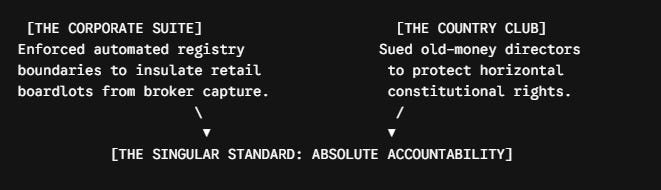
She operated on the principle that the electronic clearing ledger had to remain an entirely objective, blind arbiter of trades.
5.3 The Longevity Paradox
In the executive tiers of Kenya’s financial sector, long tenures are an absolute anomaly. Chief executives who challenge entrenched interests or disrupt profitable, opaque cartels are typically forced out through boardroom coups or political maneuvering within a few years. Yet, Mambo achieved a remarkable 15-year tenure (2004–2019) at the apex of the CDSC.
This longevity reveals a fascinating institutional paradox: Mambo survived and thrived precisely because she refused to be a flexible, accommodating insider. Her reputation as a rigid, legally unassailable rule-follower made her completely irreplaceable to the ecosystem.
6.0 Conclusion: The Legacy of the Ledger and the Law
6.1 The Invisible Guardrails
The ultimate irony of world-class infrastructure is that its success is measured by its invisibility. Today, modern value investors on the Nairobi Securities Exchange execute trades, accumulate dividend-yielding stocks, and check their digital portfolios with total peace of mind. They take frictionless, secure T+3 settlements and direct electronic payments completely for granted.