
The $470M Mirage: Why Silicon Valley Playbooks Failed Last-Mile Retail in Kenya
Table of Contents
Introduction: Silicon Savannah’s VC Reckoning
Sign 1: The “Last Raise” Trap
Sign 2: The Subsidized Unit Economics Delusion
Sign 3: “Pan-African” Expansion Before Local Profitability
Sign 4: Asset-Heavy Infrastructure in a Collapsing FX Environment
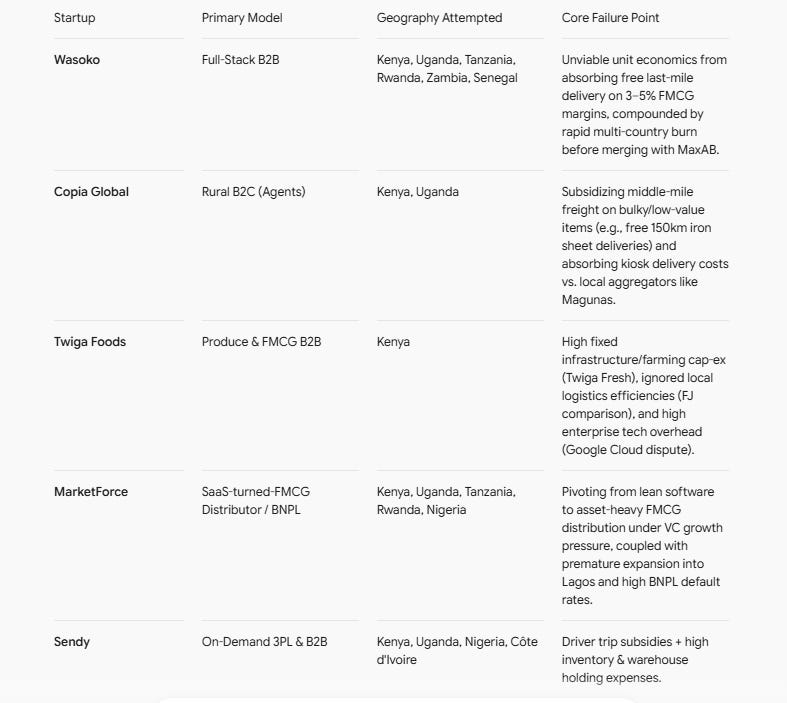
Summary Matrix: Startup Failure Profiles
Sign 5: Governance Theater & The Silent Board
Sign 6: Pivot Fatigue & The PR Smoke Screen
Sign 7: Delayed Reporting & The “Fantasy Metrics” Mirage
Sign 8: The “Sabbatical” Exodus
The Final Word: An Early Employee’s Survival Guide
Conclusion: Core Strategic Takeaways for Investors & Boardrooms
Section I: Introduction – The Half-Billion Dollar Promise
Between 2014 and 2023, venture capitalists poured over $471.6 million (approx. KES 61.3 billion) into a select group of Kenyan tech startups. The pitch deck narrative across these boardrooms was nearly identical: Kenya’s retail landscape is dominated by hundreds of thousands of informal, neighborhood shopkeepers (dukas) and rural micro-consumers. These merchants faced fragmented supply chains, irregular stock availability, and high wholesale markup layers.
The solution sounded brilliant on paper: build digital B2B marketplaces and last-mile logistics platforms, disintermediate traditional wholesalers, aggregate purchasing power directly with FMCG manufacturers, offer trade credit, and capture high-frequency consumer spend.
Armed with massive war chests, platforms like Wasoko, Copia, Twiga Foods, MarketForce, Sendy, Kyosk, Duhqa, and Kune set out to re-engineer African commerce. They built expansive fulfillment centers, deployed fleets of delivery vans and motorbikes, hired large tech teams, and aggressively subsidized prices to capture market share.
Yet, within a decade, that half-billion dollars of venture equity and debt largely evaporated. By 2024, the landscape was defined by liquidations, board restructurings, massive layoffs, and shuttered operations.
The core miscalculation was fundamental: these tech platforms treated FMCG distribution as a software network-effects problem, assuming scale would magically unlock profitability. In reality, last-mile distribution in emerging markets is an uncompromising, low-margin, physical logistics battle where digital ordering forms do not eliminate the high cost of moving low-value physical goods over congested urban streets and rough rural roads.
Startup failures in Silicon Savannah are rarely sudden, unpredictable disasters. Long before the liquidation petitions land on the High Court docket or the PR team releases a sanitized LinkedIn statement about “strategic realignments,” the red flags are blaring.
If you know where to look, here are the eight tell-tale signs that a Kenyan startup is on the fast track to collapse.
1. The “Last Raise” Trap: Collapse Within 12 Months of Capital Injection
In venture capital parlance, the “Last Raise” refers to the final, frantic cash infusion a dying startup secures right before hitting the wall. To naive employees, a massive round headline sounds like ultimate job security and growth validation. To seasoned insiders, a down-round, bridge round, or debt-heavy injection is often the clearest signal that the company is on artificial life support.
In Kenya, the timeline between a celebrated “Last Raise” and full-blown administration or shutdown has become terrifyingly short:
Copia Global: In December 2023, Copia proudly touted a $20 million Series C extension/bridge raise to supposedly achieve profitability. Just five months later, in May 2024, Copia collapsed into administration, laying off over 1,000 workers after running through the capital.
MarketForce: After raising a heavily publicized $40 million Series A round in early 2022 to scale its B2B e-commerce platform, MarketForce began downsizing its headcount and operations in under a year, eventually shuttering its core business entirely as unit economics unraveled.
Why Employees Must Watch This Metric: When a startup raises money, ask what kind of money it is. If a company that has burned tens of millions suddenly raises an emergency bridge round, converts debt, or announces a top-up round with no strategic leads, that cash isn’t for scaling—it is paying off accrued vendor debt and covering terminal payroll. If unit economics are negative, a fresh round doesn’t extend runway by two years; it burns out in under twelve months.
2. The Subsidized Unit Economics Delusion
The single most dangerous trap in African tech is confusing VC-subsidized transaction volume with true product-market fit. Founders use investor capital to offer free delivery, heavy discounts, and artificially low prices—essentially paying customers to use their platform—and then present those vanity growth charts to their next board meeting as “traction.”
The Reality Check: The Kenyan mass market is hyper-sensitive to price. If your business model relies on swallowing massive logistics and fulfillment costs on low-margin goods, you aren’t building a tech company; you’re operating a temporary charity funded by Silicon Valley. The moment you attempt to charge a price that reflects your real operational costs, volume vanishes overnight.
The Kenyan Examples:
Copia Global vs. Local Logistics: Copia built its model on subsidizing middle-mile freight. A prime illustration was when a customer shared that Copia delivered 10 bulky plastic seats to her mother’s rural home 150 km outside Nairobi at zero delivery cost—cheaper than the local hardware store. On top of that, Copia competed with dominant regional distributors like Magunas in Murang’a for basic FMCG staples (rice, flour, cooking oil). While Magunas had local shopkeepers pick up inventory from their warehouse at their own expense, Copia absorbed the full delivery cost directly to small kiosks. Moving bulky, low-margin goods across 300-kilometer round trips for free devoured any underlying margin.
Kune Food: Kune raised $1 million to deliver $3 ready-to-eat meals, claiming it could beat local vibandas on cost. It collapsed within a year because the cost of cooking gas, imported packaging, and motorbike delivery surpassed the price of the meal itself.
Sendy: Sendy similarly burned tens of millions trying to subsidize last-mile B2B and B2C deliveries before running out of cash.
3. “Pan-African” Expansion Before Local Profitability
Nothing seduces foreign venture capitalists quite like a map of Africa with five brand-new country pins dropped on it. Too many Nairobi-based founders treat regional expansion as a vanity milestone, expanding into Uganda, Nigeria, or Egypt long before achieving positive unit margins in Kenya.
The Reality Check: Regional expansion across Africa does not bring immediate economies of scale; it brings exponential complexity and administrative burn. Tax structures, regulatory hurdles, consumer habits, and supply chains differ wildly between Nairobi, Kampala, and Lagos. Expanding an unprofitable business model to three new countries doesn’t make you a Pan-African player—it multiplies your burn rate by three.
The Kenyan Examples:
MarketForce: Driven by VC pressure for explosive Gross Merchandise Value (GMV) growth, MarketForce abandoned its lean, growing SaaS platform for MSMEs to pursue direct, asset-heavy FMCG distribution. Pressed by investors to prove TAM, it aggressively expanded into five African markets—including Lagos, Nigeria—before establishing viable unit economics in Kenya. Managing disjointed supply chains, local currency devaluations, and distinct regulatory environments across borders diluted focus and drained cash, forcing a total platform shutdown.
Sendy: Between 2021 and 2022, Sendy launched operations across Uganda, Côte d’Ivoire, and Nigeria. Operating last-mile logistics in Lagos or Abidjan required navigating complex regulatory environments, driver networks, and currency risks. Spreading $26+ million across four disjointed markets multiplied corporate overhead while units remained underwater.
Copia Global: In July 2021, Copia expanded into Uganda, setting up secondary distribution hubs and agent networks. Uganda’s rural market presented the same razor-thin margins and high fulfillment costs as Kenya. After two years of bleeding capital, Copia quietly shut down its entire Ugandan operation in 2023 to “refocus on Kenya,” having burned hundreds of millions of Shillings.
4. Asset-Heavy Infrastructure In a Collapsing FX Environment
Solving Africa’s real-world supply chain problems requires physical infrastructure, but attempting to own, build, and maintain the entire value chain—warehouses, truck fleets, cold-storage units, and distribution networks—is financial suicide when macroeconomic shocks hit.
The Reality Check: Raising capital in US Dollars while earning revenue in depreciating Kenya Shillings creates a fatal currency mismatch. When the Shilling depreciated rapidly against the USD, foreign-denominated debt, enterprise cloud computing costs, imported equipment, and software subscriptions escalated dramatically, wiping out operational margins.
The Kenyan Examples:
Twiga Foods vs. Fresh & Juici (FJ): Twiga ignored existing market efficiencies and attempted to build an asset-heavy supply chain from scratch. Twiga dispatched 8-ton trucks to Meru to pick up 1-ton banana yields, whereas legacy distributors like Fresh & Juici let farmers handle micro-transit via local boda-bodas and matatus directly to gate facilities. Twiga absorbed quality sorting downstream, took on weeks-long payment delays, and suffered ~20% produce losses to reverse logistics failures—while FJ enforced gate-level QC with same-day payments. Sinking capital into Twiga Fresh (a 650-hectare commercial farm), fleet hubs, and massive cloud infrastructure (evidenced by its $261k+ debt lawsuit with Google Cloud reseller Incentro Africa) created fixed liabilities its unit economics could not support.
Copia Global: Copia constructed an enormous, asset-heavy logistics footprint with central fulfillment centers at Tatu City SEZ and dedicated transport networks across rural Kenya. When growth capital dried up, the overhead required to maintain this physical infrastructure devoured remaining cash.
5. Governance Theater & The Silent Board
Bad corporate governance is the silent killer of the Savannah. “Governance theater” happens when a startup boasts brand-name foreign VC board observers or celebrity advisors on its deck, but completely lacks an independent board with the teeth—or local operational experience—to audit the metrics and check founder excess.
The Reality Check: When boards function as rubber stamps for charismatic founders, red flags are systematically buried. Financial audits get delayed, executive spending goes unmonitored, and compliance shortfalls compound until a crisis erupts in public.
The Kenyan Example: Wapi Pay served as a major wake-up call for the ecosystem regarding governance and oversight. Beyond public relations fallout, it exposed how early-stage fintechs often operate without rigorous, independent institutional governance. When compliance and governance are viewed as roadblocks to “moving fast and breaking things,” investor confidence dissolves, often leading to immediate capital freezes that startups cannot recover from.
6. Pivot Fatigue & The PR Smoke Screen
When a startup’s core business model collapses, management rarely admits defeat right away. Instead, they enter a phase of frantic, quarterly pivots—launching buzzword-compliant product features every few months while cranking up PR output to signal strength.
The Reality Check: Healthy companies pivot out of market opportunity; dying companies pivot out of sheer panic. If a B2B logistics company rebrands into a fintech lender, then an AI-powered SaaS platform, and then a B2C direct-to-consumer marketplace within 18 months, the core business engine is officially dead.
The Kenyan Examples:
Sendy: Shifted from ride-hailing to package delivery, to B2B FMCG distribution, to a software-only logistics platform before shutting down.
Twiga Foods: Moved from pure B2B produce aggregation to direct farming, to software licensing, while shuttering its internal logistics fleet. When press releases celebrating “strategic realignments” outpace actual operating metrics, the end is near.
7. Delayed Reporting & The “Fantasy Metrics” Mirage
When a startup’s core fundamentals begin to decay, management rarely admits it directly in company updates. Instead, they weaponize delayed reporting, obfuscation, and vanity metrics to disguise structural failure.
Top-of-Funnel Sign-Ins vs. Real Monetized Revenue: Troubled startups constantly brag about top-of-funnel vanity metrics—such as “registered user sign-ins,” “app downloads,” or “onboarded merchants”—while completely concealing actual Monthly Active Users (MAU), transactional revenue, or repeat usage. Highlighting 100,000 sign-ins means nothing if 95,000 of those accounts made a single subsidized transaction and never returned.
Refusing to Disclose Margins & Direct Profitability: You will hear leadership talk relentlessly about Gross Merchandise Value (GMV)—the total value of goods passing through their platform—while remaining dead silent on gross margins, net burn rate, or contribution margin per order. Bragging about a $50 million GMV when your net margin is negative 12% simply means you paid money to move other people’s inventory.
Erratic, Late, or Radio-Silent Investor & All-Hands Updates: Financial reports that used to arrive monthly suddenly become quarterly, then semi-annually, and eventually stop altogether. When leadership stops sharing clear, standardized P&L breakdowns with employees or investors—or replaces traditional income statements with custom, non-standard financial metrics—it is almost always because the cash runway is collapsing in real time.
8. The “Sabbatical” Exodus: Sudden C-Suite & Executive Departures
Executives usually have access to real-time bank balances, upcoming debt maturities, and board meeting minutes months before ordinary employees do. When key leadership figures—the CEO, CFO, CTO, or VP of Engineering—begin quietly or suddenly stepping down, it is rarely to “pursue other interests.” It is almost always a sign that the cap table is broken or the cash runway is running out.
Twiga Foods: The clearest signal that Twiga’s corporate structure was fracturing came when co-founder and long-serving CEO Peter Njonjo went on a sudden 6-month sabbatical in late 2023, only to permanently resign as CEO and step off the board entirely by January 2024 as institutional investors moved in to take control.
Copia Global & Sendy: In the months leading up to administration filings and liquidations, both Copia and Sendy experienced erratic C-suite restructuring, high VP turnover, and leadership handoffs to external crisis managers or administrators.
The Rule: When the founders and C-suite executives who built the pitch deck start jumping ship or taking unexplained “leaves of absence,” employees should realize the captains are leaving before the vessel goes under.
Section II: Startup-by-Startup Deep Dives
1. Wasoko
Capital Raised: ~$152 Million (~KES 19.8 Billion)
Duration of Operations: 2016 – Present (Massively scaled back / merged)
Number of Employees: Peak ~1,000+ employees across 6 African markets
Main Reasons for Collapse:
Flawed Unit Economics: Offering free next-day delivery on basic FMCG items carrying only 3–5% gross margins created a negative unit contribution margin per order.
Premature Regional Expansion: Expanded rapidly across Kenya, Tanzania, Uganda, Rwanda, Zambia, and Senegal—multiplying head office overheads, country-specific compliance costs, and localized warehouse burn before achieving profitability or defensible scale in its core Kenyan market.
2. Copia Global
Capital Raised: ~$123 Million (~KES 16.0 Billion)
Duration of Operations: 2013 – May 2024 (Placed into administration)
Number of Employees: Peak ~1,800+ employees and a network of 100,000+ rural agents
Main Reasons for Collapse:
Flawed Unit Economics: Middle-mile transport, warehousing, and agent commissions vastly exceeded the gross profit generated from low-basket-value purchases by cash-constrained rural consumers.
Premature Regional Expansion: Attempted an aggressive expansion into Uganda in 2021 before proving cash self-sufficiency in Kenya, burning precious capital on duplicate country management structures that had to be hastily shut down when VC funding dried up.
3. MarketForce / RejaReja
Capital Raised: ~$42.5 Million (~KES 5.5 Billion)
Duration of Operations: 2018 – April 2024 (RejaReja marketplace shut down)
Number of Employees: Peak ~800+ employees across 5 markets
Main Reasons for Collapse:
Flawed Unit Economics: Thin margins on commodity goods were completely wiped out by high Non-Performing Loan (NPL) default rates on uncollateralized trade credit (BNPL) extended to informal shopkeepers.
Premature Regional Expansion: Scaled across 5 African markets (Kenya, Uganda, Tanzania, Rwanda, and Nigeria) in pursuit of venture-backed GMV metrics, stretching capital reserves paper-thin across different regulatory and currency regimes before stabilizing unit economics at home.
4. Sendy
Capital Raised: ~$29 Million (~KES 3.8 Billion)
Duration of Operations: 2015 – September 2023 (Insolvency and liquidation)
Number of Employees: Peak ~300+ employees
Main Reasons for Collapse:
Flawed Unit Economics: Heavily subsidized driver payouts per trip to beat traditional logistics prices, resulting in a negative unit margin on cargo moves that widened with volume growth.
Premature Regional Expansion: Expanded fulfillment and delivery hubs into Uganda, Nigeria, and Côte d’Ivoire while still burning cash heavily in Kenya, diluting operational focus and accelerating cash drain prior to proving an economically viable core model.
5. Twiga Foods
Capital Raised: ~$110 Million (~KES 14.3 Billion)
Duration of Operations: 2014 – Present (Restructured after near-collapse)
Number of Employees: Peak ~1,000+ direct employees
Main Reason for Collapse (Unit Economics): High fixed asset cost vs. gross agricultural margin. Massive capital investments in automated packhouses, cold storage, commercial farms, and corporate overhead created a fixed cost structure that could not be covered by the thin, volatile gross margins of fresh produce and dry FMCG items.
6. Kyosk.app
Capital Raised: ~$12 Million+ (~KES 1.6 Billion)
Duration of Operations: 2019 – Present (Downsized / pivot mode)
Number of Employees: Peak ~200+ employees
Main Reason for Collapse (Unit Economics): Customer Acquisition Cost (CAC) vs. Customer Lifetime Value (LTV) mismatch. Spending heavily on ground sales agents (foot soldiers) to onboard shopkeepers resulted in a high CAC that could never be recovered, because price-sensitive shopkeepers frequently churned to rival apps for penny discounts.
7. Duhqa
Capital Raised: ~$2.15 Million (~KES 280 Million)
Duration of Operations: 2021 – 2023 (Operations wound down)
Number of Employees: Peak ~40–50 employees
Main Reason for Collapse (Unit Economics): Insufficient order drop density. Delivering small, low-value baskets to scattered micro-retailers generated logistics costs per drop that exceeded the platform’s micro-commissions, compounded by credit losses from merchant working-capital defaults.
8. Kune Food
Capital Raised: ~$1 Million (~KES 130 Million)
Duration of Operations: August 2020 – June 2022 (Complete shutdown)
Number of Employees: Peak ~90 employees
Main Reason for Collapse (Unit Economics): Negative net contribution per meal. The combined cost of raw ingredients, food preparation, packaging, and dedicated rider delivery fees far exceeded the low $2 to $3 retail price tag per meal.
Section III: Individual Startup Case Studies
1. Wasoko (formerly Sokowatch)
Wasoko’s core proposition was straightforward: digitize the inventory procurement process for informal duka owners by offering app-based ordering, guaranteed next-day delivery, and access to revolving stock credit. To execute this, Wasoko chose a full-stack, asset-heavy operational model.

The Operational Breakdown
The Margin Squeeze: Basic FMCG commodities (rice, flour, cooking oil, sugar) trade on gross margins between 3% and 5%. Wasoko absorbed the full cost of warehousing, handling, and last-mile transport while offering “free delivery” to merchants. On a typical order of KES 5,000 (~$38), a 4% gross margin yielded KES 200 (~$1.50) in revenue—far below the physical fuel, driver wage, and vehicle depreciation cost required to complete the delivery.
The Expansion Trap: Driven by venture capital milestones to show rapid growth in Gross Merchandise Value (GMV), Wasoko expanded across Kenya, Uganda, Tanzania, Rwanda, Zambia, and Senegal. Each new market duplicated country headships, warehousing facilities, and regulatory overhead before the core unit economics in Nairobi were cash-flow positive.
The Capital Pivot: Following a $125 million Series B round in 2022 that valued the company at $625 million, global interest rate hikes triggered a venture capital slowdown. Wasoko could no longer rely on equity injections to subsidize order fulfillment. The company exited multiple markets, downsized headcount, and initiated a merger with Egypt’s MaxAB to consolidate operations and reduce cash burn.
2. Comparative Analysis — Twiga Foods vs. Legacy Logistics (Fresh & Juici)
Twiga Foods’ fundamental undoing was not an absence of capital, but a misdiagnosis of existing market efficiencies. By treating traditional informal supply chains as broken rather than hyper-optimized, Twiga spent over $160 million trying to engineer out low-margin realities that legacy distributors—such as Fresh & Juici (FJ)—had long since mastered.
Core Operational Disconnects
First-Mile Logistics Mismatch
Twiga’s Approach: Dispatched capital-intensive, high-capacity trucks (e.g., 8-ton vehicles) directly to rural farms in regions like Meru to collect fractional yields as small as 1 ton of produce.
Market Reality (FJ Model): Legacy operators do not run direct farm collections. Instead, farmers and local aggregators leverage existing small-quantity transit networks (boda-bodas, matatus, local pickups) to deliver directly to central processing facilities. Individual producers manage micro-transport far more cost-effectively than a centralized corporate fleet ever can.
Misaligned Quality Control & Cash Flow Incentives
Twiga’s Approach: Absorbed quality sorting and grading downstream at its centralized distribution hubs, running high labor costs, absorbing high post-harvest loss, and stretching payment cycles out for weeks—ultimately defaulting with millions owed to suppliers.
Market Reality (FJ Model): QC is strictly enforced at the gate at the time of delivery. Produce is inspected immediately: accepted yield is paid out same-day, while rejected produce is taken back home by the supplier. Crucially, immediate cash liquidity serves as the ultimate QC mechanism—farmers naturally route their highest-grade produce to buyers who pay on the spot.
Unmanaged Losses in Reverse Logistics
Twiga’s Approach: Failed to properly structure reverse logistics systems, suffering severe inventory shrinkage and post-harvest damage (losing up to ~20% of handling volume across its pipeline).
Market Reality (FJ Model): Traditional supply chains rely on lean, rapid return-trip loops. Reusable crates, empty fleet turnarounds, and fast secondary clearing markets ensure near-zero wastage on return legs.
Tech Supremacy vs. Ground-Level Operations
Twiga’s Approach: Staffed operations heavily with tech-first talent, relying on algorithms and corporate management models to solve ground-level logistics while alienating experienced industry operators.
Market Reality: Fresh produce distribution in emerging markets is driven by relationship networks, real-time market clearings, and operational experience. Twiga only attempted to integrate veteran supply chain operators after severe operational friction set in—by which point switching costs were prohibitive.
The Misdirected Innovation
Twiga’s genuine product-market innovation was its B2B ordering mobile app for mama mbogas—a last-mile software solution. However, instead of layering this digital interface on top of existing, highly efficient procurement and distribution networks (via partnerships or acquisitions of established aggregators like FJ), Twiga tried to build a parallel, asset-heavy, capital-intensive infrastructure from scratch.
When venture capital subsidies evaporated, Twiga was left with high fixed overhead, strained vendor trust, and unsustainable unit economics—proving that technology cannot easily out-engineer the ground-level economics of the informal market.
Scaling Tech Overhead Ahead of Unit Economics
Twiga committed to massive long-term enterprise software agreements—such as the multi-hundred-thousand-dollar Google Cloud contract with reseller Incentro Africa—under the assumption that its platform volume would continuously double. When demand plateaued and margins squeezed, the company was left locked into massive tech overhead that its physical revenue could not support.
High Fixed Operating Expenses Meet Cash Flow Crunch
Software licensing and cloud infrastructure function as fixed liabilities. When tech funding contracted in 2023, Twiga couldn’t cut digital infrastructure expenses fast enough, leading directly to statutory liquidation threats over relatively unpaid vendor bills ($261,000–$450,000).
Misalignment Between Margins and Tech Stacks
In high-volume, low-margin informal fresh produce retail, enterprise software commitments must remain lean and flexible. Committing heavily to enterprise-tier cloud suites created a mismatch between software operating costs and the razor-thin margins of urban B2B produce delivery.
To trace the full unraveling of this model, see the detailed deep-dive into the rise and ultimate fall of Peter Njonjo's venture in The Billion Shilling Lie: How Peter Njonjo's Twiga Foods Collapsed Under the Weight of Scale.
3. Copia Global: Subsidizing the Impossible Middle-Mile
Copia Global set out to solve e-commerce for rural and peri-urban consumers who lacked formal delivery addresses and access to traditional retail. Rather than delivering directly to doorsteps, Copia built an agent network—recruiting local shopkeepers, tailors, and teachers to place orders on behalf of customers and serve as local collection points.
+---------------------+ +--------------------------+ +--------------------+ +-----------------+
| Tatu City Hub | ---> | Long-Haul Middle-Mile | ---> | Village Agent | ---> | Rural Consumer |
| (Central Inventory) | | (Subsidized Freight) | | (Kiosk/Shopkeeper) | | (Low Basket) |
+---------------------+ +---------------------+ +--------------------+ +-----------------+
The Operational Breakdown
Subsidized Freight and Unrealistic Unit Economics
At the heart of Copia’s collapse was a business model that subsidized delivery costs to drive customer adoption, creating a massive gap between logistics expenses and order margins.
The 150km Iron Sheet Paradox: The real-world consequence of this subsidy was starkly illustrated by a post on X, where a user shared that Copia would deliver iron sheets directly to her mother’s home—150 km outside Nairobi—at a retail price cheaper than the local hardware store, complete with free delivery. Moving bulky, low-margin building materials over long distances for free absorbed immense freight costs that no e-commerce margin could cover.
The Murang’a FMCG Battle (Copia vs. Magunas): A similar structural flaw played out in basic FMCG categories like rice, flour, and cooking oil across Murang’a, where Copia attempted to compete directly with dominant local distributors like Magunas Supermarket. Magunas supplied small local kiosks by having the shopkeepers collect goods directly from their central Murang’a warehouse at their own expense. Copia, by contrast, attempted to gain market share by absorbing the entire transport cost—delivering the same staple goods directly to small kiosks at Copia’s expense.
High Cost-to-Serve Rural Routes
Transporting low-value household items from centralized facilities (such as its primary distribution center at Tatu City) to scattered rural locations incurred heavy middle-mile freight costs. Long distribution legs and low order density per kilometer constantly eroded margins.
Low Average Basket Value vs. Fixed Operational Costs
Rural households operate on tight, daily or weekly cash cycles and purchase primarily for immediate consumption. Small basket sizes generated minimal absolute profit per order, completely failing to offset the combined costs of long-haul logistics, warehousing, and agent commissions.
Premature Regional Expansion
Before establishing sustainable unit economics in Kenya, Copia expanded into Uganda in 2021. Duplicating its asset-heavy logistics infrastructure in a second market burned critical capital, forcing an emergency retreat from Uganda when foreign VC funding dried up.
In May 2024, after running out of venture subsidies to fund its logistics costs, Copia’s Kenyan operating entity was placed into administration—demonstrating that software capital cannot permanently absorb the physical costs of rural delivery.
4. MarketForce (RejaReja): VC Pressure, Asset Inflation, and Premature Expansion
MarketForce was originally founded as a lean, software-first SaaS platform designed to digitize informal trade. Its initial product provided small and medium enterprises (MSMEs) with inventory management, order tracking, and field sales automation software. The SaaS model was lightweight, capital-efficient, and growing sustainably. However, external venture capital demands for explosive volume growth forced a pivot that ultimately doomed the business.
+--------------------------+      +---------------------------+      +--------------------+
| Original Model:          | ---> | VC Growth Pressure:       | ---> | Complex Multi-Market |
| SaaS Platform for MSMEs  |      | Asset-Heavy FMCG          |      | Expansion (Lagos)  |
| (Lean, Software Margin)  |      | Distribution & BNPL       |      | (Unproven Unit Econ|
+--------------------------+      +---------------------------+      +--------------------+
The Two Cardinal Failures
1. Abandoning SaaS for Asset-Heavy FMCG Distribution
To satisfy VC expectations for rapid gross merchandise value (GMV) expansion, MarketForce shifted away from its software roots and launched RejaReja—taking on full direct FMCG distribution itself. This moved the company into a high-risk, low-margin industry where margins on staple goods (flour, rice, cooking oil) sit between 2% and 5%.
By buying, warehousing, and delivering physical stock, MarketForce entered direct competition with Kenya’s informal wholesale hubs (such as Nyamakima and Eastleigh). Traditional operators run hyper-lean setups: shopkeepers visit these hubs in person and cover their own transport costs. MarketForce attempted to out-compete these informal operators by absorbing last-mile transport expenses and layering on unsecured Buy Now, Pay Later (BNPL) credit. The razor-thin FMCG margins could not support the heavy operational overhead, leading to severe cash burn and spiraling loan default rates.
2. Forced Multi-Market Expansion Before Solving Unit Economics
To secure subsequent rounds of foreign venture capital, MarketForce was pressured to prove international scalability by expanding into larger regional markets—most notably Lagos, Nigeria.
Exporting an unproven, cash-burning distribution model into Lagos—an even more complex, highly fragmented, and volatile market than Nairobi—proved fatal. Setting up parallel logistics, local teams, and regulatory frameworks across multiple countries consumed the company’s remaining runway before it had established viable unit economics in its home market.
Premature Multi-Market Expansion
Backed by venture capital (including Y Combinator and a $40 million Series A round in 2022), MarketForce rapidly expanded its footprint across 5 African markets—Kenya, Nigeria, Uganda, Rwanda, and Tanzania. Establishing parallel operations, local teams, and logistics infrastructure across multiple regulatory jurisdictions burned cash rapidly before the core model achieved sustainable unit economics in its home market.
The BNPL Misstep and Loan Default Rates
To drive platform engagement, MarketForce pivoted heavily toward digital merchant lending (BNPL) to let shopkeepers purchase stock on credit. However, informal kiosks face volatile cash flows and severe price competition. Without physical collateral or established credit scoring for informal traders, non-performing loan (NPL) rates ballooned. RejaReja essentially financed its own sales, bearing the dual risk of unpaid stock loans and unrecovered inventory delivery costs.
Unviable FMCG Margins Meets Subsidized Delivery
FMCG distribution is a high-volume, extremely low-margin business (often 2%–5% gross margin on staples like flour, oil, and soap). Traditional wholesale hubs in Kenya (such as Nyamakima and Eastleigh) operate with minimal overhead—retailers visit the hubs in person and arrange their own transport. RejaReja attempted to win over shopkeepers by absorbing the last-mile delivery costs itself, turning razor-thin margins into net negative unit economics per order.
The Collapse
When global tech liquidity dried up during the 2022–2023 funding winter, MarketForce could no longer subsidize its physical logistics or absorb BNPL loan write-offs. After attempting to pivot back to an asset-light model, MarketForce officially shut down the RejaReja B2B platform in April 2024. The MarketForce case serves as a stark warning: forcing a software company to become an asset-heavy distributor in search of VC-fueled GMV growth—and expanding geographically before achieving sustainable unit economics—is a recipe for structural failure.
5. Sendy
Sendy began as a two-sided logistics marketplace connecting motorcycle riders, pickup drivers, and truck owners with retail and corporate clients. It later launched “Sendy Supply” to manage end-to-end fulfillment and inventory procurement for micro-retailers.
+---------------------+      +---------------------+      +--------------------+      +-----------------+
| On-Demand Marketplace| ---> | Subsidized Driver   | ---> | B2B Cargo &        | ---> | Business /      |
| (App Platform)      |      | Payouts             |      | Fulfillment Hubs   |      | Duka Client     |
+---------------------+      +---------------------+      +--------------------+      +-----------------+
The Operational Breakdown
Fleet Subsidies: In its marketplace model, Sendy subsidized driver trip payouts to keep end-user delivery prices competitive while ensuring driver retention. This created a negative unit margin structure where higher delivery volume resulted in higher absolute cash drain.
The Pivot to Inventory Management: When Sendy expanded into full-stack B2B e-commerce through Sendy Supply, it inherited the capital requirements of leasing warehouses, holding inventory, and managing credit terms for micro-retailers—a contrast to its original software-only routing model.
Regional Expansion and Liquidation: Sendy launched operations in Uganda, Nigeria, and Côte d’Ivoire while still burning cash in Kenya. When a proposed acquisition fell through in 2023 amid the broader contraction in technology sector funding, the business ran out of operating runway, entered administration, and proceeded to asset liquidation.
6. Kyosk.app
Kyosk Digital Services set out to digitize the informal kiosk sector by combining stock ordering with third-party financial products, such as micro-insurance and working capital financing.
+--------------------+      +---------------------+      +--------------------+      +-----------------+
| On-Ground Sales    | ---> | Kyosk App           | ---> | Third-Party 3PL    | ---> | Informal Kiosk  |
| Agents ("Soldiers")|      | (Stock & Financials)|      | Logistics          |      | (Low Retention) |
+--------------------+      +---------------------+      +--------------------+      +-----------------+
The Operational Breakdown
CAC to LTV Mismatch: Onboarding traditional, non-tech-native shopkeepers required intensive field agent sales teams (”foot soldiers”). This generated a high Customer Acquisition Cost (CAC). However, because shopkeepers churned frequently to chase lower commodity prices elsewhere, the Customer Lifetime Value (LTV) remained insufficient to recover field acquisition expenses.
Fintech Overlay Limitations: The strategy of cross-selling micro-insurance and financial services relied on steady, repeat merchant transactions. When core physical inventory sales struggled with low gross margins and high fulfillment costs, the adoption of secondary financial products was insufficient to offset losses on primary distribution.
7. Duhqa
Duhqa launched as a lean, third-party logistics (3PL) B2B distribution platform designed to connect manufacturers directly with informal merchants across FMCG, cold-chain perishables, and pharmaceuticals.
+---------------------+      +---------------------+      +--------------------+      +-----------------+
| Manufacturer /      | ---> | Duhqa Platform      | ---> | Outsourced 3PL     | ---> | Scattered Micro-|
| Supplier            |      | (Order Aggregation) |      | Delivery Fleet     |      | Retailers       |
+---------------------+      +---------------------+      +--------------------+      +-----------------+
The Operational Breakdown
Low Route Drop Density: Because informal merchants ordered in small, variable quantities, fulfillment trucks operated with low route density (insufficient order volume per geographic square kilometer). The delivery costs per stop regularly exceeded the platform’s distribution commissions.
Credit Risk Exposure: Offering micro-working capital to boost merchant order frequency resulted in credit default losses that further compressed net margins, leading the startup to scale back operations as venture capital dried up.
8. Kune Food
Kune Food attempted a vertically integrated prepared-meal model: cooking low-cost meals in a central dark kitchen and delivering them directly to urban office workers and street consumers for KES 250 to KES 350 ($2 to $3) per plate.
+---------------------+      +---------------------+      +--------------------+      +-----------------+
| Central Dark        | ---> | In-House Delivery   | ---> | Dedicated Rider    | ---> | Urban Consumer  |
| Kitchen             |      | Packaging & Fleet   |      | Last-Mile Transit  |      | ($2-$3 Price)   |
+---------------------+      +---------------------+      +--------------------+      +-----------------+
The Operational Breakdown
Flawed Cost-Per-Meal Mechanics: Preparing fresh food incurs raw ingredient, kitchen labor, utilities, and specialized packaging expenses. Adding single-meal last-mile motorcycle delivery fees to a $2–$3 purchase price resulted in a negative contribution margin on every order.
Rapid Capital Depletion: Kune was unable to reach the high meal order volume required to cover fixed kitchen overhead and fleet maintenance costs. The company exhausted its $1 million pre-seed funding and shut down in June 2022, 10 months after launching.
Core Strategic Takeaways & Conclusion
Building technology businesses in Kenya is notoriously tough. Consumer purchasing power is under pressure, macroeconomic conditions are volatile, and global funding markets remain tight. However, blaming “macroeconomic headwinds” for every failure ignores a fundamental truth: capital inefficiency, delusional unit economics, and weak governance kill startups far faster than market downturns.
Technology in informal African markets must serve as an agile software layer that integrates into existing, hyper-efficient informal networks—rather than attempting to engineer them out of existence from a corporate boardroom.
Until Silicon Savannah shifts its focus from vanity Gross Merchandise Value (GMV) to real unit economics and disciplined governance, the graveyard will only keep growing.
About Boardlot Africa Research
Boardlot Africa is a premier financial intelligence and corporate governance publication dedicated to unpacking the mechanics of capital, market strategies, and structural shifts across East Africa’s corporate landscape. By bridging the gap between raw economic data and actionable market intelligence, we deliver deep-dive research, independent corporate analysis, and policy insights designed for institutional investors, boardrooms, and sharp market observers.
Get in Touch
Email: boardlot.research@gmail.com
Phone: +254 753 133 901
Substack: Subscribe to Boardlot Africa
X (Twitter): BoardLotSultan
I run ops at a produce distributor in New England, so the Twiga vs Fresh & Juici part is the one I read twice.
Checking at the gate is the whole game in produce. At the gate, bad fruit is still the grower's problem. They're standing right there, and they take the bad crates home.
Once it's inside your building, it's yours. You pay to sort it, cool it, store it and ship it. Then you pay again when the store sends it back. A 20% loss doesn't surprise me at all if the sorting happened at the hub.
The same-day pay point is sharp too. Pay fast and the best product finds you first. No app does that.
One thing I'd love to know. On a short week, when supply is tight, does FJ still send crates home? Holding the line at the gate is easy when there's plenty. It's hard when you need the product.