
Bharat Thakrar: The Ultimate Networker
How One Founder Financialized the Attention Economy and Built a Continental Monopoly
1.0 Introduction: The Architecture of the Circle
1.1 The Memorial Service Revelation: Exposing the Parallel Engine of Informal Power
1.2 Network Equity as a Commercial Moat: Structuring a Lock on the Attention Economy
1.3 The Service Sector Maverick and the Valuation Paradox: Overturning Asset-Heavy Dogma
2.0 The 2006 NSE Landmark: Creating a Marketing Currency
2.1 The Over-Subscription Signal: Institutional Appetite for Asset-Light Equities
2.2 Weaponizing the Stock: Printing Listed Equity for Offensive Consolidation
2.3 Setting the Corporate Standard: Professionalizing Creative Arts via Forensic Governance
3.0 The Continental Roll-Up and the Data Divestment
3.1 Timeline of Pan-African Aggregation: Mapping the Multi-Market Corporate Vault
3.2 The Kantar Africa Exit (2020): Mega-Liquidity Influx and the Historic KSh 8.00 Special Dividend
3.3 The Elite Power Corridor: Inside Kenya’s Corporate “Boys Club”
4.0 The Global Alignment: Bringing WPP to the Table
4.1 Partnering with the Giants: Sourcing Madison Avenue Capital and Toolkits
4.2 Global Reach vs. Local Autonomy: Managing the High-Stakes Multinational Double-Helix
5.0 The February 2021 Fracturing and Corporate Warfare
5.1 The Abrupt Separation: Suspension, Executive Resignation, and the WPP Probe
5.2 The Data and Privacy Legal Battle: Weaponizing the Data Protection Act Against Investigators
5.3 Post-Bharat Splintering: Talent Drain, Account Losses, and the KSh 3.1 Billion Decay
6.0 Modern Shareholder Activism: The Founder’s Return
6.1 The 13.59% Blocking Block: Building Minority Alliances with the Local Elite
6.2 The Board Ouster Campaign (May 2026): Forcing an EGM to Dissolve WPP-Aligned Governance
6.3 The Fiduciary Playbook: Capital Protection Strategies for the Local Boardlot
7.0 Conclusion: The DNA of the Beast
7.1 The Irreplaceable Founder Syndrome: When Process-Driven Governance Kills Commercial Agility
7.2 The Permanent Impact on the Boardlot: Translating Relational Power into Listed Market Currency
8.0 Chronology of the Shareholder Battle (2021–2026)
8.1 Phase I: The Ouster and Immediate Fallout (February 2021 – Mid 2021)
8.2 Phase II: The Silent Accumulation and Legal Counter-Offensive (2022–2024)
8.3 Phase III: The Value Collapse Trigger (2025 – Early 2026)
8.4 Phase IV: Full-Scale Insurgency and the May 2026 EGM Requisition Mandate
How One Founder Financialized the Attention Economy and Built a Continental Monopoly
1.0 Introduction: The Architecture of the Circle
1.1 The Memorial Service Revelation
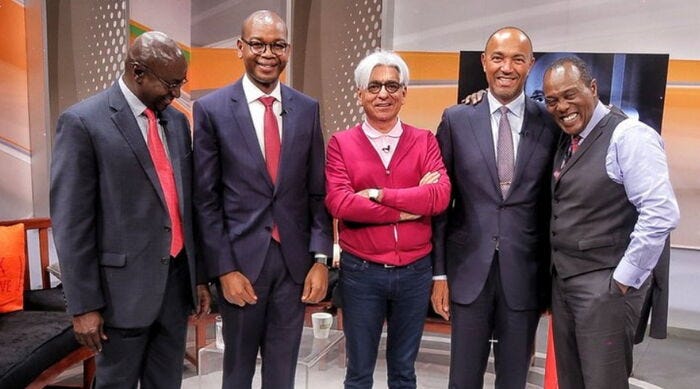
In July 2019, during the memorial service for the late Safaricom CEO Bob Collymore, then-President Uhuru Kenyatta took to the podium and did something unusual for a state eulogy. He openly addressed a tight-knit, elite fraternity sitting in the front pews—a group the local business press had long whispered about as the corporate “Boys Club.” Featuring Collymore, KCB Group CEO Joshua Oigara, media personality Jeff Koinange, politician Peter Kenneth, and Scangroup CEO Bharat Thakrar, the President jokingly lamented that despite holding the highest office in the land, his ‘uji’ (whisky) had been taken away, from the club’s last encounter. It was a lighthearted moment, but to astute market watchers, it was a public confirmation of a powerful reality: Kenya’s deepest corporate pipelines were anchored by an exclusive, parallel engine of trust and informal power.
1.2 Network Equity as a Commercial Moat
For Bharat Thakrar, this club was never a mere social gathering; it was a clinical, high-altitude commercial buffer. By embedding himself at the absolute intersection of the country’s largest telecommunications giant (Safaricom) and its largest commercial bank (KCB), Thakrar constructed an unbreakable lock on East Africa’s multi-billion-shilling corporate marketing spend.
1.3 The Service Sector Maverick and the Valuation Paradox
Long before he sat in the front pews with the nation’s corporate titans, Thakrar was an independent challenger. He founded Scanad Marketing in 1982 to aggressively disrupt a local marketing sector dominated by complacent, legacy British and American agency outposts. However, as the business scaled, he faced a rigid valuation paradox rooted in the traditional mindset of the Nairobi Stock Exchange (NSE). In the 1990s and early 2000s, local capital markets were explicitly engineered for tangible asset classes like agricultural plantations, commercial banks, and manufacturing plants. The prevailing market consensus was clear: “Service companies do not have physical factories or heavy machinery to justify a public listing.”
Thakrar completely rejected this asset-heavy dogma. He approached institutional fund managers with a revolutionary thesis: human talent, entrenched client relationships, and massive media-buying scale could be financialized, aggregated, and packaged as a premium, high-yielding equity instrument. He set out to prove that intellectual capital and elite corporate networks could be successfully listed, traded, and financialized.
2.0 The 2006 NSE Landmark: Creating a Marketing Currency
2.1 The Over-Subscription Signal
In August 2006, Thakrar tested his financial thesis on the open market, launching the Scangroup Initial Public Offering (IPO). The market’s response shattered all conventional skepticism. The IPO was oversubscribed by an unprecedented six times, signaling a massive, pent-up appetite among both local retail savers and institutional fund managers for non-traditional, asset-light equities. The spectacular debut proved that the market was fully ready to value the “attention economy.”
2.2 Weaponizing the Stock
For ordinary founders, an IPO is viewed as an exit strategy—a moment to cash out and dilute control. For Thakrar, listing on the NSE was a purely offensive maneuver. He did not view Scangroup equity as static wealth; he viewed it as a listed corporate currency. By creating a publicly traded share with transparent market pricing and high liquidity, Thakrar effectively granted himself the power to print stock and use it as a financial weapon to launch a massive, pan-African consolidation drive, systematically buying out any regional competitor that stood in his way.
2.3 Setting the Corporate Standard
The Scangroup listing did more than just mint overnight millionaires; it forced a highly informal, relationship-driven creative industry into a framework of strict corporate governance. To maintain its listed status, Scangroup had to replace handshake deals with forensic audit trails, transparent client-agency contract disclosures, and rigorous multi-market financial reporting. Thakrar successfully professionalized the creative arts, proving to the wider East African business community that an agency could operate with the fiscal discipline and transparency of a Tier-1 commercial bank.
3.0 The Continental Roll-Up and the Data Divestment
3.1 Timeline of Pan-African Aggregation & The Kantar Exit
For market participants tracking multi-market execution, Bharat Thakrar did not treat regional expansion as a slow, organic process. He used Scangroup’s listed equity currency on the NSE to execute a systematic, rapid pan-African roll-up strategy, buying his way into dominant market shares across sub-Saharan Africa.
2007 | The Safaricom Anchoring and Regional Launch: Scangroup acquired a 50% stake in RedSky, bringing Kenya’s largest advertising budget (Safaricom) into its direct orbit. Concurrently, Thakrar expanded into Tanzania by acquiring FCB Tanzania, instantly onboarding the Vodacom account.
2008 | The Ogilvy Continental Coup: Executed a massive, landmark pan-African transaction valued at approximately US$ 6.1 million using a calculated mix of cash and Scangroup’s listed equity currency. This deal absorbed a dominant share of Ogilvy & Mather’s continental network, handing Thakrar immediate operational reach across East, West, and Southern Africa. It brought tier-1 global multinational clients—including Coca-Cola, Unilever, Reckitt Benckiser, GSK, Barclays, and Standard Chartered—directly into the group’s revenue stream.
2010s | Total Market Consolidation: Systematically acquired and rolled up global agency networks across multiple African jurisdictions, absorbing Grey East Africa, JWT Kenya and Tanzania, McCann Erickson, Universal McCann, MediaCom, Mindshare, MEC, and Hill+Knowlton. This consolidation strategy was further reinforced by aggressive talent poaching from independent rivals, effectively migrating major client relationships by absorbing the underlying human capital.
2018 | The Data Integration Drive: Acquired a majority 80% stake in Research and Marketing Group Investment Limited, the holding company operating Kantar TNS across primary and emerging African markets—including Kenya, Nigeria, Senegal, Cameroon, Côte d’Ivoire, and Ghana. This integrated massive market research and data analytics capabilities into Scangroup’s pan-African service offerings.
June 2020 | The Massive Kantar Africa Divestment: Following a global realignment by parent company WPP, Thakrar steered the highly lucrative sale of the Kantar Africa Business (comprising Millward Brown East Africa, Millward Brown Nigeria, Millward Brown West Africa, and Research & Marketing Group Investment Ltd). The transaction was a monumental event for the local market, netting Scangroup a gain on disposal after tax of KSh 2,242 million (KSh 2.24 billion). Thakrar immediately used this liquidity to reward shareholders, declaring a massive, historic special interim dividend of KSh 8.00 per share in July 2020.
4.0 The Global Alignment: Bringing WPP to the Table
4.1 Partnering with the Giants
Scangroup’s absolute dominance of the African continent eventually caught the eye of global Madison Avenue power brokers. In a series of highly sophisticated corporate transactions, WPP PLC—the world’s largest communications and advertising conglomerate—began buying into Scangroup, eventually taking a dominant majority stake in the company. This alignment injected immense global capital into the entity, giving Scangroup direct access to international proprietary tools, global training frameworks, and a permanent pipeline of multinational client mandates.
4.2 Global Reach vs. Local Autonomy
This partnership created a complex, high-stakes operational dynamic. Thakrar found himself navigating a delicate corporate double-helix: he had to maintain his highly aggressive, entrepreneurial, and hands-on management style on the ground in Nairobi, while simultaneously answering to a highly rigid, corporate, and compliance-driven multinational parent listed on both the London and New York stock exchanges. For years, Thakrar successfully balanced these competing forces, using WPP’s global muscle to solidify his local monopoly while retaining absolute executive command over the day-to-day operations of the African empire.
5.0 The February 2021 Fracturing and Corporate Warfare
5.1 The Abrupt Separation
The delicate equilibrium between local entrepreneurial autonomy and multinational corporate compliance fractured permanently on February 19, 2021. In a shocking announcement that sent shockwaves through the Nairobi Securities Exchange, Scangroup’s board announced the immediate suspension of Bharat Thakrar alongside his Chief Financial Officer, citing an internal investigation into allegations of gross corporate misconduct and financial irregularities. Thakrar vehemently denied the allegations, but as the multinational machinery of WPP tightened its grip, he officially resigned from his role as CEO in March 2021, marking the dramatic end of an era.
5.2 The Data and Privacy Legal Battle
True to his combative nature, Thakrar did not retreat quietly into retirement. He immediately launched a fierce, multi-front legal counter-offensive against WPP and its appointed investigative firm, Control Risks Group. Utilizing Kenya’s stringent Data Protection Act, Thakrar dragged the multinational giants to court, alleging that investigators had illegally accessed, processed, and compromised his highly sensitive personal data and private communications during their forensic probe. This legal battle exposed the deep, bitter animosity under the hood of the corporate divorce, transforming a boardroom dispute into a landmark regulatory showcase on data privacy and executive rights.
5.3 Post-Bharat Splintering
The removal of the ultimate networker immediately exposed the vulnerabilities of an organization built entirely around a singular personality and a closed-door circle of trust. Between 2021 and 2025, Scangroup entered a period of severe operational decay. Stripped of Thakrar’s relentless competitive instincts and deep personal relationships with corporate captains, the agency suffered an unprecedented talent drain and a catastrophic loss of core accounts. The ultimate symbolic blow fell in 2025, when Scangroup lost the historic pan-African Airtel Africa account to independent rivals. The financial damage was immense: the company recorded a staggering KSh 3.1 billion in cumulative net losses over that four-year window, causing its market capitalization to collapse to historic lows.
6.0 Modern Shareholder Activism: The Founder’s Return
6.1 The 13.59% Blocking Block
Though removed from executive management, Thakrar retained an incredibly powerful financial weapon: his personal equity. Holding a commanding 13.59% stake in the company, he remains the single largest individual shareholder in Scangroup. Recognizing that the multinational management team was rapidly eroding the value of his life’s work, Thakrar began quietly building alliances with key minority stakeholders—including influential local investment groups like the Bid family and prominent retail activist Carl Ogola. Together, they formed a highly coordinated blocking minority, determined to challenge WPP’s strategy.
6.2 The Board Ouster Campaign (May 2026)
In May 2026, Thakrar went on the offensive, escalating the corporate dispute into full-scale shareholder warfare. Utilizing section 276 of the Companies Act, Thakrar and his allied minority bloc issued a formal demand forcing Scangroup to call an Extraordinary General Meeting (EGM). Their explicit agenda is radical: the immediate dissolution and ouster of the current board of directors. Thakrar’s faction argues that the current board has demonstrated total fiduciary failure, presiding over a historic destruction of shareholder value, and must be replaced by leaders who understand how to fight for local market share.
6.3 The Fiduciary Playbook
This ongoing 2026 EGM showdown provides a masterclass for contemporary market participants in minority shareholder protection. Thakrar’s strategy demonstrates that a founder is never truly powerless as long as they hold a significant block of equity. By weaponizing company law, mobilizing local retail investors, and publicly interrogating the performance metrics of a global multinational parent company, Thakrar has rewritten the playbook on how local capital can push back against international corporate overreach when a listed asset’s valuation collapses.
7.0 Conclusion: The DNA of the Beast
7.1 The Irreplaceable Founder Syndrome
The rise, fall, and subsequent rebellion of Scangroup perfectly illustrates “Irreplaceable Founder Syndrome” within the context of African capital markets. Companies that are built on raw entrepreneurial pressure, razor-sharp personal relationships, and a constant state of commercial warfare often struggle to survive when transitioned into clinical, process-driven multinational governance. Without the aggressive DNA of the person who built the pipeline and commanded the rooms, the corporate machinery quickly loses its competitive edge.
7.2 The Permanent Impact on the Boardlot
Ultimately, Bharat Thakrar’s legacy on the Nairobi Securities Exchange is permanent. Long before tech startups spoke of VC funding or valuation multiples, he proved that an East African service-sector business could scale, list, and capture global capital by leveraging elite network equity. While his ongoing boardroom war continues to dictate the short-term volatility of Scangroup’s share price, his historical blueprint remains essential reading for any entrepreneur looking to transform human relationships into a listed, weaponized, and highly liquid market currency.