
The Zombie of the NSE: Behind the Creeping Battle for Express Kenya
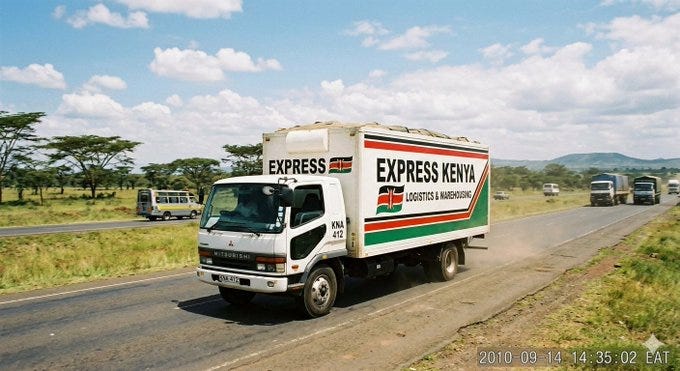
For years, retail investors tracking the Nairobi Securities Exchange (NSE) have watched a ghost haunt the boards. Express Kenya Plc (XPRS) sits there—often completely illiquid, heavily indebted, and printing consecutive annual losses. Yet, beneath the operational wreckage lies an asset-heavy battlefield.
This comprehensive deep-dive breaks down the reality of this local penny stock, analyzing its multi-decade financial decay, its deceptive asset-backed illusion, and why it serves as a textbook example of a structural market trap that retail capital should avoid.
1. The EABL Divorce and the Collapse of Revenue and Profits in 15 Years
The long-term erosion of Express Kenya’s operational income is a classic case study in structural decline. What was once a thriving regional logistics and clearing powerhouse has shrunk into a bleeding penny stock shell.
The 2011 Inflexion Point: The day East African Breweries Limited (EABL) walked out the door and terminated its massive, lucrative distribution contract, Express Kenya’s core business died. What followed was a masterclass in operational bleeding.
The Squeeze from Below: In the years that followed, stiff competition from agile third-party logistics startups, independent truckers, and modern fleet operators completely hollowed out the firm’s remaining margins.
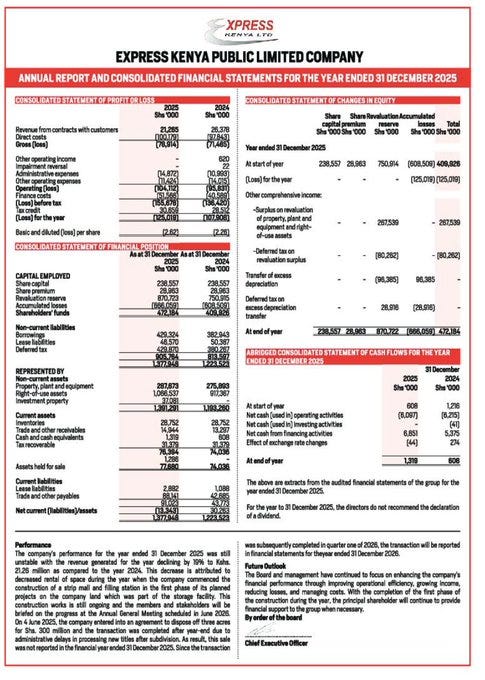
Decade-Long Bleeding: The revenue numbers tell a devastating story of decay. In its full-year financial results for the period ending December 31, 2025, Express Kenya recorded its twelfth consecutive year of losses, with a net loss of KSh 125 million (up from a net loss of KSh 107.9 million in 2024).
Top-Line Evaporation: Revenue fell by 19.4% to a meager KSh 21.27 million in 2025. This was exacerbated by severe operational disruptions to its legacy rental and warehousing streams as the company began modifying its ground assets.
The Debt Trap: With minimal money coming in, finance costs climbed a steep 27.1% to KSh 51.6 million in 2025 alone, pushing the loss before tax to KSh 155.7 million. This crushing interest expense remains the relentless engine of a dying penny stock.
2. Balance Sheet Analysis
Express Kenya’s balance sheet has transformed over the years from a busy, asset-backed logistics ledger into a highly distressed, real estate-heavy shell.
The Debt-to-Equity Crisis (Historical Period): For over two decades, this penny stock has operated under a dark cloud of negative working capital. It historically carried high commercial bank overdrafts and suffocating short-term debt liabilities relative to its liquid equity base.
The Accumulation Phase (Full-Year 2024): By the close of 2024, accumulated losses had officially reached KSh 606.5 million. Total shareholders’ equity dropped from KSh 520 million to KSh 412 million, while its actual cash reserves evaporated to a terrifying KSh 608,000. Auditors repeatedly flagged the firm with severe going-concern warnings.
The Current Breakdown (Full-Year 2025): Accumulated losses swelled past KSh 666 million. The balance sheet became functionally insolvent on an operating basis, kept alive entirely by the paper valuation of its prime land assets. Total borrowings grew to KSh 388 million, heavily outweighing total shareholders’ funds which cratered to KSh 369 million.
The Lifeline Event (Q1 2026): Faced with extreme existential distress and pressure from creditors, the company executed a major asset-stripping transaction during the first quarter of 2026, selling off a three-acre parcel of land in Nairobi’s Industrial Area for KSh 300 million net. This cash is explicitly earmarked to clear crushing short-term bank liabilities and finance costs. It isn’t growth capital—it is pure survival capital.
3. The Crafty Majority Shareholder – Attempted Takeover and Delisting
When an operating business collapses into an illiquid penny stock but the land underneath remains pristine, the incentives of a majority shareholder shift away from running a public company toward taking the whole asset private.
In 2018, CEO Hector Diniz launched a bold, open takeover bid through his investment vehicle, Diniz Holdings. The offer was pitched at KSh 5.50 per share—a price that looked like a premium compared to the depressed penny stock market rate at the time. The goal was simple: buy out the remaining 38% minority retail shareholders, take the company private, and delist it from the exchange.
Savvy “board lot” street investors read right through the play. The offer valued the entire company at just KSh 195 million, a laughable valuation given the immense market price of its Nairobi land holdings. Retail shareholders collectively blocked the move, refusing to surrender their certificates. The takeover bid failed to hit the required 75% threshold, capping out at 61.6%.
Diniz didn’t get his full buyout, but he shifted to a “creeping takeover” strategy. By gradually absorbing blocks of shares on the open market, his total controlling stake comfortably pushed past the 70% mark. Minority retail investors won the battle to stay listed, but they effectively locked themselves inside a listed penny stock cage with practically zero daily trading liquidity.
4. The Revenue Collapse Profit and Loss Statement
To look closely at Express Kenya’s profit and loss statement over the past decade is to watch a slow-motion car crash in slow motion. The financial anatomy of this penny stock reveals that it isn’t an operating business anymore—it is a purely administrative shell bleeding interest.
Gross Margin Disappearance: As logistics revenues disintegrated, fixed overhead costs like security for warehouses, administrative filing fees, and listed-company compliance costs stayed flat. This completely crushed any hope of operational gross profits.
Operating Loss Consistency: Strip away the non-operating items, and the core operating loss has been a predictable, negative downward spiral. The business model cannot generate enough cash flow from regular clients to meet everyday utility bills.
The Dominance of Finance Costs: On the P&L ledger, the single largest line item crushing the company isn’t staff salaries or transport fuel—it is the finance costs. Paying upwards of KSh 51.6 million annually in interest on a revenue base of just KSh 21.27 million creates an impossible mathematical trap. Every shilling earned is immediately swallowed up more than twice over by financiers before operational expenses are even considered.
5. The Biggest Shareholder is Your Biggest Creditor – Analysing Who Holds the Debt
In distressed penny stock companies, the ultimate leverage isn’t equity—it’s debt. Hector Diniz didn’t just control the company via the boardroom; he controlled it through the balance sheet as the primary financial lifeline.
For years, when commercial tier-1 banks refused to extend credit to a bleeding logistics firm, it was Diniz-linked entities that stepped in with internal shareholder loans to keep the lights on. Express Kenya owed tens of millions to Diniz Holdings Ltd and Airport Trade Centre Ltd—both corporate vehicles belonging directly to the CEO.
The trap snapped shut in 2019 when shareholders unanimously voted to convert KSh 80 million of this internal debt into equity at a price of KSh 6.50 per share. Through this debt-to-equity swap, Diniz minted 12.31 million new shares out of thin air. Airport Trade Centre bagged 6.46 million shares, and Diniz Holdings received 5.85 million shares.
The Penny Stock Debt Lesson: When the majority shareholder is also the chief creditor of a penny stock, they win either way. If the company pays the debt, they get cash. If the company defaults, they dilute the minority retail pool, seize more equity, and tighten their absolute control over the remaining underlying assets.
6. Majority Shareholder’s Plan – Project Nexus
With the logistics business dead, the majority shareholder’s long-term play has finally been unveiled: Project Nexus, a massive KSh 13 billion real estate development aimed at transforming the Mombasa Road urban corridor from transport into property development.
Project Nexus is a multi-phase, five-year pivot structured as follows:
Phase 1 (KSh 250 Million): The construction of a commercial strip mall and petrol station, targeted for completion by Q3 2026.
Phase 2 (KSh 7.65 Billion): A massive joint venture to construct 1,200 residential apartments between late 2026 and 2029.
Phase 3 (KSh 2.1 Billion): A 200,000-square-foot mega-commercial mall.
Phase 4 (KSh 3.0 Billion): An 80,000-square-foot medical center and 450 serviced apartments running through 2030.
The 2025/2026 Status Check: In the latest financial results, the company confirmed that this plan is actively in progress, opening a dedicated project sales office and offering a 5% apartment purchase discount to shareholders and staff. However, for a fundamentally broken penny stock company, it is an incredibly capital-intensive and risky pivot. The ongoing construction of the Phase 1 strip mall and filling station severely disrupted legacy warehousing operations, which heavily contributed to the 19.4% drop in immediate revenues.
7. The Rational Alternative: Close Shop, Liquidate, and Pay a Special Dividend
If you strip away the grand corporate poetry of a KSh 13 billion real estate masterplan, a glaring question emerges for retail investors: Why are we doing this?
Building a KSh 13 billion development requires staggering amounts of debt, complex joint-venture agreements, and years of intense execution risk. If project timelines slip, rising interest rates on construction financing could easily eat up any future profits before retail holders see a cent.
For minority shareholders trapped in this penny stock, the cleanest, most rational option would be the simplest one:
Halt Project Nexus: Stop spending capital on architectural plans, sales offices, and marketing.
Orderly Liquidation: Wind up the remaining transport shell and sell off the remaining prime acres along Mombasa Road and Industrial Area on the open market.
Pay Off All True Debt: Use the initial cash to completely wipe out any remaining commercial bank and insider liabilities.
Distribute a Special Dividend: Distribute the remaining net cash proceeds equally to all shareholders based on their holdings.
Given where the stock trades on the NSE (frequently depressed due to extreme illiquidity and its status as an unloved penny stock), an orderly liquidation of their land assets would likely unlock a per-share value significantly higher than the current market price.
Fact Check: The Reality of the KSh 300 Million Asset Disposal
While corporate press releases frame the Q1 2026 Industrial Area land sale as a strategic move to optimize working capital for “future growth corridors,” a cold reading of the financial ledger tells an entirely different story. This KSh 300 million transaction is not an inflow of expansion capital; it is a rapid, defensive liquidation of the company’s core physical assets specifically triggered to pay down suffocating debts. Chief among these liabilities are the outstanding insider shareholder loans advanced to the company by the CEO himself through his private holding firms. By liquidating the land bank to retire these specific credit facilities, the company is effectively handing its premium underlying asset value back to the chief insider in cash, leaving retail shareholders holding a hollowed-out operational shell.
The Final Verdict & Recommendation
The market will always try to lure retail capital into cheap counters with the promise of “undervalued assets,” “deep property discounts,” or “turnaround masterplans.” Express Kenya proves that asset value means absolutely nothing if you are locked inside a listed cage where the majority shareholder controls both the boardroom and the debt ledger. You are simply along for a ride where you have no say, no liquidity, and no protection.
When a company transitions from asset-rich bleeding to active asset-stripping—like the KSh 300 million land disposal—speculative traders might chase a brief bump, but the underlying structural traps remain identical. You face massive slippage if you try to sell a large block, and you are entirely dependent on insider timelines.
Therefore, my final recommendation for my followers remains exactly what it has always been: Avoid penny stocks entirely.
Do not gamble your hard-earned capital on illiquid, bleeding zombie tickers in the hopes of a speculative value extraction. Focus your money on high-conviction, deeply liquid, and structurally sound corporate or infrastructure assets where retail capital has real rights and exit liquidity. Protect your capital, keep your wealth liquid, and stay far away from the penny stock graveyard.
Keep your stops tight, your eyes on the land registry, and protect your portfolio.