
“The modern corporate myth of TransCentury is built on a narrative of seamless brotherhood—29 elite gentlemen drinking single-malt whiskey at the Muthaiga Country Club, pooling KSh 1 million each to conquer East African infrastructure. But the reality behind closed doors was far more Darwinian. These men were not standard friends; they were brilliant, hyper-ambitious, and intensely protective corporate warlords. They were ‘frenemies’ held in alignment by a single, universally respected arbiter: James Mungai Gachui. When Gachui died in late 2010, the center of gravity vanished, the invisible treaties expired, and the internal fractures began to bleed into the public market...”
HE ARCHITECT OF INDIGENOUS CAPITAL
The Visionary Life, Relational Empire, and Posthumous Friction of James Mungai Gachui (1948–2010)
James Mungai Gachui (25 March 1948 – 16 December 2010) was a pioneering Kenyan chemical engineer, entrepreneur, and investment visionary who founded TransCentury Limited (TCL), one of East Africa’s most ambitious indigenous private equity and infrastructure groups. His life story is deeply rooted in strong family foundations, which shaped his discipline, networks, and long-term vision.
Yet, in the broader theatre of East African corporate history, Gachui’s legacy is multi-dimensional. He was both the brilliant, relationship-driven patriarch who demystified elite wealth pooling, and an individual whose towering personal credibility exposed the raw vulnerabilities of key-man risk in frontier markets.
1. Family Roots and Early Childhood
Born on 25 March 1948, James grew up in a large, close-knit family that instilled foundational values of hard work, education, and communal ambition. He was one of 12 siblings (including his brother John Mwangi Gachui and sister Mary Gachui), an environment that fostered early lessons in leadership, the pooling of resources, and collective progress. These exact traits later defined his legendary ability to rally elite, fiercely independent professionals into single investment vehicles.
Details of his earliest childhood years—pre-primary and village life—remain relatively private, unfolding in late colonial and early post-independence Kenya during an era of intense national optimism and rapid social change. His family background emphasized education as the primary ladder for upward mobility, a common drive among ambitious Kenyan families of that time. This rock-solid foundation propelled him toward academic and technical excellence from a young age.
Family remained the central anchor throughout his life. He married Anne Pearl Karimi Gachui, who would later serve as the executrix of his estate and continue managing family interests. Together they raised three daughters—Jennifer, June, and Angela—to whom he was completely devoted. Obituaries and family memorials routinely highlighted him as a “loving husband, a doting father, a son, and a brother,” underscoring a deep personal warmth beneath his formidable business persona. His daughter, June Gachui, has occasionally shared public glimpses of this family legacy, carrying forward aspects of the family’s entrepreneurial, creative, and public service spirit.
2. Education and the Corporate Launchpad (1970s–1990s)
This solid family grounding supported James’s pursuit of world-class higher education. He attended the University of Surrey in Guildford, UK, graduating with First Class Honours in Chemical Engineering around 1972. The rigorous training and exposure to international engineering standards equipped him with a precise, systematic mindset and global outlook that became foundational to his later corporate victories.
Returning to Africa, Gachui built a highly distinguished, multi-decade career in the energy and petroleum sectors:
Kenya Petroleum Refineries Limited (Mombasa): Started as a trainee technologist, steadily rising to senior technologist.
Total Kenya (1978): Joined the multinational energy firm, rapidly advancing through the operational ranks to become Operations Manager.
International Postings: Dispatched by Total to Paris (focusing on supply and international trading) and later to Abidjan, Côte d’Ivoire, where he served as the Regional Trading Manager for West Africa.
Galana Petroleum (1993): After returning to Kenya in 1991, he left the multinational corporate track in 1993 to co-found Galana Petroleum, marking his official entry into full-time entrepreneurship.
These corporate roles did more than provide financial stability; they gave Gachui an intimate understanding of complex supply chains, continental trade mechanics, and a high-caliber network that he would eventually leverage to change the face of Kenyan investment.
Parallel Empires: James Gachui’s Independent Corporate Footprint
While James Gachui is widely celebrated as the founding chairman of TransCentury Limited, his personal corporate footprint outside of the group was sprawling and arguably even more agile. Operating independently or through his primary family holding company, Jimana Limited, Gachui acted as a prolific early-stage venture capitalist and institutional builder in East Africa.
Long before “venture capital” and “private equity” became mainstream buzzwords in Nairobi, Gachui used his personal net worth and corporate credibility to anchor pioneer firms across energy, telecommunications, banking, and technology.
1. Jimana Limited (The Family Engine)
Jimana Limited was Gachui’s primary private investment vehicle, which he closely utilized to hold parallel stakes in the market. Local investment peers often noted that Jimana operated strategically alongside TransCentury; it frequently invested directly in the very opportunities TransCentury touched, serving as a concentrated mechanism for Gachui to back his own corporate conviction. Beyond public markets, Jimana was the primary repository for his private equity holdings, real estate assets, and family interests, building up a personal net worth that exceeded KSh 5 billion by 2010.
2. Wananchi Online / Wananchi Group (The Internet Pioneer)
Gachui was one of the critical financial godfathers of Kenya’s modern digital revolution. In November 1999, two young tech entrepreneurs—Njeri Rionge and Joseph Mucheru (who later became Kenya’s ICT Cabinet Secretary)—were pitching a radical business plan to establish a retail-focused Internet Service Provider (ISP) called Wananchi Online Limited. After being rejected by corporate boards who believed individual retail internet was unprofitable, they pitched to Gachui.
Recognizing the massive, unserved market gap, Gachui’s Jimana Limited stepped in as the heavy anchor investor:
The Structure: Jimana Ltd took a definitive 51% majority stake in the start-up, providing the vital setup capital and regulatory backing required to secure an ISP license from the Communications Commission of Kenya (CCK).
The Scale: Gachui took over as Chairman of the Board. Under his leadership, Wananchi Online aggressively commercialized mass-market internet, eventually merged with ISP Kenya, and structured itself for massive regional scale.
This early entity laid the structural foundation for what evolved into today’s multi-billion-shilling Wananchi Group (Holdings), the parent company of consumer fiber giant Zuku and enterprise connector Simbanet.
3. Seven Seas Technologies (SST)
In the early 2000s, Gachui extended his technology focus by backing Seven Seas Technologies, an indigenous IT systems integrator founded by Michael Macharia. Gachui served as the company’s early Chairman.
At the time, the local technology landscape was dominated by multinational hardware and software vendors. Gachui’s presence gave the young, local firm massive corporate gravity. His primary contribution to SST was introducing world-class corporate governance frameworks and leveraging his deep reputation to position the firm for large-scale corporate and public-sector enterprise contracts. His daughter, June Gachui, would later continue to represent the family’s legacy on the SST board of directors.
4. Chase Bank Kenya & Genghis Capital
Through Jimana Capital (his collaborative financial engine with investment banker Jimnah Mbaru), Gachui was a central pillar and anchor shareholder of Chase Bank Kenya.
During his lifetime, Gachui acted as a vital, stabilizing boardroom force for the bank. He helped guide its niche strategy of relationship-driven corporate banking specifically tailored to the rapidly expanding, underserved small and medium enterprise (SME) sector. Alongside Chase Bank, his financial ecosystem included Genghis Capital, a specialized investment brokerage and asset management firm that fed into the group’s wider capital market transaction pipeline.
5. Galana Petroleum
Before he was an investment mogul, Gachui was fundamentally a seasoned corporate “oil man,” having spent nearly two decades climbing the executive ranks at Kenya Petroleum Refineries Limited (KPRL) and Total Kenya, including postings in Paris and Abidjan.
In 1993, Gachui broke away from the multinational corporate track to co-found Galana Petroleum. As an independent petroleum products trading and marketing company, Galana allowed Gachui to commercialize his deep international supply-chain networks, logistics expertise, and regional trading knowledge. Galana provided him with the initial independent financial liquidity and hard-core operational blueprint that he later scaled up to form TransCentury four years later.
3. Pooling Elite Capital in a Hostile Era: The Birth of TransCentury
In 1997, drawing on his innate ability to convene people, Gachui executed his most famous gambit. He rallied 29 elite Kenyan professionals—popularly dubbed the “Muthaiga Group”—into a formal investment club. In the political economy of 1997, during the twilight years of President Daniel arap Moi’s administration, private Kikuyu wealth was frequently viewed with suspicion by the state. Gachui’s genius lay in constructing a hyper-discreet, private vehicle that pooled local elite capital to build an independent economic engine.
Who Founded Transcentury
Before the “Club of 29” formally pooled their capital to incorporate TransCentury in 1997, these individuals were already highly established elite technocrats, corporate executives, and private industrialists. They were largely products of top-tier professional training who had risen to the apex of their respective fields during the 1980s and 1990s.
Here is a brief profile of what the first 10 core members were doing professionally before they came together to form the chama:
1. Zephaniah Gitau Mbugua (Zeph Mbugua)
Pre-1997 Profile: An industrialist and private entrepreneur. After graduating from Makerere University with a BSc in Chemistry and Mathematics, Mbugua built his foundational fortune by founding the Abcon Group of Companies in the late 1970s, turning it into a leading regional distributor of industrial chemicals and consumer goods.
Role in TransCentury: Chairman of the Board & Subsidiary Anchor. Mbugua served as the face of the group’s corporate governance as its long-standing Chairman for nearly two decades (until 2017). Beyond the parent board, he took an active oversight role as the Chairman of East African Cables following its 2004 acquisition, directly steering the industrial strategy that revived the manufacturer into a regional powerhouse.
2. Jimnah Mbaru
Pre-1997 Profile: A powerhouse investment banker and structural economist. Mbaru worked in the Ministry of Commerce and KCB before acquiring Dyer & Blair Investment Bank in 1990. He served as the Chairman of the Nairobi Stock Exchange (NSE) from 1992 to 2002 and was already the primary architect of Kenya’s modern capital markets framework.
Role in TransCentury: Investment Strategist & Deal Architect. While Mbaru largely maintained a non-executive director profile to avoid direct conflicts with his regulatory and investment banking roles, he was the group’s financial mastermind. He played a critical advisory role in structuring TransCentury’s capital-raising strategies, corporate valuations, and its eventual trajectory toward public listing.
3. Eddy Njoroge
Pre-1997 Profile: A private sector executive and strategic corporate actor. Long before heading KenGen in 2003, Njoroge was a well-connected corporate director and entrepreneur who managed private equity portfolios, sat on several blue-chip boards, and operated extensively within East Africa’s high-level business networks.
Role in TransCentury: Strategic Director & Energy Sector Advisor. Njoroge sat on the main TransCentury board as a key director. He brought invaluable deal-structuring expertise to the table, helping guide the firm’s entry into major infrastructure, power, and engineering projects across the region—a footprint that aligned closely with his deep understanding of East Africa’s energy landscape.
4. Michael G. Waweru (M.G. Waweru)
Pre-1997 Profile: A veteran auditor and tax professional. Waweru spent his early career rising through professional services, ultimately reaching the top of the accounting world as the Managing Partner of Ernst & Young East Africa (until 2002, before his appointment as KRA Commissioner-General).
Role in TransCentury: Audit, Governance & Financial Guardrail. Waweru was an active director on the TransCentury board, specifically anchoring the Audit and Risk Committee. He was instrumental in establishing the rigid financial governance, transparent reporting, and institutional audit structures that allowed TransCentury to shed its “informal investment club” roots and successfully attract international institutional capital.
5. Peter Tiras Kanyago
Pre-1997 Profile: A chartered corporate accountant and transport logistics entrepreneur. A Fellow of ICPAK with an MBA in Industrial Management, Kanyago spent the 1980s and 90s building high-value logistics and engineering ventures, including East African Courier Ltd and East Africa Elevator Company (ThyssenKrupp), while serving as a prominent director in the tea sector (KTDA).
Role in TransCentury: Director & Operations Overseer. Kanyago served actively as a non-executive director on the main board and sat across several key subsidiary committees. He leveraged his extensive private logistics and mechanical engineering background to help oversee the operations, supply chain efficiencies, and corporate compliance of TransCentury’s engineering divisions
6. Ngugi Kiuna
Pre-1997 Profile: An industrial engineer and premium distribution heavyweight. Holding an honors degree in Mechanical Engineering from the University of Portsmouth (UK), Kiuna was a corporate titan who served as Managing Director of DiverseyLever East Africa and held an influential executive presence at BOC Kenya. Beyond corporate management, his investment vehicle, Maxam Limited, pulled off a massive commercial coup by securing and executing the exclusive master distribution rights for global beer giant Heineken across Kenya, Uganda, and Tanzania, establishing premium cold-chain networks from scratch.
Role in TransCentury: Industrial Strategy Director & Manufacturing Lead. Kiuna was an active, long-serving director on the main TransCentury board. He directly leaned on his deep engineering and FMCG supply-chain expertise to evaluate new industrial acquisitions. His background was absolutely critical in driving operational efficiency, regional supply-chain integration, and plant turnarounds for TC’s heavy manufacturing subsidiaries across East Africa.
7. Robin Kimotho
Pre-1997 Profile: An independent financial consultant and cross-border deal structuring specialist. Kimotho cut his teeth inside the Economics and Planning division of Kenya Commercial Bank (KCB) in the 1970s and 80s. Crucially, from 1987 to 1995, he operated as an Investment Officer for the international Africa Project Development Facility (APDF) across Eastern and Southern Africa, giving him rare, elite experience in structuring complex private equity transactions across the continent.
Role in TransCentury: Investment Committee Anchor & Private Equity Tactician. Kimotho served actively as a director on the TransCentury board, specifically deploying his deep institutional PE background to anchor the group’s Investment Committee. He was heavily involved in designing the strict valuation models, conducting due diligence, and crafting the deal-structuring playbooks that enabled the chama to successfully transit into a formalized infrastructure investment fund.
8. Njeru Kirira
Pre-1997 Profile: A career public macroeconomist and high-level Treasury technocrat. Highly trained in public tax administration and fiscal policy, Kirira spent decades navigating the apex of Kenya’s economic planning. Before TransCentury’s inception, he had already served as the Director of Fiscal & Monetary Affairs at the National Treasury and as an Economic Advisor to the Central Bank of Kenya (CBK).
Role in TransCentury: Macroeconomic Director & Public Sector Strategy Advisor. Sitting actively on the board, Kirira provided vital high-level macroeconomic oversight. Because TransCentury’s primary growth engine relied on massive public-private infrastructure, power, and transport networks, Kirira’s understanding of public finance, regulatory landscapes, and state policy gave the board a sophisticated edge when aligning corporate bids with regional national development plans.
9. Joseph Karago
Pre-1997 Profile: A consulting architect and real estate development master planner. Karago spent the 1980s and 1990s as a practicing corporate architect running his own successful firm in Nairobi. His day-to-day work centered on commercial master planning, large-scale physical infrastructure design, and heavy project management across urban East Africa.
Role in TransCentury: Infrastructure Deployment & Real Estate Director. Karago sat directly on the parent board as an active director, stepping up to provide the group with direct, hands-on technical oversight. Whenever TransCentury evaluated physical infrastructure concessions, built power-generation plants, or handled large-scale real estate projects, Karago was the board’s go-to specialist to audit structural project management timelines, engineering blueprints, and capital expenditure (CapEx) costs.
10. James Gachui
Pre-1997 Profile: A corporate technology pioneer and digital infrastructure integrator. Gachui was a highly innovative systems specialist who spent his early career leading cutting-edge tech and telecommunications consulting ventures in East Africa. He was widely recognized within Nairobi’s elite business circles as a visionary in digital connectivity networks and tech infrastructure scalability.
Role in TransCentury: Founding CEO & Executive Driving Force. While other members guided the company from non-executive board seats, Gachui rolled up his sleeves to run the business day-to-day as TransCentury’s pioneer Chief Executive Officer. He was the operational anchor who tied the board’s collective genius together, setting up the executive management structures, spearheading negotiations for landmark acquisitions like East African Cables and Rift Valley Railways, and working full-time to build the chama into a multi-billion shilling corporate empire until his untimely passing.
Each member contributed KSh 1 million, creating an initial capital pool of KSh 24 million to KSh 30 million—a massive sum for an unlisted club at the time. Gachui served as Chairman and lead shareholder, holding an approximate 8.4% stake through his family estate, acting as the chief organizer, strategist, and internal troubleshooter.
                  [ 1997 - 2010: THE GACHUI ERA ]
         Hyper-discreet elite capital | Personal arbitration
                                |
                     ( Dec 2010: Gachui Passes )
                                |
             +------------------+------------------+
             |                                     |
   [ TRANSCENTURY LTD ]                     [ CHASE BANK KENYA ]
   • 2011: $56M Eurobond Issued             • Aggressive SME expansion
   • Severe currency mismatch               • Internal controls weaken
   • 2016: Near-default crisis              • 2016: Spectacular Receivership
   • Kuramo Capital buyout (Dilution)       • Portfolio systematically unwound
Under his steady hand, TransCentury grew from a private club into a powerhouse conglomerate. Early marquee moves included strategic stakes in Castle Breweries, the acquisition of East African Cables, and expansions into Tanzania and South Africa. By 2010, TransCentury’s portfolio was valued at roughly KSh 8.5 billion.
Beyond TCL, Gachui partnered with veteran investment banker Jimnah Mbaru to form Jimana Capital. Through this and other private vehicles, his personal business empire exceeded KSh 5 billion, stretching across information technology (Wananchi Group, Seven Seas Technologies) and finance (Chase Bank, Genghis Capital). Contemporary market observers noted that Gachui’s primary corporate value—beyond his technical acumen—was an extraordinary ability to unlock massive institutional contracts and manage complex corporate governance disputes through sheer personal credibility.
4. The War-Time General: The Rift Valley Railways Quagmire
While early corporate biographies often frame Gachui’s empire-building as an uninterrupted string of victories, his later years were consumed by one of the most complex and politically exhausting corporate battles in East African history: the Rift Valley Railways (RVR) concession.
TransCentury’s ambitious entry into the 25-year joint Kenya-Uganda rail concession pitted Gachui directly against international operators and aggressive foreign private equity, notably Egypt’s Citadel Capital. The rail system was plagued by severe operational deficits, aging infrastructure, and intense bureaucratic friction between Nairobi and Kampala.
Gachui spent his final years acting as a wartime general—writing high-stakes correspondence to government ministries, arbitrating boardroom standoffs, and attempting to defend the region’s primary transport artery from being entirely swallowed by foreign capital. This grueling, multi-front economic battle highlighted his profound patience and boldness, proving he was far more than a passive, fair-weather investor.
5. Death and the Institutional Turning Point (2010)
On 16 December 2010, James Gachui passed away at Nairobi Hospital from a brain tumour at the age of 62. Tributes flooded in from the highest echelons of East Africa’s political and business spheres, mourning the loss of a quiet titan.
However, the true, controversial measure of Gachui’s influence is visible in the structural fragility that exposed itself after his departure. In Kenyan corporate history, 2010 stands as a profound inflection point for his flagship investments, raising critical questions about institutional legacy versus individual charisma.
The TransCentury Debt Crisis
Just months after Gachui’s passing, TransCentury listed on the Nairobi Securities Exchange (NSE) via introduction in July 2011. Seeking to fund its massive infrastructure ambitions, the remaining leadership team pivoted away from Gachui’s traditional model of localized equity pooling and issued a $56 million dollar-denominated convertible Eurobond through a Mauritius subsidiary.
This debt facility quickly became a corporate chokehold. A severe currency mismatch emerged: TCL’s underlying subsidiaries earned revenues in volatile local East African currencies, while the debt had to be serviced in US dollars. As the Kenyan Shilling depreciated and operational headwinds at RVR mounted, TCL’s share price collapsed far below the Eurobond’s equity conversion strike price.
By the March 2016 maturity date, bondholders demanded their cash in full. Facing a catastrophic public default, the company was saved at the eleventh hour by a restructuring deal with New York-based private equity firm Kuramo Capital, which injected $20 million in exchange for a massive 25% controlling stake. The historic “Muthaiga Group” founders faced significant dilution—a stark contrast to the self-sustaining indigenous empire Gachui had originally envisioned.
Tension After Death: The Battle for TransCentury’s Soul
The untimely passing of pioneer CEO James Gachui did not just rob TransCentury of its operational anchor—it shattered the delicate equilibrium that held the chama turned corporate giant together. In the vacuum left behind, a quiet but fierce ideological and generational war erupted within the boardroom, pitting the conservative, institutional “old guard” founders against a new wave of aggressive, Ivy League-educated elite managers. This internal fragmentation ultimately paralyzed the group’s operations and set off a chain reaction that led to its dramatic financial decline.
The Kiuna-Mbugua Succession War & Dual Command
At the absolute center of this friction was the race to replace Gachui. In a move that deeply fractured the original brotherhood, founder Ngugi Kiuna aggressively maneuvered to install his own son, Dr. Gachao Kiuna—a brilliant, Cambridge-educated McKinsey alumnus—as the group’s new Managing Director and Chief Executive Officer.
This corporate succession was pushed through against the explicit wishes of several key founders, most notably the long-serving Chairman, Zephaniah Mbugua. The appointment fundamentally altered the chemistry of the board from a peer-to-peer collective into an arena of familial politics and corporate distrust.
                  [ TransCentury Board ]
                 /                      \
    Founder Ngugi Kiuna             Chairman Zeph Mbugua
            |                                |
  CEO Dr. Gachao Kiuna (Son)        (Favored Institutional Control)
            \                                /
             \                              /
           [ Conflicting Executive Commands ]
                            |
            [ Operational Subsidiary CEOs ]
               (e.g., East African Cables)
This structural rift spilled over into day-to-day operations, creating a toxic, unworkable corporate governance environment. Top executives at TransCentury’s cash-cow subsidiaries, particularly East African Cables, frequently reported receiving completely contradictory, parallel instructions:
The CEO’s Desk: Dr. Gachao Kiuna would issue high-velocity, expansionist mandates aimed at aggressive restructuring and modernizing regional supply chains.
The Chairman’s Corner: Zeph Mbugua would counter with directives rooted in the conservative, risk-averse operational philosophy that had built the original firm.
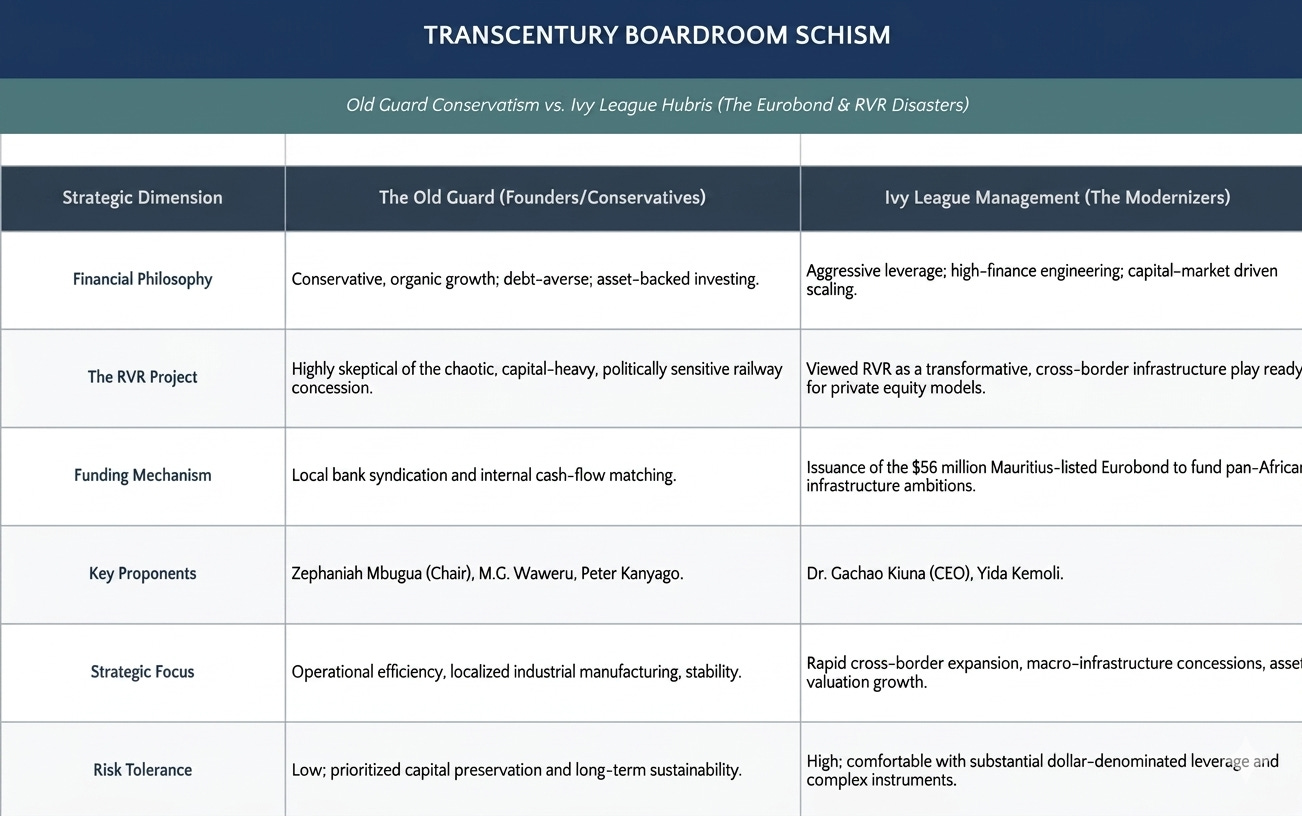
Old Guard Conservatism vs. Ivy League Hubris: The Eurobond & RVR Disasters
The philosophical divide crystallized into open warfare over two monumental, highly leveraged bets: the entry into Rift Valley Railways (RVR) and the issuance of a massive $56 million (approx. KSh 4.7 billion) Mauritius-listed Eurobond in 2011.
For operational managers on the ground, navigating these conflicting power centers became impossible, paralyzing executive decision-making and halting project execution at the worst possible time.
Led by Dr. Gachao Kiuna and supported by key young investment analysts like Yida Kemoli, the youthful management team championed high-finance engineering over physical operational metrics. The old guard, composed of veteran accountants and industrialists like M.G. Waweru and Peter Kanyago, warned that taking on dollar-denominated debt without matching dollar revenues was an existential trap.
The Ivy League faction won out, but the gamble failed catastrophically. The RVR concession disintegrated into an operational black hole, swallowing massive capital with zero returns, while the weakening Kenya Shilling exponentially expanded the cost of servicing the dollar-denominated Eurobond.
Cannibalizing East African Cables
By the time the Eurobond was screaming toward its 2016 maturity date, the broader TransCentury group was effectively hollowed out. The only functioning, genuinely profitable subsidiary left standing with a strong balance sheet was East African Cables.
Faced with a catastrophic default on the Eurobond that threatened to wipe out the entire holding company, a desperate decision was brought before the board: lump the group’s massive corporate debt directly onto the shoulders of East African Cables.
The Boardroom Flashpoint: The proposal to sacrifice the manufacturing crown jewel to save the holding company’s bad investments was the final straw. The old-guard founders fought the move tooth and nail, arguing it would cannibalize the only healthy engine they had left.
The debt re-engineering was pushed through anyway. Starved of its own working capital to service group-level debt, East African Cables was starved of raw material cash, lost its competitive edge against cheap imports, and its capacity utilization plummeted.
What began as Kenya’s premier elite investment club ultimately choked on its own ambitions—destroying itself not from an external market collapse, but from the fatal friction between the founders who built it with sweat equity and the next-generation technocrats who tried to scale it on Wall Street rules.
The Fall of Chase Bank
Simultaneously, Gachui’s banking legacy suffered an even more abrupt shock. During his lifetime, Chase Bank Kenya—where he was a central pillar and anchor shareholder via Jimana Capital—was the darling of the financial sector, rapidly capturing the SME market. Gachui had provided a stabilizing boardroom presence that balanced aggressive growth with corporate sobriety.
Following his exit, the bank embarked on a hyper-aggressive asset expansion campaign that ultimately outpaced its internal control mechanisms. In April 2016—the exact same month TransCentury was battling its Eurobond crisis—Chase Bank collapsed into Central Bank of Kenya (CBK) receivership after a routine audit exposed massive, previously hidden insider lending vulnerabilities totaling billions of shillings. A massive, social-media-driven bank run followed, forcing regulators to step in and halt operations.
The Leadership Vacuum: The Slow Death of East African Cables
For years, East African Cables (EAC) served as the vital, beating heart of the TransCentury portfolio. Under the steady, industrial-focused leadership of George Mwangi (2004–2012), the company became the region’s premier infrastructure supplier. Mwangi represented the “Old Guard” philosophy: focus on manufacturing output, local supply chains, and asset-backed profitability.
However, as the boardroom friction between the conservative founders and the aggressive “Ivy League” management team intensified, the leadership of EAC became the primary battlefield.
The Erosion of Operational Continuity
The timeline of leadership at EAC tells the story of a company slowly being stripped of its autonomy:
The Era of Stability (2004–2012): George Mwangi presided over a period of immense growth. He maintained the “Gachui Doctrine”—keeping subsidiary operations focused on product quality and regional market dominance.
The Period of Pressure (2012–2016): Peter Ndetei took the helm as the parent company began its shift toward speculative, high-finance leveraging. During this time, the pressure to “upstream” dividends to the holding company to service the ill-fated Eurobond began to degrade EAC’s working capital.
The Collapse (2017–2025): Paul Muigai arrived in 2017 with a mandate to optimize a dying supply chain. By this point, the boardroom had already forced a disastrous decision: lumping the group’s corporate debt onto EAC’s balance sheet. Muigai was tasked with navigating a sinking ship that had been drained of the very cash flow it needed to buy raw materials.
The 2016 Pivot: A Fatal Miscalculation
The most critical inflection point occurred in 2016. Amidst the height of the board infighting, George Mwangi—who had returned to provide stability—was effectively pushed out. His removal was not a strategic business decision; it was a political casualty of the war between the Kiuna-led management and the Mbugua-led board.
The loss of an experienced industrialist at the helm of the group’s only functional subsidiary was the final nail in the coffin. Without a seasoned leader to push back against the “debt-lumping” mandates from the parent board, EAC became a hollowed-out shell. It was no longer allowed to operate as a manufacturer; it was forced to function as an ATM for the holding company’s failed infrastructure bets.
By the time the subsidiary was placed under receivership in 2025, it was a ghost of the industrial giant it once was—a direct consequence of substituting operational expertise for boardroom infighting.
6. The Analytical Verdict: Charisma vs. Institution
The dual crises of 2016—the dilution of TransCentury and the receivership of Chase Bank—occurred almost exactly five and a half years after James Gachui’s passing. This timeline represents the exact lifespan of corporate projects running out of the structural momentum initially provided by their architect.
Ultimately, Gachui’s legacy presents a profound institutional paradox. He successfully proved that indigenous Kenyans could pool billions of shillings, challenge colonial-era multinationals, and take control of large-scale infrastructure. His family foundation—stewarded by Anne Pearl Karimi Gachui and his daughters—continues to quietly drive impact in education, health, and entrepreneurship through the James Gachui Foundation.
Yet, his story remains a powerful case study in frontier-market key-man risk. It raises the enduring question: Did he build resilient, self-sustaining corporate governance structures, or did these multi-billion shilling vehicles rely entirely on his personal arbitration, elite networks, and towering credibility to survive? When the central pillar was removed, the financial architecture struggled to bear the immense weight of its own ambition. For the modern African investor, James Gachui remains the ultimate example of how relational capital can build an empire—and how fragile that empire can become when the architect leaves the room.
Institutionalizing Vision: The James Gachui Memorial Lecture and Its Legacy
In the years following his death, James Gachui’s legacy transitioned from personal corporate memory into an institutionalized reference point for African business ethics and governance. The primary anchor for this transition has been the James Gachui Memorial Lecture Series, hosted by the Strathmore University Alumni Association and the Strathmore Law School in Nairobi.
Rather than serving as a standard, passive corporate memorial, the lecture series has evolved into a high-stakes, annual intellectual arena where the continent’s most pressing legal, regulatory, and corporate friction points are actively debated.
The Significance to His Enduring Legacy
The creation and continued execution of the lecture series highlights several key aspects of Gachui’s posthumous footprint:
1. Fusing Law, Business, and Governance
Gachui’s later investments—particularly the highly politicized Rift Valley Railways concession and the complex capital market maneuvers of TransCentury—demonstrated that in East Africa, pure business acumen is insufficient without an equal mastery of the legal and regulatory landscape.
The lecture series directly addresses this nexus. By attracting global legal and business icons—such as Baroness Patricia Scotland (the former Attorney General of England and Wales and Commonwealth Secretary-General)—the forum deliberately unpacks how corporate strategies must find “synergies of success” within institutional guardrails.
[ JAMES GACHUI MEMORIAL LECTURE THEMATIC AXIS ]
                    │
   ┌────────────────┴────────────────┐
   ▼                                 ▼
LAW & REGULATION               ETHICAL CAPITAL
• Synergies of Success         • Corporate Sobriety
• Frontier Market Guardrails   • Combating Key-Man Fragility
2. Convoking the Technocratic and Judicial Elite
True to Gachui’s lifetime role as the ultimate convener of the “Muthaiga Group,” the lectures have routinely served as a gathering ground for Kenya’s top institutional architects. Past events have brought together prominent figures including former Chief Justice Dr. Willy Mutunga, legal scholar Prof. P.L.O. Lumumba, and top academic deans. The fact that the highest officers of the judiciary and the private sector meet under his name underscores the immense, cross-industry authority Gachui wielded during his life.
3. A Counterweight to Corporate Fragility
The timing and content of these lectures are deeply intertwined with the fate of his investments. As TransCentury battled its Eurobond crisis and Chase Bank faced receivership due to internal governance failures in the mid-2010s, the Strathmore lectures provided a sharp, academic counterweight. They re-centered Gachui’s personal core philosophies—corporate sobriety, long-term local asset building, and ethical leadership—serving as a stark reminder of the discipline required to keep complex African conglomerates from unraveling.
Ultimately, the James Gachui Memorial Lecture ensures that his life remains far more than an entrepreneurial case study on wealth accumulation. By anchoring his memory within Strathmore—an institution synonymous with premium corporate governance and ethics—his legacy is continually framed as a textbook on how institutional guardrails must outlive personal charisma to build truly permanent African empires.