
Analyzing the Strategy, Succession, and Structural Friction at Kenya’s Oldest Investment Guard
The “Copycat” Titan – Bob Karina and the Faida Equilibrium
I. Introduction: The Facade of the Faida Empire
II. The KPC IPO: A Billion-Shilling Mandate
III. Pricing and Perils: The KPC IPO Critique (The Zakhem Liability)
IV. The Architect: Bob Karina’s Long Game
V. The “Copycat” Reputation: Strategy or Survival?
VI. Digital Friction: The Unfinished Automation
VII. King of Retail: The Last Man Standing
VIII. The Faida Guard: Succession and Structural Shifts
IX. Conclusion: The Paradox of Faida
I. Introduction: The Facade of the Faida Empire
In the high-stakes arena of the Nairobi Securities Exchange (NSE), Bob Karina stands as a towering, seasoned veteran—yet his legacy is marked by a complex duality. As the architect of Faida Investment Bank (FIB), he has steered his institution into the position of a market titan, building a firm that has become synonymous with a “fast-follower” strategy rather than a pioneering one. While Faida Investment Bank consistently secures massive, high-profile mandates—most notably the recent KPC IPO—its broader reputation within the financial community remains paradoxical. Its legacy is defined by an enduring tension: the firm provides institutional stability that satisfies the old guard, yet it is simultaneously dogged by a perceived lack of radical innovation. While competitors like Dyer & Blair and Standard Investment Bank (SIB) are frequently lauded as the industry’s trendsetters and disruptors, Faida often occupies the space of the calculated observer, moving only once the path has been paved by others.
II. The KPC IPO: A Billion-Shilling Mandate
Faida Investment Bank’s appointment as the Lead Transaction Advisor for the Kenya Pipeline Company (KPC) IPO represents a defining moment in the firm’s corporate history. By spearheading the divestment of 65% of the government’s stake, Faida positioned itself at the center of one of the largest public offerings in East African history. The mandate was not merely an advisory role; it was a high-stakes logistical operation that involved managing digital application portals, coordinating with institutional receiving banks, and orchestrating the retail investor outreach that ultimately brought the infrastructure asset to the Nairobi Securities Exchange (NSE).
For Faida, the financial windfall associated with this mandate—bolstered by substantial advisory and success fees—solidifies its dominance at the top of the local earnings food chain. Regardless of broader market sentiment or the skepticism often directed at the firm’s “fast-follower” methodology, the KPC deal demonstrates an unassailable capacity to secure and execute government-backed mandates that smaller or more experimental firms often struggle to capture.
This victory is the latest in a long-standing pattern of corporate finance successes for the firm, which has historically leveraged its credibility with local and foreign institutions to secure complex deals:
I&M Bank (Rwanda) PLC Rights Issue: Faida served as a Joint Lead Transaction Advisor for the 2020 rights issue, helping the bank achieve a 12% oversubscription and raising approximately KSh 887 million.
Nation Media Group Share Buyback: The firm acted as the sponsoring stockbroker, facilitating NMG’s strategic decision to repurchase up to 10% of its issued share capital from the open market.
Cross-Border Expertise: Faida’s subsidiary, Faida Securities Rwanda, was the first broker to sponsor an equity listing at the Rwanda Over-the-Counter Market (ROTCM) with the cross-listing of KCB Group in 2009, highlighting a long history of managing major regional capital raising efforts.
Through these mandates, Faida continues to prove that its institutional weight is a formidable asset. While critics may debate the firm’s lack of original disruption, the bank’s track record—ranging from complex rights issues to large-scale public privatizations—cements its role as a permanent fixture in the plumbing of Kenya’s capital markets.
Breaking Down The Kenya Pipeline IPO
This interview features Rina Hicks of Faida Investment Bank providing a comprehensive breakdown of the KPC IPO process, which highlights the firm’s active role in managing the transaction

Pricing and Perils: The KPC IPO Critique
The Initial Public Offering (IPO) of the Kenya Pipeline Company (KPC) was envisioned as a landmark financial event, yet it has become a lightning rod for market skepticism and intense regulatory scrutiny. At the heart of the controversy is a profound disconnect between the government’s aggressive valuation and the sober reality presented by independent market analysts.
The Valuation Gap
While the government set the IPO price at KES 9.00 per share, the market’s reaction was largely one of disbelief. A consensus of independent analysts, including institutions like Old Mutual Investment Group Uganda and NCBA Investment Bank, argued that the shares were grossly overvalued—with some estimates placing the “fair value” as low as KES 3.28 to KES 6.35.
P/E Multiples: At the KES 9.00 offer price, KPC traded at approximately 22x earnings, a figure analysts deemed exorbitant when compared to other major NSE-listed firms.
The “Transaction Advisor” Defense: Faida Investment Bank and Dyer & Blair stood out as vocal supporters of the pricing, justifying the premium through KPC’s monopoly position in critical energy infrastructure. However, critics were quick to label the process “not transparent,” suggesting the valuation was inflated to maximize government proceeds rather than provide genuine value to retail investors.
The Zakhem Liability: A Decade-Old Ghost
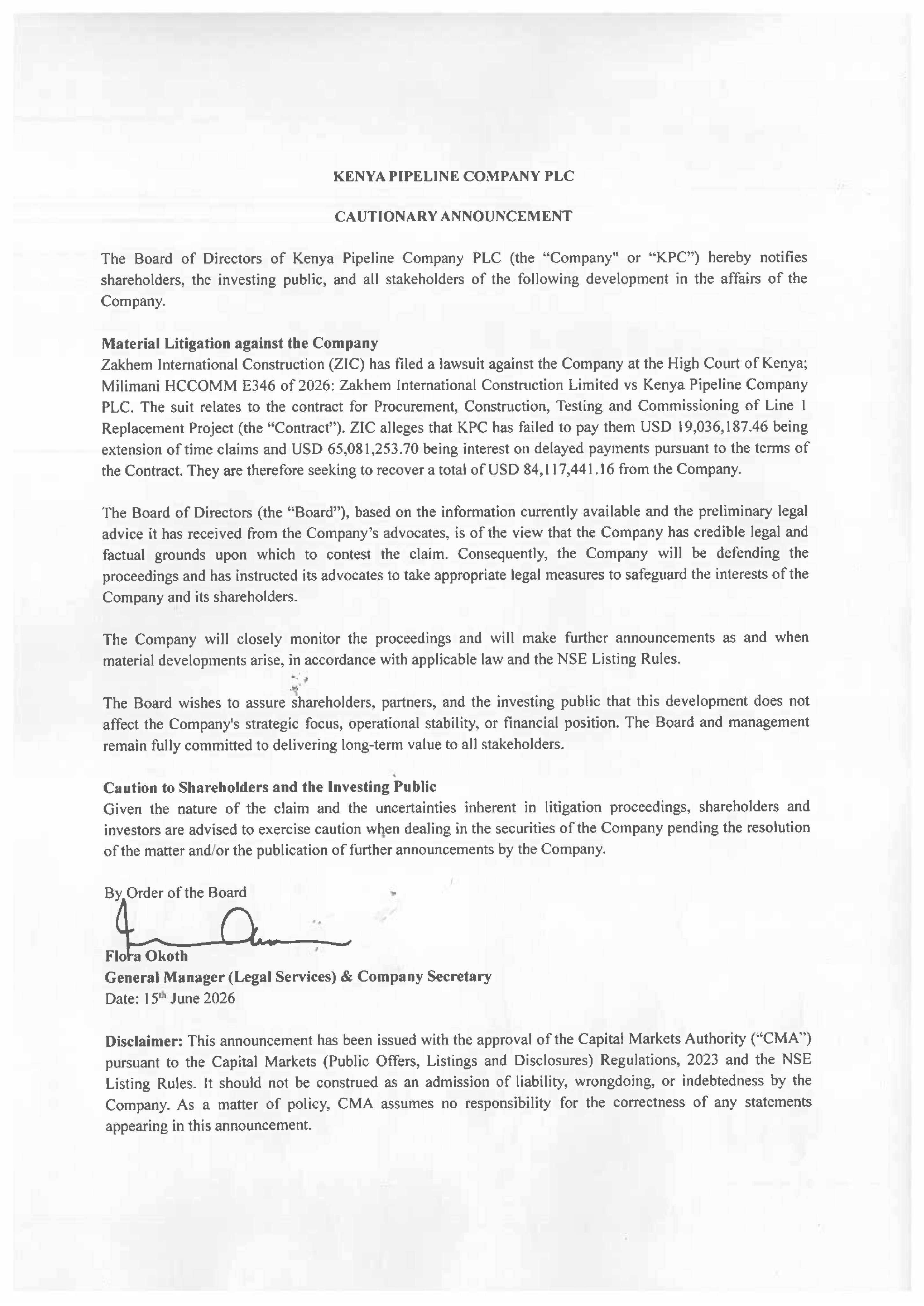
Compounding the pricing concerns is the “Zakhem Crisis,” a decade-old legal entanglement that has now spilled over into the wallets of new public shareholders. The Lebanese contractor, Zakhem International Construction (ZIC), recently filed a fresh suit against KPC, demanding approximately USD 84.1 million (roughly KES 10.8 billion) in relation to the Mombasa–Nairobi Line 5 pipeline project.
Financial Exposure: The claim covers USD 19.04 million in extension-of-time costs and USD 65.08 million in interest on delayed payments.
Contingent Risk: While Parliament had previously flagged potential legal liabilities of around KES 5.75 billion before the listing, this new, larger claim crystallizes a risk that many investors felt was inadequately reflected in the IPO’s prospectus.
Market Impact: The KPC board was forced to issue a cautionary announcement, advising shareholders to “tread carefully” as the litigation unfolds. For a newly listed company, this legal overhang acts as a drag on investor confidence and highlights the potential for future volatility that was downplayed during the IPO’s marketing phase.
Ultimately, the combination of aggressive pricing and these latent legal liabilities has left many retail investors questioning whether the IPO was a viable investment opportunity or, as some critics on social media suggested, a “government bailout disguised as a stock listing”
III. The Architect: Bob Karina’s Long Game
To understand Faida’s current market positioning, one must look past the modern corporate office to the dustier, manual days of the Nairobi Securities Exchange. Bob Karina is a true veteran of the Kenyan financial sector, a man whose professional roots were planted during the era when stock trading was an intimate, floor-based affair held at the Stanley Hotel and Nation Centre. This was a time of physical share certificates and face-to-face negotiations—an environment that demanded a mastery of “market plumbing” that is rarely seen in today’s digitized world.
Karina founded Faida in 1994, navigating the complex regulatory environment of the time to earn its Capital Markets Authority (CMA) license in 1995. His leadership has been defined by a deliberate, incremental expansion. He did not rush to conquer the continent; instead, he methodically grew the firm from a local brokerage house into a full-fledged Investment Bank by 2007. His expansion into the Rwandan market—where Faida Securities Rwanda became the first broker to sponsor an equity listing—demonstrated an early, ambitious vision for regional connectivity.
Yet, it is this very history that informs Karina’s strategic philosophy today. Having built his career on the foundation of the old guard, he operates with the caution of a man who knows exactly how fragile market confidence can be. His dual role as the Vice Chairman of the NSE highlights his unique position as both an active broker and a regulator-adjacent architect of the market. This background explains the “Faida Equilibrium”: a strategy that prioritizes institutional stability, risk management, and tested models over radical, unproven experimentation. For Karina, the market is a marathon, not a sprint—a perspective that serves him well in boardroom negotiations, even as it invites frustration from those demanding faster, more aggressive digital evolution.
Licensing and Operational Timeline
1995: Initial Licensing
Faida was officially licensed by the Capital Markets Authority (CMA) to operate as a stocks and securities broker. This established the firm’s foundation in the Kenyan market, focusing on brokerage services.
December 2007: Conversion to Investment Bank
After over a decade of operation, Faida converted into a full-fledged Investment Bank. This move allowed the firm to broaden its service offerings, moving beyond simple trade execution to include corporate finance, investment advisory, and private equity placements.
2007–2009: Regional Expansion
The firm expanded its reach into the East African region by incorporating Faida Securities Rwanda in 2007. Operations in Rwanda commenced in 2009, with the firm becoming the first broker to sponsor an equity listing on the Rwanda Over the Counter Market (ROTCM).
Faida’s regulatory journey has centered on maintaining its standing within the CMA’s framework while diversifying its business model to include regional operations and modern digital services. Despite the broader industry challenges—such as the collapse of various brokerage firms during the post-2008 period—Faida has maintained its operational status, focusing on building credibility through transaction advisory and thorough due diligence.
III. The “Copycat” Reputation: Strategy or Survival?
In the corridors of the Nairobi Securities Exchange, Faida Investment Bank is often viewed through a lens of skepticism—not for its lack of capability, but for its perceived lack of originality. While peers like Standard Investment Bank (SIB) and Dyer & Blair have built brands on the back of pioneering market disruption and digital-first outreach, Faida is frequently characterized as the “fast-follower.” This strategy, while arguably safer, has cemented a reputation for the firm as an institution that prefers to wait for competitors to test the waters before diving in themselves.
The most glaring manifestation of this strategy is the emergence of the “Oak Special Fund.” When Standard Investment Bank introduced Mansa-X, it did more than just launch a product; it fundamentally shifted the Kenyan retail investment landscape by offering a sophisticated, multi-asset strategy that traded 24 hours a day across global markets. Mansa-X became the gold standard, eventually hitting a milestone of over USD 1 billion in assets under management (AUM).
By contrast, the launch of the Oak Special Fund is often interpreted by market observers not as an act of pure innovation, but as a reactionary effort to retain client capital within Faida’s ecosystem. When comparing the two, the resemblance is hard to ignore: both funds market themselves to the same high-net-worth and retail demographic, offering similar promises of diversification, active management, and access to global asset classes. While Faida has worked hard to ensure Oak’s performance—delivering a respectable 20.49% net return in 2025—critics argue that the fund exists primarily to prevent Faida’s clients from defecting to SIB’s more established and aggressively marketed platform.
For Bob Karina, however, this “copycat” label may be a deliberate trade-off. In a market as volatile as Kenya’s, there is a distinct survival advantage in being the second mover. By allowing firms like SIB to bear the high cost of customer education and regulatory friction associated with pioneering new “special fund” categories, Faida preserves its resources and minimizes its risk. It is a philosophy that prizes institutional longevity over the “first-to-market” vanity that often leads to high-profile failures. Yet, as the market matures and a new generation of digital-native investors demands more than just a “safe” equivalent to a competitor’s product, this follower strategy faces its greatest test: can Faida continue to grow by riding the coattails of others, or will the “copycat” reputation eventually stifle its ability to lead?
Mansa X Special Fund Vs Oak Special Fund
This comparison highlights the competitive tension between these two funds and provides insight into how retail investors perceive the differences in risk, return, and strategy.
IV. Digital Friction: The Unfinished Automation
For an investment bank that positions itself as the bridge for the everyday Kenyan investor, Faida’s transition into the digital age has been marked by persistent, and increasingly conspicuous, friction. Because Faida has historically staked its reputation on being a retail-targeting broker—the “people’s choice” for stock market entry—market observers had every right to expect the firm to be a first-mover in mobile-first innovation. Instead, the firm’s digital journey has been characterized by a surprising lethargy, leaving it trailing behind the very demographic it claims to serve.
In a modern ecosystem where retail investors demand seamless, real-time access to global and local markets, Faida’s proprietary trading infrastructure is frequently cited as a bottleneck. While peers recognized that digitization was the inevitable future of retail brokerage, Faida appeared content to rely on its legacy status, only pivoting toward automation when the threat of client attrition became impossible to ignore. This struggle to modernize is not merely cosmetic; it represents a failure to evolve the internal “plumbing” of the firm. While competitors invested heavily in end-to-end digital transformation—creating platforms that allow for instantaneous onboarding and seamless trade execution—Faida’s digital footprint often feels like an additive layer bolted onto a traditional, manual-heavy backend.
The firm’s attempt to reconcile this gap through its partnership with Hisa has been met with significant scrutiny. While the collaboration is marketed as a major step toward democratizing finance, critics argue it is little more than a superficial patch on deeper structural issues.
For the astute market observer, the Hisa integration fails to address the foundational concerns that a “retail-first” broker should have solved years ago:
The First-Mover Miss: By delegating the user experience to an external app, Faida essentially surrendered its role as a digital innovator. It opted for a “quick fix” partnership rather than building the robust, in-house ecosystem that its retail-heavy client base necessitated.
Persistent Friction: The “digital” experience remains hindered by high brokerage costs and slow back-office processing. When the app’s sleek exterior hits the reality of Faida’s legacy settlement and KYC (Know Your Customer) systems, the “modern” experience falls apart.
For a firm built on the meticulous, manual logic of the exchange floor, this reliance on external partnerships suggests an uncomfortable reality: Faida is struggling to modernize the engine of its business. By choosing to decorate the facade rather than overhaul the machinery, Faida has missed the window to lead the digital revolution it was arguably the best positioned to champion.
V. King of Retail: The Survivor of the Brokerage Purge
For years, Faida Investment Bank has held a unique position as the “King of Retail,” a title earned not just through ambition, but through sheer institutional endurance. While the 2008 Safaricom IPO served as the high-water mark for public retail participation in the Kenyan market, it was immediately followed by a catastrophic industry contagion. As the market euphoria faded, a wave of broker insolvencies exposed deep structural rot within the sector, threatening to wipe out the nascent retail investor class entirely.
Bob Karina’s greatest strategic triumph during this period was not a single trade, but the survival of Faida itself while its peers imploded. Between 2007 and 2011, the brokerage landscape was decimated as firms failed under the weight of liquidity crises, misappropriation of client funds, and regulatory scrutiny. The timeline of this collapse illustrates the scale of the vacuum Faida filled:
2007–2008: The market reached a fever pitch during the Safaricom IPO, which drew hundreds of thousands of first-time retail investors into the system.
2008: The collapse of Discount Securities signaled the beginning of the end for the “old guard” brokers, leaving thousands of investors stranded and sparking widespread panic.
2009: The industry faced further turmoil as Ngenye Kariuki & Company was placed under statutory management by the Capital Markets Authority (CMA) due to massive financial irregularities and failure to meet regulatory requirements.
2010–2011: Nyaga Stockbrokers followed suit, its license revoked after it emerged that the firm had mismanaged client funds and faced insurmountable capital adequacy issues.
By outlasting these failures, Faida became the primary repository for the thousands of retail investors left leaderless by these collapses. It effectively inherited the retail market by default, positioning itself as the “last man standing” for a demographic that had nowhere else to turn.
However, this inheritance has become a double-edged sword. As the market enters a new phase—a digital revolution characterized by platforms like Hisa and a demand for “zero-friction” trading—Faida appears ill-equipped to handle the very base it saved. The transition from the era of phone-call orders to the age of the app-native investor requires technological agility that Faida has struggled to demonstrate.
The friction is palpable. Investor sentiment across digital forums reveals a recurring narrative of frustration; users who migrated to Faida, expecting the streamlined, responsive experience promised by modern fintech, are instead encountering legacy hurdles and clunky interfaces. For a firm that has spent decades acting as the “King of Retail,” the reality is sobering: the new generation of investors is defined by user experience, not the brand loyalty earned through surviving historical crises. If Faida continues to prioritize traditional back-office logic over the demands of a tech-native base, it risks alienating the very customers it survived to keep—proving that in the digital age, being the “last man standing” is no substitute for being the “first to innovate.”
This video provides context on the collapse of Ngenye Kariuki, highlighting the history of retail-focused brokers in Kenya and the vacuum they left behind, which Faida eventually filled.
VII. The Faida Guard: Succession and Structural Shifts
The strategy behind Faida’s future extends beyond the public-facing role of Rina Hicks. Bob Karina has systematically restructured his leadership team, bringing in external expertise to bolster the firm’s executive ranks. Most notably, he appointed Lucas Otieno—previously of Africa Alliance—as the Managing Director, a move that signals an intent to professionalize the firm’s operational management by looking outside the traditional “FIB family”

This reshuffling includes the appointment of board members such as Mercy Kamau, who serves as an Independent Director, complementing these changes are key figures like David Mataen, the Corporate Finance & Research Director, who remains central to the firm’s advisory operations.
However, the inclusion of these directors has sparked debate among market observers. While they bring external experience, critics argue that the board lacks the “big-name” industry heavyweights whose presence typically signals radical strategic shifts or aggressive market innovation. For an institution currently facing the heat of a digital revolution, the question remains whether this new leadership guard—anchored by the continuity of the Karina legacy and supported by a carefully curated but relatively low-profile board—possesses the vision to transform Faida from a legacy brokerage into a modern fintech leader.
The reliance on established corporate finance veterans rather than disruptive tech-market architects suggests that while Bob Karina is preparing for succession, he remains committed to a traditionalist, steady-state vision of growth.
The Succession Crossroads: Divergent Paths to Continuity
The succession strategies across Kenya’s top-tier brokerage firms reveal diverging philosophies on institutional continuity. At Faida, Bob Karina has opted for a controlled, generational transfer, installing his daughter, Rina Hicks, as the public face of the firm while bringing in external executive leadership to modernize the "last man standing" legacy. Conversely, Dyer & Blair and Standard Investment Bank have largely focused on embedding deep institutional management structures that prioritize organizational longevity over individual family legacies. Meanwhile, the management buyout of Kestrel Capital represents the most radical departure, effectively severing ties with previous ownership to place control squarely in the hands of the executive team—a stark contrast to the legacy-focused succession model currently unfolding at Faida.

