
Bharat Thakrar: The Ultimate Networker
How One Founder Financialized the Attention Economy and Built a Continental Monopoly
How One Founder Financialized the Attention Economy and Built a Continental Monopoly
1.0 Introduction: The Architecture of the Circle
1.1 The Memorial Service Revelation: Exposing the Parallel Engine of Informal Power
1.2 Network Equity as a Commercial Moat: Structuring a Lock on the Attention Economy
1.3 The Service Sector Maverick and the Valuation Paradox: Overturning Asset-Heavy Dogma
2.0 The 2006 NSE Landmark: Creating a Marketing Currency
2.1 The Over-Subscription Signal: Institutional Appetite for Asset-Light Equities
2.2 Weaponizing the Stock: Printing Listed Equity for Offensive Consolidation
2.3 Setting the Corporate Standard: Professionalizing Creative Arts via Forensic Governance
3.0 The Continental Roll-Up and the Data Divestment
3.1 Timeline of Pan-African Aggregation: Mapping the Multi-Market Corporate Vault
3.2 The Kantar Africa Exit (2020): Mega-Liquidity Influx and the Historic KSh 8.00 Special Dividend
3.3 The Elite Power Corridor: Inside Kenya’s Corporate “Boys Club”
4.0 The Global Alignment: Bringing WPP to the Table
4.1 Partnering with the Giants: Sourcing Madison Avenue Capital and Toolkits
4.2 Global Reach vs. Local Autonomy: Managing the High-Stakes Multinational Double-Helix
5.0 The February 2021 Fracturing and Corporate Warfare
5.1 The Abrupt Separation: Suspension, Executive Resignation, and the WPP Probe
5.2 The Data and Privacy Legal Battle: Weaponizing the Data Protection Act Against Investigators
5.3 Post-Bharat Splintering: Talent Drain, Account Losses, and the KSh 3.1 Billion Decay
6.0 Modern Shareholder Activism: The Founder’s Return
6.1 The 13.59% Blocking Block: Building Minority Alliances with the Local Elite
6.2 The Board Ouster Campaign (May 2026): Forcing an EGM to Dissolve WPP-Aligned Governance
6.3 The Fiduciary Playbook: Capital Protection Strategies for the Local Boardlot
7.0 Conclusion: The DNA of the Beast
7.1 The Irreplaceable Founder Syndrome: When Process-Driven Governance Kills Commercial Agility
7.2 The Permanent Impact on the Boardlot: Translating Relational Power into Listed Market Currency
8.0 Chronology of the Shareholder Battle (2021–2026)
8.1 Phase I: The Ouster and Immediate Fallout (February 2021 – Mid 2021)
8.2 Phase II: The Silent Accumulation and Legal Counter-Offensive (2022–2024)
8.3 Phase III: The Value Collapse Trigger (2025 – Early 2026)
8.4 Phase IV: Full-Scale Insurgency and the May 2026 EGM Requisition Mandate
1.0 Introduction: The Architecture of the Circle
1.1 The Memorial Service Revelation
In July 2019, during the memorial service for the late Safaricom CEO Bob Collymore, then-President Uhuru Kenyatta took to the podium and did something unusual for a state eulogy. He openly addressed a tight-knit, elite fraternity sitting in the front pews—a group the local business press had long whispered about as the corporate “Boys Club.” Featuring Collymore, KCB Group CEO Joshua Oigara, media personality Jeff Koinange, politician Peter Kenneth, and Scangroup CEO Bharat Thakrar, the President jokingly lamented that despite holding the highest office in the land, he had never been officially invited to join their ranks. It was a lighthearted moment, but to astute market watchers, it was a public confirmation of a powerful reality: Kenya’s deepest corporate pipelines were anchored by an exclusive, parallel engine of trust and informal power.
1.2 Network Equity as a Commercial Moat
For Bharat Thakrar, this club was never a mere social gathering; it was a clinical, high-altitude commercial buffer. In an asset-light industry like marketing and communication, traditional moats like factory walls or land banks do not exist. Thakrar understood that his true balance sheet was built on network equity. By embedding himself at the absolute intersection of the country’s largest telecommunications giant (Safaricom) and its largest commercial bank (KCB), Thakrar constructed an unbreakable lock on East Africa’s multi-billion-shilling corporate marketing spend. These closed-door strategy sessions blurred the lines between institutional dominance and private capital, ensuring Scangroup remained the undisputed tollgate for the region’s attention economy.
1.3 The Service Sector Maverick and the Valuation Paradox
Long before he sat in the front pews with the nation’s corporate titans, Thakrar was an independent challenger. He founded Scanad Marketing in 1982 to aggressively disrupt a local marketing sector dominated by complacent, legacy British and American agency outposts. However, as the business scaled, he faced a rigid valuation paradox rooted in the traditional mindset of the Nairobi Stock Exchange (NSE). In the 1990s and early 2000s, local capital markets were explicitly engineered for tangible asset classes like agricultural plantations, commercial banks, and manufacturing plants. The prevailing market consensus was clear: “Service companies do not have physical factories or heavy machinery to justify a public listing.”
Thakrar completely rejected this asset-heavy dogma. He approached institutional fund managers with a revolutionary thesis: human talent, entrenched client relationships, and massive media-buying scale could be financialized, aggregated, and packaged as a premium, high-yielding equity instrument. He set out to prove that intellectual capital and elite corporate networks could be successfully listed, traded, and financialized.
2.0 The 2006 NSE Landmark: Creating a Marketing Currency
2.1 The Over-Subscription Signal
In August 2006, Thakrar tested his financial thesis on the open market, launching the Scangroup Initial Public Offering (IPO). The market’s response shattered all conventional skepticism. The IPO was oversubscribed by an unprecedented six times, signaling a massive, pent-up appetite among both local retail savers and institutional fund managers for non-traditional, asset-light equities. The spectacular debut proved that the market was fully ready to value the “attention economy.”
2.2 Weaponizing the Stock
For ordinary founders, an IPO is viewed as an exit strategy—a moment to cash out and dilute control. For Thakrar, listing on the NSE was a purely offensive maneuver. He did not view Scangroup equity as static wealth; he viewed it as a listed corporate currency. By creating a publicly traded share with transparent market pricing and high liquidity, Thakrar effectively granted himself the power to print stock and use it as a financial weapon to launch a massive, pan-African consolidation drive, systematically buying out any regional competitor that stood in his way.
2.3 Setting the Corporate Standard
The Scangroup listing did more than just mint overnight millionaires; it forced a highly informal, relationship-driven creative industry into a framework of strict corporate governance. To maintain its listed status, Scangroup had to replace handshake deals with forensic audit trails, transparent client-agency contract disclosures, and rigorous multi-market financial reporting. Thakrar successfully professionalized the creative arts, proving to the wider East African business community that an agency could operate with the fiscal discipline and transparency of a Tier-1 commercial bank.
3.0 The Continental Roll-Up and the Data Divestment
3.1 Timeline of Pan-African Aggregation & The Kantar Exit
For market participants tracking multi-market execution, Bharat Thakrar did not treat regional expansion as a slow, organic process. He used Scangroup’s listed equity currency on the NSE to execute a systematic, rapid pan-African roll-up strategy, buying his way into dominant market shares across sub-Saharan Africa.
2007 | The Safaricom Anchoring and Regional Launch: Scangroup acquired a 50% stake in RedSky, bringing Kenya’s largest advertising budget (Safaricom) into its direct orbit. Concurrently, Thakrar expanded into Tanzania by acquiring FCB Tanzania, instantly onboarding the Vodacom account.
2008 | The Ogilvy Continental Coup: Executed a massive, landmark pan-African transaction valued at approximately US$ 6.1 million using a calculated mix of cash and Scangroup’s listed equity currency. This deal absorbed a dominant share of Ogilvy & Mather’s continental network, handing Thakrar immediate operational reach across East, West, and Southern Africa. It brought tier-1 global multinational clients—including Coca-Cola, Unilever, Reckitt Benckiser, GSK, Barclays, and Standard Chartered—directly into the group’s revenue stream.
2010s | Total Market Consolidation: Systematically acquired and rolled up global agency networks across multiple African jurisdictions, absorbing Grey East Africa, JWT Kenya and Tanzania, McCann Erickson, Universal McCann, MediaCom, Mindshare, MEC, and Hill+Knowlton. This consolidation strategy was further reinforced by aggressive talent poaching from independent rivals, effectively migrating major client relationships by absorbing the underlying human capital.
2018 | The Data Integration Drive: Acquired a majority 80% stake in Research and Marketing Group Investment Limited, the holding company operating Kantar TNS across primary and emerging African markets—including Kenya, Nigeria, Senegal, Cameroon, Côte d’Ivoire, and Ghana. This integrated massive market research and data analytics capabilities into Scangroup’s pan-African service offerings.
June 2020 | The Massive Kantar Africa Divestment: Following a global realignment by parent company WPP, Thakrar steered the highly lucrative sale of the Kantar Africa Business (comprising Millward Brown East Africa, Millward Brown Nigeria, Millward Brown West Africa, and Research & Marketing Group Investment Ltd). The transaction was a monumental event for the local market, netting Scangroup a gain on disposal after tax of KSh 2,242 million (KSh 2.24 billion). Thakrar immediately used this liquidity to reward shareholders, declaring a massive, historic special interim dividend of KSh 8.00 per share in July 2020.
4.0 The Global Alignment: Bringing WPP to the Table
4.1 Partnering with the Giants
Scangroup’s absolute dominance of the African continent eventually caught the eye of global Madison Avenue power brokers. In a series of highly sophisticated corporate transactions, WPP PLC—the world’s largest communications and advertising conglomerate—began buying into Scangroup, eventually taking a dominant majority stake in the company. This alignment injected immense global capital into the entity, giving Scangroup direct access to international proprietary tools, global training frameworks, and a permanent pipeline of multinational client mandates.
4.2 Global Reach vs. Local Autonomy
This partnership created a complex, high-stakes operational dynamic. Thakrar found himself navigating a delicate corporate double-helix: he had to maintain his highly aggressive, entrepreneurial, and hands-on management style on the ground in Nairobi, while simultaneously answering to a highly rigid, corporate, and compliance-driven multinational parent listed on both the London and New York stock exchanges. For years, Thakrar successfully balanced these competing forces, using WPP’s global muscle to solidify his local monopoly while retaining absolute executive command over the day-to-day operations of the African empire.
5.0 The February 2021 Fracturing and Corporate Warfare
5.1 The Abrupt Separation
The delicate equilibrium between local entrepreneurial autonomy and multinational corporate compliance fractured permanently on February 19, 2021. In a shocking announcement that sent shockwaves through the Nairobi Securities Exchange, Scangroup’s board announced the immediate suspension of Bharat Thakrar alongside his Chief Financial Officer, citing an internal investigation into allegations of gross corporate misconduct and financial irregularities. Thakrar vehemently denied the allegations, but as the multinational machinery of WPP tightened its grip, he officially resigned from his role as CEO in March 2021, marking the dramatic end of an era.
Governance: The Board Crisis and Removal of Bharat Thakrar (2021)
The structural turning point occurred in early 2021 when a severe governance crisis rocked the company. The board suspended the long-serving billionaire founder and CEO, Bharat Thakrar, alongside the CFO, over allegations of gross misconduct and financial irregularities. Though Thakrar later resigned from the board, the sudden ousting of the visionary founder who single-handedly built the agency severed deep-rooted client relationships and shattered investor confidence, triggering a permanent institutional fracture.
The Plunge into Loss-Making Years (2022-2026)
Without its founding architect and facing an aggressive shift toward in-house digital marketing by major corporates, Scangroup’s high-cost legacy structure began to cave. The company plunged into a cycle of persistent operating losses, characterized by shrinking revenues, high staff turnover, and costly restructuring exercises. The business model that once generated effortless cash was now bleeding, unable to pivot fast enough to defend its market share in a highly fragmented digital advertising landscape.
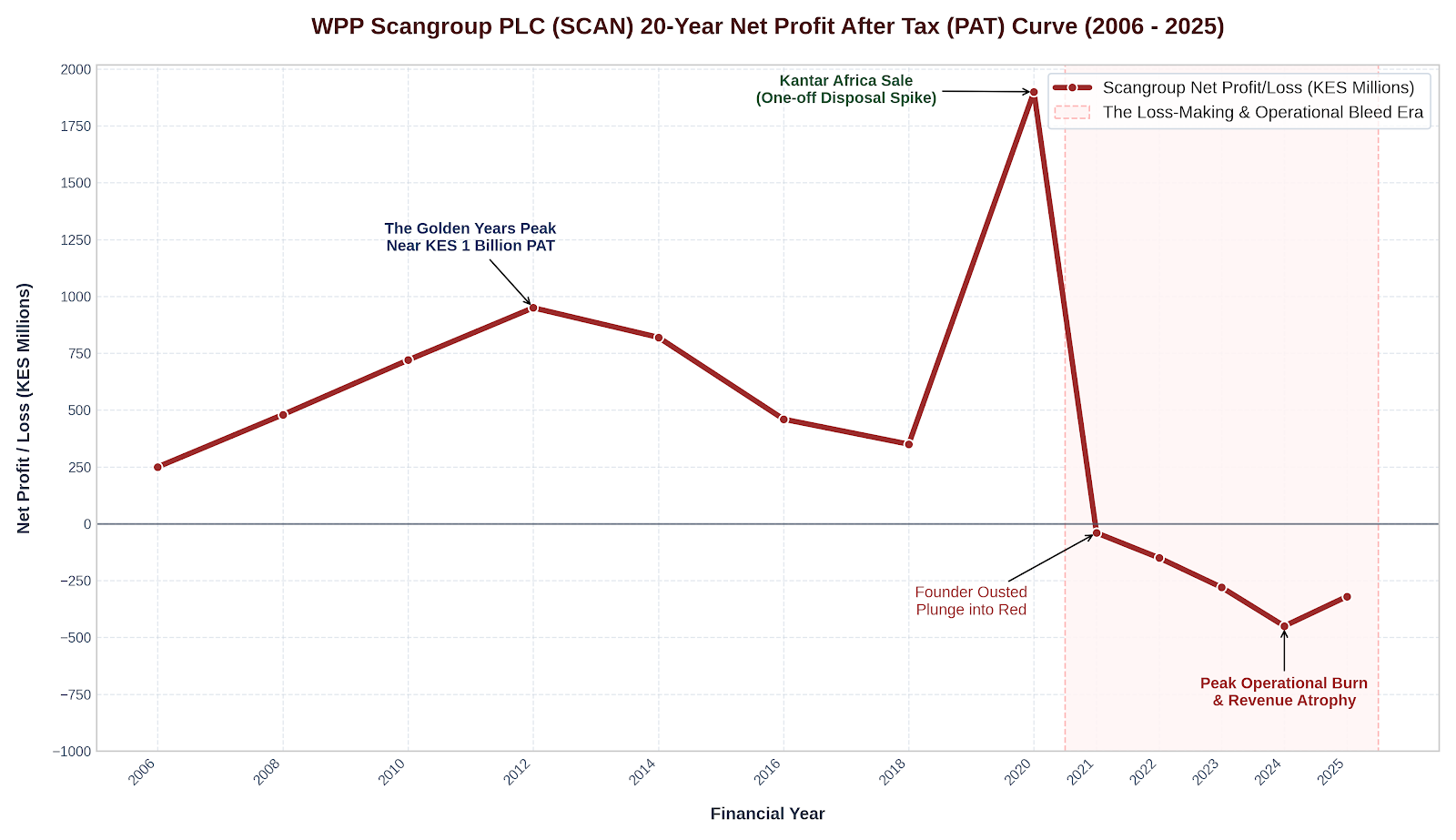
The Severe Share Slump: An 84% Destruction of Value
The financial deterioration triggered an absolute bloodbath on the trading floor. In just seven years, Scangroup’s share price collapsed from a premium of KES 15.00 down to a distressed low of KES 2.46—representing a staggering 84% wipeout of total shareholder value.
[KES 15.00 Peak] ──↘
                   └──↘
                      └──↘ [84% Shareholder Value Wipeout]
                         └──↘
                            └──► [KES 2.46 Current Floor]
To preserve appearances, management sold the company’s ultimate crown jewel—its highly profitable stake in Kantar Africa—using the proceeds to pay out a massive, one-off special dividend of KES 8.00 in 2020. Once that family jewel was gone, investors watched the remaining core business slowly burn.
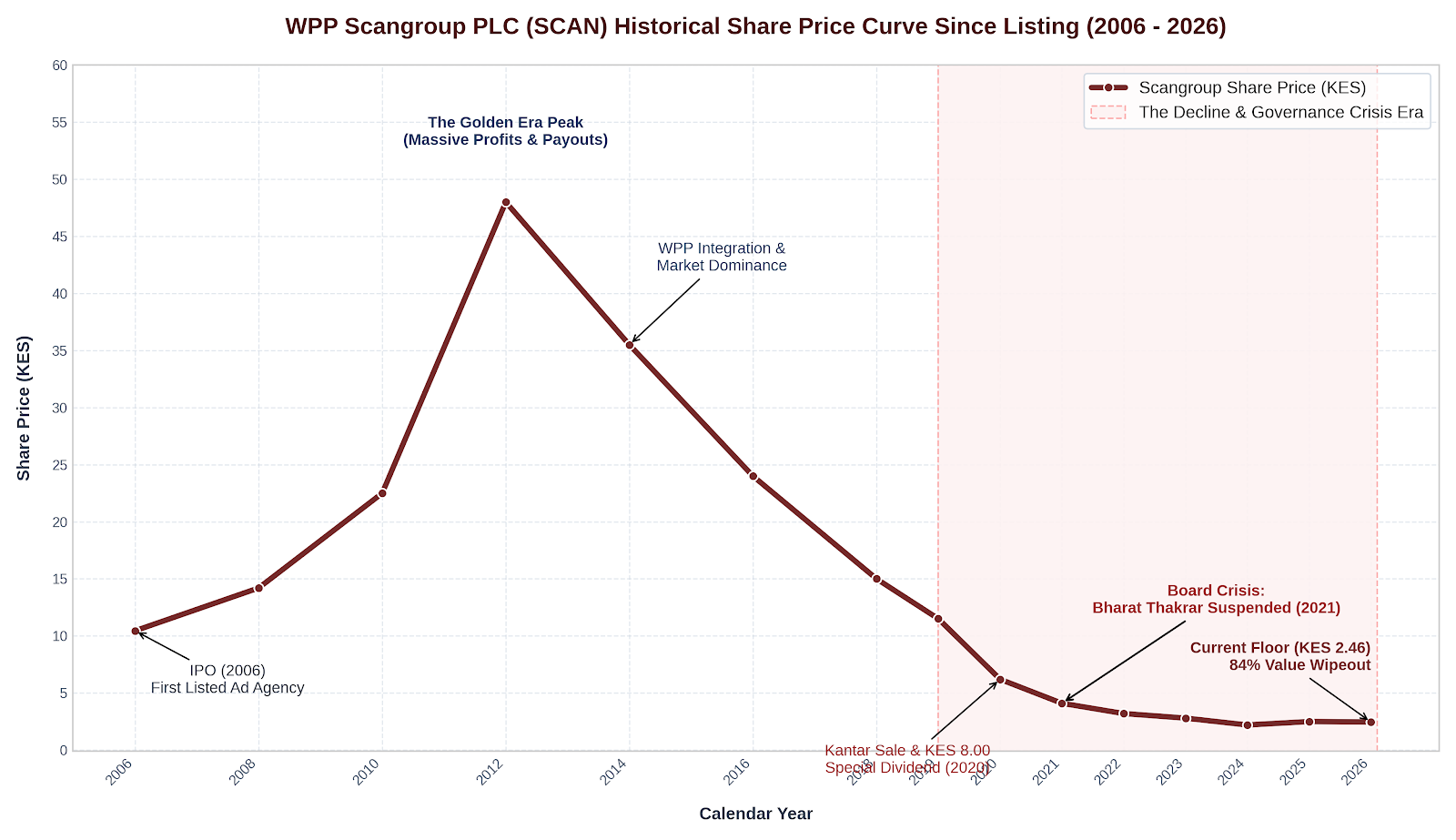
The Scangroup Cash Heist: How Capital Evaporated (2023-2025)
The underlying mathematics of Scangroup’s balance sheet over the last 14 months highlights a painful reality for investors:
The Dec 2024 Valuation Disconnect: In December 2024, the company sat on a massive KES 2.26 Billion cash reserve. This equated to a liquid cash backing of KES 5.23 per share sitting safely in the bank, while the stock itself traded on the NSE at nearly half that value.
The Missed Special Dividend: Had management acted in the best interest of equity holders, they could have paid out a special dividend of KES 5.00 per share in late 2024, safely returning capital to investors. Instead, the board chose to retain the cash to buffer “operations” in a rapidly shrinking market.
The KES 180M Monthly Burn: Because the company failed to stop the operational bleeding, that cash pile has drastically shrunk. Driven by continuous operating losses and a severe KES 180 Million monthly burn rate, the cash backing per share has officially collapsed from KES 5.23 to approximately KES 2.08.
When a company trades at a market cap significantly lower than the net cash in its bank account, it is a definitive signal that the market completely distrusts management’s capital allocation. Instead of returning that money, leadership used it to cushion recurring losses, leaving shareholders KES 3.00 per share poorer than they would have been had the company simply been liquidated 14 months ago.
5.2 The Data and Privacy Legal Battle
True to his combative nature, Thakrar did not retreat quietly into retirement. He immediately launched a fierce, multi-front legal counter-offensive against WPP and its appointed investigative firm, Control Risks Group. Utilizing Kenya’s stringent Data Protection Act, Thakrar dragged the multinational giants to court, alleging that investigators had illegally accessed, processed, and compromised his highly sensitive personal data and private communications during their forensic probe. This legal battle exposed the deep, bitter animosity under the hood of the corporate divorce, transforming a boardroom dispute into a landmark regulatory showcase on data privacy and executive rights.
5.3 Post-Bharat Splintering
The removal of the ultimate networker immediately exposed the vulnerabilities of an organization built entirely around a singular personality and a closed-door circle of trust. Between 2021 and 2025, Scangroup entered a period of severe operational decay. Stripped of Thakrar’s relentless competitive instincts and deep personal relationships with corporate captains, the agency suffered an unprecedented talent drain and a catastrophic loss of core accounts. The ultimate symbolic blow fell in 2025, when Scangroup lost the historic pan-African Airtel Africa account to independent rivals. The financial damage was immense: the company recorded a staggering KSh 3.1 billion in cumulative net losses over that four-year window, causing its market capitalization to collapse to historic lows.
6.0 Modern Shareholder Activism: The Founder’s Return
6.1 The 13.59% Blocking Block
Though removed from executive management, Thakrar retained an incredibly powerful financial weapon: his personal equity. Holding a commanding 13.59% stake in the company, he remains the single largest individual shareholder in Scangroup. Recognizing that the multinational management team was rapidly eroding the value of his life’s work, Thakrar began quietly building alliances with key minority stakeholders—including influential local investment groups like the Bid family and prominent retail activist Carl Ogola. Together, they formed a highly coordinated blocking minority, determined to challenge WPP’s strategy.
6.2 The Board Ouster Campaign (May 2026)
In May 2026, Thakrar went on the offensive, escalating the corporate dispute into full-scale shareholder warfare. Utilizing section 276 of the Companies Act, Thakrar and his allied minority bloc issued a formal demand forcing Scangroup to call an Extraordinary General Meeting (EGM). Their explicit agenda is radical: the immediate dissolution and ouster of the current board of directors. Thakrar’s faction argues that the current board has demonstrated total fiduciary failure, presiding over a historic destruction of shareholder value, and must be replaced by leaders who understand how to fight for local market share.
6.3 The Fiduciary Playbook
This ongoing 2026 EGM showdown provides a masterclass for contemporary market participants in minority shareholder protection. Thakrar’s strategy demonstrates that a founder is never truly powerless as long as they hold a significant block of equity. By weaponizing company law, mobilizing local retail investors, and publicly interrogating the performance metrics of a global multinational parent company, Thakrar has rewritten the playbook on how local capital can push back against international corporate overreach when a listed asset’s valuation collapses.
7.0 Conclusion: The DNA of the Beast
7.1 The Irreplaceable Founder Syndrome
The rise, fall, and subsequent rebellion of Scangroup perfectly illustrates “Irreplaceable Founder Syndrome” within the context of African capital markets. Companies that are built on raw entrepreneurial pressure, razor-sharp personal relationships, and a constant state of commercial warfare often struggle to survive when transitioned into clinical, process-driven multinational governance. Without the aggressive DNA of the person who built the pipeline and commanded the rooms, the corporate machinery quickly loses its competitive edge.
7.2 The Permanent Impact on the Boardlot
Ultimately, Bharat Thakrar’s legacy on the Nairobi Securities Exchange is permanent. Long before tech startups spoke of VC funding or valuation multiples, he proved that an East African service-sector business could scale, list, and capture global capital by leveraging elite network equity. While his ongoing boardroom war continues to dictate the short-term volatility of Scangroup’s share price, his historical blueprint remains essential reading for any entrepreneur looking to transform human relationships into a listed, weaponized, and highly liquid market currency.
7. The Founder’s Stake: A Bharat Thakrar Comeback?
Despite years of brutal, structural value destruction, Bharat Thakrar remains the largest individual shareholder in WPP Scangroup PLC, commanding a commanding 12.0% equity stake. As the current corporate framework continues to erode the company’s remaining cash reserves, a high-stakes question is making the rounds across the square: Should Bharat return to preside over the recreation of value?
Supporters argue that the man who built the empire from scratch is the only corporate captain with the deep network, industry clout, and raw founder’s energy required to rescue the agency from total obsolescence. Critics, however, wonder if the legacy agency model is too fundamentally broken for anyone to salvage.
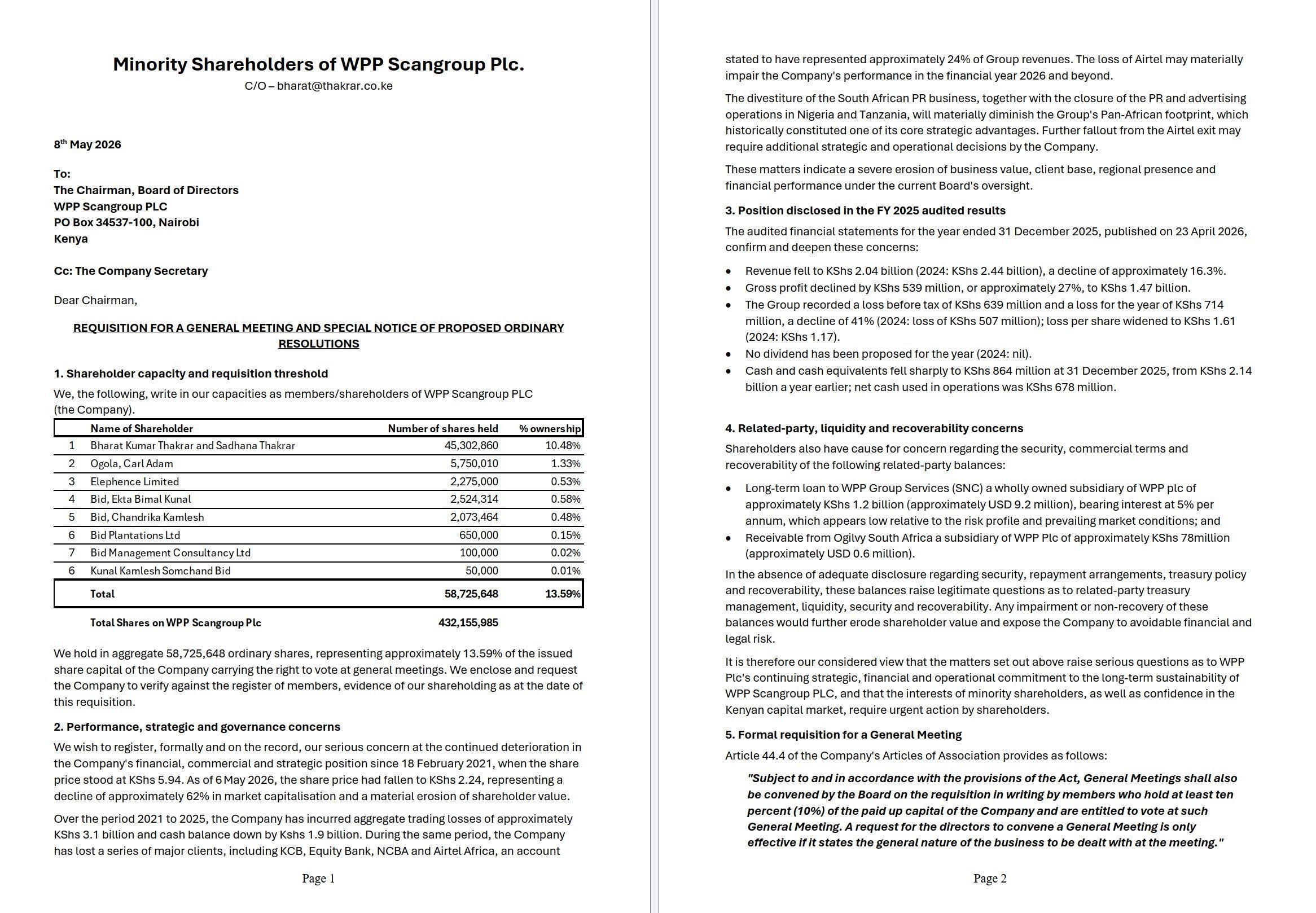
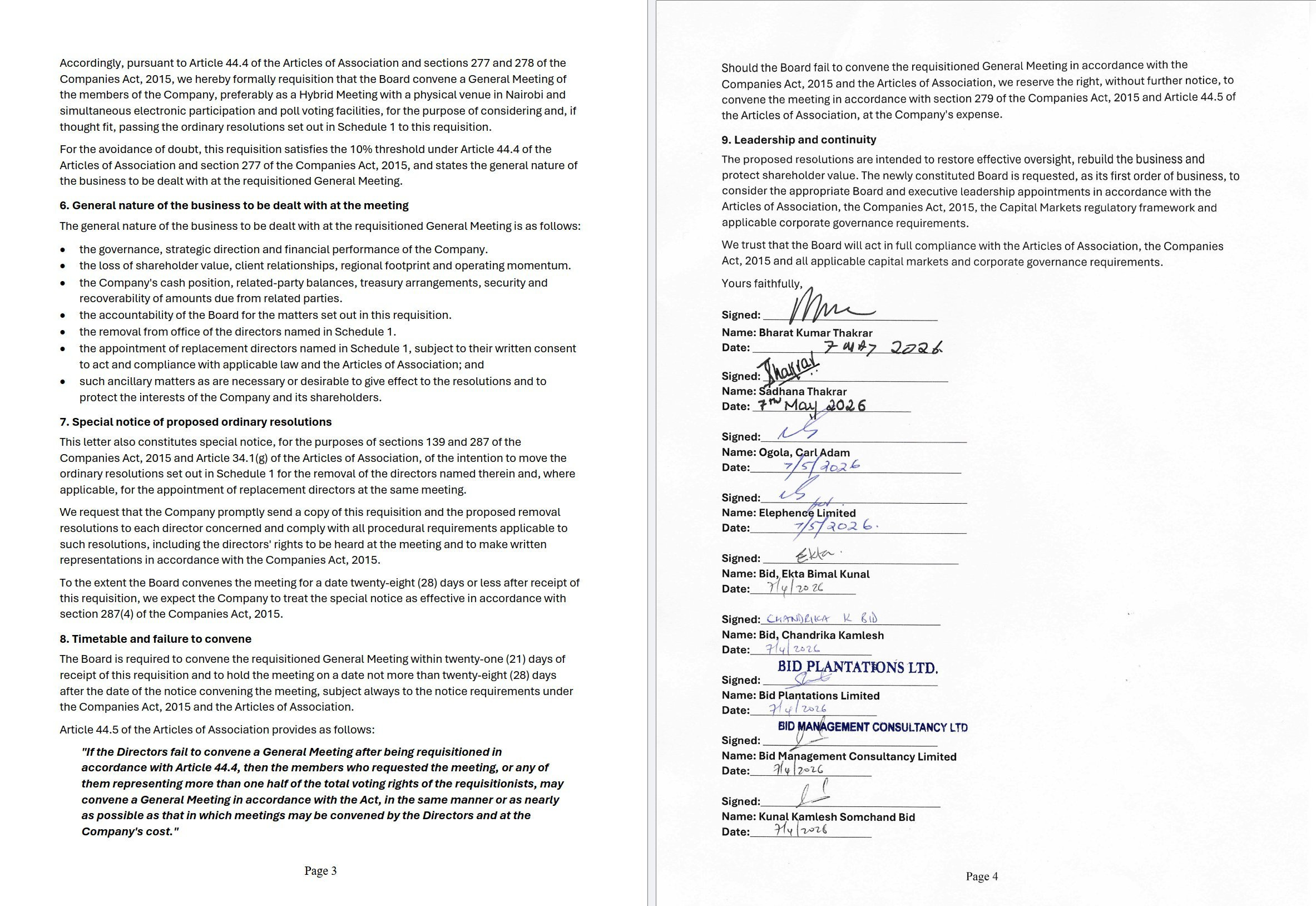
The comprehensive summary of the grounds Bharat Thakrar is citing for the removal of the current Scangroup board:
Here is the summarized breakdown of the grounds for the ouster:
1. Severe Commercial Atrophy & Client Attrition
The minority bloc argues that the board has overseen the destruction of the agency’s “crown jewel” relationships, leading to a massive loss of market power:
Loss of the “Big Three” Banks: The agency has lost the lucrative accounts of KCB, Equity Bank, and NCBA, effectively ceding its dominance in the Kenyan financial services marketing sector.
The Airtel Africa Exit: The termination of the 15-year relationship with Airtel Africa in May 2025 is cited as the most damaging blow. The requisitionists allege this account alone represented 24% of total group revenue.
Market Share Erosion: The loss of Airtel to The Partnership—a firm founded by former Scangroup executives—is highlighted as proof of the board’s inability to retain top talent and defend the business against internal disruption.
2. Financial Freefall (2021–2025)
The requisitionists provide concrete numbers to illustrate a business in an “uncontrolled descent”:
Widening Losses: Aggregate trading losses have reached KSh 3.1 billion over the last five years. The FY2025 results show a net loss of KSh 713.67 million, a 40.8% worsening from the previous year.
Revenue Collapse: Total revenue has imploded by over 70%, falling from KSh 7 billion in 2021 to just KSh 2.04 billion in 2025.
Cash Reserves: Cash and equivalents have collapsed by 59.7%, leaving only KSh 864.48 million in the tank—a critical level given the current burn rate.
3. The “Related-Party” Loan Scandal
A central pillar of the ouster is the allegation that the board is acting as a “rubber stamp” for the majority shareholder (WPP Plc) at the expense of minorities:
KSh 1.2 Billion Exposure: The board extended a long-term loan to WPP Group Services SNC (a WPP Plc subsidiary).
Sub-Market Returns: The loan carries a 5% interest rate, which shareholders argue is significantly below market rates and does not compensate for the risk profile.
Liquidity Risk: With only KSh 864 million in cash left, the KSh 1.2 billion tied up in this loan represents a massive portion of the company’s remaining value that is being “hoarded” by the parent company.
4. Massive Destruction of Shareholder Value
The financial argument concludes with the impact on the NSE investor:
62% Price Decline: Since Thakrar’s removal, the share price has plummeted from KSh 5.94 to KSh 2.24 (as of May 2026).
Market Distrust: The requisitionists argue the current valuation is a “vote of no confidence” by the market in the board’s ability to manage the remaining assets.
8. The Coming AGM: Will the Founder Win the Day?
All eyes now turn to the upcoming Annual General Meeting (AGM), which promises to be the most explosive shareholder showdown in the company’s history. With retail investors furious over the vanishing cash pile and lack of accountability at the top, Bharat Thakrar’s 12.0% voting block represents a massive swing factor.
Will the founder rally dissatisfied minority shareholders, confront the WPP-dominated board, and mount a dramatic boardroom comeback? Or will institutional inertia prevail while the remaining cash continues to burn? For NSE investors, the upcoming AGM will determine whether Scangroup undergoes an aggressive strategic turnaround or continues its slow march toward liquidation.
Based on the recent notice and the escalating governance standoff, here is the summary of the WPP Scangroup 20th Annual General Meeting (AGM) agenda scheduled for 8 June 2026:
1. Ordinary Business (Standard Proceedings)
Financial Review: Presentation and adoption of the audited financial statements for the year ended 31 December 2025.
Dividend Ratification: Discussion on the dividend (or lack thereof) following years of aggregate losses.
Director Appointments: Formal ratification of the three new WPP-appointed directors (Kagiso Musi, Manuel Segimon, and Nick Douglas) who replaced the recently retired members.
Auditor Remuneration: Re-appointment of the external auditors and authorizing the board to set their pay.
2. Special Business: The Minority Bloc Resolutions (Item 8)
The board has folded Bharat Thakrar’s requisition directly into the AGM agenda. Shareholders will vote on:
Removal of the Board: A resolution to oust the remaining directors named in the minority bloc’s removal bid.
Governance Accountability: A formal vote acting as a “governance campaign” against the current leadership’s performance over the last five years.
3. Key Points of Contention for the Meeting
While the “Ordinary Business” is standard, the discussions during the meeting are expected to focus on these critical performance metrics:
Financial Hemorrhage: Addressing the KSh 3.1 billion in aggregate losses over the last five years.
Revenue Atrophy: Explaining the collapse in turnover from KSh 7 billion to KSh 2.04 billion.
The WPP Loan: Scrutiny of the contested KSh 1.2 billion related-party loan to WPP Group Services SNC at a 5% annual interest rate.
Equity Erosion: A formal record of the 62% share price decline that has decimated shareholder value.
4. Logistics & Voting Power
Meeting Format: Hybrid (online and physical) at 10:00 a.m. on Monday, 8 June 2026.
Registration Deadline: Shareholders must register by 6 June 2026 at noon.
Voting Dynamics: WPP Plc holds 50.1% of the vote, making the defeat of the removal resolutions mathematically certain, despite the minority bloc’s 13.59% holding.
Transparency: Final poll results will be published within 48 hours of the meeting.
Given the 50.1% controlling stake held by WPP Plc and the specific governance dynamics at play, the upcoming AGM on 8 June 2026 is less of a mathematical battle and more of a strategic negotiation.
Here are the three primary scenarios for the outcome of the meeting:
The Scangroup Showdown: Strategic Scenarios for the 20th AGM
Scenario 1: The “Wall of Capital” (WPP Dominance)
In this most likely scenario, WPP Plc uses its absolute majority to vote down every minority resolution.
The Outcome: All 9 directors (including the 3 new appointees) are retained/ratified. Bharat Thakrar’s removal resolutions fail.
The Signal: WPP re-asserts that Scangroup is a subsidiary of a global network, not an independent Kenyan agency.
Impact: While the “bleed” continues, management gains a short-term mandate, but the stock likely remains depressed as the market continues to price in a lack of trust.
Scenario 2: The “Grand Bargain” (The Middle Ground)
This is the scenario we predict, where both sides realize that a toxic AGM destroys what little value is left. A compromise is reached behind the scenes before the poll results are finalized.
Board Recomposition: Bharat drops the ouster bid in exchange for WPP accepting one or two “independent” directors nominated by the minority bloc. These would act as “watchdogs” over the KSh 1.2 billion related-party loans and cash burn.
The Founder’s Role: Bharat is not reinstated as CEO (due to the WPP global compliance stance), but is given a Strategic Consultant or Chairman Emeritus role to help stabilize client relationships.
The Logic: WPP gets to keep its majority, while Bharat gets a seat at the table to protect his 12% equity.
Scenario 3: The “Scorched Earth” & Exit Strategy
If the AGM becomes exceptionally hostile and the minority bloc manages to rally other institutional investors (beyond the 13.59%), the “Governance Campaign” could make the company ungovernable.
The Outcome: WPP wins the vote but loses the war. Client churn accelerates as the brand is dragged through “Cash Heist” headlines.
The Exit: Realizing the Kenyan market is too localized for their current global structure, WPP begins exploring a Share Buyback or a Private Equity exit, potentially selling their stake back to a consortium led by the founder or a new regional suitor.
Scangroup AGM: Mathematics vs. Narrative.
We know WPP controls 50.1%. Mathematically, Bharat’s ouster bid is “dead on arrival.” BUT... in the court of public opinion and corporate governance, the founder has already forced a board refresh.
Do you think we are heading for a “Grand Bargain” where Bharat returns in a strategic role to save the KES 2.00/share cash remaining? Or will WPP use their 51% to shut the door for good?
Is a middle ground even possible at this level of hostility? Let’s discuss. 🧵
#wppscangroup #bharatthakrar #NSEKenya
An excellent article, closely following Bharat’s comeback or defeat!