
Welcome to Boardlot Africa, where we pull back the curtain to reveal the untold stories, power dynamics, and strategic maneuvers shaping the boardrooms of Corporate Africa—subscribe for free to join the conversation. join 1000 other subscribers
We publish:
Sultans weekly NSE Stock Picks, every Friday at 5pm
Kenya’s Most Consequential Legal, Governance & Labor Disputes
A Series on the 100 Most Influential Kenyan Captains of Industry
The Queens of East Africa Boardrooms
The Silicon Savana Chronicles, every Wednesday at 5.00pm
Sultan’s Farming Diary, every Monday at 5.00pm
The Art of Knowing When to Exit: My Personal Framework for Portfolio Management
As an investor in both the NSE and global markets, the most common question I receive in my DMs isn’t about what to buy—it’s about when to sell.
“Should I take my profits now, or let it run?”
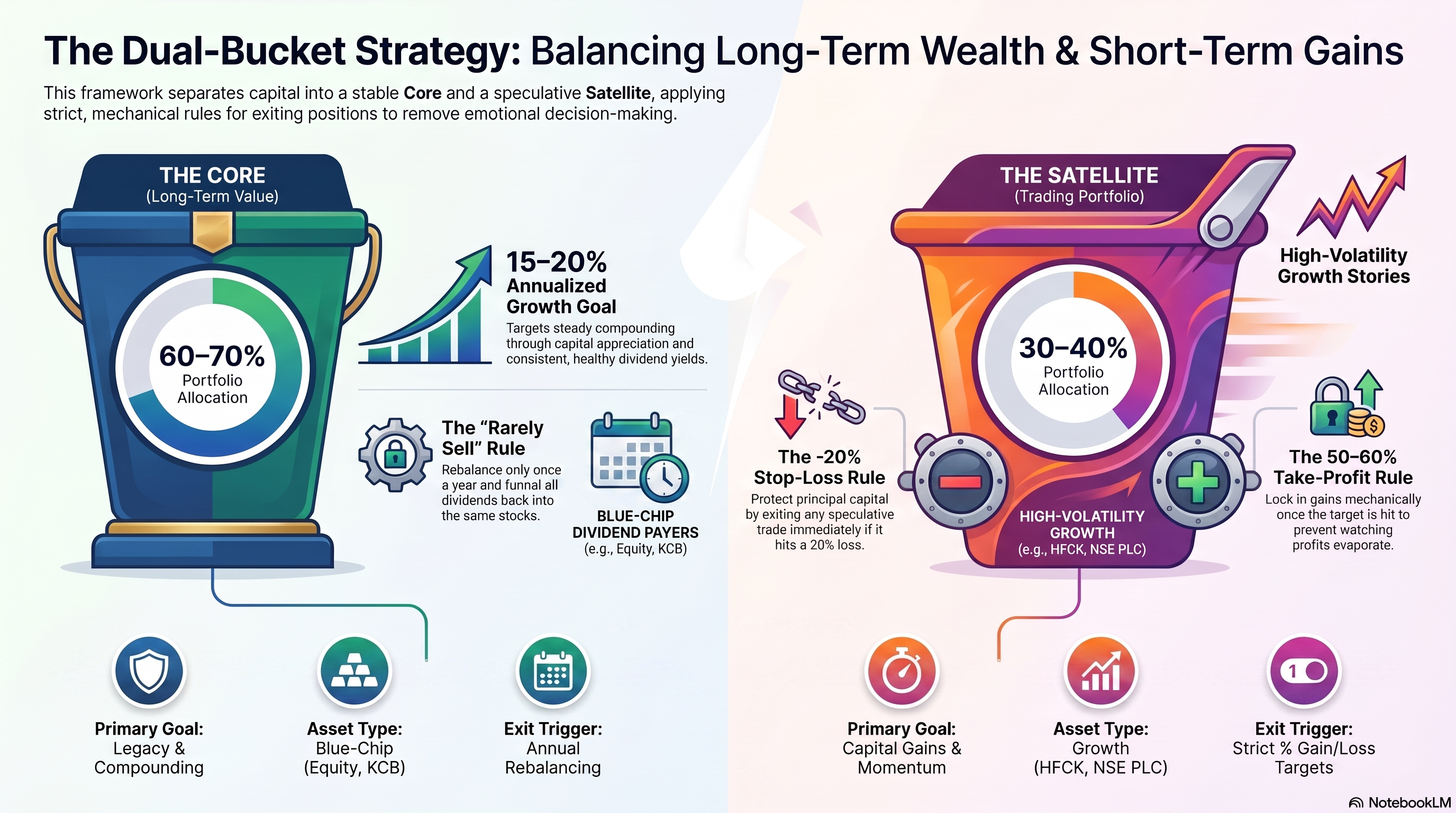
There is no “one size fits all” answer, but there is a framework. If you are struggling with emotional decision-making, it’s likely because you are treating all your investments the same way. I don’t. I divide my capital into two distinct “buckets,” each governed by its own set of rules.
Here is how I manage my portfolios to balance long-term wealth creation with short-term opportunistic gains.

1. The Core: The Long-Term Value Portfolio (60–70% of Assets)
This is the engine of my financial freedom. It is not about “beating the market” in a single month; it is about compounding wealth over years.
The Strategy: High-conviction, blue-chip dividend payers (e.g., Standard Chartered, Equity Group, BAT, EABL).
The Goal: 15–20% annualized growth plus a consistent, healthy dividend yield.
The Performance: Investing is not without its scars. I have lost money—most notably in KQ—and I currently find myself stuck in a large position in Centum. However, I have used these painful lessons to rebalance my portfolio over time and mature my strategy. On the flip side, my biggest winners have been Equity, KCB, and NCBA. Today, my profits outweigh my losses by more than 10x, and with this refined approach, I am overall very happy with the portfolio’s trajectory.
The “Exit” Rule: I rarely sell. I look at this portfolio only once a year for rebalancing. I operate on a strict “Dividend Reinvestment” policy, funneling every cent back into the same stocks to purchase more shares.
The Lesson: If you have selected high-quality assets, your biggest enemy is your own impulse to trade. Let time do the heavy lifting for you.
2. The Satellite: The Trading Portfolio (30–40% of Assets)
This is where I experiment. I officially moved to this split-portfolio approach in early 2025, and it has fundamentally changed how I view risk. This portfolio is for growth stories (e.g., NSE PLC HFCK, Home Afrika) and speculative plays.
Because this portfolio is volatile, I do not “hope” for results. I use strict mechanical rules to remove emotion from the equation.
The Stop-Loss Rule
I never let a bad trade cripple my capital. If a speculative position hits a -20% loss, I exit. Period. This protects my principal so I can live to trade another day. Some platforms allow you to define this when you are buying the stock
The Take-Profit Rule
Most investors get greedy and watch a 50% gain evaporate. My rule is simple: When a trade hits a 50–60% gain, I take the profit.
An Example:
I currently hold 5000 stocks in NSE PLC. I bought a stock at 18/=. If it hits 27/=, I sell. It does not matter if the stock continues to rally to 35/=. I have achieved my target and locked in my gains.
Performance Outlook
It is still early days for this experiment, but I am watching my positions in HFCK, NSE PLC, and Home Afrika closely. If the current momentum holds, it seems that in 2026, my trading portfolio will by far outperform my long-term value portfolio—even when I account for the dividends I collect in the core.
Final Thoughts: Tools and Execution
You don’t have to watch your tickers 24/7 to apply these rules. Platforms like AIB-AXYS (and others available on the NSE) allow you to set price alerts or automated orders.
My advice? Define your goals before you enter the trade. Are you building a legacy (Value Portfolio), or are you capturing a move (Trading Portfolio)? If you know the “why” behind the trade, the “when” to sell becomes obvious.
About Boardlot Africa Research
Boardlot Africa is a premier financial intelligence and corporate governance publication dedicated to unpacking the mechanics of capital, market strategies, and structural shifts across East Africa’s corporate landscape. By bridging the gap between raw economic data and actionable market intelligence, we deliver deep-dive research, independent corporate analysis, and policy insights designed for institutional investors, boardrooms, and sharp market observers.
Get in Touch
Email: boardlot.research@gmail.com
Phone: +254 753 133 901
Substack: Subscribe to Boardlot Africa
X (Twitter): BoardLotSultan
due diligence is more important for investing than profits, what Ratios do you pay more attention to in the statements?
It's always great to learn from the master