
The Balance Sheet Cleanup: How Debt Paydowns and Grid Loss Reductions Re-engineered KPLC
Top-line revenue growth usually gets the headlines in financial media, but for utility giants, real value creation happens deep inside the balance sheet and the physical grid. Kenya Power and Lighting Company PLC’s (KPLC) FY26 financial results present a textbook case of why investors need to look past top-line numbers.
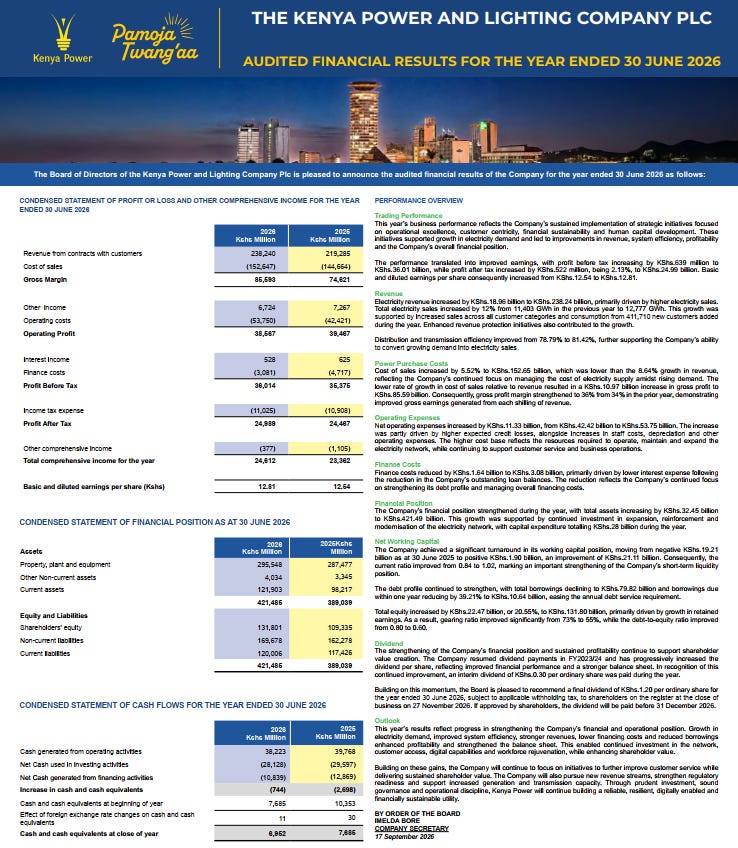
While market commentary might focus on the 8.64% top-line revenue expansion, the real story lies in managerial courage. CEO Eng. Joseph Siror has taken unglamorous, high-friction operational decisions that previous leadership kicked down the road—cleaning up bad debts, aggressively extinguishing expensive short-term liabilities, and plugging physical energy leakages across the network.
Here is why Eng. Siror deserves explicit credit for this set of results.
1. Having the Balls to Write Down Credit Losses Operating expenses jumped by 26.71% (a KSh 11.33 billion surge), which on the surface looks like margin erosion. However, a closer look reveals that this was largely driven by heavy provisions for expected credit losses alongside staff and depreciation costs.
Instead of papering over aging receivables to artificially inflate operating margins, Siror faced reality and cleaned up the ledger. Taking these write-downs upfront requires significant spine, but it establishes an honest baseline for KPLC’s receivables and protects the balance sheet from sudden, catastrophic write-offs down the line.
2. Aggressive Deleveraging and Real Cash Generation Siror didn’t just manufacture book profits; he generated actual cash flow. Operating cash flows remained robust at KSh 38.22 billion, which was immediately channeled toward paying down expensive debt obligations.
Finance Costs: Reduced by 34.68% (saving KSh 1.64 billion).
Short-Term Debt: Debt due within one year dropped by 39.21% down to KSh 10.64 billion.
Working Capital Turnaround: Swapped a chronic working capital deficit of KSh -19.21 billion into a positive KSh 1.90 billion cushion, pushing the current ratio above 1.0x.
This aggressive debt reduction single-handedly protected bottom-line profitability and brought overall gearing down from 73% to 55%.
3. The Grid Loss Victory: Progress, Global Benchmarks, and the Friction of Illegal Connections The ultimate operational highlight of these results is an engineer doing what an engineer does best: fixing physical infrastructure. KPLC’s distribution and transmission efficiency improved from 78.79% to 81.42%—a ~2.63 percentage point gain.
While an 8.64% revenue increase is modest, plugging grid leakage by 2.63% delivered a far greater impact on gross margins, expanding them by 190 basis points (34.03% to 35.93%). Every unit of electricity saved before reaching the meter translates directly into bottom-line cash.
However, context is critical: the job is far from finished.
The Global Benchmark Gap: Total system losses (technical and commercial) still hover around ~18.58% (100% - 81.42% efficiency). Global industry best practice for well-run utilities sits between 4% and 8% total system loss, with developed transmission networks keeping technical losses under 5% alone. KPLC is making right-direction progress, but it is still operating well above global benchmarks and the regulator’s ideal thresholds.
The High-Friction Reality of “Commercial Losses”: In the Kenyan operating environment, reducing system losses isn’t just a technical matter of swapping out aging transformers or re-conductoring lines. A substantial chunk of these losses are commercial losses—driven by organized electricity cartels, meter tampering, and widespread illegal connections in dense informal settlements and commercial bypasses.
Fixing commercial losses requires physical enforcement, revenue protection raids alongside law enforcement, and dismantling entrenched local political/cartel dynamics. It is hostile, politically sensitive, and operational grind. Moving the efficiency needle by 2.63% in that environment means Siror’s teams actively took on those high-friction battles on the ground.
4. The Capital Allocation Challenge: Time to Lift the Dividend Payout A 50% increase in the final dividend to KSh 1.20 per share (taking the full-year payout to KSh 1.50) is a very welcome signal to equity holders who have waited out the turnaround.
However, with a payout ratio sitting at roughly 8% of net profit, the distribution remains conservative. As the debt service burden continues to fall and working capital stabilizes, management should aim to expand this payout ratio toward 20%. Shareholders who backed the balance sheet repair deserve a fairer share of the resulting cash flow.
Verdict Eng. Joseph Siror has delivered a masterclass in balance sheet repair and grid stabilization. By reducing short-term debt risk, taking honest credit loss provisions, and clawing back efficiency in a brutal operating environment, KPLC is building a far healthier balance sheet. The mandate now is clear: keep taking on the friction of commercial loss reduction to push toward international benchmarks, while passing more of that saved cash back to equity investors.
About Boardlot Africa Research
Boardlot Africa is a premier financial intelligence and corporate governance publication dedicated to unpacking the mechanics of capital, market strategies, and structural shifts across East Africa’s corporate landscape. By bridging the gap between raw economic data and actionable market intelligence, we deliver deep-dive research, independent corporate analysis, and policy insights designed for institutional investors, boardrooms, and sharp market observers.
Get in Touch
Email: boardlot.research@gmail.com
Phone: +254 753 133 901
Substack: Subscribe to Boardlot Africa
X (Twitter): BoardLotSultan