
The Retail Powerhouses: A 2026 Deep-Dive into Kenya’s Banking Giants
Following my recent X thread analysis, I am moving the conversation to Substack to provide a more granular breakdown of the “Big 5” retail banks. We are at a historic juncture where the “Retail Crown” is being contested not just on branch counts, but on digital depth and regional muscle.
The Sultan’s Verdict: 🏛️⚖️ In the 2026 retail landscape, Equity is the growth play, Co-op is the dividend play, and KCB is the value-unlock play. NCBA remains the digital alpha, while Family Bank is the wild card to watch as it hits the main board.
#NSEKenya #ziidiTrader #BankingDeepDive #EquityBank #KCB #NCBA CoopBank #FamilyBank
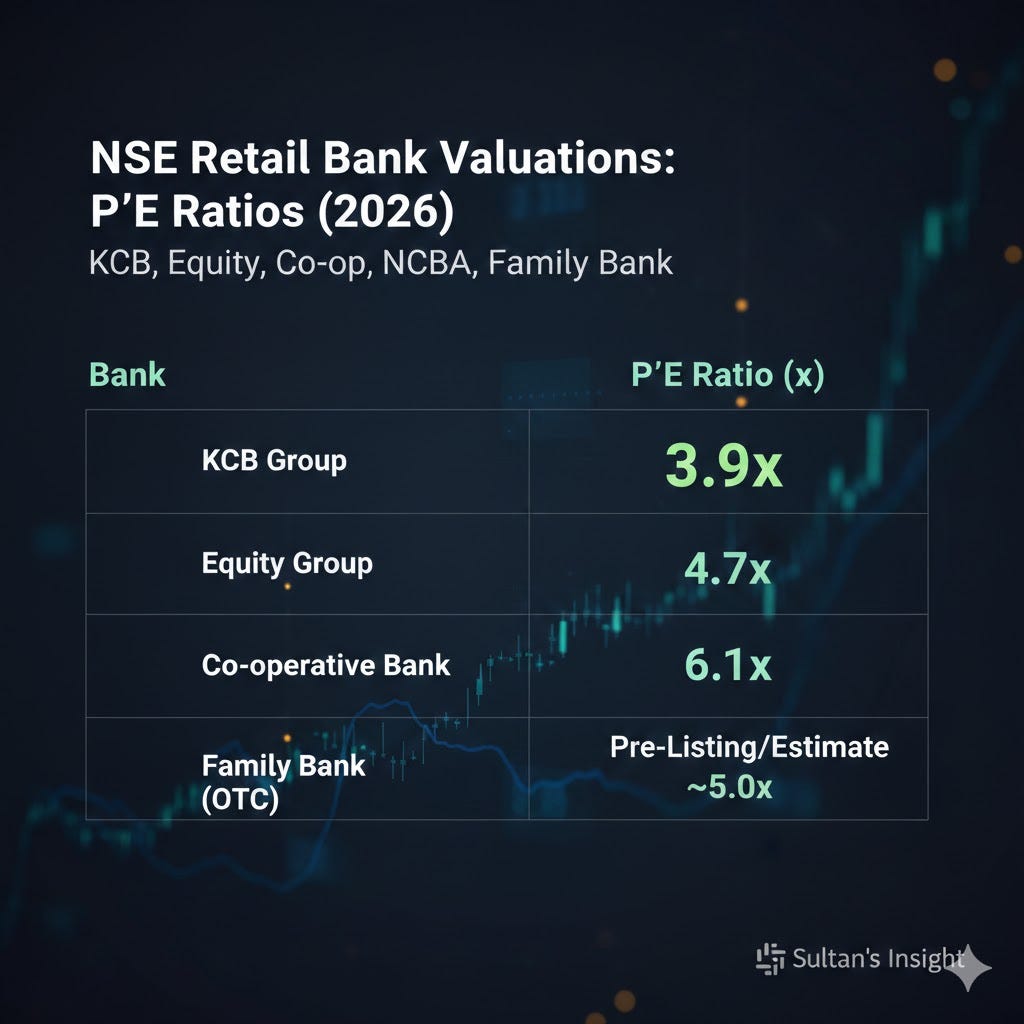
1. Market Valuation: P/E and Price-to-Book (P/B)
The market is currently pricing Kenyan banks as “Value” plays. Despite strong earnings, multiples remain compressed.
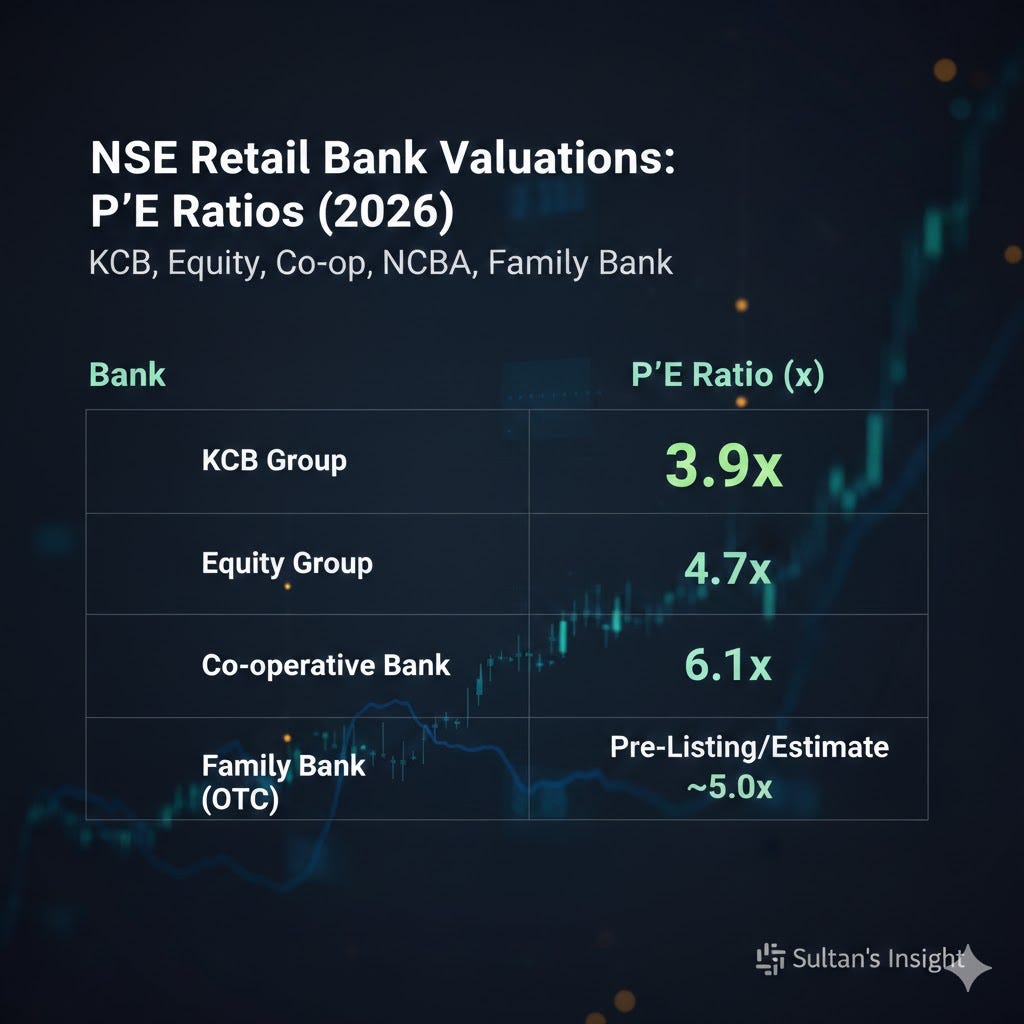
KCB Group: Currently the “Value” king with a P/E of 3.9x and P/B of ~0.6x. The market is still pricing in the post-NBK sale recovery and DRC integration risks.
Equity Group: Commands a premium with a P/E of 4.7x. Its P/B remains the highest among peers (~1.1x), reflecting investor confidence in its regional “super-platform” model.
Co-op Bank: Steady and dependable at P/E 6.1x. It trades at a slight premium to KCB due to its consistent dividend track record and lower volatility.
NCBA: Trading at P/E 6.3x. Its valuation is heavily anchored on its dominant digital lending (M-Shwari) and its recent dividend hike.
Family Bank (OTC): As it prepares for its 2026 listing, its OTC price reflects a “pre-IPO” discount, but valuations are trending toward Tier-1 levels as transparency improves.
2. Profitability: PAT CAGR Growth
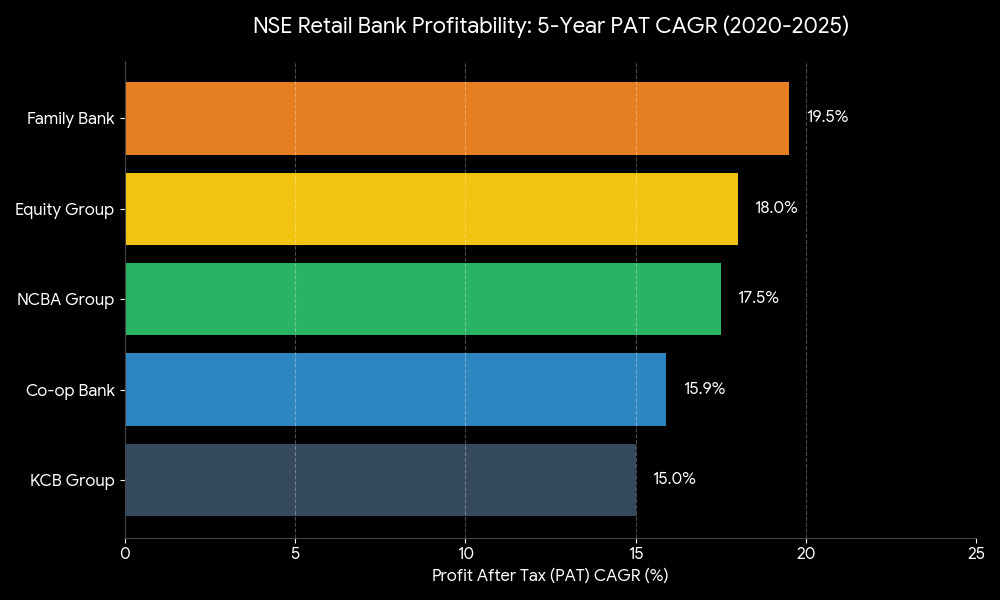
Profitability has been resilient despite the 2024-2025 macro-headwinds.
NSE Retail Bank Profitability: Resilient Growth (2025/2026)
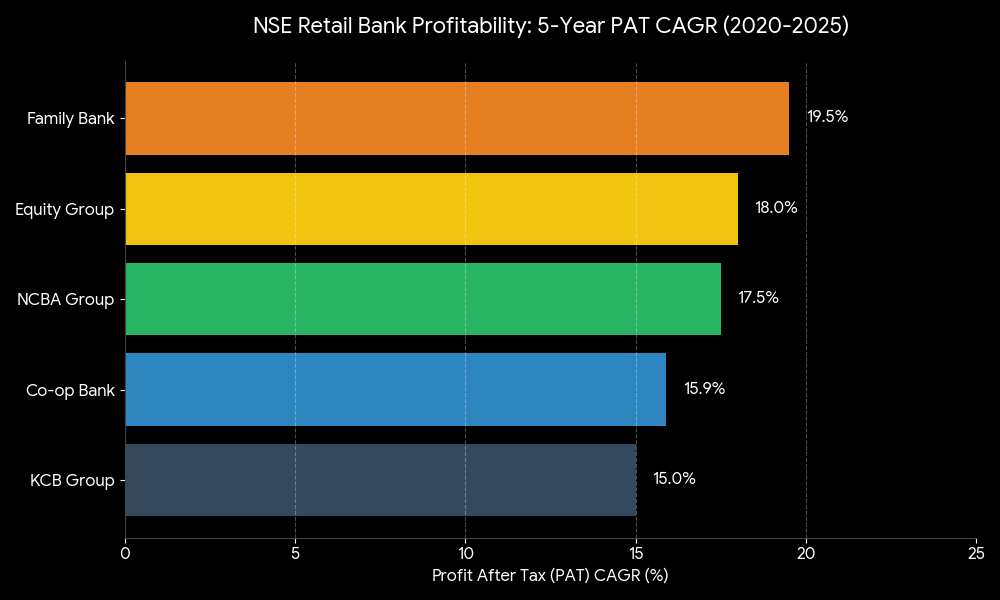
Despite the 2024-2025 macroeconomic headwinds, the top-tier Kenyan banks have demonstrated remarkable earnings resilience. The shift from aggressive lending to high-yield government paper, coupled with cost-efficiency through digital transformation, has kept the 5-year Profit After Tax (PAT) CAGR in double digits across the board.
Equity Group: Reclaimed the crown as the most profitable bank in 2025, posting a staggering KES 33 Billion PAT in the first half of the year. This 17% YoY growth is supported by its massive regional footprint, which now cushions the group against domestic shocks. Its 5-year CAGR remains the industry gold standard at 18%.
KCB Group: Following neck-and-neck with KES 32 Billion PAT (H1 2025). The bank is seeing a significant “DRC Dividend” as its acquisition of Trust Merchant Bank (TMB) matures, contributing nearly a third of the group’s bottom line.
NCBA Group: Has emerged as the “Growth Alpha” in the corporate and digital lending space. With a 13% YoY PAT growth in 2025, NCBA’s dominance in asset finance and mobile micro-loans (M-Shwari) has translated into a robust 17.5% 5-year CAGR.
Co-operative Bank: Continues its streak of stability, maintaining a 15.9% CAGR. Its unique “Sacco-link” model provides a stable, low-cost deposit base that fuels consistent performance even in volatile interest rate cycles.
Family Bank: The dark horse of the group, showing the most aggressive recent trajectory (+56% YoY profit surge in Q3 2025). As it gears up for its 2026 NSE Listing, its 19.5% CAGR makes it a prime target for growth-seeking investors looking for the next Tier-1 heavyweight.
3. Efficiency: Cost-to-Income Ratio (C/I)
Efficiency is where the “Digital-First” banks are pulling away.
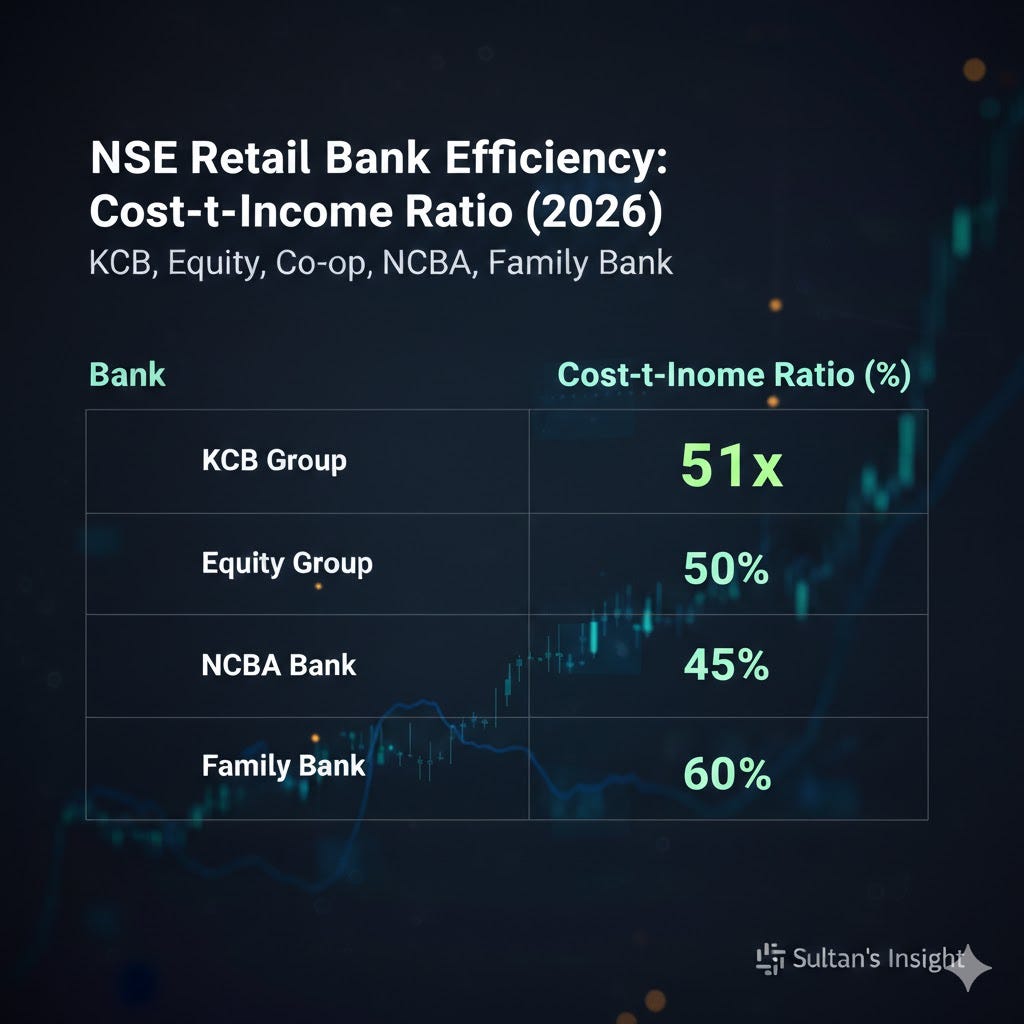
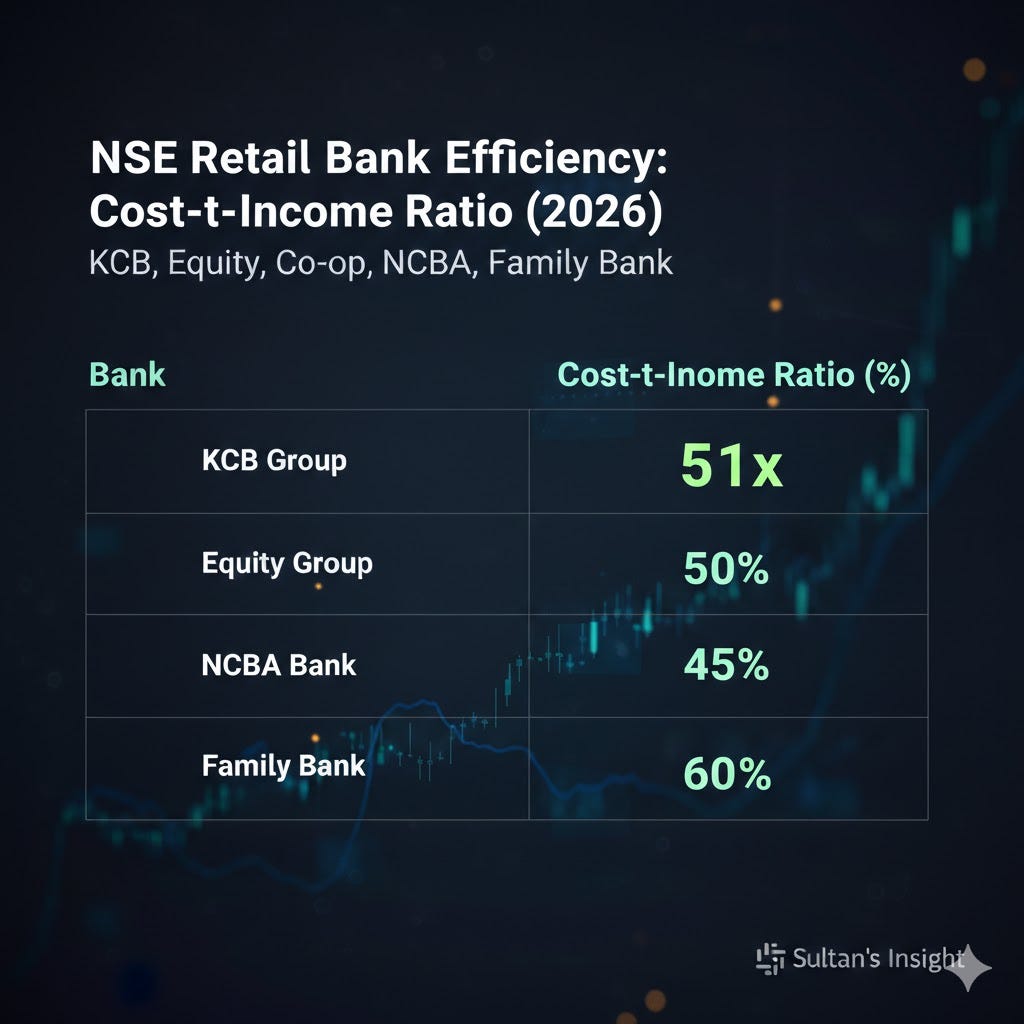
Co-op Bank: Highly efficient with a C/I ratio of ~45.5%, though it faced slight cost pressures in early 2025.
Equity & KCB: Hovering between 47% – 51%. While their digital transactions are cheap, their massive regional expansion (hiring and infrastructure in DRC/South Sudan) keeps their cost base elevated.
NCBA: Benefits from a leaner branch network and high digital automation, keeping its ratio competitive in the low 40s.
Understanding the Efficiency Gap: Why the 60%?
While the market generally rewards a Cost-to-Income Ratio (CIR) below 50%, a deeper look at Family Bank’s 60.3% reveals a bank in a calculated “Inauguration Phase.” Unlike the established Tier-1 giants who are harvesting mature networks, Family Bank is currently deploying massive capital into three strategic areas ahead of its 2026 NSE listing:
Aggressive Physical Expansion: In 2025/26, the bank accelerated its “Last Mile” banking strategy, opening its 95th and 96th branches in locations like Kilifi and Wanguru. This upfront “brick-and-mortar” cost hits the balance sheet immediately, while the revenue from these new regions typically takes 18–24 months to mature.
Digital Modernization: To compete with Equity and KCB, Family has overhauled its PesaPap infrastructure and integrated AI-driven credit scoring. These are high-cost, high-yield investments in scalability.
The IPO Grooming: Preparing for a listing by introduction involves significant regulatory, legal, and consultancy expenses.
The Sultan’s Verdict: For an investor, the question isn’t “Why is the cost high?” but “Is the cost productive?” As long as Family Bank’s Operating Income continues to grow at a double-digit rate, this 60% ratio is simply the price of admission to the Tier-1 club. Once the branch network matures and the listing is finalized, expect this ratio to gravitate back toward the 50% industry average, unlocking significant value.
4. Balance Sheet Strength & Liquidity
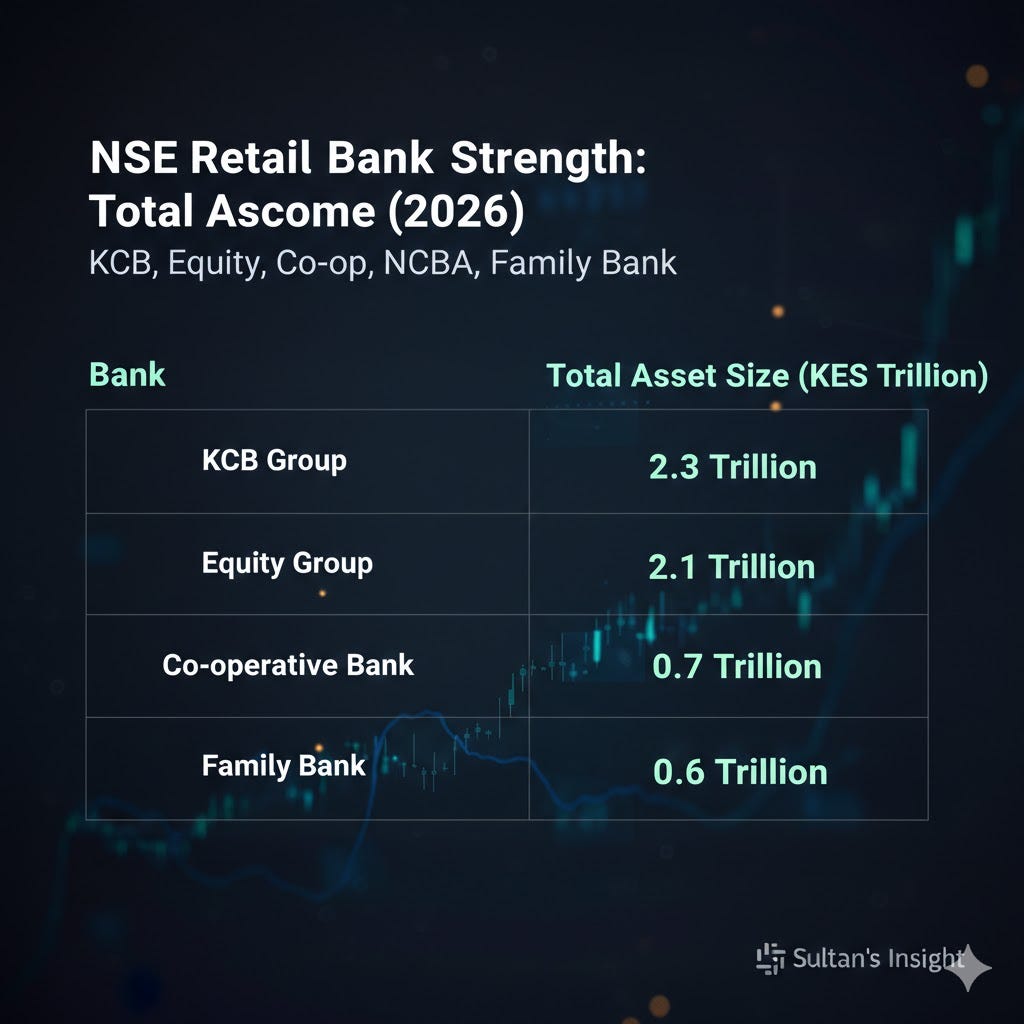
To expand this section, we can break down the individual balance sheet performance of the top tier banks as of the latest 2025 reporting periods. The “over-liquid” status is a common thread, with most banks aggressively pivoting toward government securities to mitigate private sector risk.
Balance Sheet Strength & Liquidity
The 2-Trillion Club
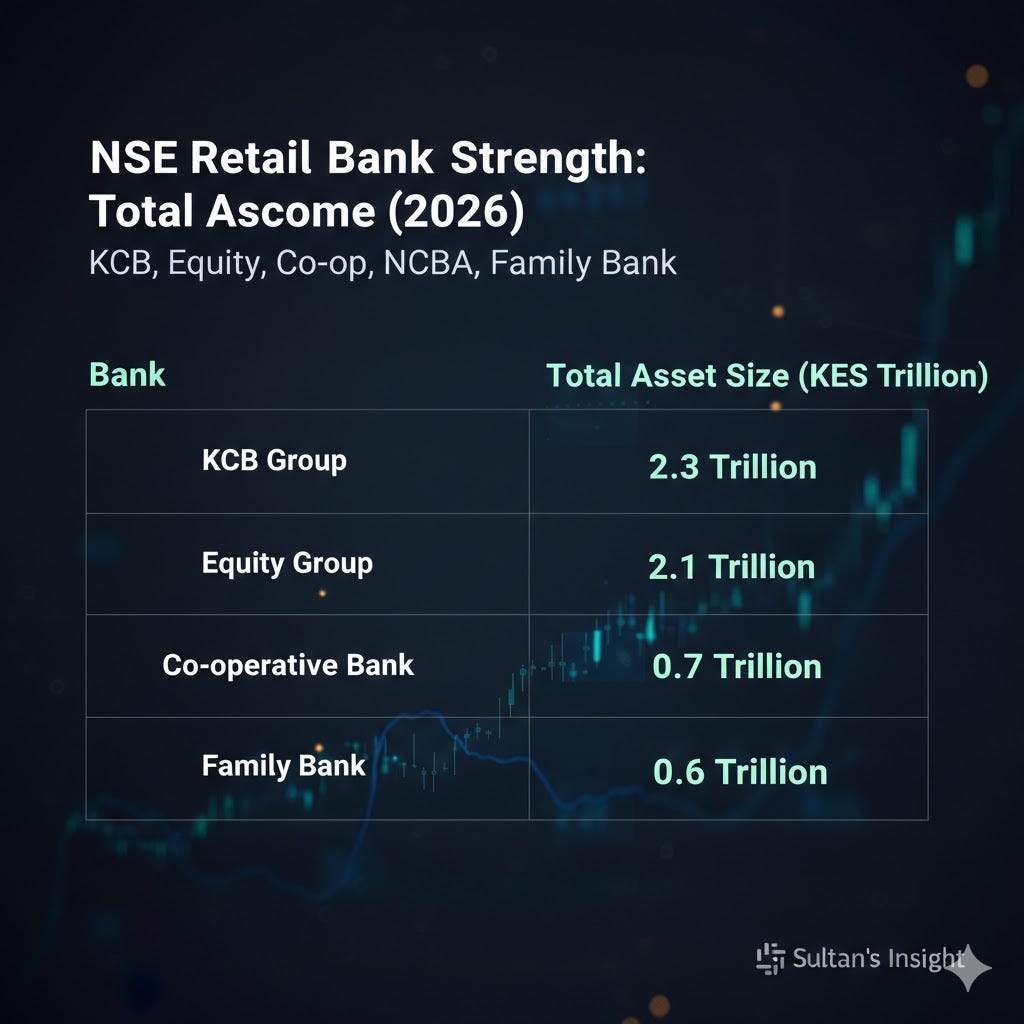
KCB Group: Successfully breached the KES 2.04 Trillion mark by Q3 2025, representing a steady expansion even after the strategic sale of National Bank of Kenya (NBK). Its growth was underpinned by a 6.1% increase in government securities and a resilient 8.2% rise in net loans.
Equity Group: Maintaining its position as a regional giant, Equity’s total assets climbed to KES 1.82 Trillion by late 2025. The group saw a massive 19.9% surge in government securities holdings, signaling a flight to quality in a high-rate environment.
Tier 1 & Mid-Tier Performance
Co-operative Bank: Reached a total asset base of KES 815.3 Billion by Q3 2025. The bank remains highly conservative, holding KES 255.4 Billion in government paper—nearly 31% of its entire balance sheet—to ensure stability.
NCBA Group: Reported total assets of approximately KES 663 Billion by mid-2025. NCBA has leveraged its dominant position in asset finance and digital lending to maintain a core capital-to-risk-weighted assets ratio of 22.4%, far exceeding the 14.5% regulatory floor.
Family Bank: Representing the high-growth mid-tier segment, its balance sheet expanded by 24.1% y/y to reach KES 203.6 Billion in Q3 2025. This was fueled by a near-doubling of income from government securities, which rose by 43.2% as the bank optimized its risk-weighted assets.
Liquidity: The “Safe Haven” Strategy
All major banks are currently operating with massive liquidity buffers. While the law requires a 20% minimum, the industry average is significantly higher:
Bank Liquidity Ratio (2025)Strategy Focus
KCB46.7%Balancing regional expansion with T-Bond yields.
Equity61.0%Heavy deployment into liquid government assets.
Co-op~50%+”Universal banking” model backed by SACCO liquidity.
Family53.1%Aggressive branch and digital-led deposit growth.
Key Trend: Banks are currently "over-liquid" by choice. With Treasury Bill and Bond yields remaining attractive, lenders are prioritizing the "risk-free" 12%–16% returns from the government over the higher default risks currently associated with private-sector SMEs.
5. Regional Presence: The East African Empire
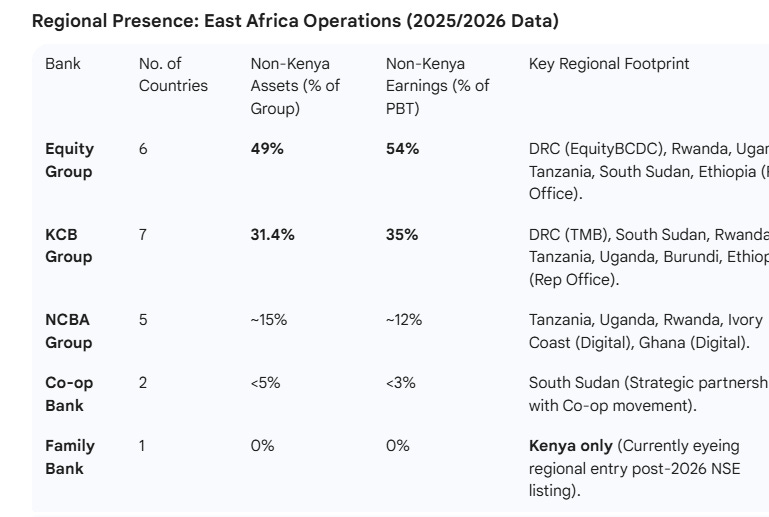
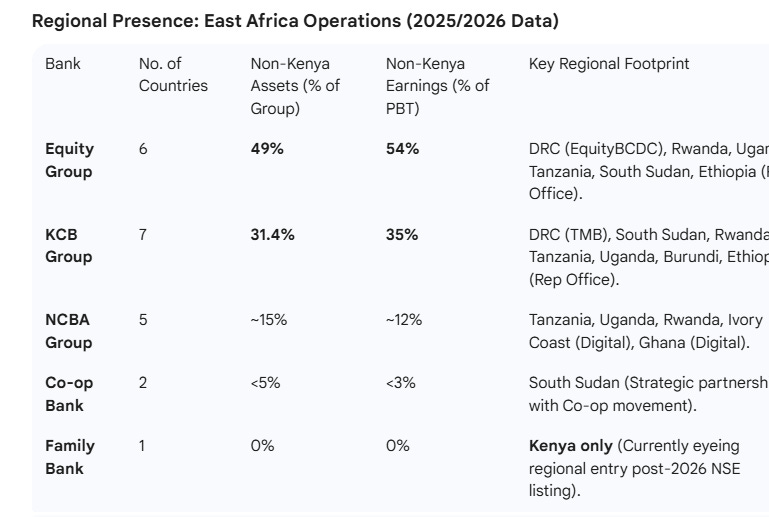
The battle for retail dominance is now a regional one.
he Sultan’s Analysis 🌍🛡️
Equity Group: The DRC Alpha. Equity has successfully de-risked its dependency on Kenya. With 54% of profits now coming from outside the home market, it is effectively a “Regional Bank headquartered in Nairobi.” Its crown jewel, EquityBCDC (DRC), is growing at nearly double the rate of the Kenyan unit.
KCB Group: The Acquisition Specialist. KCB’s acquisition of Trust Merchant Bank (TMB) in the DRC was a masterstroke that pushed their non-Kenya PBT contribution to a solid 35%. They currently operate in the highest number of markets (7), giving them the most diverse risk profile.
The “Kenya-Centric” Play (Co-op & Family): While Equity and KCB chase regional scale, Co-op Bank has doubled down on the Kenyan “Sacco” ecosystem. This makes them less exposed to regional currency devaluations but limits their growth ceiling. Family Bank’s strategy is one to watch—they are using their 2026 listing as a springboard to finally cross borders.
NCBA: The Digital Alpha of East Africa
While other banks are busy laying bricks, NCBA is writing code. Its regional strategy is a “Capital Light” masterclass—using digital partnerships to enter markets where a physical branch would be too expensive to maintain.
The M-Shwari Engine: Kenya remains the powerhouse, with disbursements nearing KES 850 Billion as the bank refines its AI-driven limit-allocation algorithms.
The Regional Surge: Tanzania and Uganda have become significant contributors. By partnering with M-Pawa (Vodacom) and MoKash (MTN), NCBA has captured the micro-loan market in these territories, proving that their credit scoring model is “country-agnostic.”
The West African Frontier: Ghana and Ivory Coast represent the next growth leg. While volumes are currently smaller, the scalability of the digital model means NCBA can double its customer base in these regions without doubling its staff count.
The Sultan’s Verdict: 🏛️⚖️ NCBA isn’t just a bank; it’s a regional fintech platform with a banking license. For the investor, this means higher margins and lower operational risk from physical infrastructure. If you believe the future of African banking is mobile, NCBA is your primary play.
6. Diversification: Beyond Banking
The “Big 5” are evolving into Financial Supermarkets.
Equity: Equity Insurance Group is the star performer, with a 71% increase in premiums in 2025. They are leveraging their 15M bank customers to sell health and life insurance.
KCB: Strong focus on Asset Management and Investment Banking, with non-banking profits rising to 2.1% of the group total.
NCBA: Dominates Asset Finance (Car loans) and is the regional leader in Digital Micro-lending partnerships.
Co-op: Unrivaled dominance in the Sacco ecosystem, acting as the “Bank for Banks” for Kenya’s cooperative movement.
7. Digital Execution Depth
The branch is becoming a “showroom,” not a transaction center.
KCB & Equity: Both report that 99% of transactions now happen outside the branch. KCB’s 2025 unified app launch with AI-driven personalization is the new benchmark.
NCBA: The “Mobile First” leader. It disbursed KES 646 Billion in digital loans in H1 2025 alone.
Family Bank: Has successfully moved its “trader” customer base to its PesaPap platform, proving that even SME-focused retail can be digitized.
The Sultan’s Verdict: 🏛️⚖️ In the 2026 retail landscape, Equity is the growth play, Co-op is the dividend play, and KCB is the value-unlock play. NCBA remains the digital alpha, while Family Bank is the wild card to watch as it hits the main board.
#NSEKenya #ziidiTrader #BankingDeepDive #EquityBank #KCB #NCBA #CoopBank #FamilyBank

James Mwangi's Talent Factory: Why Equity’s Leadership Depth is the Ultimate Lead Indicator.

Sultan’s Recommendation on Equity Bank Stock, May 2026