
The Graveyard of Energy Projects: A History of Capital Destruction in Kenya
When discussing corporate value destruction on the Nairobi Securities Exchange (NSE), conversation invariably turns to legacy retail meltdowns or state-backed structural losses. However, some of the most profound capital destruction occurs quietly on the balance sheets of holding companies and agricultural cooperatives betting on long-gestation infrastructure projects.
Kenya has some of the most ambitious energy blueprints in Africa. Guided by Vision 2030, we have successfully built a grid that runs on greater than 90% renewable energy, anchored by geothermal expansions and massive wind farms. But underneath these celebrated success stories lies a hidden, highly expensive graveyard of unbuilt capacity.
For equity investors, institutional funds, and smallholder cooperatives, these failed projects are not just missed opportunities; they represent massive, unrecoverable cash write-offs. Analyzing this graveyard reveals a stark truth: in the modern Kenyan market, the ultimate risk isn’t geology or engineering—it is the social, legal, and regulatory license to operate.
The Concept of Sunk-Cost Asymmetry
In power infrastructure, the timing of a failure dictates the severity of the loss. If a project fails after completion, it often becomes a fiscal black hole for the state or utility via “take-or-pay” capacity charges. But when a project fails before breaking ground or mid-construction, the development capital, legal overhead, and procurement costs are completely vaporized—leaving behind zero physical assets to salvage.
To map this graveyard, we must look at both the multi-billion-shilling headline grabbers and the decentralized, captive projects running down to the factory level. When you scale down the capacity, you don’t escape the graveyard; you just find different causes of death.
⏳ The Timeline of Capital Destruction
The timeline below traces how the primary “killer” of Kenyan energy infrastructure has evolved over the last two decades—shifting from early grid bottlenecks to localized land rebellions, and finally to global ESG warfare.
The Early IPP Era: Thermal Heavy Fuel Oil (HFO) Drag :Late 1990s — 2000s
The Context: Severe droughts cripple Kenya’s hydro-dependent grid, forcing the state to sign emergency Independent Power Producer (IPP) deals. The Failure Mode: High fuel-cost pass-throughs and rigid take-or-pay capacity charges. While these plants were built, they became massive fiscal drains on Kenya Power (KPLC). They triggered years of parliamentary probes, anti-corruption audits, and state-led contract renegotiation demands that severely soured early private investor sentiment.
Kinangop Wind Park (60.8 MW): The Local Rebellion: 2016
The Context: A USD 150 million premier wind project under the early Feed-in-Tariff (FiT) framework, fully funded by international equity. The Failure Mode: Total execution failure due to localized land compensation disputes and political friction regarding turbine proximity to homes. Culminating in violent protests and local litigation, the project was completely aborted mid-construction. Investors placed the entity into receivership and sold off uninstalled turbines at a steep loss, proving that state backing cannot override local community friction.
The failure of the Kinangop Wind Park (60.8 MW) is a defining case study in infrastructure risk in Kenya, demonstrating how local community friction and poor stakeholder management can completely derail a project, even with significant international backing.
Below is the timeline of the project’s collapse:
2012 — Project Approval: The Kinangop Wind Park project is approved as a key component of the government’s Feed-in-Tariff (FiT) framework, intended to inject 60.8 MW of clean wind energy into the national grid.
2013 — Initial Resistance: As land surveying and preparation for turbine installation begin, local landowners express growing dissatisfaction, citing a lack of meaningful consultation regarding land compensation rates.
2014 — Escalation of Tensions: Protests intensify across the Kinangop plateau. Local communities raise alarms over the proximity of 38 massive turbines to residential homes and agricultural land, fearing health impacts and land devaluation.
2015 — Project Paralysis: Tensions reach a breaking point, resulting in violent protests, destruction of property, and the filing of multiple court cases by residents seeking to halt construction. The developer fails to secure the “social license” required to proceed, and work on the site grinds to a complete halt.
2016 — Abandonment and Receivership: After failing to resolve the legal and community deadlocks, the project is officially abandoned. Investors and lenders move to place the project into receivership.
Post-2016 — Asset Liquidation: The unused wind turbines and other associated equipment are liquidated at a significant loss, marking the formal end of the USD 150 million project.
The failure of Kinangop Wind serves as a stark warning to developers: without genuine and early engagement with local stakeholders, project viability—regardless of its environmental benefits or governmental support—remains highly susceptible to total collapse
Lake Turkana Wind Power (310 MW): The Evacuation Failure: 2017 — 2019
The Context: Africa’s largest wind farm is fully completed on time in January 2017 by private developers. The Failure Mode: Grid transmission failure. The state-backed transmission line required to evacuate the power was delayed by over 600 days due to contractor bankruptcies and wayleave land disputes. Because of a rigid take-or-pay contract, taxpayers were hit with a KES 5.7 billion penalty (deemed-generated energy fee) for power that was produced but physically could not reach the grid.
Below is the timeline detailing the events leading to these fiscal penalties:
2014 — PPA Signing: Lake Turkana Wind Power (LTWP) signs a Power Purchase Agreement (PPA) with Kenya Power and Lighting Company (KPLC), which includes a “take-or-pay” clause—a standard infrastructure mechanism requiring the utility to pay for generated power regardless of whether it is successfully dispatched to the grid.
2017 — Project Completion: The 310 MW wind farm is completed on schedule in January 2017, ready to begin full-scale power generation.
2017 — Transmission Bottleneck: The critical 428-kilometer Loiyangalani-Suswa transmission line, tasked with evacuating the wind power to the national grid, fails to reach completion due to the bankruptcy of the original contractor and subsequent delays in wayleave acquisition.
2017–2018 — The Penalty Accumulation: Because the wind farm was fully operational but unable to export power due to the missing transmission line, the state-backed “take-or-pay” contract is triggered.
2018 — The Final Penalty: After a delay of over 600 days, the transmission line is finally completed. However, the state is forced to pay LTWP a KES 5.7 billion penalty for “deemed energy”—power that was generated by the wind farm but could not be transmitted to the national grid due to the infrastructure delay.
2019 — Commissioning: With the transmission line operational, the project is officially commissioned, though the financial burden of the prior delay remains a major point of contention regarding project planning and fiscal accountability.
Amu Power & Akiira Geothermal: The Corporate Wipeout: 2019 — 2025
The Context: Corporate heavyweights attempt massive diversification into baseload generation via the USD 2 billion Lamu Coal project (Amu Power) and Akiira Geothermal. The Failure Mode: Regulatory and ESG extinction. The National Environment Tribunal (NET) revoked Amu’s license due to flawed public participation, while global financiers (ICBC) fled coal assets. Akiira stalled over local community resettlement disputes. This crystallized a combined KES 4.07 billion book-value impairment for equity holders like Centum.
The collapse of Amu Power (the Lamu Coal Project) stands as a monumental case of regulatory and environmental failure that resulted in a total loss of equity capital.
Below is the timeline detailing the events that led to the total cancellation of the project:
2013 — The Genesis: The Kenyan government identifies coal as a key component of its national energy strategy to provide stable baseload power, launching the initiative that would become the Amu Power project.
2014 — Project Formation: Amu Power Company Ltd is established as a joint venture, with Centum Investment Company holding 51% and Gulf Energy holding 49%, to develop a 1,050 MW coal-fired plant in Lamu.
2015–2016 — Environmental & Social Opposition: Plans are met with intense resistance from local communities, environmental activists, and UNESCO, who express concerns over the project’s impact on the ecologically sensitive Lamu Archipelago and the health of the local population.
2018 — Financial Cracks: Global financiers and international banks, under increasing pressure from ESG (Environmental, Social, and Governance) mandates, begin to reconsider their participation in coal projects, signaling a looming funding crisis for Amu Power.
2019 — The Legal Death Blow: The National Environment Tribunal (NET) officially revokes Amu Power’s Environmental Impact Assessment (EIA) license. The tribunal cites a failure to conduct adequate public participation, a flawed climate change analysis, and inadequate stakeholder engagement as the primary grounds for the decision.
2020–2024 — Judicial Finality: Despite multiple appeals by the developers, the Kenyan judiciary consistently upholds the NET’s decision, effectively blocking any path forward for the project.
2025 — Crystallization of Loss: Centum confirms the full impairment of its ~KES 2.1 billion equity stake in Amu Power, acknowledging that the project is completely defunct and has no path to recovery.
The timeline of Amu Power’s collapse highlights how a “check-box” approach to public participation and a failure to align with international climate finance standards can render a multi-billion-dollar project financially and legally non-viable before a single turbine is installed
🪦 The Graveyard Map: Categorizing the Failures
To extract actionable insights for a portfolio, we can divide Kenya’s energy graveyard into three distinct plots based on scale, sector, and failure mode.
Plot A: The Corporate Monuments (The Mega-Projects)
The Prime Example: Amu Power (Lamu Coal Project — 1,050 MW).
The Anatomy of Death: Structured as a joint venture between Centum (51%) and Gulf Energy (49%), this USD 2 billion project aimed to bring coal to an ecologically sensitive UNESCO heritage region. It was killed by a pincer movement. Locally, the courts and tribunals threw out its environmental licenses due to “check-box” public participation. Internationally, the delay allowed global capital mandates to shift. By the time the dust settled, anchor international banks withdrew funding under strict anti-coal ESG mandates.
The Financial Toll: Centum fully impaired KES 2.1 billion on Amu Power alone, leaving behind zero salvageable physical infrastructure.
Plot B: The Agro-Industrial Crypts (Captive & Small-Scale Power)
Value destruction is not unique to multi-billion-shilling mega-projects. Smallholder cooperatives and agricultural players trying to escape high KPLC tariffs have built their own corner in the graveyard.
1. The Small Hydro Sector: KTDA’s KES 978 Million Power Struggle
The Kenya Tea Development Agency (KTDA) established its power affiliate, KTDA Power Company (KTPC), to construct “run-of-the-river” hydro plants, aiming to insulate factories from high KPLC tariffs and volatile grid reliability. While the program saw isolated successes, the broader initiative hit a catastrophic execution wall, resulting in significant financial hemorrhaging for smallholder farmers.
The Settet & Kipsonoi Stalls: These projects, designed to generate ~2.6 MW to power seven regional tea factories, became the epicenter of a major public and parliamentary crisis. By early 2026, the Senate and the Office of the Director of Public Prosecutions (ODPP) launched intensive inquiries into the alleged misappropriation and mismanagement of KES 978 million—funds contributed directly by smallholder farmers that now sit trapped in stalled construction sites and audit inquiries.
The Private vs. Sovereign Execution Trap: KTDA’s status as a private entity left it without the legal mandate for compulsory land acquisition, turning wayleave negotiations into expensive extortion traps where local landowners inflated property prices or lacked the clear titles required to finalize legal transfers.
Stranded Capacity: Beyond the direct capital loss of KES 978 million, the program suffered from regulatory inertia; the prolonged absence of a finalized “wheeling tariff” framework—which would have allowed KTDA to pay KPLC to transport private power across the national grid—left early operational capacity functionally stranded, preventing factories from ever realizing the projected energy cost savings.
The Kenya Tea Development Agency (KTDA) has developed a portfolio of small hydropower plants to provide captive power to its factories and supply surplus electricity to the national grid.
Below is the status of these projects, categorized by their current operational state.
Completed and Operational Projects
KTDA has successfully commissioned several hydropower stations. Collectively, these facilities generate approximately 50 MW of electricity.
Aberdare
Chania
Chemuka
Greater Meru
Gura
Kirinyaga
Lower Nyamindi
Metumi
North Mathioya
Nyakwana
Nyambunde
Thuchi
Incomplete, Stalled, or Proposed Projects
Certain projects have faced significant delays, often attributed by KTDA to challenges in land acquisition, wayleave negotiations, and the lack of a legal mandate for compulsory land procurement. These projects are currently subject to parliamentary scrutiny and investigations regarding the utilization of funds.
Chemosit (Settet) Hydropower Project: Located in Kericho County, this project is designed to generate approximately 2.6 MW. As of April 2026, KTDA reported that the project was 51% complete. It is currently the subject of an investigation by the Ethics and Anti-Corruption Commission (EACC) following complaints about the use of KES 978 million in farmer contributions.
Kipsonoi Hydropower Project: Located in Bomet County, this project is currently in the proposed/implementation stage. There have been concerns raised regarding the lack of commencement despite earlier commitments, and it is included in the ongoing ODPP/EACC investigation regarding the management of funds.
2. The Biomass Flop: The KES Multi-Billion Sugar Belt Collapse
For two decades, Western Kenya’s sugar millers promised to solve regional power deficits through bagasse-based cogeneration (burning sugarcane waste to generate electricity). While these projects were touted as the ultimate renewable solution for the sugar belt, they became synonymous with industrial ruin.
The Mumias Co-Gen Collapse: Mumias Sugar Company invested heavily to construct a 38 MW co-generation plant, with a business model premised on consuming 12 MW internally while exporting 26 MW to the national grid under a lucrative long-term Power Purchase Agreement (PPA). The collapse of this energy asset—valued at billions of shillings in total capital expenditure and associated debts—occurred in direct tandem with the miller’s commercial and financial implosion. Today, the plant sits as a rusting monument to stranded assets in the sugar belt.
The Failure Mode & Capital Erosion: The primary failure was supply-chain volatility. Unlike wind or hydro, biomass requires a highly predictable agricultural feedstock to remain operational. When core factory management mismanaged farmer payments, sugarcane production plummeted, starving the power plant of the essential raw material required to meet its PPA obligations. This mismanagement effectively wiped out the multi-billion-shilling investment, as the inability to generate power meant the PPA could not be serviced, leaving the infrastructure to depreciate into total obsolescence
The collapse of the Mumias Sugar Company co-generation plant is a definitive example of how energy infrastructure can be tethered to—and ultimately destroyed by—the insolvency of its parent agricultural business.
Below is the timeline detailing the rise and fall of the Mumias co-generation project:
2009 — The Strategic Pivot: Mumias Sugar Company commissions a state-of-the-art 38 MW co-generation plant. The project is hailed as a breakthrough, aiming to use 12 MW for internal factory operations and export 26 MW to the national grid under a long-term Power Purchase Agreement (PPA).
2010–2014 — The Golden Era: The plant begins dispatching power to the grid, providing a stable, secondary revenue stream for the miller. During these years, the plant operates effectively, leveraging the consistent supply of bagasse (sugarcane residue) from a robust network of contracted farmers.
2015 — Supply Chain Volatility: The miller begins to face significant financial distress. Core management struggles to maintain timely payments to farmers, causing sugarcane production to plummet. As raw material feedstock dries up, the co-generation plant begins to face chronic under-utilization.
2016–2018 — The Spiraling Failure: With the factory unable to process cane, the supply of bagasse effectively vanishes. The co-generation plant, designed for high-throughput operation, cannot meet its obligations under the PPA because it lacks the necessary feedstock to generate power.
2019 — Total Insolvency: Mumias Sugar Company is placed under receivership. The collapse of the core agricultural business creates a terminal bottleneck for the energy asset.
2020–2026 — Stranded Asset: The power plant is officially abandoned. Left without maintenance, the multi-million-shilling infrastructure sits as a rusting, non-functional monument within the defunct Mumias complex, having completely depreciated into obsolescence.
The failure of the Mumias co-generation plant illustrates the systemic risk of linking renewable power assets to agricultural supply chains: if the parent company fails to manage its raw material feedstock, even a technically sound power plant will inevitably collapse into an abandoned, stranded asset.
Plot C: The Ghostly Mini-Grids (Off-Grid Rural Solar)
Across rural Kenya, the shores of Lake Victoria, and arid northern counties, the landscape is littered with abandoned, donor-funded solar mini-grids and community micro-hydro installations.
The Battery Lifecycle Trap: These projects almost always suffer from an “Install-and-Forget” phenomenon. Donors enthusiastically fund the initial capital expenditure (CapEx) to install panels. However, operations are left to rural community committees with no commercial structure. When the expensive industrial battery banks reach the end of their 3-to-5-year lifecycle, the local community cannot raise the millions required for replacement. The asset immediately transitions into a dead monument.
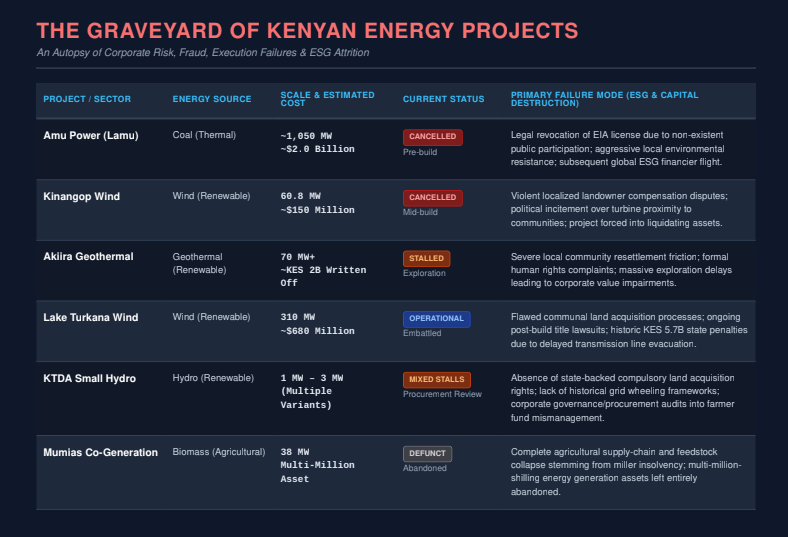
📊 Summary Comparison: Energy Project Failures at a Glance
🎯 The Substack Takeaway: Lessons for the Investor
For asset managers and individual investors evaluating corporate pipelines on the Nairobi Securities Exchange, this historical autopsy offers three definitive lessons:
“Green-Washing” is Not a Shield: Akiira Geothermal and Kinangop Wind prove that clean, renewable energy projects are just as vulnerable to local execution failure as a dirty coal plant. Environmental alignment does not exempt a project from social risk.
The Illusion of Corporate Pipelines: When analyzing infrastructure holding companies, project pipelines should be heavily discounted until the asset achieves Financial Close and secures its Social License to Operate. Valuing an investment company based on “intended megawatts” or political goodwill is a path to severe portfolio disappointment.
The Private Asset vs. Sovereign Muscle Dilemma: While the state can deploy its sovereign weight to push through land wayleaves for KenGen or KETRACO, private enterprises and agricultural cooperatives enjoy no such privilege. In the micro-energy and captive space, a single uncooperative neighbor or an unfinalized wheeling tariff can lock up farmer-contributed capital for a decade, dropping the internal rate of return (IRR) directly to zero.
In the modern Kenyan economy, capital is no longer the limiting factor for energy infrastructure—execution, community alignment, and regulatory resilience are. If a company cannot secure these components upfront, its project is already sitting in the graveyard.